MCQ
$y = A \sin \left(\frac{\omega x}{v}-\omega k\right)$
Where $\omega$ is the angular frequency, $v$ is linear velocity? X is distance then dimension formula for $( k )$ is :
  • A
    $[ L\ T]$
  • $[ T ]$
  • C
    $\left[ T ^{-1}\right]$
  • D
    $\left[ T ^2\right]$

Answer

Correct option: B.
$[ T ]$
(B) $[ T ]$,
$\omega K$ should be dimension less
$[ K ]=[\omega]^{-1}=[ T ]$

Need a full question paper?

Generate a complete, print-ready paper with questions like this in minutes — across 16+ boards, with answer keys.

Start Generating Free

Similar questions

If the temperature of a wire of length $2 \,m$ and area of cross-section $1 \,cm ^2$ is increased from $0^{\circ} C$ to $80^{\circ} C$ and is not allowed to increase in length, then force required for it is ............$N$ $\left\{Y=10^{10} \,N / m ^2, \alpha=10^{\left.-6 /{ }^{\circ} C \right\}}\right.$
A man in a balloon rising vertically with an acceleration of $4.9\,m/{\sec ^2}$ releases a ball $2$ sec after the balloon is let go from the ground. The greatest height above the ground reached by the ball is...........$m$ $(g = 9.8\,m/{\sec ^2})$
Which one of the following schematic graphs best represents the variation of $p V$ (in Joules) versus $T$ (in Kelvin) of one mole of an ideal gas? (The dotted line represents $p V=T$ )
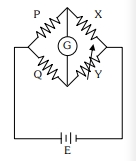
A wheatstone bridge is used to determine the value of unknown resistance $X$ by adjusting the variable resistance $Y$ as shown in the figure. For the most precise measurement of $X$, the resistances $P$ and $Q$:
At a place, the horizontal and vertical intensities of earth's magnetic field is $0.30$ Gauss and $0.173$  Gauss respectively. The angle of dip at this place is.....$^o$
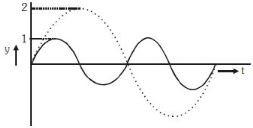
Dependence of disturbances due to two waves on time is shown in the figure. The ratio of their intensities $I_1 / I_2$ will be
$1 \,g=$ …… $a.m.u.$
$A$ paritcle falls freely near the surface of the earth. Consider $a$ fixed point $O$ (not vertically below the particle) on the ground.
The escape velocity for a body of mass $1\, kg$ from the earth surface is $11.2\,\,km{s^{ - 1}}.$ The escape velocity for a body of mass $100\, kg$ would be
A physical quantity of the dimensions of length that can be formed out of $c, G$ and $\frac{e^2}{4\pi \varepsilon _0}$  is $[c$ is velocity of light, $G$ is the universal constant of gravitation and $e$ is charge $] $