Question
  1. You are given tall pea plants with yellow seeds, whose genotypes are unknown. How would you find the genotype of these plants? Explain with the help of cross.
  2. Identify A, B and C in the table given below:
Pattern of Inheritance
Monohybrid F1 Phenotypic Expression
Codominance
‘A’
‘B’
Progeny resembled only one of the parents.
Incomplete dominance.
‘C’

Answer

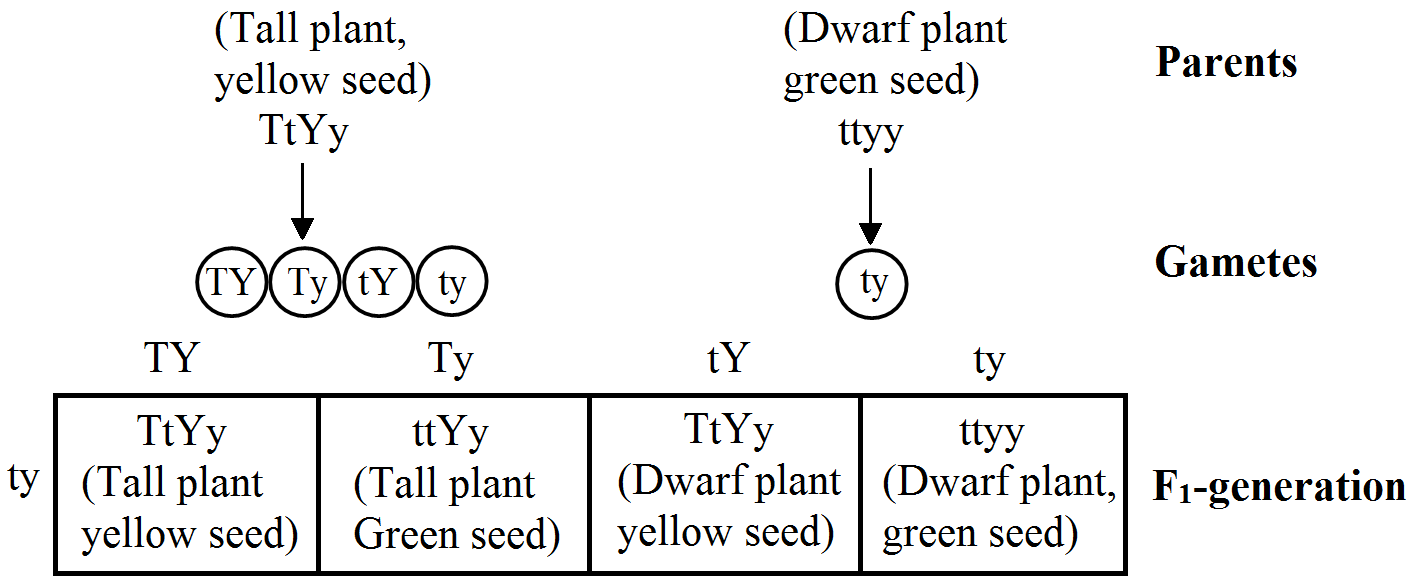
  1. The given tall pea plant with yellow seeds need to be crossed with a dwarf plant with green seeds:
  1. The dominant traits are tallness and yellow colour of seeds. The recessive traits are dwarfness and green colour of seeds.
  2. Cross between tall plant/ yellow seeds and dwarf plant/green seeds. Cross showing heterozygous nature for both traits.

In this cross, the F-generation shows four phenotypes in the ratio of 1 : 1 : 1 : 1. So, the given plant is heterozygous for both the traits.

  1.  

 A - Dominant trait.

B - Dominance.

C - Phenotype obtained in between of two parental traits.

Need a full question paper?

Generate a complete, print-ready paper with questions like this in minutes — across 16+ boards, with answer keys.

Start Generating Free

Similar questions

Arrange the following in the decreasing order (most important first) of their importance, for the welfare of human society. Give reasons for your answer.
Write the components of nucleotide. Write one important feature of the structure of double helical DNA. Draw a labelled diagram of double helical DNA.
Does light factor affect the distribution of organisms? Write a brief note giving suitable examples of either plants or animals.
Draw a labelled diagram of an anther lobe at microspore mother cell stage. Mention the role of different wall layers of anther.
Which element is responsible for causing soil salinity? At what concentration does the soil become saline?
Explain : Restriction Enzymes and DNA
The following is the illustration of the sequence of ovarian events (a – i) in a human female.

What is the difference between “d” and “e” ?

  1. Draw a labelled diagram of L.S. of an embryo of grass (any six labels).
  2. Give reason for each of the following:
  1. Anthers of angiosperm flowers are described as dithecous.
  2. Hybrid seeds have to be produced year after year.
  1.  
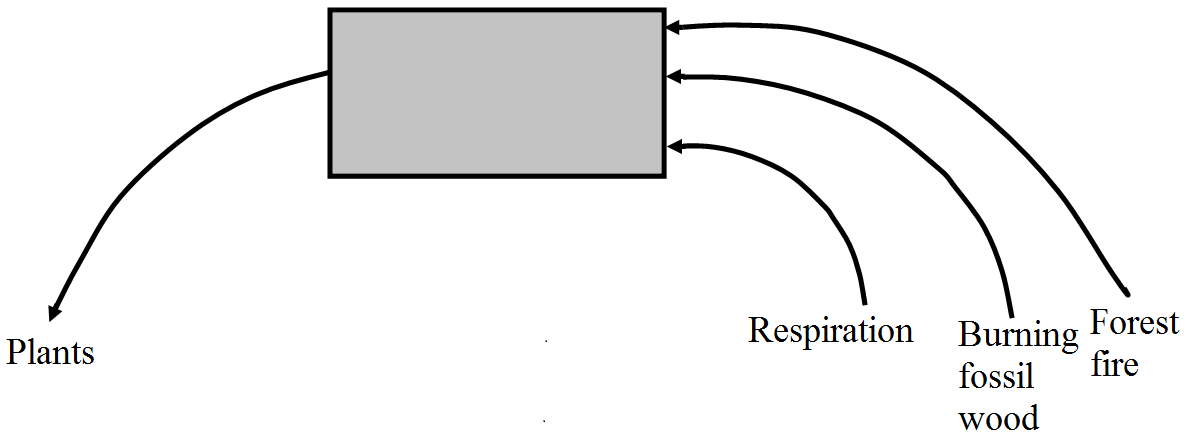
  1. Name the biogeochemical (nutrient) cycle shown below:
  2. Name an activity of the living organisms not depicted in the cycle by which this nutrient is returned to the atmosphere.
  1. How would the flow of nutrient in the cycle be affected due to large scale deforestation? Explain giving reasons.
  2. Describe the effect of an increased level of this nutrient in the atmosphere on our environment.

List the harmful effects caused by alcohol/drug abuse.