MCQ
Young's modulus of a wire depends on:
  • Its material.
  • B
    Its length.
  • C
    Its area of cross-section.
  • D
    Both $(b)$ and $(c).$

Answer

Correct option: A.
Its material.

Need a full question paper?

Generate a complete, print-ready paper with questions like this in minutes — across 16+ boards, with answer keys.

Start Generating Free

Similar questions

If $G$ is universal gravitation constant and $g$ is acceleration due to gravity, then dimensions of $\frac{G}{g}$ will be ...................
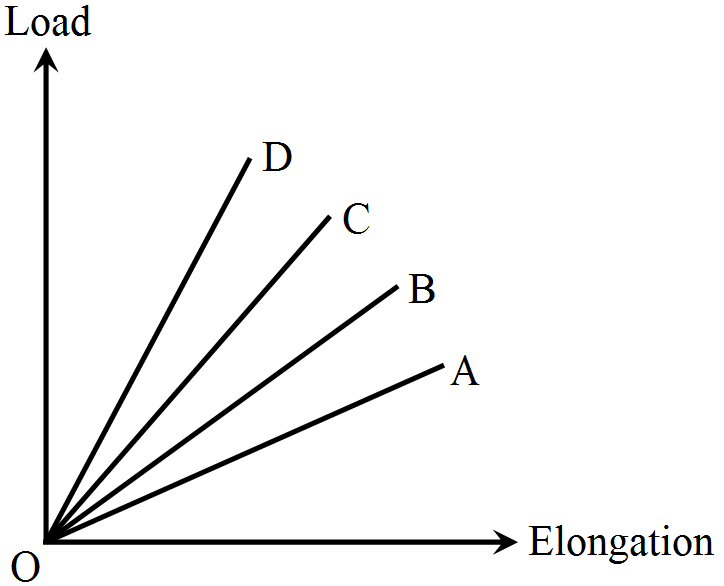
The load versus elongation graph for four wires of the same material is shown in the fig. The thinnest wire is represented by the line.
A spiral galaxy can be approximated as an infinitesimally thin disc of a uniform surface mass density (mass per unit area) located at $z=0$. Two stars $A$ and $B$ start from rest from heights $2 z_{0}$ and $z_{0}$ $\left(z_{0} < <  \right.$ radial extent of the disc), respectively and fall towards the disc, cross over to the other side and execute periodic oscillations. The ratio of time periods of $A$ and $B$ is
For a constant volume gas thermometer, one should fill the gas at:
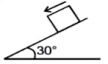
A block of mass $10 \,kg$ is released on rough incline plane. Block start descending with acceleration $2 \,m / s ^2$. Kinetic friction force acting on block is ..... $N$ (take $g=10 \,m / s ^2$ )
The value of gravitational acceleration $C.G.S.$ system is $980 \;cm / sec$ ? .find the value of $g$ in $M.K.S$ system?
A missile is fired in horizontal direction from a height of $20\,m$ at a speed of $1000\, m/s.$ At what distance of ground will the missile land ?
The unit of length, velocity and force are doubled. Which of the following is the correct change in the other units?
A car of mass $500\, kg$ is driven with acceleration $1\, m/s^2$ along straight level road against constant external resistance of $1000\, N$. When the velocity is $5\, m/s$ the rate at which the engine is working is .............. $\mathrm{kW}$
Two rods of different materials having coefficient of linear expansion $\alpha_1$and $\alpha_2$ and  Young's modulii $Y_1$ and $Y_2$ respectively are fixed between two rigid massive walls. The rods are heated such that they undergo the same increase in temperature. There is no bending of rods. If  $\alpha_1:\alpha_2= 2 : 3$, the thermal stress developed in two rods are equal provided $Y_1 : Y_2$ is equal to