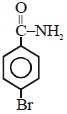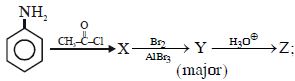
MCQ
$Z$ is

  • B

  • C

  • D

Answer

Correct option: A.

a

Need a full question paper?

Generate a complete, print-ready paper with questions like this in minutes — across 16+ boards, with answer keys.

Start Generating Free

Similar questions

Among the properties $(a) $ reducing $ (b) $ oxidising $(c)$  complexing, the set of properties shown by $C{N^ - }$ ion towards metal species is
The complex ion that will lose its crystal field stabilization energy upon oxidation of its metal to $+3$ state is
Number of sp hybridised carbon atom in the given compound is :

$C{H_2} = CH - C \equiv C - C{H_2} - CN$

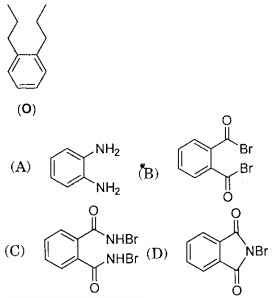
Treatment of compound $O$ with $KMnO_4 / \mathrm{H}^{+}$gave $P$, which on heating with ammonia gave $Q$. The compound $Q$ on treatment with $Br_2 / NaOH$ produced $R$. On strong heating, $Q$ gave $S$, which on further treatment with ethyl $2$-bromopropanoate in the presence of $KOH$ followed by acidification, gave a compound $T$.

(image)

($1$) The compound $R$ is

(image)

($2$) The compound $T$ is

($A$) glycine

($B$) alanine

($C$) valine

($D$) serine

Given the answer question ($1$) and ($2$) 
$\mathop {C{H_2}}\limits_{(I)}  = O \leftrightarrow \mathop {{}^ \oplus C{H_2}}\limits_{(II)}  - {O^\circleddash } \leftrightarrow \mathop {{}^\circleddash C{H_2}}\limits_{(III)}  - {O^ \oplus }$

Which of these structures is practically not a valid canonical structure for formaldehyde ?

What is the end product of the following sequences of operations 

 $Ca{C_2}\xrightarrow{{{H_2}O}}A\mathop {\xrightarrow{{{\text{dil}}{\text{. }}{H_2}S{O_4}}}}\limits_{H{g^{ +  + }}} B\mathop {\xrightarrow{{Ni}}}\limits_{{H_2}} C$

Which of the following complex is paramagnetic and inner orbital complex
The colour of $p-$amino azobenzene is
The $IUPAC$ name of acraldehyde is
A group of atoms can function as a ligand only when