Question types

Biodiversity and Conservation question types

534 questions across 7 question groups — pick any mix to generate a BIOLOGY paper with step-by-step answer keys.

534
Questions
7
Question groups
5
Question types
Sample Questions

Biodiversity and Conservation questions

One sample from each question group in this chapter. Select any group above to see the full set with answer keys.
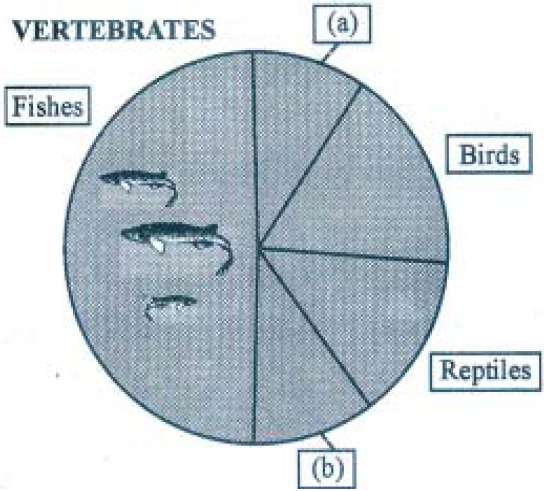
Q 2M.C.Q [1M]1 Mark
Which of the following type of animal is chiefly protected by man?
  • A
    Harmless animals
  • B
    Economically useful animals
  • C
    Extinct animals
  • D
    Feeble animals
View full solution
Q 3M.C.Q [1M]1 Mark
The conversion of natural resources within natural ecosystem is:
  • A
    Exsitu conservation
  • B
    In situ conservation
  • C
    Both A and B
  • D
    None of the above
View full solution
Q 4M.C.Q [1M]1 Mark
Which of the following forests is known as the ‘lungs of the planet Earth’?
  • A
    Tundra forest.
  • B
    Tiaga forest.
  • C
    Amazon rain forest.
  • D
    Rain forests of North East India.
View full solution
For question two statements are given-one labelled Assertion and the other labelled Reason. Select the correct answer to these questions from the codes (a), (b), (c) and (d) as given below.
  1. Both assertion and reason are true and reason is the correct explanation of assertion.
  2. Both assertion and reason are true but reason is not the correct explanation of assertion.
  3. Assertion is true but reason is false.
  4. Both assertion and reason are false.
Assertion: Many endemic species are seen to flourish in sacred forests.
Reason: Sacred forests are undisturbed forest patches and biodiversity rich areas.
View full solution
For question two statements are given-one labelled Assertion and the other labelled Reason. Select the correct answer to these questions from the codes (a), (b), (c) and (d) as given below.
  1. Both assertion and reason are true and reason is the correct explanation of assertion.
  2. Both assertion and reason are true but reason is not the correct explanation of assertion.
  3. Assertion is true but reason is false.
  4. Both assertion and reason are false.
Assertion: Non-native or exotic species are often introduced in a region for their economic uses.
Reason: Exotic species are considered to be a major cause of extinction of indigenous species.
View full solution
For question two statements are given-one labelled Assertion and the other labelled Reason. Select the correct answer to these questions from the codes (a), (b), (c) and (d) as given below.
  1. Both assertion and reason are true and reason is the correct explanation of assertion.
  2. Both assertion and reason are true but reason is not the correct explanation of assertion.
  3. Assertion is true but reason is false.
  4. Both assertion and reason are false.
Assertion: Biodiversity loss is now one of the world's most pressing crisis.
Reason: Lower diversity in a species leads to non-uniformity.
View full solution
For question two statements are given-one labelled Assertion and the other labelled Reason. Select the correct answer to these questions from the codes (a), (b), (c) and (d) as given below.
  1. Both assertion and reason are true and reason is the correct explanation of assertion.
  2. Both assertion and reason are true but reason is not the correct explanation of assertion.
  3. Assertion is true but reason is false.
  4. Both assertion and reason are false.
Assertion: The rate of extinction of organisms have increased in recent years.
Reason: Human activities like deforestation, industrialisation, etc., have destroyed the natural habitat of plants and animals.
View full solution
For question two statements are given-one labelled Assertion and the other labelled Reason. Select the correct answer to these questions from the codes (a), (b), (c) and (d) as given below.
  1. Both assertion and reason are true and reason is the correct explanation of assertion.
  2. Both assertion and reason are true but reason is not the correct explanation of assertion.
  3. Assertion is true but reason is false.
  4. Both assertion and reason are false.
Assertion: There are 36 biodiversity hotspots in the world.
Reason: High level of species richness is a criteria for selection of a biodiversity hotspot.
View full solution
Name the type of biodiversity represented by the following:
  1. 1000 varieties of mangoes in India.
  2. Variation in terms of potency and concentration of reserpine in Rauwolfia vomitoria growing in different regions of Himalayas.
View full solution
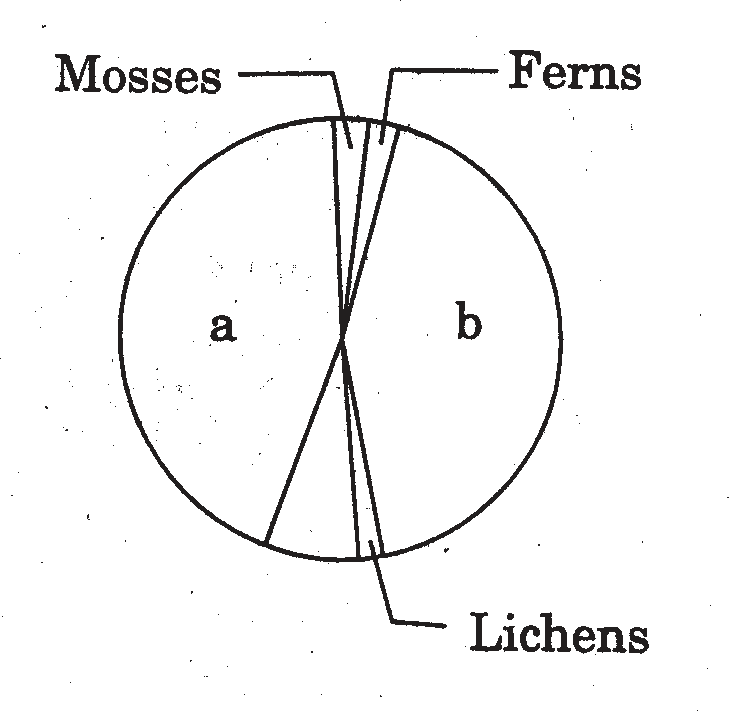
Name the unlabelled areas ‘a’ and ‘b’ of the pie chart representing the biodiversity of plants showing their proportionate. Number of species of major taxa.

View full solution
Name the type of biodiversity represented by the following:
  1. 50,000 different strains of rice in India.
  2. Estuaries and alpine meadows in India.
View full solution
Q 233 Marks Question3 Marks
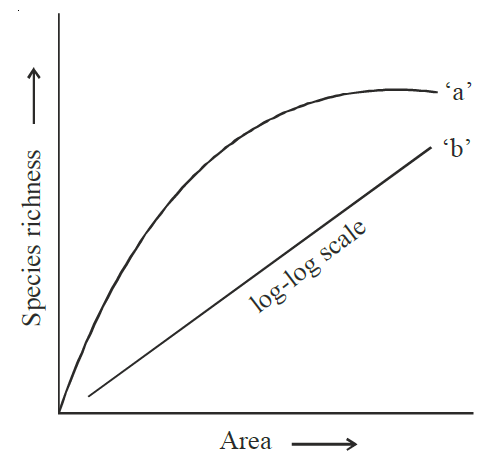
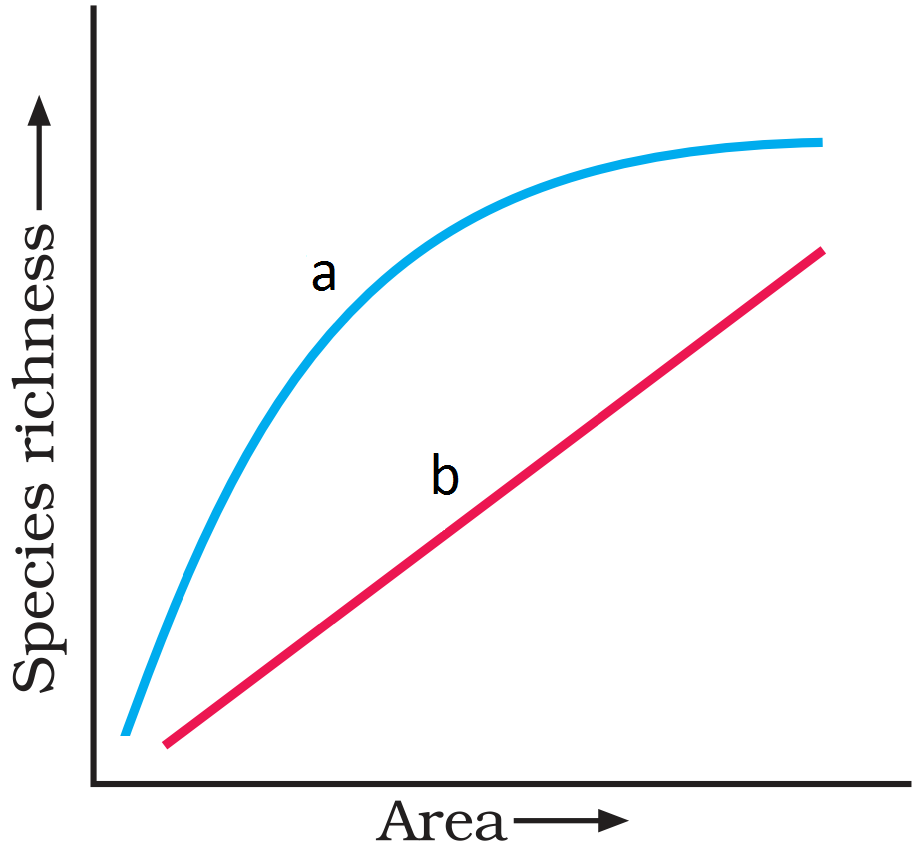
The following graph shows the species-area relationship. Answer the following question as directed.

  1. Name the naturalist who studied the kind of relationship shown in the graph. Write the observation made by him.
  2. Write the situations as discovered by the ecologists when the value of 'Z' (slope of the line) lies.
  1. 0.1 and 0.2
  2. 0.6 and 1.2

What does 'Z' stand for?

  1. When would the slope of the line 'b' become steeper?
View full solution
Q 253 Marks Question3 Marks
Community Service department of your school plans a visit to a slum area near the school with an objective to educate the slum dwellers with respect to health and hygiene.
  1. Why is there a need to organize such visits?
  2. Write the steps you will highlight, as a member of this department, in your interaction with them to enable them to lead a healthy life.
View full solution
The graph shows species-area relationship:

  1. If b denotes the relationship on log scale-
  1. Describe a and b.
  2. How is slope represented? Give the normal range of slope.
  3. What kind of slope will be observed for frugivorous birds and mammals in a tropical forest?
  1. Species diversity of plants (22%) is much less than that of animals (72%). Analyze the reasons for greater diversity of animals as compared to plants.


View full solution
Read the following and answer any four questions from (i) to (v) given below:
The Kakapo is the world's largest and heaviest parrot, found only in New Zealand. It is unusual in that it is nocturnal, flightless and ground-dwelling. It is an excellent climber of trees, has strong legs that allow it to "jog" several kilometres in a single trip, and has mossy green plumage mottled with brown and yellow. The Kakapo is also critically endangered as of now, there were only few known living individuals left.
  1. Which could be the possible reason for Kakapo to be well-adapted to its environment prior to the arrival of humans in New Zealand?
  1. Kakapo was active only in the night when its potential predators would not be out for hunting.
  2. The Kakapo would likely be well-camouflaged among the forest foliage due to its greenish plumage.
  3. It was able to effectively hunt for food in the night.
  4. All of these.
  1. When humans started to settle in New Zealand, they took with them non-native animals, including mammals such as cats, dogs and stoats. By which of the following ways, human settlement likely contributed to a near decimation of Kakapo populations in New Zealand?
  1. Habitat destruction.
  2. Alien species invasion.
  3. Pollution.
  4. Both (a) and (b).
  1. All known survived Kakapo have been relocated by the New Zealand government to three predator-free islands, where they are monitored year round by staffs and volunteers to ensure that the birds are safe, healthy and well-fed. The extremely low population of Kakapo is a hurdle to the species becoming viable in the long term, despite such dedicated conservation efforts. This is because.
  1. The small population results in very small gene pool.
  2. There would be very Ii mited genetic diversity among the resulting offspring.
  3. Of reduced capacity of the species to adapt and survive changes in the environment.
  4. All of these.
  1. The reasons behind conserving biodiversity have been grouped into which of the following categories?
  1. Narrowly utilitarian.
  2. Broadly utilitarian.
  3. Ethical.
  4. All of these.
  1. One of the ex situ conservation methods for endangered species is:
  1. Wildlife sanctuaries.
  2. Biosphere reserves.
  3. Cryopreservation.
  4. National parks.
View full solution
Read the following and answer any four questions from (i) to (v) given below:
IUCN maintains a Red Data Book or Red List which is a catalogue of taxa facing risk of extinction. The IUCN Red List (2004) documents the extinction of 784 species in the last 500 years. Some examples of recent extinctions include the dodo, quagga, thylacine and Steller's sea cow. The last twenty years alone have witnessed the disappearance of 27 species. Red List has eight categories of species.
  1. Dodo, an extinct taxon, belongs to which country?
  1. Mauritius
  2. Africa
  3. Australia
  4. Russia
  1. To which of the following categories of IUCN, Berberis nilghiriensis belongs?
  1. Extinct.
  2. Extinct in wild.
  3. Endangered.
  4. Critically endangered.
  1. Steller's sea cow and passenger pigeon became extinct due to:
  1. Alien species invasion.
  2. Over-exploitation.
  3. Coextinctions.
  4. Intensive agriculture.
  1. Bali, Javan and Caspian are:
  1. Species of tiger.
  2. Species of cheetah.
  3. Subspecies of cheetah.
  4. Subspecies of tiger.
  1. Select the correct term for the following definitions (i, ii, iii, iv).
  • The taxon is liable to become extinct if not allowed to realise its full biotic potential by providing protection from exotic species/ human exploitation/habitat deterioration/depletion of food.
  • The taxon has been completely eliminated or died out from earth, e.g., Dodo.
  • The taxon is facing a high risk of extinction in the wild in the near future due to decrease in its habitat, excessive predation or poaching.
  • They are species with naturally small populations, either localised or thinly scattered, which are always at risk from pests/ pathogens/ predators/ exotic species.
 
(i)
(ii)
(iii)
(iv)
(a)
Threatened
Extinct
Endangered
Rare
(b)
Endangered
Extinct
Threatened
Rare
(c)
Extinct
Rare
Threatened
Endangered
(d)
Threatened
Extinct
Rare
Endangered
View full solution
Read the following and answer any four questions from (i) to (v) given below:

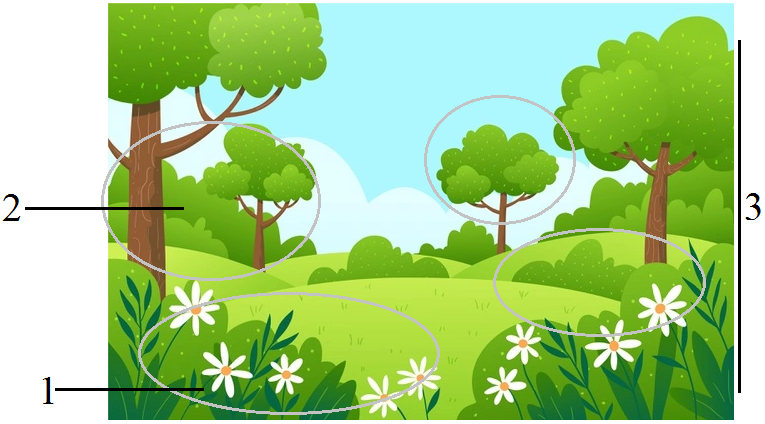
Ecosystem diversity is the variety of forms in the ecosystem due to diversity of niches, trophic levels and ecological processes like nutrient recycling, food webs, energy flow, etc. Study the given figure.

  1. Identify different types of diversity denoted by 1, 2 and 3 in the given figure.
 
1
2
3
(a)
Alpha diversity
Beta diversity
Gamma diversity
(b)
Gamma diversity
Alpha diversity
Beta diversity
(c)
Gamma diversity
Beta diversity
Alpha diversity
(d)
Beta diversity
Alpha diversity
Gamma diversity
  1. Alpha diversity is biodiversity present.
  1. Within conununity.
  2. Between conununities.
  3. In ranges of communities.
  4. None of these.
  1. Diversity represented by diversity of habitats over a total landscape area is:
  1. $\alpha-\text{diversity}$

  2. $\gamma-\text{diversity}$

  3. $\beta-\text{diversity}$

  4. $\delta-\text{diversity}$

  1. Concept of three types of ecological diversity was given by:
  1. Elton
  2. Odum
  3. Edward Wilson
  4. Whittaker
  1. The diversity of organisms sharing the same habitat or conununity is termed as:
  1. Alpha diversity.
  2. beta diversity.
  3. gamma diversity.
  4. delta diversity.
View full solution
Read the following and answer any four questions from (i) to (v) given below:

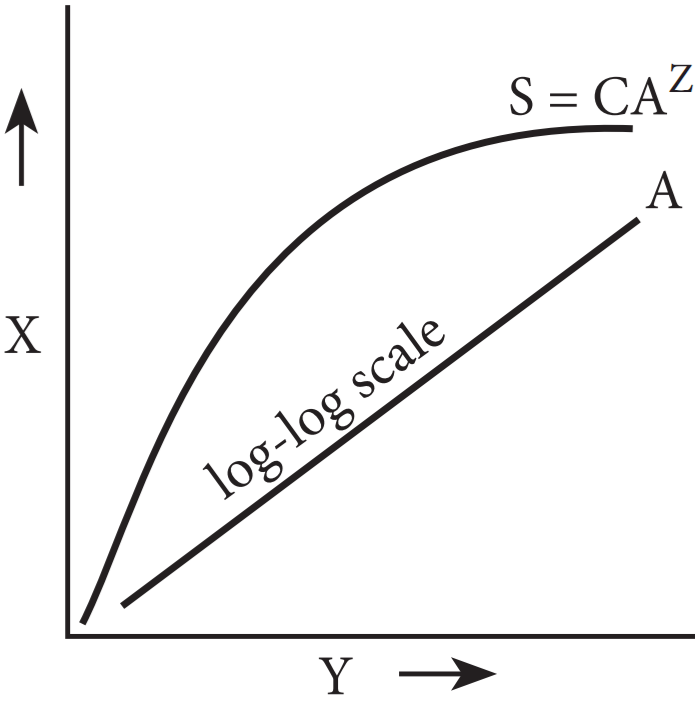
Within a region, species richness increases with increasing explored area, but only upto a limit. TI1e given graph explains this relationship.

  1. What does the given figure show?
  1. Rivet-popper hypothesis.
  2. Species-area relationship.
  3. Proportionate number of species of major taxa.
  4. $\alpha-\text{ecological diversity }$
  1. Equation for relationship (A) between species richness and area is:
  1. $\log\text{ S}=\log\text{ C}+\text{Z }\log\text{ A}$

  2. $\log\text{ C}=\log\text{ S}+\text{Z }\log\text{ A}$

  3. $\text{Z }\log\text{ A}=\log\text{ S}+\log\text{ C}$

  4. $\log\text{ S}=\log\text{ C}+\log\text{ A}$

  1. What is the value of slope of line or regression coefficient Z for frugivorous birds?
  1. 0.1 - 0.2
  2. 1.15
  3. 0.01 - 0.1
  4. 0.6 - 1.2
  1. The shape of curve for relationship between species richness and areas for wide variety of taxa is:
  1. Straight line.
  2. Parabola.
  3. Rectangular hyperbola.
  4. Bell shaped.
  1. Who gave this concept of increase in species richness with increasing offered area?
  1. Humboldt.
  2. Odum.
  3. Edward Wilson.
  4. Paul Ehrlich.
View full solution
Read the following and answer any four questions from (i) to (v) given below:
Wetlands are called Ramsar sites because the first international convention on their conservation was held in Ramsar in Iran in 1971. Wetlands or Ramsar sites are low lying marshy areas which get filled up during rains due to runoff and overflow from other water bodies. They are often considered to be waste lands which are used as dumping areas and filled up to recover land for various constructions activities. As a result, a large number of wetlands have disappeared.
  1. Select the incorrect match of wetland and its location.
 
Wetland
Location
(a)
Harike
Punjab
(b)
Chandra Tai
H.P.
(c)
Bhoj
M.P.
(d)
Ashtamudi
Odisha
  1. Migratory bird flamingo breeds in which of the following wetlands?
  1. Bhitarkanika Mangroves.
  2. Rann of Kutch.
  3. Harike.
  4. Chandra Tal.
  1. Which of the following is not an importance of wetlands?
  1. They are an important source of recharging groundwater.
  2. They provide protection from floods.
  3. They are good source of siltation and purification of water.
  4. None of these.
  1. Which of the following wetland ecosystem is highly acidic and has a accumulation of decomposed plants known as peat?
  1. Bog
  2. Mangrove
  3. Estuary
  4. Watershed
  1. The mangroves of Bhitarkanika are famous for:
  1. Rare migratory waterbirds.
  2. Nesting sites for endangered olive ridley turtles.
  3. Prawn cultivation.
  4. All of these.
View full solution

Generate a Biodiversity and Conservation paper free

Pick question groups from the list above, set marks and difficulty, and export a branded PDF with step-by-step answer keys. First 3 chapters free — no signup.

Download App