Question types

STD 12 - 9. biotechnology principlas and process question types

286 questions across 1 question group — pick any mix to generate a BIOLOGY paper with step-by-step answer keys.

286
Questions
1
Question groups
5
Question types
Sample Questions

STD 12 - 9. biotechnology principlas and process questions

One sample from each question group in this chapter. Select any group above to see the full set with answer keys.

Q 1M.C.Q [1M]1 Mark
Which of the following statements is incorrect?
  • A
    Most commonly used bio-reactors are of stirring type
  •  Bio-reactors are used to produce small scale bacterial cultures
  • C
    Bio-reactors have an agitator system, an oxygen delivery system and foam control system
  • D
    A bio-reactor provides optimal growth conditions for achieving the desired product

Answer: B.

View full solution
Q 2M.C.Q [1M]1 Mark
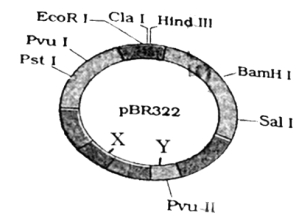
The following diagram showing restriction sites in $E$. coli cloning vector pBR322. Find the role of ' $X$ ' and ' $Y$ genes:
  • The gene ' $X$ ' is responsible for controlling the copy number of the linked DNA and ' $Y$ ' for protein involved in the replication of Plasmid.
  • B
    The gene ' $X$ ' is for protein involved in replication of Plasmid and ' $Y$ for resistance to antibiotics.
  • C
    Gene ' $X$ ' is responsible for recognitions sites and ' $Y$ ' is responsible for antibiotic resistance
  • D
    The gene ' $X$ ' is responsible for resistance to antibiotics and ' $Y$ ' for protein involved in the replication of Plasmid.

Answer: A.

View full solution
Q 3M.C.Q [1M]1 Mark
The "Ti plasmid" of Agrobacterium tumefaciens stands for
  • A
    Tumor independent plasmid
  • Tumor inducing plasmid
  • C
    Temperature independent plasmid
  • D
    Tumour inhibiting plasmid

Answer: B.

View full solution
Q 4M.C.Q [1M]1 Mark
What is the fate of a piece of $DNA$ carrying only gene of interest which is transferred into an alien organism?

$A$. The piece of $DNA$ would be able to multiply itself independently in the progeny cells of the organism.

$B$. It may get integrated into the genome of the recipient.

$C$. It may multiply and be inherited along with the host $DNA$.

$D$. The alien piece of DNA is not an integral part of chromosome.

$E$. It shows ability to replicate.

Choose the correct answer from the options given below:

  • A
    $D$ and $EV$ only
  • $B$ and $C$ only
  • C
    $A$ and $E$ only
  • D
    $A$ and $B$ only

Answer: B.

View full solution

Generate a STD 12 - 9. biotechnology principlas and process paper free

Pick question groups from the list above, set marks and difficulty, and export a branded PDF with step-by-step answer keys. First 3 chapters free — no signup.

Download App