Questions · Page 1 of 3

1 Marks Question

🎯

Test yourself on this topic

50 questions · timed · auto-graded

Question 21 Mark
Name the following compounds according to IUPAC system.

$\text{H}_2\text{C}=\text{CH}-\text{CH}-\text{CH}_2-\text{CH}_2-\text{CH}_3\\ \ \ \ \ \ \ \ \ \ \ \ \ \ \ \ \ \ \ \ \ \ \ \ \ \ |\\ \ \ \ \ \ \ \ \ \ \ \ \ \ \ \ \ \ \ \ \ \ \ \ \ \text{OH}$
Answer
Hex-1-en-3-ol.
View full question & answer
Question 31 Mark
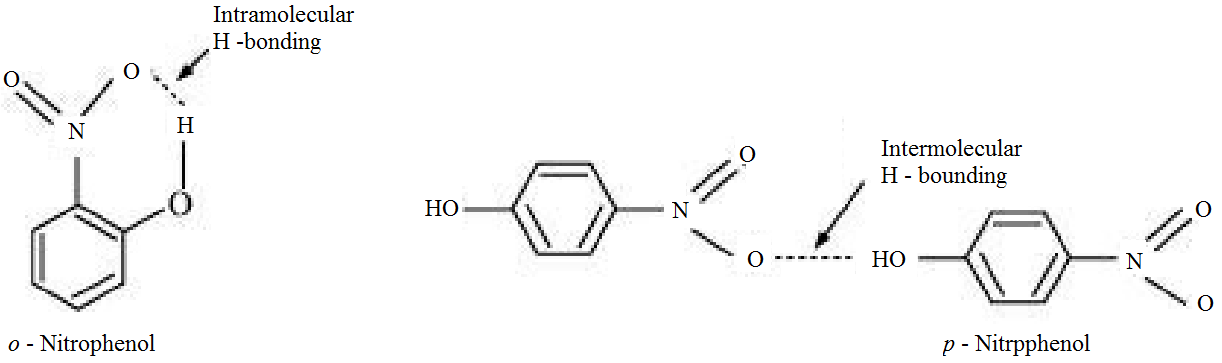
While separating a mixture of ortho and para nitrophenols by steam distillation, name the isomer which will be steam volatile. Give reason.
Answer
Intramolecular H-bonding is present in o-nitrophenol. O-Nitrophenol is steam volatile because of weak intra molecular H-Bonding. In p-nitrophenol, the molecules are strongly associated due to the presence of intermolecular bonding. Hence, o-nitrophenol is steam volatile whereas p-nitrophenol is not.

View full question & answer
Question 41 Mark
What is the structure and IUPAC name of glycerol?
Answer
$\text{CH}_2\text{OH} \\ \ | \\ \text{CHOH} \\ \ | \\ \text{CH}_2\text{OH}$
IUPAC name of glycerol is Propane-1,2,3-triol.
View full question & answer
Question 61 Mark
Write structures of the products of the following reactions:

$\text{CH}_3-\text{CH}=\text{CH}_2\ \xrightarrow{\text{H}_2 \text{O}/\text{H}^+}$

Answer
$\text{CH}_3-\text{CH}-\text{CH}_3\\ \ \ \ \ \ \ \ \ \ \ \ \ \ \ |\\ \ \ \ \ \ \ \ \ \ \ \ \ \ \text{OH}$

Propane-2-ol

View full question & answer
Question 71 Mark
Write IUPAC names of the following compound:

$\ \ \ \ \ \ \ \ \ \ \ \ \ \ \ \ \ \ \ \ \ \ \ \ \ \ \ \ \ \ \ \ \ \ \text{CH}_3\\\ \ \ \ \ \ \ \ \ \ \ \ \ \ \ \ \ \ \ \ \ \ \ \ \ \ \ \ \ \ \ \ \ \ \ |\\\text{CH}_3-\text{CH}-\text{CH}-\text{C}-\text{CH}_3\\\ \ \ \ \ \ \ \ \ \ \ \ \ \ |\ \ \ \ \ \ \ \ \ \ |\ \ \ \ \ \ \ \ \ |\\\ \ \ \ \ \ \ \ \ \ \ \ \ \text{CH}_3\ \ \ \ \text{OH}\ \ \ \ \text{CH}_3$

Answer
2, 2, 4-Trimethyl pentan-3-ol.
View full question & answer
Question 81 Mark
Give IUPAC name of the following ether:

$\text{CH}_3\text{CH}_2\text{CH}_2\text{OCH}_3$

Answer
1-Methoxypropane.
View full question & answer
Question 91 Mark
Write IUPAC names of the following compound:

$\text{C}_6\text{H}_5-\text{O}-\text{C}_2\text{H}_5$
Answer
1 -Methoxy-2-methyl propane.
View full question & answer
Question 101 Mark
Name the alkyl halide and sodium alkoxide used to synthesise tert-butyl ethyl ether.
Answer
Ethyl bromide and sodium tert-butoxide.
View full question & answer
Question 111 Mark
Suggest a reagent for conversion of ethanol to ethanoic acid.
Answer
Strong oxidizing agents such as acidified potassium permanganate are used for getting carboxylic acids from alcohols directly.
View full question & answer
Question 121 Mark
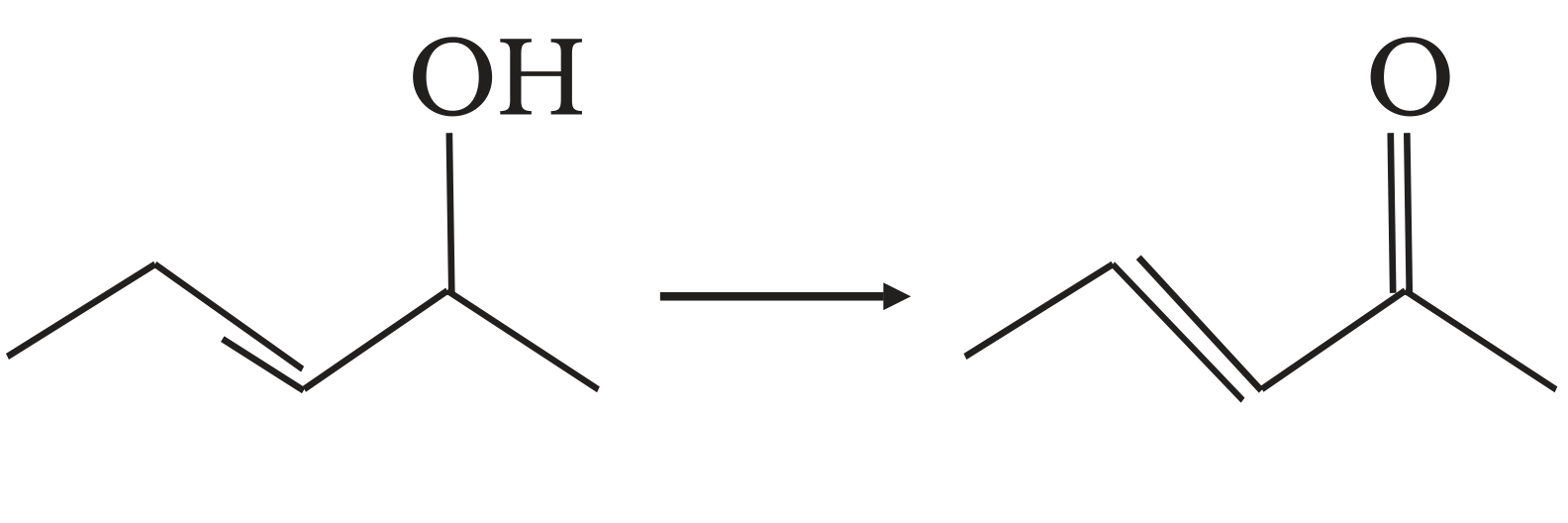
Suggest a reagent for the following conversion.

Answer
Pyridinium cholochromate (PCC), a complex of chromium trioxide with pyridine and HCl
CH3-CH-CH-CH2OH
PCC CH3-CH-CH-CHO.
View full question & answer
Question 131 Mark
In Kolbe’s reaction, instead of phenol, phenoxide ion is treated with carbon dioxide. Why?
Answer
Phenoxide ion is more reactive than phenol towards electrophilic substitution. The negative charge on oxygen is transferred to benzene through resonance. This helps in the attachment of Co2 which is a weak electrophilc to the benzene ring finally giving salicylic acid.
View full question & answer
Question 141 Mark
Diethyl ether does not react with sodium.
Answer
Since diethyl ether does not contain an active hydrogen attached to oxygen like alcohols and phenols, it does not react with sodium.
View full question & answer
Question 151 Mark
What is denatured alcohol?
Answer
Alcohol is made unfit for drinking by mixing some copper sulphate and pyridine to it. This process is called denaturation of alcohol and alcohol mixed with copper sulphate and pyridine is called denatured alcohol.
View full question & answer
Question 161 Mark
Nitration is an example of aromatic electrophilic substitution and its rate depends upon the group already present in the benzene ring. Out of benzene and phenol, which one is more easily nitrated and why?
Answer
Phenol will be easily nitrated since the -OH group attached to the benzene ring activates it towards electrophilic substitution. Also, it directs the incoming group to ortho and para positions in the ring as these positions become electron rich due to the resonance effect caused by -OH group.
View full question & answer
Question 171 Mark
Suggest a reagent for conversion of ethanol to ethanal.
Answer
CrO3, pyridine and HCl (Pyridinium chlorochromate, PCC) in CH2C12.
View full question & answer
Question 211 Mark
Write IUPAC names of the following compound:

$\text{HO}-\text{CH}_2-\text{CH}-\text{CH}_2-\text{OH}\\\ \ \ \ \ \ \ \ \ \ \ \ \ \ \ \ \ \ \ \ \ \ \ \ \ |\\ \ \ \ \ \ \ \ \ \ \ \ \ \ \ \ \ \ \ \ \ \ \ \ \ \text{OH}$

Answer
Propane-1,2,3-triol.
View full question & answer
Question 241 Mark
Write IUPAC names of the following compound:

$\text{CH}_3-\text{CH}_2-\text{O}-\text{CH}-\text{CH}_2-\text{CH}_3\\\ \ \ \ \ \ \ \ \ \ \ \ \ \ \ \ \ \ \ \ \ \ \ \ \ \ \ \ \ \ \ \ \ \ \ |\\\ \ \ \ \ \ \ \ \ \ \ \ \ \ \ \ \ \ \ \ \ \ \ \ \ \ \ \ \ \ \ \ \ \ \text{CH}_3$

Answer
2-Ethoxy butane.
View full question & answer
Question 251 Mark
Write IUPAC names of the following compound:

$\text{CH}_3-\text{CH}-\text{CH}-\text{CH}_3\\\ \ \ \ \ \ \ \ \ \ \ \ \ \ |\ \ \ \ \ \ \ \ \ \ |\\\ \ \ \ \ \ \ \ \ \ \ \ \ \text{OH}\ \ \ \ \ \text{OH}$
Answer
Butane-2, 3-diol.
View full question & answer
Question 261 Mark
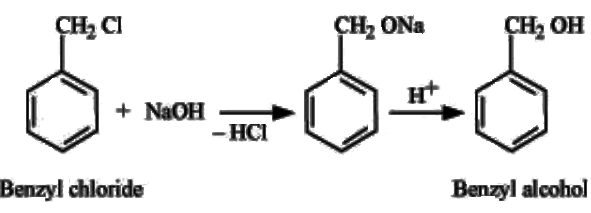
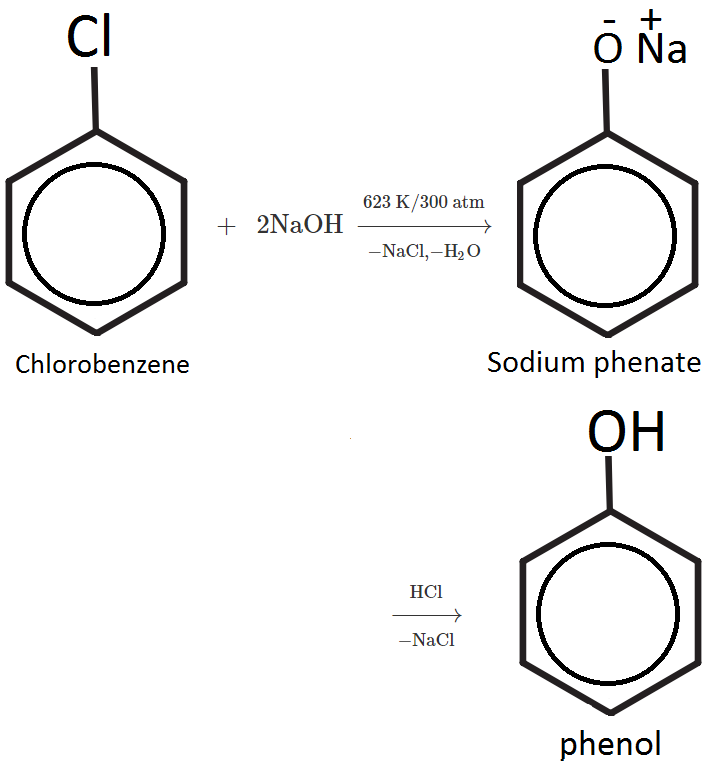
Write chemical reaction for the preparation of phenol from chlorobenzene.
Answer
Chlorobenzene is heated with 6 to 8% solution of NaOH to about 623 K under a pressure of 300 atmospheres to form sodium phenate which upon acidification with dilute HCl gives phenol as follows:

View full question & answer
Question 271 Mark
Show how will you synthesise:

pentan-1-ol using a suitable alkyl halide?

Answer
When 1-chloropentane is treated with NaOH, pentan-1-ol is produced.

$\text{CH}_3\text{CH}_2\text{CH}_2\text{CH}_2\text{CH}_2\text{Cl}+\text{NaOH}\xrightarrow{\ \ \ \ \ \ \ \ \ }\text{CH}_3\text{CH}_2\text{CH}_2\text{CH}_2\text{CH}_2\text{OH}+\text{NaCl}\\ \text{1-Chloropentane} \ \ \ \ \ \ \ \ \ \ \ \ \ \ \ \ \ \ \ \ \ \ \ \ \ \ \ \ \ \ \ \ \ \ \ \ \ \ \ \ \ \ \ \ \ \text{Pantan-1-ol}$

View full question & answer
Question 281 Mark
Answer the following questions:
Why are ethers insoluble in water?
Answer
Ethers are insoluble in water because due to the bigger size of the alkyl groups, the oxygen atom in ethers fails to form intermolecular H-bonds with water.
View full question & answer
Question 291 Mark
Write structure of the compound whose IUPAC names are as follow:

3-Chloromethylpentan-1-ol.

Answer
$\text{CH}_3-\text{CH}_2-\text{CH}-\text{CH}_2-\text{CH}_2-\text{OH}\\\ \ \ \ \ \ \ \ \ \ \ \ \ \ \ \ \ \ \ \ \ \ \ \ \ \ |\\\ \ \ \ \ \ \ \ \ \ \ \ \ \ \ \ \ \ \ \ \ \ \ \ \ \text{CH}_2\text{Cl}$
View full question & answer
Question 301 Mark
Name the alcohol that is used to make the following ester:
$ \ \ \ \ \ \ \ \ \ \ \ \ \ \text{O} \ \ \ \ \ \ \ \ \ \ \ \ \ \text{CH}_3\\ \ \ \ \ \ \ \ \ \ \ \ \ \ || \ \ \ \ \ \ \ \ \ \ \ \ \ \ \ |\\\text{CH}_3-\text{C}-\text{O}-\text{CH}-\text{CH}_3$
Answer
$ \ \ \ \ \ \ \ \ \ \ \ \ \text{OH}\\ \ \ \ \ \ \ \ \ \ \ \ \ \ \ \ \text{|}\\\text{CH}_3-\text{CH}-\text{CH}_3$
View full question & answer
Question 311 Mark
Write the IUPAC name of the compound given below.
$\text{CH}_3-\text{CH}_2-\text{C}=\text{C}-\text{OH} \\ \ \ \ \ \ \ \ \ \ \ \ \ \ \ \ \ \ \ \ \ \ \ \ \ \ \ {|} \ \ \ \ \ \ \ \ {|} \\ \ \ \ \ \ \ \ \ \ \ \ \ \ \ \ \ \ \ \ \ \ \ \ \ \ \text{CH}_3 \ \ \text{CH}_2\text{OH}$
Answer
$\text{CH}_3-\text{CH}_2-\text{C}=\text{C}-\text{OH} \\ \ \ \ \ \ \ \ \ \ \ \ \ \ \ \ \ \ \ \ \ \ \ \ \ \ \ {|} \ \ \ \ \ \ \ \ {|} \\ \ \ \ \ \ \ \ \ \ \ \ \ \ \ \ \ \ \ \ \ \ \ \ \ \ \text{CH}_3 \ \ \text{CH}_2\text{OH} \\ 3-\text{Methylpent}-2-\text{ene}-1,3-\text{diol}$
View full question & answer
Question 351 Mark
Write IUPAC names of the following compound:

$\text{C}_6\text{H}_5-\text{O}-\text{C}_7\text{H}_{15}(\text{n}-)$

Answer
1-Phenoxy heptane.
View full question & answer
Question 361 Mark
Write the equation of the reaction of hydrogen iodide with:

1-propoxypropane.

Answer
$\text{CH}_3\text{CH}_2\text{CH}_2\text{OCH}_2\text{CH}_2\text{CH}_3\xrightarrow[373\text{K}]{\text{HI}}\text{CH}_3\text{CH}_2\text{CH}_2-\text{OH}+\text{CH}_3\text{CH}_2\text{CH}_2\text{I}\\\ \ \ \ \ \ \ \ \text{1-Propoxypropane}\ \ \ \ \ \ \ \ \ \ \ \ \ \ \ \ \ \ \ \ \ \ \ \ \ \text{Propan-1-ol}\ \ \ \ \ \ \ \ \ \ \ \ \ \ \ \text{Iodopropane}$
View full question & answer
Question 371 Mark
Which of the following is most soluble in water?
  1. n- butyl alcohol
  2. Iso-butyl alcohol
  3. Tertiary butyl alcohol
  4. None of the above
Answer
  1. Tertiary butyl alcohol

Explanation:

Amongst isomeric alcohols, the solubility increases with branching. This is due to the reason that as the branching increases, the surface area of the non-polar hydrocarbon and the solubility increases.

So, the sequence of solubility of alcohols are

Tertiary alcohol > secondary alcohol > primary alcohol
View full question & answer
Question 381 Mark
Write the IUPAC name of the following compounds.

  1. $\text{CH}_3-\text{CH}-\text{CH}-\text{CH}-\text{CH}-\text{CH}_3 \\ \ \ \ \ \ \ \ \ \ \ \ \ \ \ {|} \ \ \ \ \ \ \ \ \ \ {|} \ \ \ \ \ \ \ \ \ \ {|} \ \ \ \ \ \ \ \ \ \ {|} \\ \ \ \ \ \ \ \ \ \ \ \ \ \ \text{CH}_3 \ \ \ \ \text{OH} \ \ \ \ \ \text{C}_2\text{H}_5 \ \ \text{OH}$
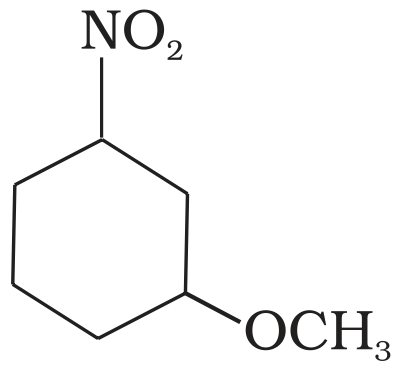
  2.  

Answer
  1. 3-Ethyl-5-methylhexan-2,4-diol.
  2. 1-Methoxy-3-3nitrocyclohexan.
View full question & answer
Question 391 Mark
Name the following compounds according to IUPAC system.

$\ \ \ \ \ \ \ \ \ \ \ \ \ \ \ \ \ \ \ \ \ \ \ \ \ \ \ \ \ \ \ \ \ \ \ \ \ \ \ \ \ \ \ \ \ \ \ \text{CH}_2\text{OH}\\\ \ \ \ \ \ \ \ \ \ \ \ \ \ \ \ \ \ \ \ \ \ \ \ \ \ \ \ \ \ \ \ \ \ \ \ \ \ \ \ \ \ \ \ \ \ \ \ |\\\text{CH}_3-\text{CH}-\text{CH}_2-\text{CH}-\text{CH}-\text{CH}_3\\\ \ \ \ \ \ \ \ \ \ \ \ \ \ |\ \ \ \ \ \ \ \ \ \ \ \ \ \ \ \ \ \ \ \ \ \ |\\\ \ \ \ \ \ \ \ \ \ \ \ \ \text{CH}_3 \ \ \ \ \ \ \ \ \ \ \ \ \ \ \ \ \text{OH}$

Answer
2, 5-Dimethylhexane-1, 3-diol.
View full question & answer
Question 401 Mark
Predict the products of the following reactions:

$\text{CH}_3-\text{CH}_2-\text{CH}_2-\text{O}-\text{CH}_3+\text{HBr}\xrightarrow{\ \ \ }$

Answer
$\text{CH}_3-\text{CH}_2-\text{CH}_2-\text{O}-\text{CH}_3+\text{HBr}\xrightarrow{\ \ \ \ \ \ \ \ \ }\text{CH}_3-\text{CH}_2-\text{CH}_2\text{OH}+\text{CH}_3-\text{Br}\\\\ \ \ \ \ \ \ \text{n-Propylmethyl ether}\ \ \ \ \ \ \ \ \ \ \ \ \ \ \ \ \ \ \ \ \ \ \ \ \ \ \ \ \ \ \ \ \ \ \ \ \ \ \ \ \ \ \ \ \text{Propanol}\ \ \ \ \ \ \ \ \ \ \ \ \ \ \ \ \ \text{Bromomethane}$
View full question & answer
Question 411 Mark
Alcohol can be dehydrated by:
  1. (CH3​CO)2​O
  2. (CH3​)2​SO4​
  3. HI/P
  4. AnhyZnCl2​/$\Delta$
Answer
  1. AnhyZnCl2​/$\Delta$

Explanation:

$\text{R}-\text{CH}_2-\text{OH}\xrightarrow{\text{Anhy Zncl}_2{\Delta}}\text{R}=\text{CH}_2$


View full question & answer
Question 421 Mark
Give the major products that are formed by heating the following ethers with HI.
$ \ \ \ \ \ \ \ \ \ \ \ \ \ \ \ \ \ \ \ \ \ \ \ \ \ \text{CH}_3\\ \ \ \ \ \ \ \ \ \ \ \ \ \ \ \ \ \ \ \ \ \ \ \ \ \ \ \ \ \text{|}\\\text{CH}_3-\text{CH}_2-\text{CH}-\text{CH}_2-\text{O}-\text{CH}_2-\text{CH}_3$
Answer
$\text{CH}_3-\text{CH}_2-\text{CH}-\text{CH}_2\text{OH}+\text{CH}_3\text{CH}_2\text{I} \ \ \ \ \ \ \\ \ \ \ \ \ \ \ \ \ \ \ \ \ \ \ \ \ \ \ \ \ \ \ \ \ \ \ \ \text{|}\\ \ \ \ \ \ \ \ \ \ \ \ \ \ \ \ \ \ \ \ \ \ \ \ \ \ \text{CH}_3$
View full question & answer
Question 431 Mark
Explain why sodium metal can be used for drying diethyl ether but not ethyl alcohol.
Answer
Due to presence of an active hydrogen atom, ethyl alcohol reacts with sodium metal.
$2\text{CH}_3-\text{CH}_2-\text{OH}+2\text{Na}\rightarrow2\text{CH}_3-\text{CH}_2-\text{ONa}+\text{H}_2$
Diethyl ether, on the other hand, does not have replaceable hydrogen atom therefore does not react with sodium metal hence can be dried by metallic sodium.
View full question & answer
Question 441 Mark
How are the following conversions carried out?

Propene → Propan-2-ol.

Answer
If propene is allowed to react with water in the presence of an acid as a catalyst, then propan-2-ol is obtained.
$\text{CH}_3-\text{CH}=\text{CH}_2+\text{H}_2\text{O}\stackrel{{\text{H}^{+}}}{{\rightleftharpoons}}\text{CH}_3-\text{CH}-\text{CH}_3\\ \ \ \ \ \ \ \ \ \ \ \ \ \ \ \ \ \ \ \ \ \ \ \ \ \ \ \ \ \ \ \ \ \ \ \ \ \ \ \ \ \ \ \ \ \ \ \ \ \ \ \ \ \ \ \ \ \ \ \ \ \ \ \ \ |\\ \ \ \ \ \ \ \ \ \ \ \ \ \ \ \ \ \ \ \ \ \ \ \ \ \ \ \ \ \ \ \ \ \ \ \ \ \ \ \ \ \ \ \ \ \ \ \ \ \ \ \ \ \ \ \ \ \ \ \ \ \ \ \ \text{OH}\\ \text{Propene}\ \ \ \ \ \ \ \ \ \ \ \ \ \ \ \ \ \ \ \ \ \ \ \ \ \ \ \ \ \ \ \ \ \ \ \ \ \ \ \ \ \ \ \ \ \ \text{Propan-2-ol}$
View full question & answer
Question 451 Mark
Explain why is OH group in phenols more strongly held as compared to OH group in alcohols.
Answer
In phenols, the -OH group is attached to sp2 hybridised carbon of an aromatic ring. The carbon- oxygen bond length (136 pm) in phenol is slightly less than that in methanol. This is due to partial double bond character on account of the conjugation of unshared electron pair of oxygen with the aromatic ring whereas in alcohols, the oxygen of the -OH group is attached to carbon by a sigma bond formed by the overlap of a sp3 hybridised orbital of carbon with a sp3 hybridised orbital of oxygen. That is why -OH group in phenol is more strongly held as compared to alcohol.
View full question & answer
Question 461 Mark
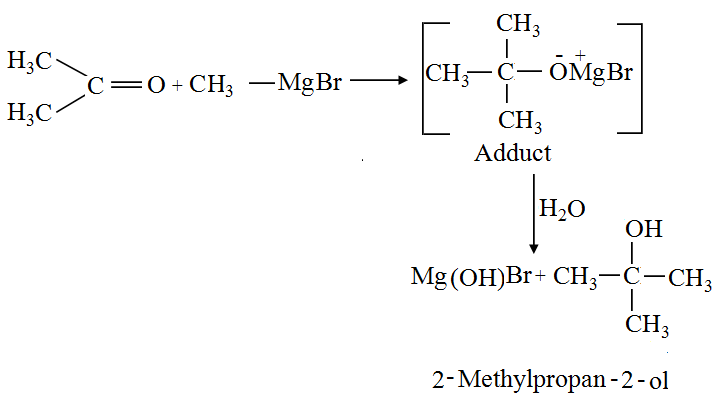
How can propan-2-one be converted into tert- butyl alcohol?
Answer
$\ \ \ \ \ \ \ \ \ \ \ \ \ \text{O} \ \ \ \ \ \ \ \ \ \ \ \ \ \ \ \ \ \ \ \ \ \ \ \ \ \ \ \ \ \ \ \ \ \ \ \ \ \ \ \ \ \ \ \ \ \ \ \ \ \ \ \ \ \ \ \ \text{CH}_3 \ \ \ \ \ \ \ \ \ \ \ \ \ \ \ \ \ \ \ \ \ \ \ \ \ \ \ \ \ \ \text{CH}_3 \\ \ \ \ \ \ \ \ \ \ \ \ \ \ {||} \ \ \ \ \ \ \ \ \ \ \ \ \ \ \ \ \ \ \ \ \ \ \ \ \ \ \ \ \ \ \ \ \ \ \ \ \ \ \ \ \ \ \ \ \ \ \ \ \ \ \ \ \ \ \ \ \ \ {|} \ \ \ \ \ \ \ \ \ \ \ \ \ \ \ \ \ \ \ \ \ \ \ \ \ \ \ \ \ \ \ \ \ \ \ \ {|} \\ \text{CH}_3 - \text{C} - \text{CH}_3 + \text{CH}_3\text{MgI}\xrightarrow{\text{Ether}}\text{CH}_3-\text{C}-\text{CH}_3\xrightarrow[\text{H}]{\text{H}_2\text{O}}\text{CH}_2-\text{C}-\text{CH}_3+\text{Mg(I)OH} \\ \ \ \ \ \ \ \ \ \ \ \ \ \ \ \ \ \ \ \ \ \ \ \ \ \ \ \ \ \ \ \ \ \ \ \ \ \ \ \ \ \ \ \ \ \ \ \ \ \ \ \ \ \ \ \ \ \ \ \ \ \ \ \ \ \ \ \ \ \ \ \ \ \ {|} \ \ \ \ \ \ \ \ \ \ \ \ \ \ \ \ \ \ \ \ \ \ \ \ \ \ \ \ \ \ \ \ \ \ \ \ \ {|} \\ \ \ \ \ \ \ \ \ \ \ \ \ \ \ \ \ \ \ \ \ \ \ \ \ \ \ \ \ \ \ \ \ \ \ \ \ \ \ \ \ \ \ \ \ \ \ \ \ \ \ \ \ \ \ \ \ \ \ \ \ \ \ \ \ \ \ \ \ \ \ \ \ \text{CH}_3 \ \ \ \ \ \ \ \ \ \ \ \ \ \ \ \ \ \ \ \ \ \ \ \ \ \ \ \ \ \ \ \text{OH} \\ \ \ \ \ \ \ \ \ \ \ \ \ \ \ \ \ \ \ \ \ \ \ \ \ \ \ \ \ \ \ \ \ \ \ \ \ \ \ \ \ \ \ \ \ \ \ \ \ \ \ \ \ \ \ \ \ \ \text{Addition Product} \ \ \ \ \ \ \ \ \ \ \ \ \ \ \text{teri-Butyl alcohol} \\ \ \ \ \ \ \ \ \ \ \ \ \ \ \ \ \ \ \ \ \ \ \ \ \ \ \ \ \ \ \ \ \ \ \ \ \ \ \ \ \ \ \ \ \ \ \ \ \ \ \ \ \ \ \ \ \ \ \ \ \ \ \ \ \ \ \ \ \ \ \ \ \ \ \ \ \ \ \ \ \ \ \ \ \ \ \ \ \ \ \ \ \ (2-\text{Methylpropan}-2-\text{Ol})$
View full question & answer
Question 471 Mark
What is the order of dehydration of primary, secondary and tertiary alcohols?
Answer
Tertiary alcohols > Secondary alcohols > Primary alcohols.
View full question & answer
Question 481 Mark
Arrange the following compounds in decreasing order of acidity.
$\text{H}_2\text{O}, \text{ROH}, \text{HC}\equiv \text{CH}$
Answer
$\text{H}_2\text{O}> \text{ROH} > \text{HC}\equiv \text{CH}$
View full question & answer
Question 491 Mark
Dipole moment of phenol is smaller than that of methanol. Why?
Answer
Due to electron withdrawing effect of phenyl group, the C-O bond in phenol is less polar, whereas in case of methanol the methyl group has electron releasing effect and hence C-O bond in it is more polar. Dipole moment depends upon the polarity of bonds.
View full question & answer
Question 501 Mark
Methyl alcohol is industrially prepared by the action of?
  1. CH3​COCH3
  2. CO + H2
  3. CH3​COOH
  4. C2​H5​OH
Answer
  1. CO + H2

Explanation:

The industrial method of preparation of methanol or methyl alcohol is by the action of CO+H2​ as:

CO + H2 ​→ CH3​OH (230−400°C)

Carbon monoxide reacts with hydrogen to produce methanol/methyl alcohol.

This reaction takes place at a temperature of 230−400°C and at 50-100 atm. In this reaction, the catalyst is can be copper oxide on oxide chromium(III).

View full question & answer
1 Marks Question - Chemistry STD 12 Science Questions - Vidyadip