Question 13 Marks
Give reasons-
(a) The bond length of C-O bond in phenol is less than that of methanol.
(b) C-O-C bond angle present in ether is more than tetrahedral angle.
(c) Boiling point decreases on increasing branching in isomeric alcohols.
(a) The bond length of C-O bond in phenol is less than that of methanol.
(b) C-O-C bond angle present in ether is more than tetrahedral angle.
(c) Boiling point decreases on increasing branching in isomeric alcohols.
Answer
View full question & answer→(a) Bond length of C-O bond in phenol vs. methanol
The C-O bond length in phenol is shorter than in methanol for two main reasons:
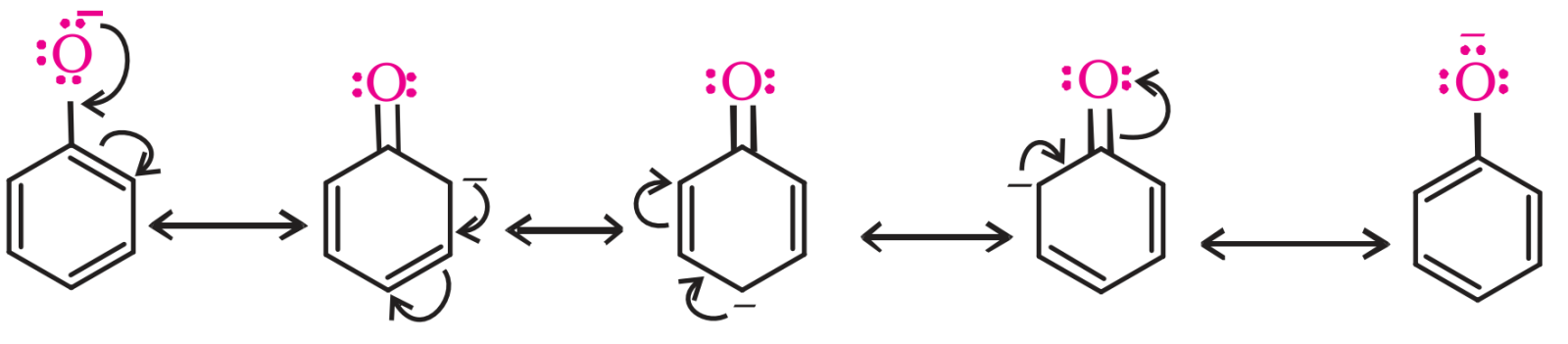
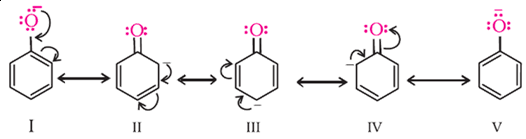
1. Partial Double Bond Character: In phenol, the lone pair of electrons on the oxygen atom is in conjugation with the $\pi$ electrons of the benzene ring. This resonance gives the C-O bond a partial double bond character, which shortens the bond.
2. Hybridization: In phenol, the oxygen is attached to an $s p^2$ hybridized carbon of the benzene ring, while in methanol, it is attached to an $s p^3$ hybridized carbon. Since$s p^2$ carbon is more electronegative and has more s-character, it holds the electron pair of the C-O bond more tightly, reducing the bond length.
(b) C-O-C bond angle in ether
The C-O-C bond angle in ethers is slightly greater than the tetrahedral angle $\left(109^{\circ} 28^{\prime}\right)$.
(c) Boiling point and branching in isomeric alcohols
In isomeric alcohols, the boiling point decreases as branching increases.
Reason: Boiling point depends on the strength of Van der Waals forces, which are proportional to the surface area.
As branching increases, the molecule becomes more spherical and compact.
This reduction in surface area leads to weaker intermolecular Van der Waals forces.
Consequently, less energy is required to break these forces, resulting in a lower boiling point. (e.g., n-butyl alcohol has a higher boiling point than t-butyl alcohol).
The C-O bond length in phenol is shorter than in methanol for two main reasons:
1. Partial Double Bond Character: In phenol, the lone pair of electrons on the oxygen atom is in conjugation with the $\pi$ electrons of the benzene ring. This resonance gives the C-O bond a partial double bond character, which shortens the bond.
2. Hybridization: In phenol, the oxygen is attached to an $s p^2$ hybridized carbon of the benzene ring, while in methanol, it is attached to an $s p^3$ hybridized carbon. Since$s p^2$ carbon is more electronegative and has more s-character, it holds the electron pair of the C-O bond more tightly, reducing the bond length.
(b) C-O-C bond angle in ether
The C-O-C bond angle in ethers is slightly greater than the tetrahedral angle $\left(109^{\circ} 28^{\prime}\right)$.
(c) Boiling point and branching in isomeric alcohols
In isomeric alcohols, the boiling point decreases as branching increases.
Reason: Boiling point depends on the strength of Van der Waals forces, which are proportional to the surface area.
As branching increases, the molecule becomes more spherical and compact.
This reduction in surface area leads to weaker intermolecular Van der Waals forces.
Consequently, less energy is required to break these forces, resulting in a lower boiling point. (e.g., n-butyl alcohol has a higher boiling point than t-butyl alcohol).