MCQ 11 Mark
 is-
is-- AGatterman reaction
- BSandmayer reaction
- ✓Coupling reaction
- DNone of these
Answer
View full question & answer→Correct option: C.
Coupling reaction
C
50 questions · timed · auto-graded
Explanation:
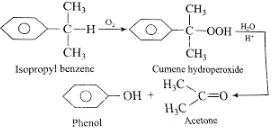
Functional groups are best analyzed by IR spectroscopy. IR is infrared spectroscopy that works in IR region of electromagnetic radiations. stretching frequencies of functional groups are measured due to their vibration around bonds. Every functional groups have their particular stretching frequency range.In this way functional groups are analyzed by IR.
Explanation:
Monochlorination of toluene in sunlight gives benzyl chloride. On hydrolysis with aq. NaOH, benzyl chloride, shows nucleophilic substitution reaction to give benzyl alcohol.
Explanation:
Explanation:
Methanol acquired the name "wood spirit" because it was once produced chiefly as a byproduct of the destructive distillation of wood.
Explanation:
O− nitrophenol undergoes creation because of intra-moleculer hydrogen bonding. So, it is least soluble.
Explanation:
Phenol on reaction with ammonia gives aniline. In this reaction, -OH group is replaced with −NH2 group.
Explanation:
Phenol does not react with Na2CO3 because it is weaker acid than carboxylic acid and thereby do not have the strength to substitute or give away its H+ ions to that of weak bases like sodium carbonate.
Phenol is used for the preparation of aspirin which is used as an analgesic as well as antipyretic drugs.
Phenol is more soluble in water than chlorobenzene due to formation of H-bond with water molecules.
o-nitrophenol form intramolecular H−bonding while p-nitrophenol form intermolecular H−bonding. Due to this, nature o-nitrophenol has a lower boiling point than p-nitrophenol.
Explanation:
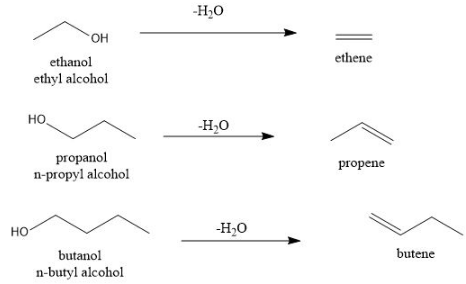
Alcohols undergo dehydration (removal of water) to form an alkene.
To form alkene, we need at least two carbon atoms. But, methanol (CH3OH) has only one carbon atom. So, it does not give a stable compound on dehydration.
Explanation:
Dilute H2SO4 will increase the acidity of phenol. This is because now phenol will be easily able to donate H+ ion and delocalise its negative charge more efficiently. Also addition of dilute H2SO4 which is itself an acid increases the acidity of phenol.
Explanation:
Phenol being more acidic reacts with sodium hydroxide solution in water to give sodium phenoxide which is resonance stabilized.
Alcohols are very weak acids.
C6H5OH + NaOH → C6H5ONa + H2O
Explanation:
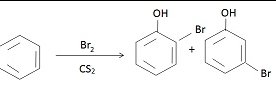
−OH is ring activating group because it is electron-donating so it is ortho and para director with compound o− and p− bromophenols.
Explanation:
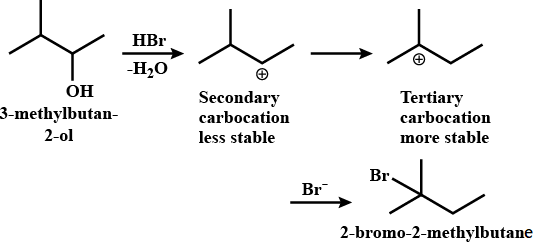
The reaction (along with mechanism) for the conversion of 3-methylbutan-2-ol to 2-bromo-2-methylbutane is as given below.
Explanation:
Isopropyl alcohol (IUPAC name 2-propanol), also called isopropanol or dimethyl carbinol.
Explanation:
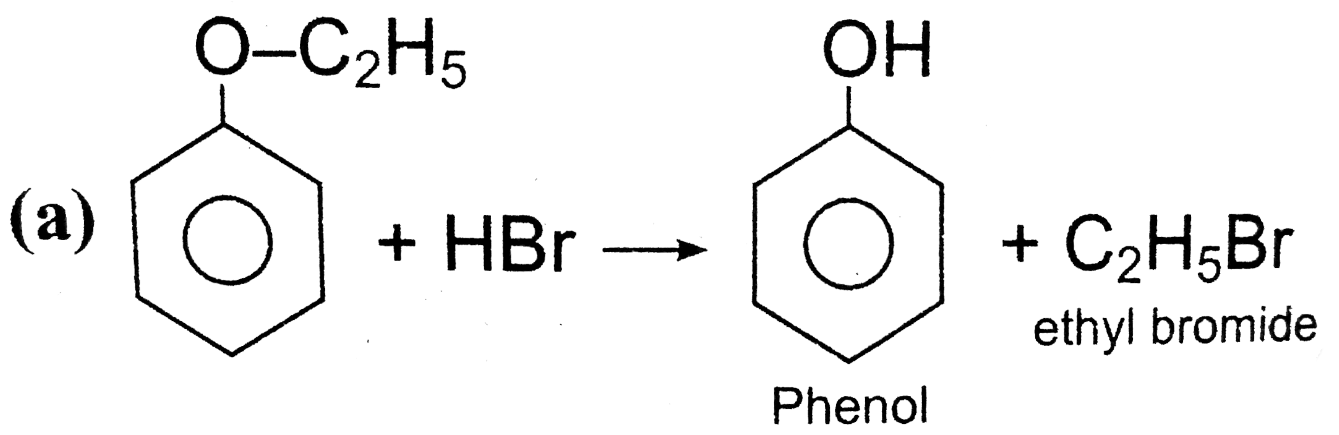
On boiling with concentrated hydrobromic acid, phenyl ethyl ether will yield phenol and ethyl bromide.
Explanation:
Priority will be given to -OH group.
Explanation:
Among given compounds, ethylene glycol (HO−CH2−CH2−OH) is the most soluble in water. Ethylene glycol has two hydroxy groups both of which form hydrogen bonds with water. Greater is the number of hydrogen bonds, greater is the extent of hydrogen bonding and greater is the solubility in water.
Explanation:
(X): C2H5OH + HI → C2H5I+H2O
(Y): CH3OCH3 + HI → CH3I+CH3OH
Explanation:
Aldehydes and ketones are reduced to the corresponding alcohols by addition of hydrogen in the presence of catalysts (catalytic hydrogenation. It is also prepared by treating aldehydes and ketones with sodium borohydride (NaBH4) or lithium aluminium hydride (LiAlH4).
Explanation:
Cyclohexanol is used as substrate and phosphoric acid is present as catalyst which promotes the reaction but is not consumed in it. The hydroxyl group in R-OH is a poor leaving group because it leaves as hydroxide ion. An acid is used to protonate the alcohol and form $\text{R}−\text{OH}_2^+$
Explanaition:
Acid-catalyzed method of preparing symmetrical ethers from primary alcohols is temperature dependence. At 110°413KC or 383K to 130∘C or 403K, a SN2 reaction of the alcohol conjugate acid leads to an ether product. At higher temperatures (over 150°C or 423K) an E2 elimination takes place and instead of ether, an alkene is obtained.
Thus, Ether is obtained from ethyl alcohol in presence of H2SO4 at 413K.
Explanation:
As we know that the higher the extent of intermolecular Hydrogen bonding in a molecule, the higher its boiling point becomes.
By that logic, n-butyl alcohol will have a higher boiling point than n-butyraldehyde due to the presence of more extensive H-bonding.
Again, there is no H-bonding present in both diethyl ether and n-pentane. But as n-pentane has a higher molecular weight than that of diethyl ether, it will possess a higher boiling point.
Explanation:
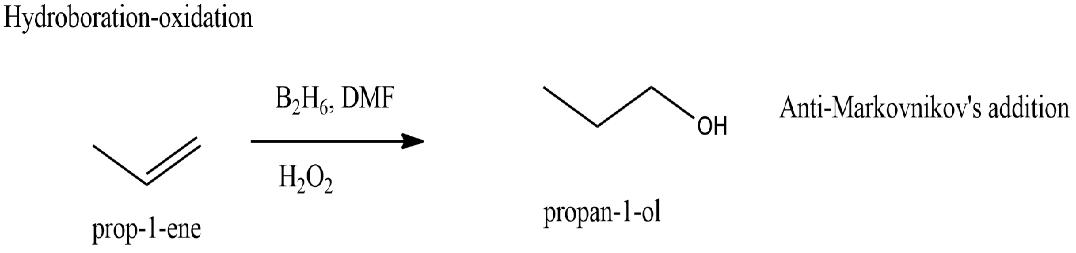
Hydroboration-oxidation reaction follows anti-Markovnikov's addition of H−OH across C=C to give alcohol.
Thus an alkene CH3CH=CH2 when treated with B2H6 in presence of H2O2 will yield the final product as CH3CH2CH2OH

Explanation:
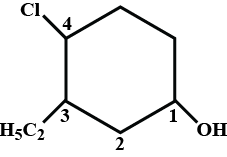
-OH group is given preference over Cl group so, 1 number to carbon attach to -OH group
so, 4-chloro-3 ethyl-cyclohexan -1-ol.
Explanation:
The molecules of butane are held together by weak vander Waals forces of attraction, while those of propanol are held together by stronger intermolecular hydrogen bonding.
Therefore, the boiling point of propanol is much higher than of butane.
Explanation:
Since alcohols can participate in H−bonding while hydrocarbons cannot, alcohols are able to interact with water molecules more easily than hydrocarbons of comparable molecular masses.
Hence alcohols possess greater solubility in water than hydrocarbons of comparable molecular masses.
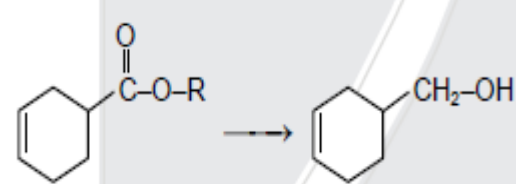
Explanation:
Suitable Reagent for this conversion is LiAlH4.
Explanation:
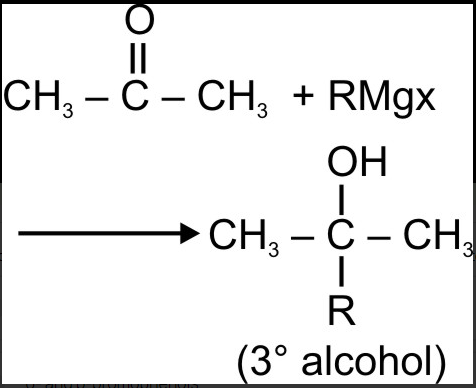
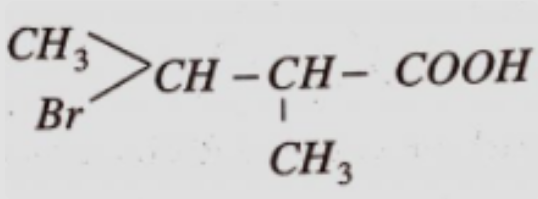
Explanation:
Intramolecular hydrogen bonding in ortho-substituted nitrophenol reduces water solubility and increases volatility.
Thus, o-nitrophenol is steam distillable while the isomeric p-nitrophenol is soluble in water.
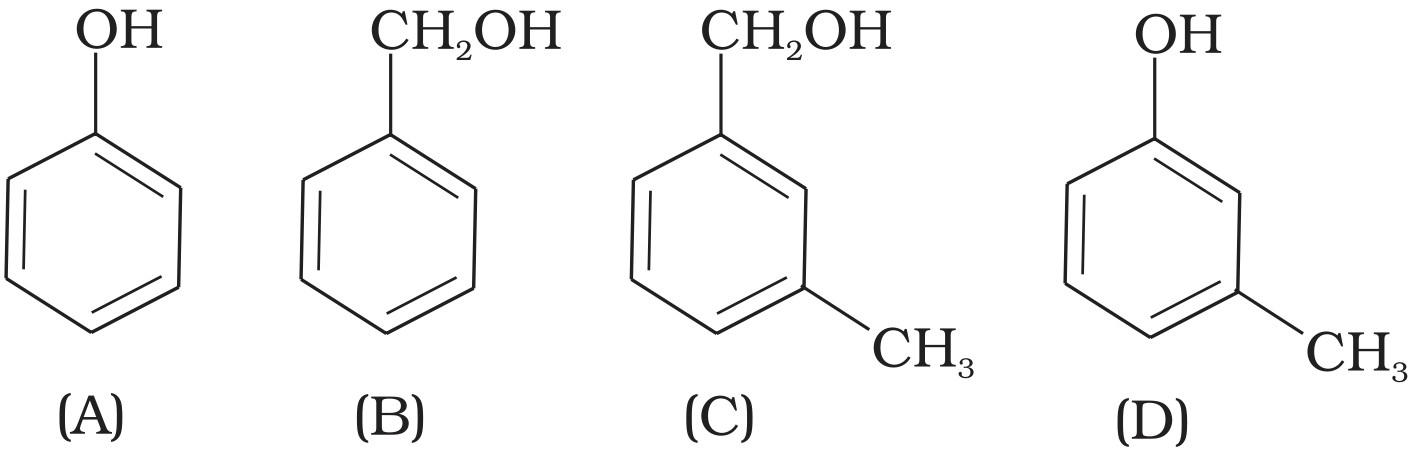
Explanation:
Compound (A) i.e., phenol and compound (D) i.e., a derivative of phenol cannot be considered as aromatic alcohol. As phenol is also known as, carbolic acid cannot be considered as aromatic alcohol.
Compound (B) and (C), -OH group is bonded to sp3 hybridised carbon which in turn is bonded to benzene ring.
Explanation:
Esters (RCOOR') are prepared by the reaction between alcohol (R'OH) and organic acid (RCOOH).
Explanation:
The general formula for alcohol series is CnH2n+1OH. The formula for alcohol contains four carbon atoms is
CnH2n+1OH = C4H2(4)+1 OH = C4H8+1 OH = C4H9OH.
Explanation:
Except for ethyl alcohol, no other primary alcohol can be prepared by this method as the addition of H2SO4 follows Markownikoff's rule. Generally, secondary and tertiary alcohols are obtained.

Explanation:
When ethylene react with KMnO4, than pink colour of KMnO4 gets disappear and ethylene gets converted with ethylene glycol.
Explanation:
Alkenes react with water in the presence of acid as a catalyst to form alcohol. In case of unsymmetrical alkenes, OH is added to the carbon having fewer hydrogen atoms according to Markovnikov's rule.
Hence, acid catalyzed hydration of alkenes except ethene leads to the formation of secondary or tertiary alcohol. To obtain primary alcohol, hydroboration oxidation is used.
Explanation:
Baeyer's reagent, named after the German organic chemist Adolf von Baeyer, is used in organic chemistry as a qualitative test for the presence of unsaturation, such as double bonds.
Baeyer's reagent is an alkaline solution of cold potassium permanganate, which is a powerful oxidant making this a redox reaction.
Explanation:
Ethers have general structural formula R-O-R'. Hence all of them have the C-O bond. We know that the C-O bond is polar due to the difference between the electronegativities of carbon and oxygen. Hence, ethers show dipolar nature.
Explanation:
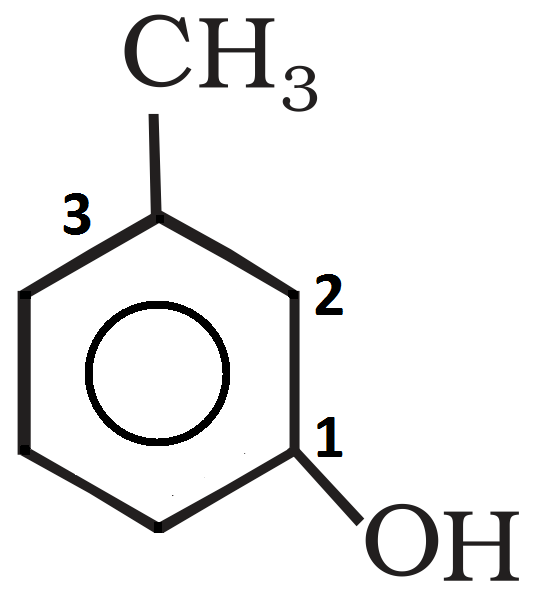
-OH is functional group and -CH3 is substituent.
IUPAC name: 3-methylphenol.
Explanation:
o-nitro phenol participates in intra-molecular H−bonding, which makes it less acidic than p-nitro phenol. Since acidic strength depends on the stability of negative ion after removal of acidic H, −NO2 group in o and p position provides −M effect as the negative charge delocalizes.
Explanation:
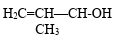
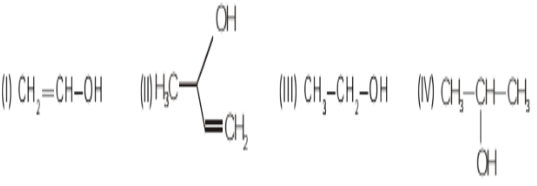
The correct reactivity order of alcohols towards H−X will be II>IV>III>I
Alcohol II has maximum reactivity as the carbocation formed will be stabilized by resonance with adjacent C=C double Bond.
Alcohol I has minimum reactivity as the carbocation formed will have positive charge on sp2 carbon atom.
Alcohol IV is more reactive than alcohol III because alcohol IV gives secondary carbocation whereas alcohol III gives primary carbocation.
Secondary carbocation is more stable than primary carbocation.
Explanation:
On an industrial scale, methanol is predominantly produced from natural gas by reforming the gas with steam and then converting and distilling the resulting synthesized gas mixture to create pure methanol. The result is a clear, liquid, organic chemical that is water-soluble and readily biodegradable.
Some methanol can be produced during fermentation, but this is not derived from the ethanol or by carbohydrate oxidation. It is produced in small amounts, either by non-enzymatic reactions or through the reduction of formaldehyde.
Explanation:
Only one alcohol contains chiral carbon atom.
$\ \ \ \ \ \ \ \ \ \ \ \ \ \text{CH}_3 \\ \ \ \ \ \ \ \ \ \ \ \ \ \ \ | \\ \text{CH}_3 - \text{C} - \text{OH} \\ \ \ \ \ \ \ \ \ \ \ \ \ \ \ | \\ \ \ \ \ \ \ \ \ \ \ \ \ \ \text{CH}_3$
$\text{CH}_3\text{CH}_2\text{CH} - \text{CH}_3 \\ \ \ \ \ \ \ \ \ \ \ \ \ \ \ \ \ | \\ \ \ \ \ \ \ \ \ \ \ \ \ \ \ \ \text{OH}$
Only III is chiral in nature.
Explanation:
Methanol has high boiling point than methyl thiol because there is intermolecular hydrogen bonding in methanol and no hydrogen bonding in methyl thiol.
Explanation:
The dehydration reaction is as: Alcohol + H2SO4 → alkene is an elimination reaction that goes via carbocation formation.
Higher is the stability of carbocation more easily it can be dehydrated.
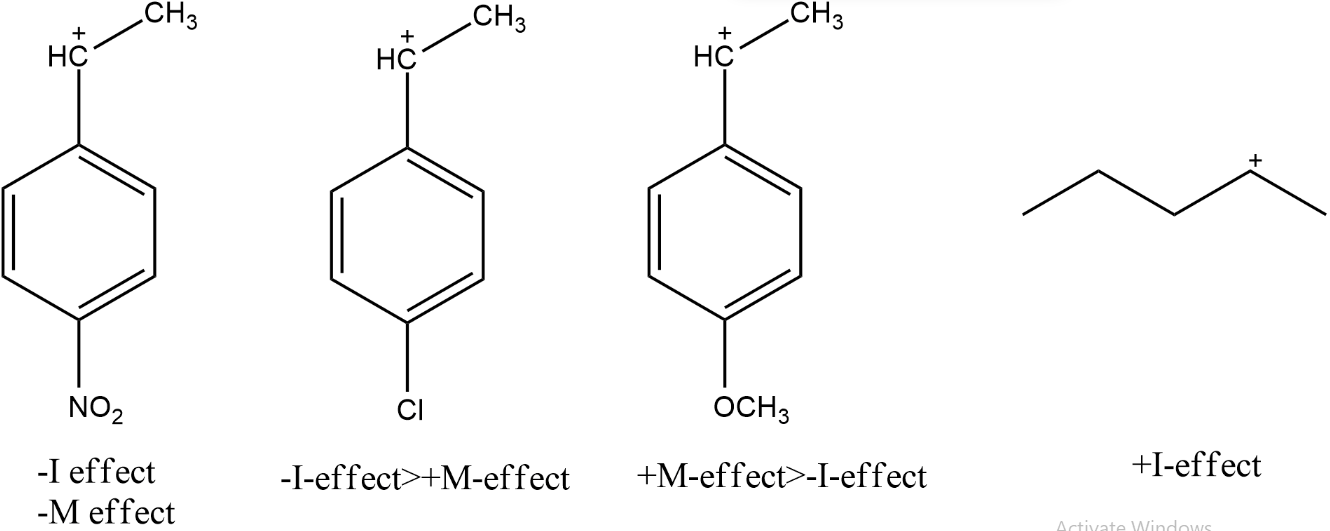
The corresponding carbocations formed by given molecules are shown in the figure.
Due to the --Inductive effect (-I)and --Mesomeric effect (-M) of NO2 group, it will decrease the electron density on benzene and will, therefore, destabilise the carbocation the most and makes it difficult to dehydrate.
In case of p−ClC6H4CH(OH)CH3, the Cl has stronger -I effect (due to high electronegativity) than its +M effect (due to a lone pair of electrons) thus will destabilise the carbocation and unfavour dehydration.
In case of p−CH3OC6H4CH(OH)CH3, the CH3O has the stronger +M effect due to a lone pair of electrons on O than its -I effect and will stabilise the carbocation by increasing the electron density in the benzene ring and will favour dehydration.
C3H5CH(OH)CH3 has +I effect that stabilises the carbocation but its impact is lower than the +-mesomeric effect of the methoxy group.
The alcohol that is dehydrated most easily with conc. H2SO4 is p−CH3OC6H4CH(OH)CH3
Explanation:
Osmium tetroxide (OsO4) is a volatile liquid that is most useful for the synthesis of 1,2 diols from alkene.
The OsO₄ is a catalyst. It reacts with the π electrons of the alkene in a syn addition to form a cyclic osmate ester.
The OH⁻ hydrolyzes the ester. This forms the cis-diol and H2OsO4.
Explanation:
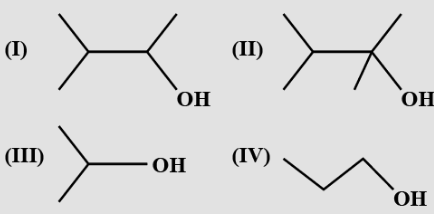
Reactivity of alcohol towards dehydration is increased by the stability of the carbocation formed subsequently. Order of carbocation stability is:
tertiary>secondary>primary.
Also presence of +I groups like CH3 increases the stability.
According to this the order of reactivity is, II>I>III>IV