Questions

4 Marks Questions

🎯

Test yourself on this topic

3 questions · timed · auto-graded

Question 14 Marks
What happens when primary, secondary and tertiary alcohols are:
(i) Oxidised using acidified potassium permanganate.
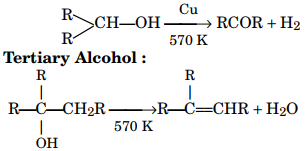
(ii) Passed over heated copper at 570 K.
Answer
(i) Oxidation of $1^{\circ}, 2^{\circ}, 3^{\circ}$ alcohols by alkaline potassium permangnate
$1 ^{\circ}$ Alcohol :
$RCH _2 OH \xrightarrow[\text { [O] }]{ \text {Acidic} KMnO_4} RCHO \xrightarrow{[ O ]} RCOOH$
$2 ^{\circ}$ Alcohol :
$R _2 CHOH \xrightarrow{[ O ]}$$RCOR \xrightarrow{[ O ]} RCOOH$
$3^{\circ}$ Alcohol :
Do not oxidise with acidic $KMnO _4$.
(ii) When passed over heated copper at 570 K .
Primary Alcohol :
$RCH _2 OH \xrightarrow[570 K]{ Cu } RCHO + H _2$
Secondary Alcohol :
Image
View full question & answer
Question 24 Marks
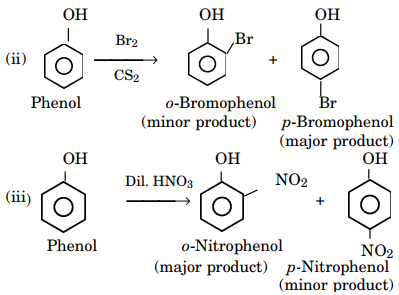
Give equations for the following reactions :
(i) Oxidation of propan-1-ol with alkaline $KMnO _4$ solution.
(ii) Bromine in presence of $C S _{ 2 }$ with phenol.
(iii) Dilute nitric acid with phenol.
Answer
(i) $\underset{\text { Propan-1-ol }}{ CH _3 CH _2 CH _2 OH +2[ O ]} \xrightarrow[\text { Oxidation }]{ KMnO _4 \text { Alkaline }}$ $\underset{\text {Propanoic acid}}{CH _3 CH _2 COOH} + H _2 O$
Image
View full question & answer
Question 34 Marks
Explain giving reasons :
(i) Alcohols are generally soluble in water.
(ii) Phenols boil at higher temperature than arenes of comparable molecular mass.
(iii) The lower homologues of alcohols are soluble in water whereas phenols are slightly soluble in water.
(v) Boiling point of an alcohol is higher than the corresponding alkane.
(vi) The solubility of alcohols in water decreases with increase in molecular mass.
Answer
(i) Alcohols are generally soluble in water because they form hydrogen bonding with water.
(ii) Phenol boils at a higher temperature than arenes of comparable molecular masses because phenol has intermolecular hydrogen bonding.
(iii) Phenols are slightly soluble in water because of hydrophobic nature of benzene ring.
(iv) Alcohols form hydrogen bonding with water but alkyl halides not.
(v) Alcohols possess intermolecular hydrogen bonding but alkanes not.
(vi) The solubility of alcohols decreases with increase in molecular mass because with increase in molecular mass the polarity of - OH decreases. This is due to the increased + I effect of alkyl groups.
View full question & answer
4 Marks Questions - Chemistry STD 12 Science Questions - Vidyadip