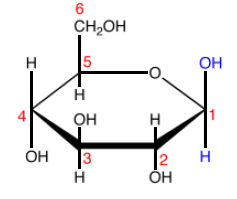
This structure was assigned on the basis of the following evidences: - Molecular formula: The molecular formula of glucose has been found to be C6H12O6. Straight chain structure:
When aqeous solution of glcouse is treated with sodium amalgam or sodium borohdride, it is reduced to sorbitol.
$\ \text{CHO} \ \ \ \ \ \ \ \ \ \ \ \ \ \ \ \ \ \ \ \ \ \ \ \ \ \ \ \ \ \ \ \ \text{COOH} \\ \ \ {|} \ \ \ \ \ \ \ \ \ \ \ \ \ \ \ \ \ \ \ \ \ \ \ \ \ \ \ \ \ \ \ \ \ \ \ \ \ \ \ \ {|} \\ \text{(CHOH)}_4+2[\text{H}] \xrightarrow{\text{Br}_2/\text{H}_2\text{O}}(\text{CHOH})_4\\ \ \ {|} \ \ \ \ \ \ \ \ \ \ \ \ \ \ \ \ \ \ \ \ \ \ \ \ \ \ \ \ \ \ \ \ \ \ \ \ \ \ \ \ \ \ {|} \\ \ \text{CH}_2\text{OH} \ \ \ \ \ \ \ \ \ \ \ \ \ \ \ \ \ \ \ \ \ \ \ \ \ \ \ \ \ \text{CH}_2\text{OH} \\ \text{Glucose} \ \ \ \ \ \ \ \ \ \ \ \ \ \ \ \ \ \ \ \ \ \ \ \ \ \ \ $
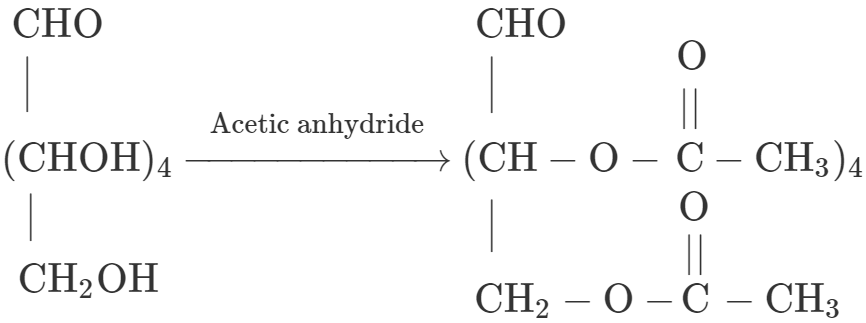
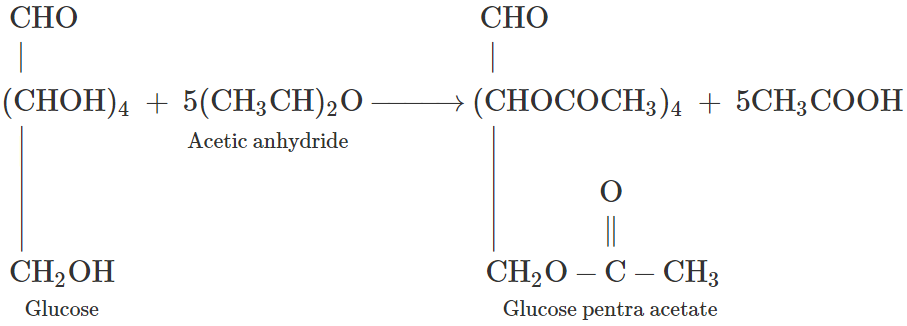
- Presence of five hydroxyl (-OH) groups: On acetylation with acetic anhydride, glucose gives a pentaacetate. This confirms that glucose contains five -OH groups. We know that the presence of two or more -OH groups on the same carbon atom makes the molecules unstable.
Now since glucose is a stable compound, therefore, the five -OH groups must present on different carbon atoms.
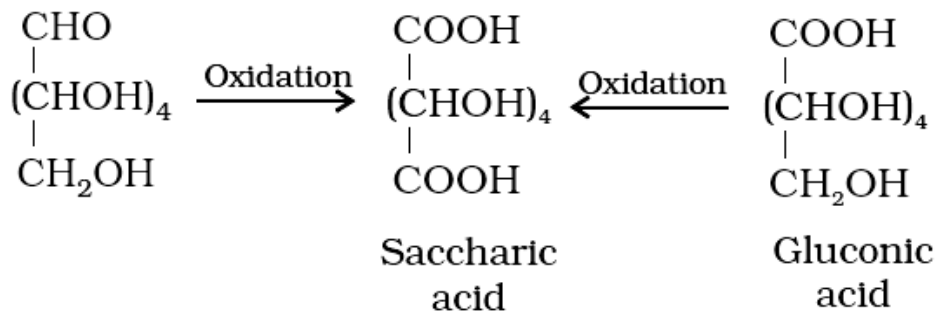
- Presence of one primary alcoholic group: On oxidation with cone, nitric acid, both glucose and gluconic acid give the same dicarboxylic acid, saccharic acid or glucaric acid. The primary alcoholic group (CH2OH) is always present at the end of the carbon chain.
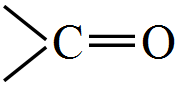
- Presence of an aldehyde (-CHO) group: Glucose reacts with hydroxylamine, NH2OH to form glucose CHO oxime. Which suggest that glucose contains a carbonyl (CHOH)4 (>C = O) groups.
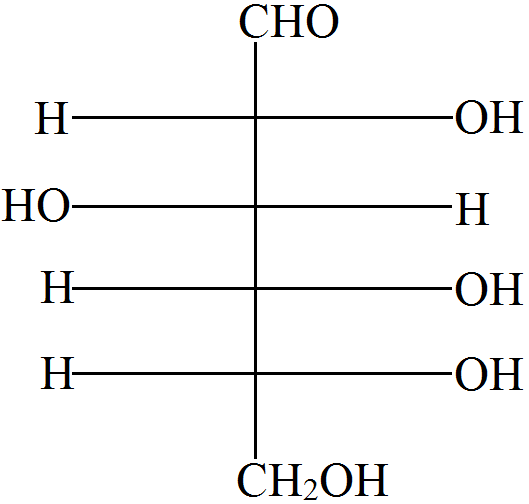
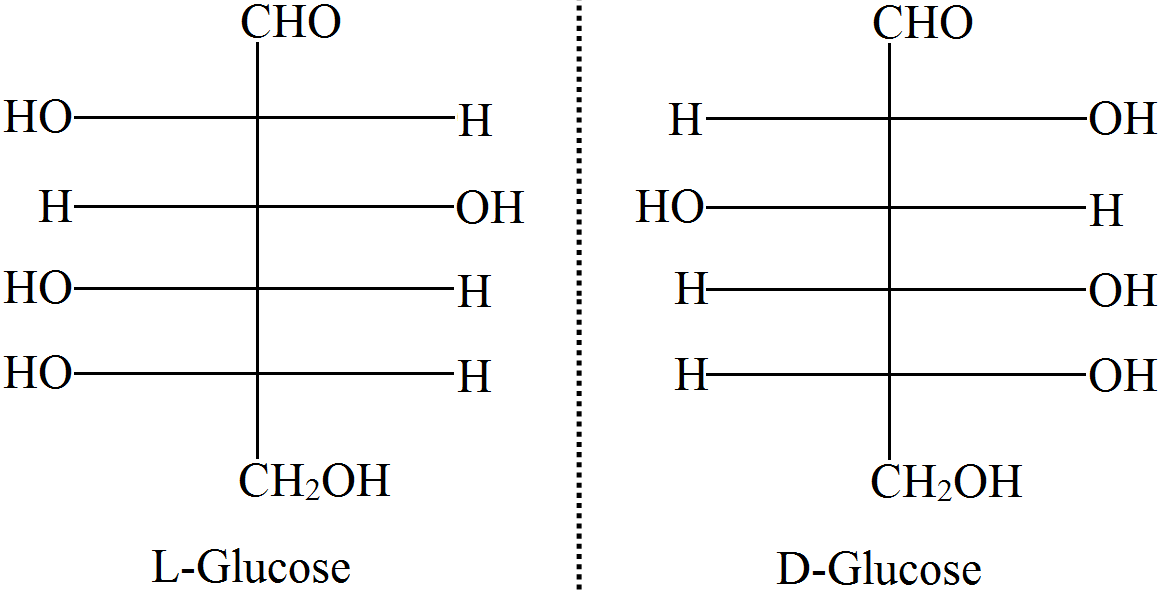
On the basis of above observations, the following open CH2OH chain structure for glucose can be written as follows:
$\text{CHO}\\ \ \ |\\ (\text{CH}_{2}\text{OH})_{4}\\\ \ |\\\text{CH}_{2}\text{OH}$

 and -NH group of the peptide bond.