Questions · Page 1 of 2

3 Marks Question

🎯

Test yourself on this topic

50 questions · timed · auto-graded

Question 13 Marks
How is the concept of coupling reactions useful in explaining the occurrence of non spontaneous thermochemical reactions? Explain giving an example.
Answer
There are reactions for which the value of ∆G is not negative i.e they are non spontaneous. However such reactions can be made spontaneous if they are coupled with reactions having very large negative Gibb’s energy change of reaction.
When  ∆G is +ve, then it is coupled with some other reaction which has ∆G –ve and large.
e.g 2Fe2 O3 (s)  → 4Fe(s) + 3O2 (g)  ∆G° = X kJmol-1
Thus for the overall reaction to become spontaneous, this reaction is coupled with carbon monoxide oxidation reaction.
6CO(g) + 3O2(g) → 6CO2 ∆G° = -Y kJmol-1
Where Y > X. The large negative value of ∆G° for this reaction shows that Fe2O3 can be reduce to Fe by CO.
View full question & answer
Question 23 Marks
A certain reaction is 50% complete in 20 minutes at 300 K and the same reaction is again 50% complete in 5 minutes at 350 K. Calculate the activation energy if it is a first order reaction. [R = 8.314$$ JK-1mol-1, log 4 = 0.602].
Answer
$\log\frac{\text{k}_{2}}{\text{k}_{1}}=\frac{\text{E}_\text{a}}{\text{2.303R}}\bigg(\frac{\text{T}_{2} \ - \ \text{T}_{1}}{\text{T}_{1}\text{T}_{2}}\bigg)$

$\log\frac{\text{k}_{2}}{\text{k}_{1}}=\frac{\text{E}_\text{a}}{\text{2.303}\times\text{8.314 JK}^{-1}\text{mol}^{-1}}\bigg(\frac{\text{350-300}}{\text{350}\times\text{300 K}}\bigg)$

$\log\frac{\frac{0.693}{5}}{\frac{0.693}{20}}=\frac{\text{Ea}}{\text{2.303}\times\text{8.314}}\times\frac{\text{50}}{\text{350}\times\text{300}}$

$\log{4}=\frac{\text{E}_\text{a}}{\text{2.303}\times\text{8.314}}\times\frac{\text{50}}{\text{350}\times{300}}\text{ J mol}^{-1}$

$\text{E}_\text{a}=\text{2.303}\times\text{8.314}\times\text{300}\times\text{7}\times\text{0.6021 J}\text{mol}^{-1}$

$\text{= 24210 J mol}^{-1}=\text{24.210 kJ mol}^{-1}.$

View full question & answer
Question 33 Marks
For the first order thermal decomposition reaction, the following data were obtained:
$\text{C}_{2}\text{H}_{5}\text{Cl}\text{(g)}\rightarrow \text{C}_{2}\text{H}_{4}\text{(g)} + \text{HCl}\text{(g)} $
Time/sec Total pressure/atm
0 0.30
300 0.50
Calculate the rate constant
(Given: log 2 = 0.301, log 3=0.4771, log 4 =0.6021)
Answer
Given: Initial pressure, Po = 0.30 atm
Pt = 0.50 atm
t = 300 s
Rate constant, $\text{k} = \frac{2.303}{t}\text{log}\frac{\text{p}_{o}}{2\text{p}_{o} - \text{p}_{t}}$
$ = \frac{2.303}{300\text{ s }}\text{log}\frac{0.30}{2\times0.30-0.50}$
$ = \frac{2.303}{300\text{ s }}\text{log}\frac{0.30}{0.60 - 0.50}$
$ = \frac{2.303}{300\text{ s}}\text{log}\frac{0.30}{0.10}$
$ = \frac{2.303}{300\text{ s}}\text{log }3$
$=\frac{2.303}{300\text{ s }}\times0.4771$
$ = \frac{1.099}{300\text{ s }}$
$ = 0.0036\text{ s}^{-1} / 3.66\times10^{-3}\text{ s}^{-1}.$
View full question & answer
Question 43 Marks
A first order reaction takes 20 minutes for 25% decomposition. Calculate the time when 75% of the reaction will be completed. (Given : log 2 = 0·3010, log 3 = 0·4771, log 4 = 0·6021)
Answer
$t=\frac{2.303}{k}\log\frac{[A]o}{[A]}$

$20\text{ }\text{min}=\frac{2.303}{k}\text{ }\log\frac{100}{75}\text{ }\text{ }\text{ }\text{ }\dots(1)$

$t=\frac{2.303}{k}\text{ }\log\frac{100}{25}\text{ }\text{ }\text{ }\text{ }\dots(2)$

Divide (1) equation by (2)

$\frac{20}{t}=\frac{\frac{2.303}{k}\text{ }\log\frac{100}{75}}{\frac{2.303}{k}\text{ }\log\frac{100}{25}}$

$=\frac{\log4/3}{\log4}$

$20/\text{t}=0.1250/0.6021$

$\text{t}=96.3\text{ }\text{min}$

View full question & answer
Question 53 Marks
The following data were obtained during the first order thermal decomposition of SO2Cl2 at a constant volume:
SO2Cl2(g) $\rightarrow$SO2(g) + Cl2(g)
Experiment
Time/s–1
Total pressure/atm
1
0
0.4
2
100
0.7
Calculate the rate constant.
(Given: log4 = 0.6021, log2 = 0.3010).
Answer
SO2Cl2 → SO2+Cl2
At t
=
0s
0.4 atm
0 atm
0 atm
At t
=
100s
(0.4 – x) atm
x atm
x atm
Pt = 0.4 – x + x + x
Pt = 0.4 + x
0.7 = 0.4 + x
x = 0.3
$\text{k}=\frac{\text{2.303}}{\text{t}}\log\frac{\text{pi}}{\text{2pi-pt}}$
$\text{k}=\frac{\text{2.303}}{\text{t}}\log\frac{\text{0.4}}{\text{0.8-0.7}}$
$\text{k}=\frac{\text{2.303}}{\text{100s}}\log\frac{\text{0.4}}{\text{0.1}}$
$\text{k}=\frac{\text{2.303}}{\text{100s}}\times0.6021=1.39\times10^{-2}\text{s}^{-1}$
View full question & answer
Question 63 Marks
The rate of a reaction becomes four times when the temperature changes from 293 K to 313K. Calculate the energy of activation (Ea) of the reaction assuming that it does not change with temperature.
[R=8.314 J K-1 MOL-1, log 4=0.6021]
Answer
Given if rate at 293K is R thus at 313K rate becomes 4R
$\log\frac{\text{k}_{2}}{\text{k}_{1}}=\frac{\text{E}_{a}}{\text{2.303 R}}\Bigg[\frac{\text{T}_{2}-\text{T}_{1}}{\text{T}_{1}\times\text{T}_{2}}\Bigg]$
$\log\frac{\text{4R}}{\text{R}}=\frac{\text{E}_{a}}{\text{2.303 }\times{8.314}}\Bigg[\frac{\text{313}-\text{293}}{\text{293}\times\text{313}}\Bigg]$
$\log\text{4}=\frac{\text{E}_{a}}{\text{19.1471 }}\Bigg[\frac{\text{20}}{\text{91709}}\Bigg]$
$\text{0.6021}=\frac{\text{E}_{a}}{\text{19.1471 }}\Bigg[\frac{\text{20}}{\text{91709}}\Bigg]$
$\frac{\text{0.6021}\times{19.1471}\times{91709}}{\text{20 }}=\text{E}_{a}$
Ea = 52863∙2177J or 52∙863KJ.
View full question & answer
Question 73 Marks
A first order reaction has a rate constant of 0.0051 min–1. If we begin with 0.10 M concentration of the reactant, what concentration of the reactant will be left after 3 hours?
Answer
$\text{t}=\frac{2.303}{\text{k}}\times\log\frac{[\text{A}]_{0}}{[\text{A}]}$
$3\times60\text{min}=\frac{2.303}{0.0051\text{min}^{-1}}\log\frac{0.10}{[\text{A}]}$
$\log\frac{0.10}{[\text{A}]}=\frac{180\times0.0051}{2.303}$
$\log\frac{0.10}{[\text{A}]}=0.399$
$[\text{A}] = 0.04 \text{M}.$
View full question & answer
Question 83 Marks
The rate constant for a first order reaction is 60 s-1 How much time will it take to reduce the concentration of the reactant to 1/10th of its initial value?
Answer
$\text{t}=\frac{2.303}{\text{k}}\times\log\frac{[\text{A}]_{0}}{[\text{A}]_{t}}$
$=\frac{2.303}{60\text{s}^{-1}}\times\log\frac{1}{1/10}$
= 0.038s OR 3.8 x 10⁻² s.
View full question & answer
Question 93 Marks
For the first order thermal decomposition reaction, following data were obtained:
C2H5Cl(g) $\xrightarrow{\text{ }\text{ }\text{ }\text{ }\text{ }\text{ }\text{ }\text{ }\text{ }}$  C2H4(g) + HCl(g)
Time/sec   Total pressure/atm
0   0.30
300   0.50
Calculate the rate constant.
(Given : log 2 = 0.301, log 3 = 0.4771, log 4 = 0.6021)
Answer
$\text{k}=\frac{2.303}{\text{t}}\text { }\log\text{ }\frac{\text{p}_{\text{i}}}{2\text{p}_{\text{i}}-\text{p}_{\text{t}}}$
$=\frac{2.303}{300}\text{ }\log\text{ }\frac{0.3}{2\times0.3-0.5}$
$=\frac{2.303}{300}\text{ }\log\text{ }3$
$=\frac{2.303\times0.4771}{300}$
= 0.0036 atm-1 or 0.004 atm-1 (approx.)
View full question & answer
Question 103 Marks
Following data are obtained for the reaction:
N2O5 $\rightarrow$ 2NO2 + ½O2
t/s 0 300 600
[N2O5]/mol L–1 1.6 × 10⁻² 0.8 × 10⁻² 0.4 × 10⁻²
  1. Show that it follows first order reaction.
  2. Calculate the half-life.
(Given log 2 = 0.3010 log 4 = 0.6021)
Answer
  1. $\text{k}=\frac{2.303}{\text{t}}\text{ }\log\frac{\text{[A]}o}{[\text{A}]}$

$\text{k}=\frac{2.303}{300}\text{ }\log\frac{1.6\times10^{-2}}{0.8\times10^{-2}}$

$\text{k}=\frac{2.303}{300}\text{ }\log2=2.31\times10^{-3}\text{S}^{-1}$

$\text{At}\text{ }600\text{s},\text{ }\text{k}=\frac{2.303}{\text{t}}\text{ }\log\frac{\text{[A]}o}{\text{[A]}}$

$=\frac{2.303}{600}\text{ }\log\ \frac{1.6\times10^{-2}}{0.4\times10^{-2}}$

$\text{k}=2.31\times10^{-3}\text{S}^{-1}$

k is constant when using first order equation, therefore, it follows first order kinetics.

OR

In equal time interval, half of the reactant gets converted into product and the rate of reaction is independent of concentration of reactant, so it is a first order reaction.

  1. t1/2 = 0.693/k

= 0.693/2.31$\times$10-3

= 300 s

View full question & answer
Question 113 Marks
The following data were obtained during the first order thermal decomposition of SO2Cl2 at a constant volume:
SO2Cl2(g)$\rightarrow$SO2(g) + Cl2(g)
Experiment
Time/s-1
Total pressure/atm
1
2
0
100
0.4
0.7
Calculate the rate constant.
(Given: log4 = 0.6021, log2 = 0.3010)
Answer
SO2Cl2→ SO+ Cl2
At t = 0s0.4 atm 0 atm0 atm
At t = 100s (0.4 – x) atm x atm x atm
Pt = 0.4 – x + x + x
Pt = 0.4 + x
0.7 = 0.4 + x
x = 0.3
$k=\frac{\text{2.303}}{\text{t}}\log\frac{\text{pi}}{\text{}2pi-pt}$
$k=\frac{\text{2.303}}{\text{t}}\log\frac{\text{0.4}}{\text{0.8-0.7}}$
$k=\frac{\text{2.303}}{\text{100}}\log\frac{\text{0.4}}{\text{0.1}}$
$k=\frac{\text{2.303}}{\text{100}}\times0.6021=1.39\times10^{-2}\text{s}^{-1}$
View full question & answer
Question 123 Marks
The rate constant for the first order decomposition of H2O2 is given by the following equation:

$\log{k}=14.2-\frac{\text{1.0}\times\text{10}^{4}}{\text{T}}K$

Calculate Ea for this reaction and rate constant k if its half-life period be 200 minutes.
(Given: R = 8.314 J K–1 mol–1)

Answer
$\log{k}=\log{A}-\text{E}_{a}\text{/2.303 RT}$
$\text{E}_{a}=\text{/2.303RT=1.0}\times\text{10}^{4}\text{K/T}$
$\text{E}_{a}=1.0\times\text{10}^{4}\times\text{2.303}\times\text{8.314}$
=191471.4 J/mol
t1/2=0.693/k
k=0.693/200 min
=0.0034 min-1.
View full question & answer
Question 133 Marks
For the reaction
2NO(g) + Cl2(g) → 2 NOCl(g)
The following data were collected. All the measurements were taken at 263K:

Experiment. No. Initial [NO] (M) Initial [Cl2] (M)

Initial rate of disappearance of Cl2 (M/min)

1 0.15 0.15 0.60
2 0.15 0.30 1.20
3 0.30 0.15 2.40
4 0.25 0.25 ?
  1. Write the expression for rate law.
  2. Calculate the value of rate constant and specify its units.
  3. What is the initial rate of disappearance of Cl2 in exp. 4?
Answer
  1. Rate = k[NO]2[Cl2].
  2. 0.60M min–1 = k[0.15]2[0.15]M2.

k = 177.7M–2 min–1

  1. Initial rate of disappearance of Cl2 in exp. 4

Rate = k[NO]2[Cl2]

Rate = 177.7M–2 min–1 × (0.25)2 × (0.25)M3

Rate = 2.8M min–1.

View full question & answer
Question 143 Marks
Nitrogen pentoxide decomposes according to equation: $\text{2N}_{2}\text{O}_{5}\text{(g)}\rightarrow\text{4NO}_{2}\text{(g)}+\text{O}_{2}\text{(g)}.$
This first order reactionwas allowed to proceed at 40° C and the data below were collected:
[N2O5](M) Time (min)
0.400 0.00
0.289 20.0
0.209 40.0
0.151 60.0
0.109 80.0
  1. Calculate the rate constant. Include units with your answer.
  2. What will be the concentration of N2O5 after 100 minutes?
  3. Calculate the initial rate of reaction.
Answer
  1. $\text{k}=\frac{2.303}{t}\log\frac{[A_{o}]}{[A]}$

$\text{k}=\frac{2.303}{\text{20 min}}\log\frac{0.400}{0.289}$

$\text{k} = 0.0163\text{ min}^{–1}$

  1. $\text{k}=\frac{2.303}{\text{t}}\log\frac{[A_o]}{[A]}$

$\text{0.0163}=\frac{2.303}{\text{100}}\log\frac{0.400}{[A]}$

$[\text{A}] = 0.078\text{M}$

  1. $\text{Initial rate R = k}[\text{N}_2\text{O}_5]$

$= 0.0163\text{ min}^{–1} \times (0.400\text{ M})$

$= 0.00652\text{M min}^{–1}.$

View full question & answer
Question 153 Marks
A first order reaction has a rate constant of 0.0051 min–1. If we begin with 0.10 M concentration of the reactant, what concentration of reactant will remain in solution after 3 hours?
Answer
$\text{t}=\frac{\text{2.303}}{\text{k}}\times\log\frac{\text{[A]}_{o}}{\text{[A]}}$
$\text{3}\times\text{60min}=\frac{\text{2.303}}{\text{0.0051 min}^{-1}}$ $\frac{\text{log0.10}}{\text{[A]}}$
$\log\frac{\text{0.10}}{\text{[A]}}=\frac{\text{180}\times\text{0.0051}}{\text{2.303}}$
$\log\frac{\text{0.10}}{\text{[A]}}=\text{0.399}$
$\text{[A]}=\text{0.04M}$
View full question & answer
Question 163 Marks
The decomposition of NH3 on platinum surface,$\text{2NH}_{3}\text{(g)}\text{ }^{Pt}_\rightarrow\text{N}_{2}\text{(g)}+\text{3H}_{2}\text{(g)}$ is a zero order reaction with k$=\text{2.5}\times\text{10}^{-4}\text{Ms}^{-1}$ . what are the rates of production of N2 and H 2?
Answer
$\text{2NH}_{3}\text{(g)}\text{ }^{Pt}_\rightarrow\text{ N}_{2}\text{(g)}+\text{3H}_{2}\text{(g)}$

$\frac{\text{-d[NH}_{3}]}{\text{dt}}=\text{k[NH}_{3}]^{o}=\text{2.5}\times\text{10}^{-4}\text{Ms}^{-1}$

$-\frac{\text{1}}{\text{2}}\frac{\text{d[NH}_{3}]}{\text{dt}}=+\frac{\text{d[N}_{2}]}{\text{dt}}=+\frac{\text{1}}{\text{3}}\frac{\text{d[H}_{2}]}{\text{dt}}$

Rate of Production of N2=$+\frac{\text{d[N}_{2}]}{\text{dt}}=-\frac{\text{1}}{\text{2}}\frac{\text{d[NH}_{3}]}{\text{dt}}$

=$\frac{\text{1}}{\text{2}}\times\text{(2.5}\times\text{10}^{-4}\text{Ms}^{-1})=\text{1.25}\times\text{10}^{-4}\text{Ms}^{-1}$

Rate of production of hydrogen= $\frac{\text{d[H}_{2}]}{\text{dt}}=-\frac{\text{3}}{\text{2}}\frac{\text{d[NH}_{3}]}{\text{dt}}$

=$\frac{\text{3}}{\text{2}}\times\text{(2.5}\times\text{10}^{-4}\text{ Ms}^{-1})$

=3.75$\times$10-4 Ms-1 

View full question & answer
Question 173 Marks
The rate of a particular reaction triples when temperature changes from 50°C to 100°C. Calculate the activation energy of the reaction.

[log 3 = 0.4771; R = 8.314 JK-1 mol-1].

Answer
T1=50oC=323K  T= 100oC = 373K

let rate constant = k1 at 323 K.

let rate constant = k2 at 373 K

$\log\frac{\text{k}_{2}}{\text{k}_{1}}=\frac{\text{Ea}}{\text{2.303R}}\bigg(\frac{\text{T}_{2}-\text{T}_{1}}{\text{T}_{1}\text{T}_{2}}\bigg)$

when T is 373K, k2=3k1

$\log\frac{\text{3k}_{1}}{\text{k}_{1}}=\frac{\text{Ea}}{\text{2.303}\times\text{8.314}}\bigg(\frac{\text{373}\text{-}\text{323}}{\text{323}\times\text{373}}\bigg)$

$\text{0.4771}=\frac{\text{Ea}}{\text{2.303}\times\text{8.314}}\times\frac{\text{50}}{\text{323}\times\text{373 J mol}^{-1}}$

$\text{Ea}=\text{22011.76 J mol}^{-1}=\text{22.012kJ mol}^{-1}.$

View full question & answer
Question 183 Marks
A first order reaction is 50% completed in 40 minutes at 300K and in 20 minutes at 320K. Calculate the activation energy of the reaction.
$\big(\text{Given}:\log2=0.3010,\log4=0.6021,\text{R}=8.314\ \text{JK}^{-1}\text{mol}^{-1}\big)$
Answer
Given,
$\text{t}_{\frac{1}{2}}=40\text{ min}.$
$\text{T}_1=300\text{k}$
$\text{t}_{\frac{1}{2}}=20\text{ min}.$
$\text{T}_2=320\text{k}$
Half-life $\text{t}_{\frac{1}{2}}$ for the first-order reaction is,
$\text{t}_{\frac{1}{2}}=\frac{0.693}{\text{k}_1}\ \text{and}\ \text{t}_{\frac{1}{2}}=\frac{0.693}{\text{k}_2}$
$\text{k}_1=\frac{0.693}{40}\ \text{and}\ \text{k}_2=\frac{0.693}{20}$
$\frac{\text{k}_2}{\text{k}_1}=\frac{\frac{0.693}{20}}{\frac{0.693}{10}}=\frac{40}{20}=2$
$\log2=\frac{\text{E}_\text{a}}{2.303\times8.314}\Big[\frac{320-300}{300\times320}\Big]$
$\frac{2.303\times8.314\times300\times320\log2}{20}=\text{E}_\text{a}$
$\text{E}_\text{a}=\frac{2.303\times8.314\times300\times320\times0.3010}{20}$
$=27663.79\text{J mol}^{-1}$
$\text{E}_\text{a}=27.66379\text{kJ mol}^{-1}$
Activation energy of the reaction is 27.66kJ mol-1.
View full question & answer
Question 193 Marks
The decomposition of NH3 on platinum surface is zero order reaction. If rate constant (k) is 4 × 10⁻³ Ms-1, how long will it take to reduce the initial concentration of NH3 from 0.1M to 0.064M.
Answer
​​​Given,
$\text{k}=4\times10^{-3}\text{Ms}^{-1}$
$[\text{A}_0]=0.1\text{M}$
$[\text{A}]=0.064\text{M}$
For a zero-order reaction,
$\text{k}=\frac{1}{\text{t}}\big\{[\text{A}_0]-[\text{A}]\big\}$
$4\times10^{-3}\text{ Ms}^{-1}=\frac{1}{\text{t}}\big\{[0.1]-[0.064]\big\}$
$\text{t}=\frac{0.1-0.64}{4\times10^{-3}}$
$\text{t}=0.009\times10^{3}$
$\text{t}=9\text{ seconds}$
View full question & answer
Question 203 Marks
What is a secondary cell or battery? Explain the charging mechanism of over all reaction in a lead storage battery.
Answer
Secondary Cell
A secondary cell is an electrochemical cell that can be recharged after use by passing an electric current through it in the opposite direction. Unlike primary cells, the chemical reactions in secondary cells are reversible, allowing them to be reused multiple times.
Charging Mechanism of Lead Storage Battery
When the battery is connected to an external DC source for charging, it acts as an electrolytic cell. The chemical reactions that occurred during discharge are reversed.
Overall Charging Reaction:
$2 PbSO_4(s)+2 H_2 O(l) \xrightarrow{\text { Electrolysis }} Pb(s)+PbO_2(s)+2 H_2 SO_4(aq)$
1. At Cathode: The Lead sulphate ( $PbSO _4$ ) deposited on the negative electrode is reduced back to metallic Lead $(P b)$.
$PbSO_4(s)+2 e^{-} \rightarrow Pb(s)+SO_4^{2-}(a q)$
2. At Anode: The Lead sulphate on the positive electrode is oxidized back to Lead dioxide ( $PbO _2$ ).
$PbSO _4(s)+2 H _2 O \rightarrow PbO _2(s)+ SO _4^{2-}(a q)+4 H ^{+}+2 e^{-}$
As a result, the concentration of sulphuric acid ( $H _2 SO _4$ ) increases, restoring the battery to its original state.
View full question & answer
Question 213 Marks
Draw a diagram of galvanie cell and explain the following reaction
$Zn ( s )+2 Ag ^{+}( aq ) \longrightarrow Zn ^{2+}( aq )+2 Ag ( s )$ which electrode is electronegative in this reaction? what are the charge carriers in a cell? write the reactions occurring at each electrode.
Answer
self
View full question & answer
Question 223 Marks
A + 2B → 3C + 2D. The rate of disappearance of B is 1 × 10⁻² mol L-1 s -1. What will be:
  1. Rate of the reaction.
  2. Rate of change in concentration of A and C?
View full question & answer
Question 233 Marks
Why can we not determine the order of a reaction by taking into consideration the balanced chemical equation?
Answer
Balanced chemical equation often leads to incorrect order or rate law. For example the following reaction seems to be a tenth order reaction.
$\text{KClO}_3+6\text{FeSO}_4+3\text{H}_2\text{SO}_4\xrightarrow{\ \ \ \ \ \ \ }\text{KCl}+3\text{H}_2\text{O}+3\text{Fe}_2(\text{SO}_4)_3$
This is actually a second order reaction. Actually the reaction is complex and occurs in several steps. The order of such reaction is determined by the slowest step in the reaction mechanism. Order is determined experimentally and is confined to the dependence of observed rate of reaction on the concentration of reactants.
View full question & answer
Question 243 Marks
What is the effect of temperature on the rate constant of a reaction? How can this temperature effect on rate constant be represented quantitatively?
Answer
The rate constant of reaction increases with increase of temperature. This increase is generally two fold to five fold for 10 Krise in temperature. This is explained on the basis of collision theory. The main parts of collision theory are as follows:

  1. For a reaction to occur, there must be collision between the reacting species.
  2. Only a certain fraction of total collisions are effective in forming the products.
  3. For effective collisions, the molecule must possess the sufficient energy (equal or greater than threshold energy) as well as proper orientation.

On the basis above conclusions, the rate of reaction is given by

Rate = f × 2 (where f is the effective collisions and is total number of collisions per unit volume per second)

Quantitatively, the effect of temperature on the rate of a reaction and hence on the rate constant k was proposed by Arrhenius. The equation, called Arrhenius equation is usually written in the form,

$\text{K}=\text{Ae}^{\text{-E}_\text{a}/\text{RT}}\ ....(\text{i})$

where A is a constant called frequency factor (because it gives the frequency of binary collisions of the reacting molecules per second per litre, E0 is the energy of activation, Risa gas constant and Tis the absolute temperature. The factor e-Ea/RT gives the fraction of molecules having energy equal to or greater than the activation energy, Ea.

The energy of activation (Ea) is an important quantity and it is characteristic of the reaction. Using the above equation, its value can be calculated.

Taking logarithm or both sides of equation (i), we get,

$\text{In k}=\text{In A}-\frac{\text{E}_\text{a}}{\text{RT}_1}$

If the value of the rate constant at temper-atures T1 and T2 are k1 and k2 respectively, then we have

$\text{In k}_1=\text{In A}-\frac{\text{E}_\text{a}}{\text{RT}_1}\ ....(\text{ii} )$

$\text{In k}_2=\text{In A}-\frac{\text{E}_\text{a}}{\text{RT}_2}\ ....(\text{iii} )$

Subtracting eqn. (i) from eqn. (ii), we get

$\text{In k}_2=\text{In k}_1=\frac{\text{-E}_\text{a}}{\text{RT}_2}+\frac{\text{E}_\text{a}}{\text{RT}_1}$

$=\frac{\text{E}_\text{a}}{\text{RT}_1}+\frac{\text{E}_\text{a}}{\text{RT}_2}$

$\text{or}\ \ \ \text{In}\frac{\text{k}_2}{\text{k}_1}=\frac{\text{E}_\text{a}}{\text{R}}+\bigg(\frac{1}{\text{T}_1}-\frac{1}{\text{T}_2}\bigg)$

$=\frac{\text{E}_\text{a}}{\text{R}}\bigg(\frac{\text{T}_2-\text{T}_1}{\text{T}_1\text{T}_2}\bigg)$

$\text{or}\ \ \ \text{log}\frac{\text{k}_2}{\text{k}_1}=\frac{\text{E}_\text{a}}{\frac{2.303}{\text{R}}}\bigg(\frac{\text{T}_2-\text{T}_1}{\text{T}_1\text{T}_2}\bigg)$

Thus knowing the values of the constant k1 and k2 at two different temperature T1 and T2, the value of Ea can be calculated.

View full question & answer
Question 253 Marks
Thermodynamic feasibility of the reaction alone cannot decide the rate of the reaction. Explain with the help of one example.
Answer
Thermodynamics feasibility of a reaction depends on Gibbs free energy i.e., AG must be negative for spontaneous process. Kinetic feasibility depends on the activation energy of reaction, the lesser is the activation energy, the greater is the feasibility of reaction, i.e.,
$\text{Diamond}\xrightarrow{\ \ \ \ \ \ }\text{Graphite }\Delta\text{G}=-\text{ve}$
This process is thermodynamically feasible but it is very slow due to its high activation energy.
View full question & answer
Question 263 Marks
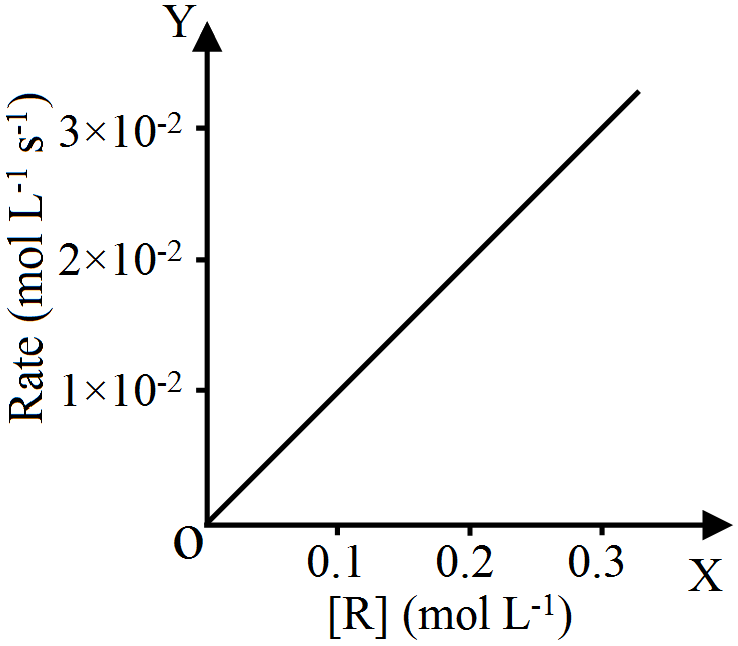
The rate for the reaction R→P is rate = k[R]. It has been shown graphically below. What is rate constant for the reaction?

Answer
From the graph:
Case I: Rate = k|A|
1 × 10-2 mol L-1 s-1 = k (0.1 mol L-1)
$\therefore \text{ k}=\frac{1\times10^{-2} \text{ mol L}^{-1}\text{s}^{-1}}{0.1\text{ mol L}^{-1}}=0.1\text{ s}^{-1}$
Case II:
3 × 10⁻² mol L-1 s-1 = k (0.3 mol L-1)
$ \text{ k}=\frac{3\times10^{-2} \text{ mol L}^{-1}\text{s}^{-1}}{0.3\text{ mol L}^{-1}}=0.1\text{ s}^{-1}$
Hence, K = 0.1 s-1.
View full question & answer
Question 273 Marks
In a reaction if the concentration of reactant A is tripled, the rate of reaction becomes twenty seven times. What is the order of the reaction?
Answer
The rate of reaction is directly proportional to the concentration of reactants.
Then acc to the information, if the reactant get tripled, then the rate becomes 27 times.
 3 × 3 × 3 = 27 times
It will be 3 power 3.
Order can be defined as the power that will be raised in the conc. of reactant in the rate law equation.
So, here the order will be 3, it’s a 3rd order reaction.
View full question & answer
Question 283 Marks
Rate constant k for first order reaction has been found to be 2.54 × 10⁻³ s-1. Calculate its three-fourth life.
Answer
$\text{t}=\frac{2.303}{\text{k}}\log \frac{\text{|R|}_0}{\text{|R|}}\dots(\text{i)}$
$\text{k}=2.54\times10^{-3}\text{s}^{-1};[\text{R}]=\frac{|R|}{4}$
Substituting these value in equation (i), we get
$\text{t}_{\frac{3}{4}}=\frac{2.303}{2.54\times10^{-3}}\log\frac{ \frac{\text{|R|}_0}{\text{|R|}_0}}{4}=0.9066\times10^3\log4$
$\text{t}_{\frac{3}{4}}=0.9066\times10^3\times0.6021\text{ s}=5.46\times10^2\text{s}.$
View full question & answer
Question 293 Marks
For a reaction $\text{A + B}\xrightarrow{\ \ \ \ \ }\text{Products},$ the rate law is - $\text{Rate}=\text{k}[\text{A}][\text{B}]^\frac{3}{2}$ Can the reaction be an elementary reaction? Explain.
Answer
During an elementary reaction, the number of atoms or ions colliding to react is referred to as molecularity. Had this been an elementary reaction the order of reaction with respect to B would have been 1, but in the given rate law it is $\frac{3}{2}.$ This indicates that the reaction is not an elementary reaction. Moreover for elementary reactions. the reaction order, the molecularity and the stoichiometric coefficient are the same, although only numerically, because they are different concept.
View full question & answer
Question 303 Marks
$^{238}_{92}\text{U}$ Change to $^{206}_{92}\text{Pb}$ by successive radioactive decay. A sample of urenium ore was anlaysed and found to contain 1.0 g of $^{238}\text{U}$ and 0.1 g of $^{206}\text{Pb}$ had accumulated due to decay of $^{238}\text{U}$, find out the age of ore. (Half- life of $^{238}\text{U}$$= 4.5\times10^9$ years).
Answer
[A]= Initial amount of $^{238}\text{U}$ = amount of $^{238}\text{U}$ left at time of $^{238}\text{U}$ decayed

[A]0 = 1.0 + amount of $^{238}\text{U}$ decayed

Now, amount of $^{238}\text{U}$ decayed $=\frac{1.0\times238}{206}\text{ g}=0.1155 {\text{ g}}$

$\therefore\text{ [A]}_0 = 1.0 \text{ g + 0.1155 g = 1.1155 g}$ 

Determination of k: $\text{k}=\frac{0.693}{\text{t}_{1/2}}=\frac{0.693}{4.5\times10^9}=0.154\times 10^{-9}\text{ year}^{-1}$

Determination of times: $\text{t}=\frac{2.303}{\text{k}}\log\frac{|\text{A}|_0}{|\text{A}|}$

Substituting the values of [A]0 = 1.1155 g and k $= 0.154\times10^{-9}\text{year}^{-1}$

$\text{t}= \frac{2.303}{0.154\times10^9} \log \frac{1.1155}{1}$

$=0.7099\times10^9 \text{ year}$

$=0.7099\times10^8 \text{ year}$

View full question & answer
Question 313 Marks
Match the items of Column I and Column II.
 
Column I
 
Column II
(i)
Diamond.
(a)
Short interval of time.
(ii)
Instantaneous rate.
(b)
Ordinarily rate of conversion is imperceptible.
(iii)
Average rate.
(c)
Long duration of time.
Answer
 
Column I
 
Column II
(i)
Diamond.
(b)
Ordinarily rate of conversion is imperceptible.
(ii)
Instantaneous rate.
(a)
Short interval of time.
(iii)
Average rate.
(c)
Long duration of time.

Explanation:

  1. Rate of conversion of diamond is imperceptible because it requires high activation energy.
  2. Instantaneous rate of a reaction is rate of a reaction at a particular moment of time.
  3. Average rate is obtained by dividing the change in concentration of any one of the reactant of product by the time taken for the change i.e. $\frac{\Delta\text{x}}{\Delta\text{t}}.$
View full question & answer
Question 323 Marks
A reaction is first order in A and second order in B.
  1. Write the differential rate equation.
  2. How is the rate affected on increasing the concentration of B three times?
  3. How is the rate affected when the concentrations of both A and B are doubled?
Answer
  1. Differential rate equation of reaction is

$\frac{\text{dx}}{\text{dt}}=\text{k}[\text{A}]^1[\text{B}]^2=\text{k}[\text{A}]\ [\text{B}]^2$

  1. When cone. of B is tripled, it means cone. of B becomes (3 × B)

$\therefore$ New rate of reaction,

$\frac{\text{dx'}}{\text{dt}}=\text{k}[\text{A}]\ [\text{3B}]^2=9\text{k}[\text{A}]\ [\text{B}]^2=\bigg(\frac{\text{dx}}{\text{dt}}\bigg)$

i.e., rate of reaction will become 9 times.

  1. When cone. of A is doubled and that of B is also doubled, then cone. of A becomes [2A] and that of B becomes [2B] rate of reaction,

$\frac{\text{dx''}}{\text{dt}}=\text{k}[\text{2A}]\ [\text{3B}]^2=8\text{k}[\text{A}]\ [\text{B}]^2$

i.e., the rate of reaction will become 8 times the rate as in (1).

View full question & answer
Question 333 Marks
Consider the decomposition of hydrogen peroxide in alkaline medium which is catalysed by iodide ions.
$\text{2H}_2\text{O}_2\xrightarrow{\text{OH}^-}2\text{H}_2\text{O}+\text{O}_2$
This reaction takes place in two step as given below:
Step-I $\text{H}_2\text{O}_2+\text{I}^-\rightarrow\text{H}_2\text{O}_2+\text{IO}^-\text{ (slow)}$
Step-II $\text{H}_2\text{O}_2+\text{IO}^-\rightarrow\text{H}_2\text{O}_2+\text{I}+\text{O}_2\text{ (fast})$
  1. Write the rate law expression and determine the order of reaction w.r.t. H2O2.
  2. What is the molecularity of each individual step?
Answer
  1. Rate = K[H2O2]1 [I-]1

Order of reaction w.r.t.H2O2 = 1.

  1. Molecularity of step I = 2 amd step II = 2.
View full question & answer
Question 343 Marks
Calculate the half-life of a first order reaction from their rate constants given below:
  1. 200 s–1
  2. 2 min–1
  3. 4 years–1
Answer
  1. $\text{Half life, t}_\frac{1}{2}=\frac{0.693}{\text{k}}$

$=\frac{0.693}{200\ \text{min}^{-1}}$

= 3.4 × 10-3 s(approximately)

  1. $\text{Half life, t}_\frac{1}{2}=\frac{0.693}{\text{k}}$

$=\frac{0.693}{2\ \text{min}^{-1}}$

= 0.35 min (approximately)

  1. $\text{Half life, t}_\frac{1}{2}=\frac{0.693}{\text{k}}$

$=\frac{0.693}{4\ \text{years}^{-1}}$

= 0.173 years (approximately)

View full question & answer
Question 353 Marks
In a reaction between A and B, the initial rate of reaction (r0) was measured for different initial concentrations of A and B as given below:
A/mol L-1 0.20 0.20 0.40
B/mol L-1 0.30 0.10 0.05
r0/mol L-1 s-1 5.07 × 10-5 5.07 × 10-5 1.43 × 10-4
What is the order of the reaction with respect to A and B?
Answer
In a reaction A and B, Let order of reaction w.r.t. A is x and w.r.t. B is y. Then the rate of reaction can be written as
rate = k[A]x [B]y
From given table data, 1 and 2 we can write
5.07 × 10-5 = k[10.20]x [0.30]y ....(i)
5.07 × 10-5 = k[0.20]x [0.10]y ....(ii)
Dividing (ii) by (i), we get
$\frac{5.07\times10^{-5}}{5.07\times10^{-5}}=\frac{\text{k}[0.20]^\text{x}\ [0.10]^\text{y}}{\text{k}[0.20]^\text{x}\ [0.30]^\text{y}}$
$\text{or}\ \ \ 1=\Big(\frac{0.10}{0.30}\Big)^\text{y}\ \text{or}\ \ \ \ \text{y}=0$
From given table data, 2 and 3 we can write
5.07 × 10-5 = k[0.20]x [0.20]y
$=\text{k}[0.20]^\text{y}\times1\ \ \ [\therefore\ \ \text{y}=1]\ ...\text{(iii)}$
7.06 × 10-5 = k[0.20]x [0.05]y
$=\text{k}[0.40]^\text{x}\times1\ \ ...(\text{iv})$
Dividing (iv) by (iii), we get
$\frac{5.07\times10^{-5}}{5.07\times10^{-5}}=\frac{\text{k}[0.20]^\text{x}}{\text{k}[0.20]^\text{x}}=\bigg[\frac{0.4}{0.2}\bigg]^\text{x}=(2)^2$
or (2)x = 3/2 = 1.5
or x = 0.5
Thus the order of reaction w.r.t. A is $\frac{1}{2}$ and w.r.t. B is zero.
View full question & answer
Question 363 Marks
The rate for the reaction R→P is rate = k[R]. It has been shown graphically below. What is rate constant for the reaction?

Answer
From the graph:
Case I: Rate = k|A|
1 × 10-2 mol L-1 s-1 = k (0.1 mol L-1)
$\therefore \text{ k}=\frac{1\times10^{-2} \text{ mol L}^{-1}\text{s}^{-1}}{0.1\text{ mol L}^{-1}}=0.1\text{ s}^{-1}$
Case II:
3 × 10⁻² mol L-1 s-1 = k (0.3 mol L-1)
$ \text{ k}=\frac{3\times10^{-2} \text{ mol L}^{-1}\text{s}^{-1}}{0.3\text{ mol L}^{-1}}=0.1\text{ s}^{-1}$
Hence, K = 0.1 s-1.
View full question & answer
Question 373 Marks
During nuclear explosion, one of the products is 90Sr with half-life of 28.1 years. If 1μg of 90Sr was absorbed in the bones of a newly born baby instead of calcium, how much of it will remain after 10 years and 60 years if it is not lost metabolically.
Answer
$\text{Here, k}=\frac{0.693}{\text{t}{1/2}}=\frac{0.693}{28.1}\text{y}^{-1}$
It is known that, $\text{t}=\frac{2.303}{\text{k}}\text{log}\frac{[\text{R}]_\circ}{\text{[R]}}$
$10=\frac{2.303}{\frac{0.693}{28.1}}\text{log}\frac{1}{\text{[R]}}$
$10=\frac{2.303}{\frac{0.693}{28.1}}(-\text{log[R])}$
$\text{log[R}]=-\frac{10\times0.693}{2.303\times28.1}$
[R] = anti log( 0.1071)
$=\text{anti log}(\bar{1}.8929)$
= 0.7814µg
Therefore, = 0.7814µg of 90Sr will remain after 10 years.
$\text{Again, t}=\frac{2.303}{\text{k}}\text{log}\frac{[\text{R}]_\circ}{\text{[R]}}$
$60=\frac{2.303}{\frac{0.693}{28.1}}\text{log}\frac{1}{\text{[R]}}$
$\text{log[R}]=-\frac{60\times0.693}{2.303\times28.1}$
[R] anti log(-0.6425)
$=\text{anti log}(\bar{1}.3575)$
= 0.2278µg
Therefore, 0.2278µg of 90Sr will remain after 60 years.
View full question & answer
Question 383 Marks
For the decomposition of azoisopropane to hexane and nitrogen at 543 K, the following data are obtained.
t (sec) P(mm of Hg)
0 35.0
360 54.0
720 63.0
Calculate the rate constant.
Answer
The decomposition of azoisopropane to hexane and nitrogen at 543 K is represented by the following equation.
$(\text{CH}_{3})_{2} \text{CHN = NCH ( CH}_{3})_{2\text{g}} \xrightarrow{\ \ \ \ \ \ \ \ \ \ \ \ \ \ \ }\text{N}_{2\text{(g})} + \text{C}_{6}\text{H}_{14\text{(g})}\\ \ \ \text{At t= 0 }\ \ \ \ \ \ \ \ \ \ \ \ \text{p}_{0} \ \ \ \ \ \ \ \ \ \ \ \ \ \ \ \ \ \ \ \ \ \ \ \ \ \ \ \ \ \ \ \ \ \ \ \ \ 0 \ \ \ \ \ \ \ \ \ \ \ \ 0 \\ \ \text{At t= 0 }\ \ \ \ \ \ \ \ \ \ \ \text{p}_{0-\text{p}}\ \ \ \ \ \ \ \ \ \ \ \ \ \ \ \ \ \ \ \ \ \ \ \ \ \ \ \ \ \ \ \ \ \ \ \text{p} \ \ \ \ \ \ \ \ \ \ \ \ \text{p}$
After time, t, total pressure, Pt = (P0 - p) + p + p
Pt = P0 + p
p = Pt - P0
Therefore, P0 - p = P0 - (Pt - P0)
= 2P0 - Pt
For a first order reaction,
$\text{k}=\frac{2.303}{\text{t}}\text{log}\frac{\text{P}_\circ}{\text{P}_\circ-\text{P}}$
$=\frac{2.303}{\text{t}}\text{log}\frac{\text{P}_\circ}{2\text{P}_\circ-\text{P}_\text{t}}$
$\text{When t}=360\ \text{s, k}=\frac{2.303}{360\ \text{s}}\text{log}\frac{35.0}{2\times35.0-54.0}$
= 2.175 × 10-3 s-1
$\text{When t}=720\ \text{s, k}=\frac{2.303}{720\ \text{s}}\text{log}\frac{35.0}{2\times35.0-63.0}$
View full question & answer
Question 393 Marks
Following reaction takes place in one step:
$\text{2NO(g)+O}_2\text{(g)}\rightarrow\text{2NO}_2\text{(g)}$
How will the rate of the above reaction change if the volume of the reaction vessel is reduced to one-third of its original volume? Will there be any change in the order of the reaction with reduced volume?
Answer
$\therefore$ Rate $=\text{k[NO]}^2[\text{O}_2]$
Let initially, moles of NO = a, moles of O= b, volume of vesse l= V.Then
$\text{[NO]}=\frac{\text{a}}{\text{V}}\text{M},[\text{O}_2]=\frac{\text{b}}{\text{V}}\text{M}$
Rate $\text{(r}_1)=\text{k}\bigg(\frac{\text{a}}{\text{V}}\bigg)^2\bigg(\frac{\text{b}}{\text{V}}\bigg)=\text{k}\frac{\text{a}^2\text{b}}{\text{V}^3}\dots(\text{i)}$ 
Now, new volume $=\frac{\text{V}}{3 }$
$\therefore$ New concentrations:$ [\text{NO]}=\frac{\text{a}}{\frac{\text{V}}{3}}=\frac{3}{\text{V}}$
$[\text{O}_2]= \frac{\text{b}}{\frac{\text{V}}{3}}=\frac{\text{3a}}{\text{V}}$
$\therefore$ New rate (r2)= $\text{k}\bigg(\frac{\text{3a}}{\text{V}}\bigg)^2\bigg(\frac{3\text{b}}{\text{V}}\bigg)= \frac{27\text{ka}^2\text{b}}{\text{V}^3}\dots \text{(ii)}$
 $\therefore \frac{\text{r}_2}{\text{r}_2}=27 \text{ or}\text{ r}_2=27\text { r}_1$,i.e., rate becomes 27 times.
Thus, there is no effact on the order of reaction.
View full question & answer
Question 403 Marks
The activation energy for the reaction,
2 HI(g) → H2 + I2(g)
is 209.5 kJ mol–1 at 581K. Calculate the fraction of molecules of reactants having energy equal to or greater than activation energy?
Answer
2HI (g) → H + I2 (g)
Activation energy, Ea = 209.5 kJ mol−1
Multiply by 1000 to convert in j
E= 209500 J mol−1
Temperature, T = 581 K
Gas constant, R = 8.314 JK−1 mol−1
According to Arhenious equation
K = A e–Ea/RT
In this formula term e–Ea/RT represent the number of molecules which have energy equal or more than activation energy,
Number of molecules = e–Ea/RT
Plug the values we get
Number of molecules
$=\text{e}-\frac{209500}{8.314\times581}$
= e-43.4
$=\frac{1}{\text{e}^{-43.4}}$
taking antilog of we get
= 1.47 x 10⁻¹⁹
View full question & answer
Question 413 Marks
For the reaction:
2A + B → A2B
The rate = k[A][B]2 with k = 2.0 × 10–6 mol–2 L2 s–1. Calculate the initial rate of the reaction when [A] = 0.1 mol L–1, [B] = 0.2 mol L–1. Calculate the rate of reaction after [A] is reduced to 0.06 mol L–1.
Answer
The initial rate of the reaction is
Rate= k[A][B]2
= (2.0 × 10-6 mol-2 L2 s-1)(0.1mol L-1)(0.2 mol L-1)2
= 8.0 × 10-9 mool-2 L2 s-1
When [A] is reduced from 0.1 mol L-1 to 0.06 mol-1, the concentration of A reacted
= (0.1 - 0.06) mol L-1 = 0.004 mol L-1
Therefore, concentration of B reacted $=\frac{1}{2}\times0.04\ \text{mol L}^{-1}-0.02\ \text{mol L}^{-1}$
Then, concentration of B available, [B] = (0.2 - 0.02) mol L-1
= 0.18 mol L-1
After [A] is reduced to 0.06 mol-1, the rate of the r euction is given by,
Rate = k[A][B]2
= (2.0 × 10-6 mol-2 L2 s-1)(0.06 mol L-1)(0.18 mol L-1)2
= 3.89 mol L-1 s-1
View full question & answer
Question 423 Marks
The rate constant for the decomposition of hydrocarbons is 2.418 × 10–5s–1 at 546 K. If the energy of activation is 179.9 kJ/mol, what will be the value of pre-exponential factor.
Answer
k =2.418 × 10-5 s-1
T = 546 K
Ea = 179.9kJ mol-1
= 179.9 × 103 J mol-1
According to the Arrhenius equation,
k = Ae-Ea/RT
$\text{In k}=\text{In A}-\frac{\text{E}_\text{a}}{\text{RT}}$
$\text{log k}=\text{log A}-\frac{\text{E}_\text{a}}{2.303\text{RT}}$
$\text{log A}=\text{log k}+\frac{\text{E}_\text{a}}{2.303\text{RT}}$
$=\text{log}(2.418\times10^{-5}\text{s}^{-1})+\frac{179.9\times10^3\text{J mol}^{-1}}{2.303\times8.314\text{Jk}^{-1}\text{mol}^{-1}\times546\text{K}}$
= (0.3835 - 5) + 17.2082
= 12.5917
Therefore, A = antilog (12.5917)
= 3.9 × 10¹² s−1  (approximately)
View full question & answer
Question 433 Marks
Explain the difference between instantaneous rate of a reaction and average rate of a reaction.
Answer
Average rate of a reaction is the change in concentration of reactants or products and the time taken for that change to occur.
Average rate $=-\frac{\Delta[\text{R}]}{\Delta\text{t}}=+\frac{\Delta[\text{P}]}{\Delta\text{t}}$
It occurs for a long interval of time. It can be determined for multistep as well as elementary reactions.
Instantaneous rate is obtained when we consider the average rate at the smallest time interval dt (i.e., when $\Delta\text{t}$ approaches zero). Hence, for an infinitesimally small dt intantaneous rate is given by:
Intantaneous rate $=-\frac{\text{d[R]}}{\text{dt}}=+\frac{\text{d[P]}}{\text{dt}}$
It occurs for a short span of time.
It cannot be determined for multistep and elementry reaction.
View full question & answer
Question 443 Marks
For a first order reaction, show that time required for 99% completion is twice the time required for the completion of 90% of reaction.
Answer
For a first order reaction, the time required for 99% completion is
$\text{t}_1=\frac{2.303}{\text{k}}\text{log}\frac{100}{100-99}$
$=\frac{2.303}{\text{k}}\text{log}{100}$
$=2\times\frac{2.303}{\text{k}}$
For a first order reaction, the time required for 90% completion is
$\text{t}_2=\frac{2.303}{\text{k}}\text{log}\frac{100}{100-99}$
$=\frac{2.303}{\text{k}}\text{log}{10}$
$=\frac{2.303}{\text{k}}$
Therefore, t1 = 2t2
Hence, the time required for 99% completion of a first order reaction is twice the time required for the completion of 90% of the reaction.
View full question & answer
Question 453 Marks
The decomposition of A into product has value of k as 4.5 × 10³ s–1 at 10°C and energy of activation 60 kJ mol–1. At what temperature would k be 1.5 × 104s–1?
Answer
From Arrhenius equation, we obtain $\text{log}\frac{\text{k}_2}{\text{k}_1}=\frac{\text{E}_\text{a}}{2.303\text{R}}\bigg(\frac{\text{T}_2-\text{T}_1}{\text{T}_1\text{T}_2}\bigg)$
Also, k1 = 4.5 × 103 s-1
T1 = 273 + 10 = 283 K
k2 = 1.5 × 104 s-1
Ea = 60 kJ mol-1 = 6.0 × 104 J mol-1
$\text{Then, log}\frac{1.5\times10^4}{4.5\times10^3}=\frac{6.0\times10^4\text{Jmol}^{-1}}{2.303\times8.314\ \text{JK}^{-1}\text{mol}^{-1}}\bigg(\frac{\text{T}_2-283}{283\text{T}_2}\bigg)$
0.5229 = 3133.6279 $\bigg(\frac{\text{T}_2-283}{283\text{T}_2}\bigg)$
$\frac{0.5229\times283\text{T}_2}{3133.627}=\text{T}_2-283$
0.0472 T2 = T2 - 283
0.9528T2 = 283
T2 297.019 K (approximately)
= 297 K
= 24°C
Hence, k would be 1.5 × 104 s-1 at 24°C.
View full question & answer
Question 463 Marks
The reaction between A and B is first order with respect to A and zero order with respect to B. Fill in the blanks in the following table:
Experiment [A]/mol L-1 [B]/mol L-1 Initial rate/mol L-1 min-1
I 0.1 0.1 2.0 × 10-2
II - 0.2 4.0 × 10-2
III 0.4 0.4 -
IV - 0.2 2.0 × 10-2
Answer
The given reaction is of the first order with respect to A and of zero order with respect to B.
Therefore, the rate of the reaction is given by,
Rate = k[A]1 [B]0
Rate = k[A]
From experiment I, we obtain
2.0 × 10-2 mol L-1 min-1 = k(0.1 mol L-1)
k = 0.2 min-1
From experiment II, we obtain
4.0 × 10-2 mol L-1 min-1 = 0.2 min-1 [A]
[A] = 0.2 mol L-1
From experiment III, we obtain
Rate = 0.2 min-1 × 0.4 mol L-1
= 0.08 mol L-1 min-1
From experiment IV, we obtain
2.0 × 10-2 mol L-1 min-1 = 0.2 min-1[A]
[A] = 0.1 mol L-1
View full question & answer
Question 473 Marks
The following data were obtained during the first order thermal decomposition of SO2Cl2 at a constant volume.
SO2Cl2 (g) → SO2 (g) + Cl2 (g)
Experiment Time/s-1 Total pressure/atm
1 0 0.5
2 100 0.6
Calculate the rate of the reaction when total pressure is 0.65 atm.
Answer
The thermal decomposition of SO2Cl2 at a constant volume is represented by the following equation.
$\ \ \ \ \ \ \ \ \ \ \ \ \ \ \text{SO}_{2}\text{Cl}_{2}\text{(g)} \xrightarrow{\ \ \ \ \ \ \ \ \ \ \ \ \ \ \ }\text{SO}_{2\text{(g})} + \text{Cl}_{2\text{(g)}}\\ \ \ \text{At t= 0 }\ \ \ \ \ \ \ \ \ \ \ \ \text{p}_{0} \ \ \ \ \ \ \ \ \ \ \ \ \ \ \ \ \ \ \ \ 0 \ \ \ \ \ \ \ \ \ \ \ \ 0\ \ \ \\ \ \ \ \ \ \ \ \ \ \\ \text{At t= 0 }\ \ \ \ \ \ \ \ \ \ \ \ \text{p}_{0-\text{p}}\ \ \  \ \ \ \text{p} \ \ \ \ \ \ \ \ \ \ \ \ \ \text{p}\ \ $
After time, t, total pressure, Pt = (P0 - p) + p + p
Pt = P0 + p
p =Pt - P0
Therefore,
P0 - p = P0 - (Pt - P0)
= 2P0 - Pt
For a first order reaction,
$\text{k}=\frac{2.303}{\text{t}}\text{log}\frac{\text{P}_\circ}{\text{P}_\circ-\text{p}}$
$=\frac{2.303}{\text{t}}\text{log}\frac{\text{P}_\circ}{2\text{P}_\circ-\text{p}_\text{t}}$
$\text{When t}=100\ \text{s, k}=\frac{2.303}{100\ \text{s}}\text{log}\frac{0.5}{2\times0.5-0.6}$
= 2.231 × 10-3 s-1
When Pt = 0.65 atm,
P0 + p = 0.65
p = 0.65 - P0
= 0.65 - 0.5
= 0.15 atm
Therefore, when the total pressure is 0.65 atm, pressure of SOCl2 is
PSOCl2 = P0 - p
= 0.5 - 0.15
= 0.35 atm
Therefore, the rate of equation, when total pressure is 0.65 atm, is given by,
Rate = k(PSOCl2)
= (2.23 × 10-3 s-1)(0.35 atm)
= 7.8 × 10-4 atm s-1
View full question & answer
Question 483 Marks
Sucrose decomposes in acid solution into glucose and fructose according to the first order rate law, with t1/2 = 3.00 hours. What fraction of sample of sucrose remains after 8 hours?
Answer
For a first order reaction, k $=\frac{2.303}{\text{t}}\text{log}\frac{\text{[R]}_0}{\text{[R]}}$
It is given that, t1/2 = 3.00 hours
$\text{Therefore, k}=\frac{0.693}{\text{t}_{1/2}}$
$=\frac{0.693}{3}\text{h}^{-1}$
= 0.231 h-1
$\text{Then},0.231\text{h}^{-1}=\frac{2.303}{\text{8h}}\text{log}\frac{\text{[R]}_0}{\text{[R]}}$
$=\text{log}\frac{\text{[R]}_0}{\text{[R]}}=\frac{0.231\ \text{h}^{-1}\times8\text{h}}{\text{2.303}}$
$\frac{\text{[R]}_0}{\text{[R]}}=\text{anti log}(0.8024)$
$\frac{\text{[R]}_0}{\text{[R]}}=6.3445$
$\frac{\text{[R]}_0}{\text{[R]}}=0.1576\ (\text{approx})$
= 0.158
Hence, the fraction of sample of sucrose that remains after 8 hours is 0.158.
View full question & answer
Question 493 Marks
After 24 hrs. Only 0.125gm out of the initial quantity of 1gm of a radioactive isotope remains behind. What is its half life period?
Answer
$\text{Here, [R]}_0 =\text{ g, [R]} = 0.125\text{g, t = 24h.}$

$\text{k}=\frac{2.303}{\text{t}}\log\frac{|\text{R|}_0}{\text{|R|}} $

$\text{k}=\frac{2.303}{24}\log\frac{1}{0.125}$

$\text{k}=\frac{2.303}{24}\log8$

$\text{k}=\frac{2.303}{24}\times0.9031$

$\text{k}=0.866 \text{ h}^{-1}$

$\text{t}_{\frac{1}{2}}=\frac{0.693}{\text{k}}$

$\text{t}_{\frac{1}{2}}=\frac{0.693}{0.0866\text{ h}^{-1}}\text{ or t}_{\frac{1}{2}}=8\text{ h}.$

View full question & answer
Question 503 Marks
The following data were obtained during the first order thermal decomposition of N2O5(g) at a constant volume:
2N2O5(g) → 2N2O4(g) + O2(g)
S. No. Time/s Total pressure/atm
1. 0 0.5
2. 100 0.512
Calculate the rate constant.
Answer
Let the pressure of N2O5(g) decrease by 2x atm. As two moles of N2O5 decompose to give two moles of N2O4(g) and one mole of O2(g), the pressure of N2O4(g) increases by 2x atm and that of O2(g) increases by x atm.

2N2O5(g) → 2N2O4(g) + O2(g)
At t= 0 0.5 atm 0 atm 0 atm
At time t (0.5 - 2x) atm 2xatm Xatm

 $\text{p}_\text{t}=\text{PN}_2\text{O}_5+\text{PN}_2\text{O}_4+\text{PO}_2$

$=(0.5-2\text{x})+2\text{x}+\text{x}=0.5+\text{x}$

$\text{x}=\text{p}_\text{t}-0.5$

$\text{PN}_2\text{O}_5=0.5-2\text{x}=0.5-2(\text{p}_\text{t}-0.5)=1.5-2\text{p}_\text{t}$

$= (0.5 – 2 \text{x}) + 2 \text{x} + \text{x} = 0.5 + \text{x}$

$\text{x = pt} – 0.5$

$\text{PN}_2\text{O}_5=0.5-2\text{x}=0.5-2(\text{p}_\text{t}-0.5)=1.5-2\text{p}_\text{t}$

$\text{At t}=100\text{ s};\text{p}_\text{t}=0.512\text{ atm},$

$\text{PN}_2\text{O}_5=1.5-2\times0.512=0.476\text{ atm}$

Thus, $\text{k}=\frac{2.303}{\text{t}}\log\frac{\text{p}_\text{i}}{\text{p}_\text{A}}$

$=\frac{2.303}{100\text{ s}}\log\frac{0.5\text{ atm}}{0.476\text{ atm}}$

$=\frac{2.303}{100\text{ s}}\times0.0216=4.98\times10^{-4}\text{s}^{-1}$

View full question & answer
3 Marks Question - Chemistry STD 12 Science Questions - Vidyadip