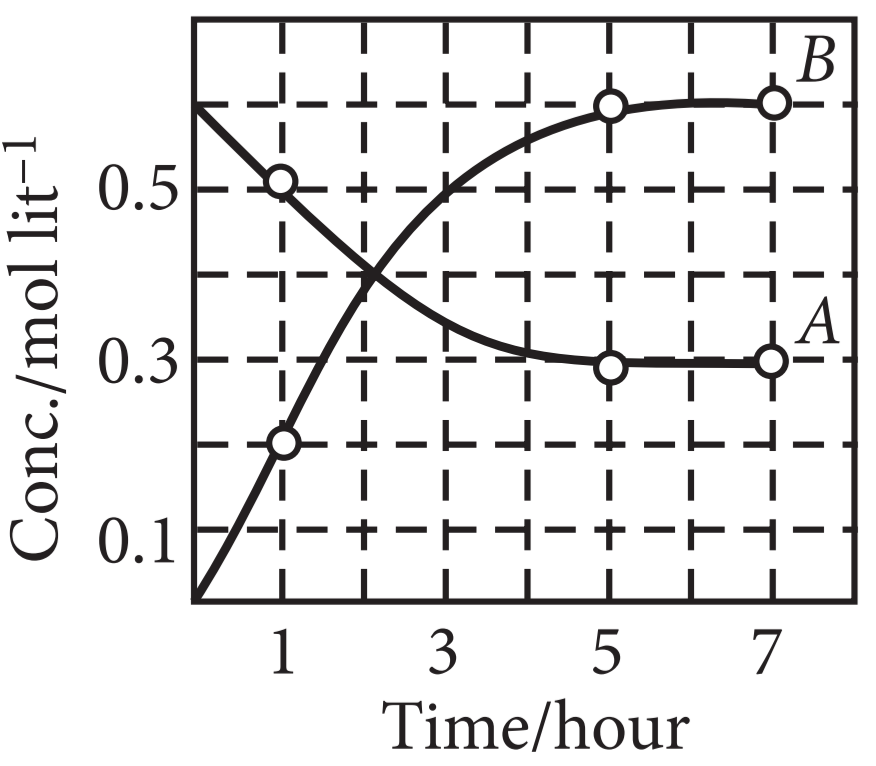
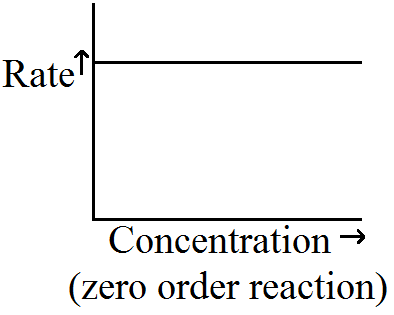
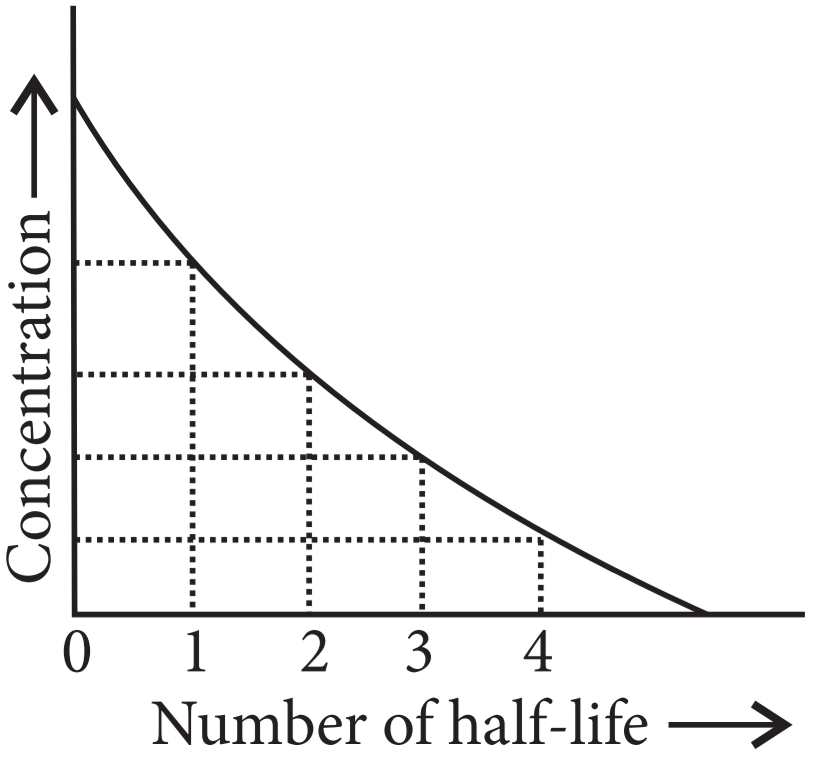
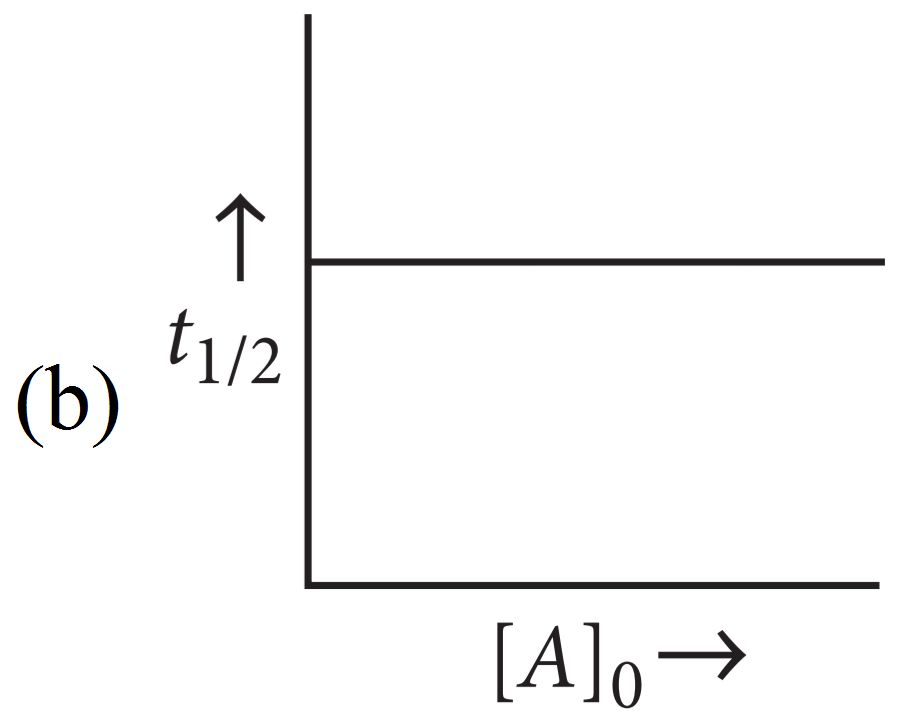
- Instantaneous rate of reaction: Rate of change of concentration of reactant or product at a particular time is called instantaneous rate of reaction.
$\text{r}_\text{inst.}=\frac{\text{dC}}{\text{dt}}$
where, dC = infinitely small change in concentration
dt = infinitely small change in time.
- Average rate of reaction: Ratio of change in concentration and time required for the change is average rate of reaction.
$\text{r}_\text{av}=\frac{\triangle\text{x}}{\triangle\text{t}}=\frac{\text{Change in concentration}}{\text{Time required for the change}}$
For a reaction of the type, m1A + m2B → n1C + n2D
Rate of reaction is given as
$\frac{1}{\text{m}_1}\frac{\text{d[A]}}{\text{dt}}=-\frac{1}{\text{m}_2}\frac{\text{d[B]}}{\text{dt}}=+\frac{1}{\text{n}_1}\frac{\text{d[C]}}{\text{dt}}=+\frac{1}{\text{n}_2}\frac{\text{d[D]}}{\text{dt}}$
In these questions (Q. No. i-iv), a statement of assertion followed by a statement ofreason is given. Choose the correct answer out of the following choices.
- Assertion and reason both are correct statements and reason is correct explanation for assertion.
- Assertion and reason both are correct statements but reason is not correct explanation for assertion.
- Assertion is correct statement but reason is wrong statement.
- Assertion is wrong statement but reason is correct statement.
- Assertion: The kinetics of the reaction, $\text{mA}+\text{nB}+\text{pC}\rightarrow\text{m}'\text{ X}+\text{n}'\text{ Y}+\text{p}'\text{ Z}$ obey the rate expression as $\frac{\text{dx}}{\text{dt}}=\text{k}[\text{A}]^\text{m}[\text{B}]^\text{n}.$
Reason: The rate of the reaction does not depend upon the concentration of C.
- Assertion: Instantaneous rate of reaction is equal to $\frac{\text{dx}}{\text{dt}}.$
Reason: lt is the rate of reaction at any particular instant of time.
- Assertion: For the reaction, $\text{RCl}+\text{NaOH}\rightarrow\text{ROH}+\text{NaCl},$ the rate of reaction is reduced to half on reducing the concentration of RCl to half.
Reason: The rate of reaction is represented by k[RCl].
- Assertion: ln rate law, unlike in the expression for equilibrium constants, the exponents for concentrations do not necessarily match the stoichiometric coefficients.
Reason: It is the mechanism and not the balanced chemical equation for the overall change that governs the reaction rate.
- Assertion: ln a reaction, 2A + B → A2B, the reactant B will disappear at twice the rate as A will decrease.
Reason: The rate of disappearance of reactant will be $-\frac{1}{2}\frac{\text{d[A]}}{\text{dt}}=-\frac{\text{d[B]}}{\text{dt}}$
- (a) Assertion and reason both are correct statements and reason is correct explanation for assertion.
Explanation:
Rate expression $\frac{\text{dx}}{\text{dt}}=\text{k}[\text{A}]^\text{m}[\text{B}]^\text{n}$
shows that the total order of reactions is m + n + 0 = m + n, as the rate of reaction is independent of concentration of C, i.e., the order with respect to C is zero. This is the reason that C does not figure in the rate expression.
- (b) Assertion and reason both are correct statements but reason is not correct explanation for assertion.
Explanation:
Instantaneous rate of a reaction is equal to small change in concentration (dx) during a small interval of time (dt) at that particular instant of time divided by the time interval.
- (a) Assertion and reason both are correct statements and reason is correct explanation for assertion.
Explanation:
For the given reaction, rate of reaction (r) = k[RCl] (where k is rate constant). Therefore if the concentration of [RCl] is reduced to half, then new rate $(\text{r}')=\frac{\text{k}}{2}[\text{RCl}].$
- (a) Assertion and reason both are correct statements and reason is correct explanation for assertion.
- (d) Assertion is wrong statement but reason is correct statement.
Explanation:
2A + B → A2B
The rate of disappearance of reactant will be
$-\frac{1}{2}\frac{\text{d[A]}}{\text{dt}}=\frac{\text{d[B]}}{\text{dt}}=\frac{\text{d}[\text{A}_2\text{B}]}{\text{dt}}$
Therefore, the reactant B will disappear at half the rate as A will decrease.