Questions

4 Marks Questions

🎯

Test yourself on this topic

3 questions · timed · auto-graded

Question 14 Marks
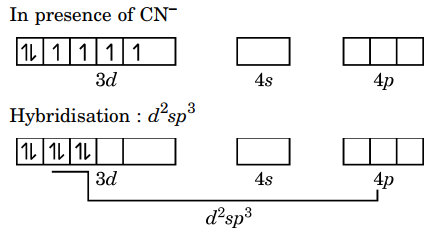
(a) For the complex $\left[ Fe ( CN )_6\right]^{4-}$, write the hybridization magnetic character and spin type of the complex. [At. Number : Fe $=26$ ]
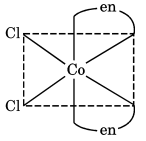
(b) Draw one of the geometrical isomers of the complex $\left.Co ( en )_2 Cl _2\right]^{+}$which is optically active.
View full question & answer
Question 24 Marks
What are ligands? Classify them with examples ?
Answer
Ligands : Neutral molecules or ionc (generally aminos) bonded to central metal atom or ion against normal valency rules in a complex or coordinate compounds are called ligands. They are classified as :
(i) Uni or monodentate : Only one atom of the ligand acts as donor e.g. $CH ^{-}, NH _3$ etc.
(ii) Di or bidentate : Two atoms of the ligand act as donor e.g. $H _2 N- CH _2- CH _2- NH _2$ etc.
(iii) Tridentate : Three atoms of the ligand act as donor e.g. $H _2 N- CH _2- CH _2- NH - CH _2- CH _2- NH _2$ etc.
In the same way tetra, penta, hexa dentate ligands are possible.
(iv) Ambideatate : Ligands having two donor atoms but using only one donor atom according to need are called ambidentate ligands e.g. $NO _2^{\overline{2}}$ can use only one donor atom N or O according to need, hence called ambidentate legand.
View full question & answer
Question 34 Marks
Account for the following statements:
(i) Co(II) is stable in aqueous solution but in the presence of strong ligands and air it can get oxidised to Co(III).
(ii) $[Ni(CN)_{4}]^{2-}$ is square planar and diamagnetic whereas $[NiCl_{4}]^{2-}$ is tetrahedral and paramagnetic.
Answer
(i) Co (II) has the configuration $3 d^7$ i.e., it has three unpaired electrons. Water being a weak ligand, the unpaired electrons do not pair up. In the presence of strong ligands and air, two unpaired electrons in $3 d$ pair up and the third unpaired electron shifts to higher energy sub-shell from where it can be easily lost and hence shows an oxidation state of III.
(ii) In $\left[ Ni ( CN )_4\right]^{2-}, CN ^{-}$is a strong ligand and cause pairing of electrons. So, it form $d s p^2$ hybridisation and acquire square planar shape and diamagnetic due to non-availability of unpaired electrons.
In $\left[ NiCl _4\right]^{2-}, Cl ^{-}$has weak ligand field so, it will not cause pairing of electrons and due to availability of unpaired electrons it is paramagnetic in nature. Since, it forms $s p^3$ hybridisation. So, it will have tetrahedral shape.
View full question & answer
4 Marks Questions - Chemistry STD 12 Science Questions - Vidyadip