Questions · Page 1 of 4

M.C.Q [1M]

🎯

Test yourself on this topic

50 questions · timed · auto-graded

MCQ 21 Mark
What will be the no of halide ions in the complex $\left[ Pt ( NH )_3 Cl _2 Br \right] Cl -$
  • A
    4
  • B
    3
  • C
    2
  • 1
Answer
Correct option: D.
1
D
View full question & answer
MCQ 31 Mark
Pair of compounds which is planar:
  • A
    [Ni(CN)4​]−4, [PtCl4​]−2
  • B
    [NiCl4​]−2, [Ni(CN)4​]−4
  • C
    [Ni(CN)4​​]−4, [Rh(CO)2​(PPh3​)2​]+
  • D
    [PtCl4​]−2, [Ni(CN)4​]−4
Answer
  1. [Ni(CN)4​​]−4, [Rh(CO)2​(PPh3​)2​]+
View full question & answer
MCQ 41 Mark
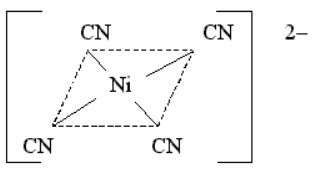
The geometry of [Ni(CN)4​]2− is:
  • A
    Tetrahedral
  • B
    Square planar
  • C
    Triangular
  • D
    Octahedral
Answer
  1. Square planar

Explanation:

The geometry of [Ni(CN)4​]2− is square planar as shown in the image.
View full question & answer
MCQ 51 Mark
What is the angle between any two bonds in methane molecule?
  • A
    105°54′
  • B
    109°28′
  • C
    119°28′
  • D
    190°28′
Answer
  1. 109°28′

Explanation:

The angle between any two bonds to the central carbon atom in the methane molecule is 109°28′. The molecule of methane has a tetrahedral geometry.

View full question & answer
MCQ 61 Mark
Number of stereoisomer's possible for coordination complex Na[Cr(en)Cl2​Br2​] is:
  • A
    2
  • B
    3
  • C
    4
  • D
    5
Answer
  1. 4

Explanation:

There are four stereoisomers are possible for the given coordination compound.

View full question & answer
MCQ 71 Mark
Copper sulphate dissolves in ammonia due to the formation of:
  • A
    Cu2​O
  • B
    [Cu(NH3​)4​]SO4​
  • C
    [Cu(NH3​)4​]OH
  • D
    [Cu(H2​O)4​]SO4​
Answer
  1. [Cu(NH3​)4​]SO4​

Explanation:

Copper sulphate dissolves in ammonia due to the formation of [Cu(NH3​)4​]SO4​.

CuSO4 + 4NH3 ​→ [Cu(NH3​)4​]SO4

[Cu(NH3​)4​]SO4​ contains complex cation [Cu(NH3​)4​]2+.

View full question & answer
MCQ 81 Mark
Consider the coordination compound, K2​[Cu(CN)4​]. A coordinate covalent bond exists between:
  • A
    Kand CN
  • B
    Cu2+ and CN
  • C
    Kand Cu(CN)4
  • D
    C and N in CN
Answer
  1. Cu2+ and CN

Explanation:

The coordinate covalent bond exists between the central metal and ligand. In K2​[Cu(CN)4​] ex the coordinate bond exists between Cu2+ and CN.

View full question & answer
MCQ 91 Mark
True structure is predicted by:
  • A
    Valence bond approach
  • B
    Sidgwick approach
  • C
    Hybrid orbital formation
  • D
    None of the above
Answer
  1. Hybrid orbital formation

Explanation:

Hybrid formation was introduced to explain molecular structure when the other theories failed to correctly predict them.

View full question & answer
MCQ 101 Mark
The correct IUPAC name of Mn3​(CO)12​ is:
  • A
    Mangesedodecylcarbonyl(0)
  • B
    Dodecacarbonylmanganate(0)
  • C
    Dodecacarbonylmanganic(II)
  • D
    Dodecacarbonyltrimanganese(0)
Answer
  1. Dodecacarbonyltrimanganese(0)

Explanation:

The correct IUPAC name of Mn3​(CO)12​ is dodecacarbonyltrimanganese(0). The central metal atom is a cobalt atom in zero oxidation state. The oxidation state is written in parenthesis.

Three such Mn atoms are present. Hence, the prefix tri is used. 12 carbonyl groups are present. Hence, the prefix dodeca is used.

View full question & answer
MCQ 111 Mark
What is the oxidation number of gold in the complex [AuCl4​]1−?
  • A
    +4
  • B
    +3
  • C
    +2
  • D
    +1
Answer
  1. +3

Explanation:

Oxidation state of chlorine Cl is −1.

Let the oxidation number of gold Au be x.

∴ x + 4 × (−1) = −1
⟹ x = +3
Thus oxidation number of gold is +3.

View full question & answer
MCQ 121 Mark
Which of the following statement is correct?
  • A
    Energy difference should be more between orbitals which undergo hybridization.
  • B
    Number of hybrid orbitals formed should be same as the number of atomic orbitals involved in hybridization.
  • C
    Hybrid orbitals arrange around the center of the atom unsymmetrically.
  • D
    Hybrid orbitals can form π bonds.
Answer
  1. Number of hybrid orbitals formed should be same as the number of atomic orbitals involved in hybridization.

Explanation:

Number of hybrid orbitals formed is equal to number of atomic orbitals involved in hybridisation. $\pi$ bonds will be formed always by pure orbitals (p or d orbitals). Hybrid orbitals arrange around the centre of atom gymmetrically depending on number of bond pairs and lone pairs.

View full question & answer
MCQ 131 Mark
Developed photography film is due to:
  • A
    AgBr
  • B
    [Ag(​S2O3​)2​]3+
  • C
    Ag
  • D
    Ag2​O
Answer
  1. Ag

Explanation:

The developed photography film is due to Ag.

The treatment of the exposed photgraphic film with reducing agent is called developing of the film.

A developer is usually an alkaline solution of hydroquinone or alkaline solution of pyrogallol.

The pairs activated by light are reduced to deposit more of black silver.

View full question & answer
MCQ 141 Mark
When 1mol CrCl3⋅6H2O is treated with excess of AgNO3, 3mol of AgCl are obtained. The formula of the complex is:
  • A
    [CrCl3(H2O)3]⋅3H2O
  • B
    [CrCl2(H2O)4]Cl⋅2H2O
  • C
    [CrCl(H2O)5]Cl2⋅H2O
  • D
    [Cr(H2O)6]Cl3
Answer
  1. [Cr(H2O)6]Cl3

Explanation:

One mol of AgCl is precipitated by one mole of Cl- ion, therefore three moles of AgCl would get precipitared by three moles of chloride ions, Cl- and, in this case 3Cl- are present in ionization sphere (i.e. outside the coordination sphere) in complex at (iv), therefore when 1mol of it is treated with excess of this complex 3mols of AgCl is precipitated. This satisfies the formula of the complex at (iv).

View full question & answer
MCQ 151 Mark
Which element is not present in chlorophyll?
  • A
    Carbon
  • B
    Calcium
  • C
    Magnesium
  • D
    Hydrogen
Answer
  1. Calcium

Explanation:

In chlorophyll the central ion is magnesium, and the large organic molecule is a porphyrin. The porphyrin contains four nitrogen atoms that form bonds to magnesium in a square planar arrangement. There are several forms of chlorophyll.

So, an element not present in chlorophyll is calcium.

View full question & answer
MCQ 161 Mark
Which is a coordination compund?
  • A
    Ferrous ammonium sulphate
  • B
    Carnallite
  • C
    Potassium ferrocyanide
  • D
    Gypsum
Answer
  1. Potassium ferrocyanide

Explanation:

Only 'Potassium ferrocyanide' (i.e. [Fe(CN)5​] ) shows properties of coordination compound.

When it gets dissolve they do not form simple ion like Fe+2 or CN, but instead their complex ions remain intact.

whereas carnallite (i.e. KMgCl3​ ), Gypsum (i.e. CaSO4​) and Ferrous ammonium sulphate (i.e. (NH4​)2​Fe(SO4​)2​ ) they dissovle and give simple ions.

View full question & answer
MCQ 171 Mark
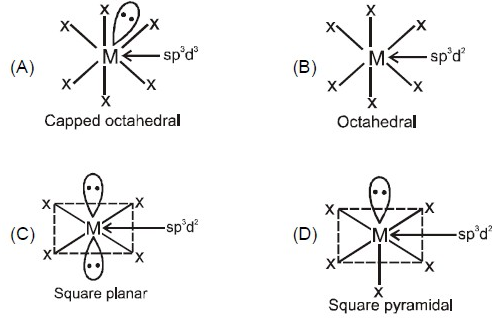
Which one of the following molecular geometries (i.e. shapes) is not possible for the sp3d2 hybridization?
  • A
    Capped octahedral
  • B
    Octahedral
  • C
    Square planar
  • D
    Square pyramidal
Answer
  1. Capped octahedral

Explanation:


View full question & answer
MCQ 181 Mark
Select the correct IUPAC name for [FeF4​(OH2​)2​].
  • A
    Diaquatetrafluoroiron(III) ion
  • B
    Diaquatetrafluoroferrate(III) ion
  • C
    Diaquatetrafluoroiron(I) ion
  • D
    Diaquatetrafluoroferrate(I) ion
Answer
  1. Diaquatetrafluoroferrate(III) ion

Explanation:

In [FeF4​(OH2​)2​] the oxidation state of iron is +3 so correct IUPAC name is diaquatetrafluoroferrate(III) ion.

View full question & answer
MCQ 191 Mark
Iron carbonyl, Fe(CO)5​ is __________.
  • A
    Trinuclear
  • B
    Tetranuclear
  • C
    Dinuclear
  • D
    Mononuclear
Answer
  1. Mononuclear

Explanation:

Iron carbonyl, Fe(CO)5​ is mononuclear. In Fe(CO)5​, one Fe atom is surrounded by 5 CO ligands. Mononuclear complexes are those complexes in which one metal atom/ion is surrounded by ligands.

View full question & answer
MCQ 201 Mark
The formula of prussian blue is:
  • A
    Na4​[Fe(CN)6​]
  • B
    Fe(CN)2​
  • C
    Fe(CNS)3​
  • D
    Fe4​[Fe(CN)6​]3
Answer
  1. Fe4​[Fe(CN)6​]3

Explanation:

Ferric ferrocyanide / Potassium ferrocyanide / Sodium ferrocyanide is prussian blue. 

Fe4​[Fe(CN)6​]3

View full question & answer
MCQ 211 Mark
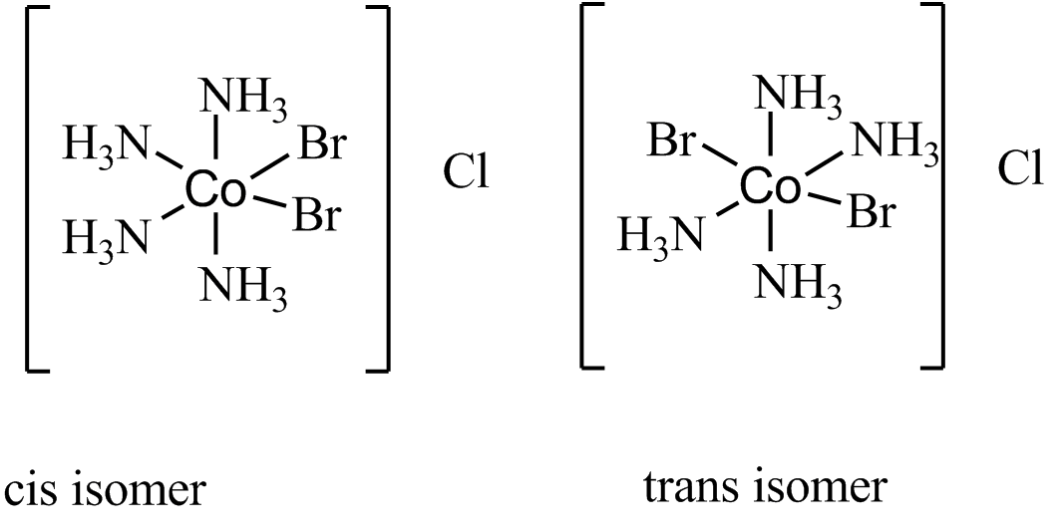
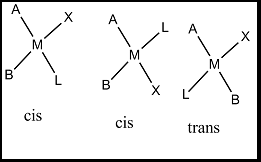
Square planar complex of the type MAXBL (where A, B, X and L are unidentate ligands) shows following set of isomers.
  • A
    Two cis and one trans
  • B
    Two trans and one cis
  • C
    Two cis and two trans
  • D
    Three cis and one trans
Answer
  1. Two cis and one trans

Explanation:

Square planar complex of the type MAXBL (where A, B, X, and L are unidentate ligands) shows two cis and one trans isomer as shown in the image.
View full question & answer
MCQ 221 Mark
According to Werner’s theory of valency, transition metals possess:
  • A
    Only one type of valency
  • B
    Two types of valencies
  • C
    Three types of valencies
  • D
    Four types of valencies
Answer
  1. Two types of valencies

Explanation:

According to Werner’s theory of valence, transition metals has two valencies are primary valencies and secondary valency.

The primary valency relates to the oxidation state and the secondary valency relates to the coordination number or it is the number of ligands attached to metal ions.

View full question & answer
MCQ 231 Mark
Which of the following complexes exists in facial and meridional forms? 
  • A
    K[Cr(H2​O)2​(C2​O4​)2​]
  • B
    [Co(NH)3​(NO2​)3​]
  • C
    [Co(NH3​)5​(NO2​)](NO3​)2​
  • D
    [Pt(NH3​)(H2​O)Cl2​]
Answer
  1. [Co(NH)3​(NO2​)3​]
View full question & answer
MCQ 241 Mark
The properties of a compound are:
  • A
    Similar to the properties of its constituents.
  • B
    Similar to the properties of one of the constituents.
  • C
    Different from the properties of its constituents.
  • D
    None of these
Answer
  1. Different from the properties of its constituents

Explanation:

A compound is a substance formed when two or more chemical elements are chemically bonded together. The elements in any compound are always present in fixed ratios. 

Example: Pure methane is a compound made from two elements - carbon and hydrogen. The ration of hydrogen to carbon in methane is always 4:1. The properties of a compound are different from the properties of its constituents.

View full question & answer
MCQ 251 Mark
In calcium fluoride, having the fluorite structure, the coordination numbers for calcium ion (Ca2+) and fluoride ion (F) are:
  • A
    8 and 4
  • B
    4 and 8
  • C
    4 and 2
  • D
    6 and 6
Answer
  1. 8 and 4

Explanation:

Calcium fluoride crystallizes in a Face-Centered Cubic unit cell (FCC) having an edge length of 5.463 Angstroms.

The cell is displayed here with calcium cations (in blue) defining FCC lattice sites, and fluoride anions (in green) occupying all tetrahedral sites.

Fluoride anions have 4 neighbors of opposite charge arranged at vertices of an tetrahedron. Calcium cations have EIGHT neighbors of opposite charge arrange at corners that outline a smaller cube.

So the Ca: F coordination ratio is 8 : 4 or 2 : 1.

In 4CaF2​ the the co ordination number of Ca+2 is 8 F is 4.

View full question & answer
MCQ 261 Mark
Among the following coordination compounds, the one giving a white precipitate with BaCl2​ solution is:
  • A
    [Cr(H2​O)5​Br]SO4​
  • B
    [Cr(H2​O)5​SCN]
  • C
    [Co(NH3​)5​SO4​]Br
  • D
    [Pt(NH3​)6​]Cl4
Answer
  1. [Cr(H2​O)5​Br]SO4​

Explanation:

Among the following coordination compounds, the one giving a white precipitate with BaCl2​ solution is [Cr(H2​O)5​Br]SO4​.

It dissociates in aqueous solution to give sulphate ions. Sulphate ions react with barium chloride to form a white precipitate of barium sulphate.

View full question & answer
MCQ 271 Mark
Which compound is formed when excess of KCN is added to an aqueous solution of copper sulphate?
  • A
    Cu(CN)2​
  • B
    K2​[Cu(CN)2​]
  • C
    K[Cu(CN)2​]
  • D
    K3​[Cu(CN)4​]
Answer
  1. K3​[Cu(CN)4​]

Explanation:

When excess of KCN is added to an aqueous solution of CuSO4​ then-

Initially, cupric cyanide is formed, Cu(CN)2​.

CuSO4​ + 2KCN → K2​CO4 ​+ Cu(CN)2​

Cupric Cyanide will decompose to produce cuprous cyanide,Cu2​(CN)2​.

2Cu(CN)​→ 2Cu2​(CN)2​ + 2(CN)

Cuprous cyanide reacts with an excess of KCN to form a complex, K3​[Cu(CN)4​], which is a stable complex.

CuCN + 3Ka → K3​[Cu(CN)4​].

View full question & answer
MCQ 281 Mark
Which of the following will give Fe3+ ions in the solution?
  • A
    [Fe(CN)6​]3−
  • B
    [Fe(CN)6​]4−
  • C
    NH4​(SO4​)2​.FeSO4​.6H2​O
  • D
    Fe2​(SO4​)3​
Answer
  1. Fe2​(SO4​)3​

Explanation:

[Fe(CN)6​]3− and [Fe(CN)6​]4−​ are complex ions.

They retain their identity in the solution.

Hence, they will not give Fe3+ ions in the solution.

NH4​(SO4​)2​.FeSO4​.6H2​O is a double salt.

In the solution, it breaks into individual ions, but it will give Fe2+ ions in the solution.

Similarly, Fe2​(SO4​)3​​ also breaks into individual ions.

Hence, they will give Fe3+ ions in the solution.

View full question & answer
MCQ 291 Mark
In which one of the following the central atom is sp3 hydridised?
  • A
    $\text{NH}_4^+$
  • B
    BF3
  • C
    SF6​
  • D
    XeF4​
Answer
  1. $\text{NH}_4^+$
View full question & answer
MCQ 301 Mark
IUPAC name of [Pt(NH3)2 Cl(NO2)] is:
  • A
    Platinum diaminechloronitrite.
  • B
    Chloronitrito-N-ammineplatinum (II).
  • C
    Diamminechloridonitrito-N-platinum (II).
  • D
    Diamminechloronitrito-N-platinate (II).
Answer
  1. Diamminechloridonitrito-N-platinum (II).

Explanation:

In this case both the central atom as well as ligands are present in the coordination sphere. The legands are named first in alphabetical order before the name of central atom or ion. Names of the anionic ligands end with suffix '-o'. The name of the central metal atom is written at the end along with its oxidation state in Roman numeral, which is (II) for the central metal atom "platinum". Note the "chlorido" is preferred term/ name over chloro for chloride ion as a ligand as per modern trend.

View full question & answer
MCQ 311 Mark
Total number of space isomers of the formula of the above complex is:
  • A
    2
  • B
    3
  • C
    4
  • D
    1
Answer
  1. 3

Explanation:

Loss of water on treatment with sulfuric acid indicates presence of water molecule in the ionization sphere.

Yellow precipitate of AgI on treatment with silver nitrate indicates presence of the iodide ion in the ionization sphere.

Thus the complex is [Co(en)2​Cl2​](H2​O)I.

Two geometrical isomers cis and trans are possible.

Cis isomer is optically active and exists in d and l forms.

Trans isomer is optically inactive.

Thus total three steroisomers are possible.

View full question & answer
MCQ 321 Mark
Indicate the incorrect statement:
  • A
    Number of hybrid orbitals formed is equal to no. of atomic involved.
  • B
    2px​ and 2py​ orbitals of carbon can be hybridized to yield two new more stable orbitals.
  • C
    Effective hybridisation is not possible with orbitals of widely different energies.
  • D
    The concept of hybridization has a greater significance in the VB theory of localised orbitals than MO theory.
Answer
  1. 2px​ and 2py​ orbitals of carbon can be hybridized to yield two new more stable orbitals.

Explanation:

2px​ & 2py​ orbitals of Carbon cannot be hybridized to yield 2 more stable orbitals. This is because hybridization takes place between orbitals of different atoms thus the statement of option B is incorrect.

View full question & answer
MCQ 331 Mark
Atomic number of Mn, Fe, Co and Ni are 25, 26, 27 and 28 respectively. Which of the following outer orbital octahedral complexes have same number of unpaired electrons?
  • A
    [MnCl6]3-
  • B
    [FeF6]3-
  • C
    [CoF6]3-
  • D
    [Ni(NH3)6]2+
Answer
  1. [MnCl6]3-
  1. [CoF6]3-

Explanation:

Outer orbital complex or high spin complex Orbitals of Co3+ ion:

Again, fluoride ion is a weak field ligand. It cannot cause the pairing of the 3d electrons. As a result, the Co3+ ion will undergo sp3d2 hybridization sp3d2. Hybridized orbitals of Co3+ ion are:
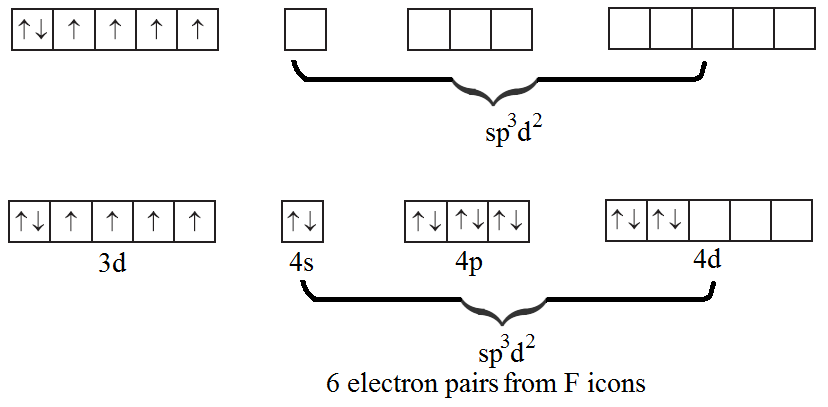
Similarly, [MnCl6]3- is also outer orbital complex or high spin complex. Magnetic propertyparamagnetic due to presence of unpaired electrons in it.(The number. of unpaired electrons = 4)

View full question & answer
MCQ 341 Mark
Transition metals are coloured due to the following electronic transition:
  • A
    d - s
  • B
    d - d
  • C
    s - p
  • D
    f - s
Answer
  1. d - d

Explanation:

Transition metals are coloured due to the d-d electronic transition.It's a transition where an electron jumps from one d orbital to another. Normally these are degenerate (the d orbitals have the same energy), but under some conditions, such as the presense of ligands, the degeneracy can be removed so that there is a specific energy (and therefore wavelength) associated with these transitions.

These sorts of transitions sometimes have energies located in the visible band, and it's one reason transition metal ions (and complex ions in particular) tend to be highly colored.

View full question & answer
MCQ 351 Mark
Which of the following shows maximum number of isomers?
  • A
    [Co(NH3​)4​Cl2​]
  • B
    [Ni(en)(NH3​)4]2+
  • C
    [Ni(C2​​O4​)(en)2​]2−
  • D
    [Cr(SCN)2​(NH3)4​]+
Answer
  1. [Cr(SCN)2​(NH3)4​]+

Explanation:

[Cr(SCN)2​(NH3)4​]+ shows maximum number of isomers. It shows geometrical (cis trans) isomerism as well as linkage isomerism. SCN is ambidentate ligand and can coordinate through either S or N atom.

View full question & answer
MCQ 361 Mark
A hybrid orbital formed from s-and p-orbital can contribute to:
  • A
    $\sigma$ bond only
  • B
    $\pi$ bond only
  • C
    Either $\sigma$ or $\pi$ bond
  • D
    None of these
Answer
  1. $\sigma$ bond only

Explanation:

A hybrid orbital formed from s-and p-orbital can contribute to a $\sigma$ bond only.

This is because sideways or lateral overlap with s orbital is not possible.

View full question & answer
MCQ 371 Mark
Which kind of isomerism is exhibited by octahedral [Co(NH3​)4​Br2​]Cl?
  • A
    Geometrical and ionization
  • B
    Geometrical and optical
  • C
    Optical and ionization
  • D
    Geometrical only
Answer
  1. Geometrical and ionization

Explanation:

The octahedral complex [Co(NH3​)4​Br2​]Cl exhibits geometrical as well as ionization isomerism.

The geometrical isomers are cis and trans isomers.

The ionization isomers are [Co(NH3​)4​Br2​]Cland[Co(NH3​)4​Cl]Br2​.

View full question & answer
MCQ 381 Mark
The neutral complex, diamine dibromo dichloro platinum (IV) is best represented as:
  • A
    [Pt(NH3​)2​Br2​Cl2​]
  • B
    [PtCl2​Br2​(NH3​)2​]
  • C
    [PtBr2​Cl2​(NH3​)2​]
  • D
    [Pt(NH3​)2​Cl2​Br2​]
Answer
  1. [Pt(NH3​)2​Br2​Cl2​]

Explanation:

In a complex compound, the neutral ligand is written first followed by an anionic ligand. But if there are more than one anionic ligand then their name is written in alphabetical order thus bromo is written first then chloro.

View full question & answer
MCQ 391 Mark
The primary valence of the metal ion is satisfied by:
  • A
    Neutral molecules
  • B
    Positive ions
  • C
    Negative ions
  • D
    All
Answer
  1. Negative ions

Explanation:

The primary or principal valency; this is the ionisable valency.

A metal always gives electron and becomes positively charged that can be neutralized by bonding with negative ion only. In a coordination compound, the number of negative ions needed to satisfy the charge on the central metal ion is it's primary valency.

View full question & answer
MCQ 401 Mark
[Co(NH3​)4​Cl2​] possesses:
  • A
    Square planar geometry
  • B
    Tetrahedral geometry
  • C
    Tetrahedral nature
  • D
    Octahedral geometry
Answer
  1. Octahedral geometry

Explanation:

View full question & answer
MCQ 411 Mark
Total number of stereoisomers of [Co(acac)2​BrCl]- are.
  • A
    4
  • B
    3
  • C
    6
  • D
    2
Answer
  1. 3

Explanation:

Total number of stereo isomers of [Co(acac)2​BrCl] are 3 i.e. cis, trans, optical.

View full question & answer
MCQ 421 Mark
Due to the presence of ambidentate ligands coordination compounds show isomerism. Palladium complexes of the type [Pd(C6H5)(SCN)2] and [Pd(C6H5)(NCS)2] are
  • A
    Linkage isomers.
  • B
    Coordination isomers.
  • C
    Ionisation isomers.
  • D
    Geometrical isomers.
Answer
  1. Linkage isomers.

Explanation:

Linkage isomerism arises in a coordination compound containing ambidentate ligand. A simple example is provided by complexes containing the thiocyanate ligand, NCS-, which may bind through the nitrogen to give M-NCS or through sulphur to give M-SCN.

View full question & answer
MCQ 431 Mark
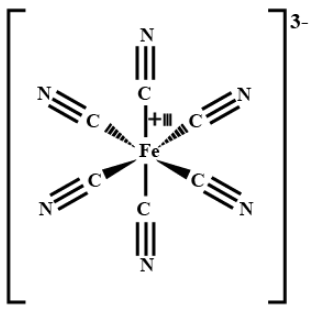
Turnbull's blue is:
  • A
    Fe3​[Fe(CN)6​]2​
  • B
    K4​Fe(CN)6​
  • C
    K3​Fe(CN)6
  • D
    Na4​Fe(CN)6​
     
Answer
  1. Fe3​[Fe(CN)6​]2​

Explanation:

Turnbull's blue is Fe3​[Fe(CN)6​]2​.

The structure is as follows:

View full question & answer
MCQ 441 Mark
TEL is a compound used as:
  • A
    Antibiotic
  • B
    Antiseptic
  • C
    Antiknocking
  • D
    None of these
Answer
  1. Antiknocking

Explanation:

Anti knocking compounds are the chemicals which reduce knocking for improving the quality of gasoline. example:- Tetraethyl lead (TEL).

View full question & answer
MCQ 451 Mark
Which of the following complex has five unpaired electrons?
  • A
    [Mn(H2​O)6​]2+
  • B
    [Mn(CN)6​]3−
  • C
    [CrCl3​(H2​O3​]
  • D
    [Ag(NH3​)2​]+
Answer
  1. [Mn(H2​O)6​]2+

Explanation:

Mn2+ has d5 configuration, since H2​O is weak ligand field, so it does not causes pairing of electrons and hence it has 5 unpaired electrons.

View full question & answer
MCQ 461 Mark
Co-ordination compounds are mostly formed by:
  • A
    s-block elements
  • B
    p-block elements
  • C
    d-block elements
  • D
    f-block elements
Answer
  1. d-block elements

Explanation:

Since 'd' block elements have higher oxidation states and variable oxidation states and their tendency to form co-ordinate bonds due to presence of unpaired electrons, they form co-ordination complexes.

View full question & answer
MCQ 471 Mark
IUPAC name for the complex [Cu(NH3​)4​]SO4​ is:
  • A
    Cupramonium sulphate.
  • B
    Copper sulphate tetraamonia.
  • C
    Tetrammine copper (II) sulphate.
  • D
    Copper amonium (IV) sulphate.
Answer
  1. Tetrammine copper (II) sulphate.

Explanation:

Since 4 amino groups are present, it will be called as tetrammine.

Since copper(II) is the central metal, it will be tetrammine copper(II). Note that we can determine the oxidation number of copper by charge balance.

Now finally since sulphate is the counter ion, it's full name will be tetrammine copper(II) sulphate.

View full question & answer
MCQ 481 Mark
Which of the following compounds would exhibit co-ordination isomerism?
  • A
    [Cr(H2​O)5​]Cl2​
  • B
    [Cr(NH3​)5​][Co(CN)5​]
  • C
    [Cr(en)2​]NO2​
  • D
    [Ni(NH3​)5​][BF4​]3
Answer
  1. [Cr(NH3​)5​][Co(CN)5​]

Explanation:

Co-ordination isomerism is a form of structural isomerism in which the composition of the complexion varies. In a coordination isomer, the total ratio ligand to metal remains the same, but the ligand attached to specific metal ion change. In B option ratio of metal to the ligand is the same and they can exchange their ligands (NH3​,CN).

View full question & answer
MCQ 491 Mark
The CFSE for octahedral [CoCl6]4- is 18,000cm-1. The CFSE for tetrahedral [CoCl4]2- will be:
  • A
    18,000cm-1.
  • B
    16,000cm-1.
  • C
    8,000cm-1.
  • D
    20,000cm-1.
Answer
  1. 8,000cm-1.

Explanation:

CFSE for tetrahedral complex is $\Delta_\text{t}=\Big(\frac{4}{9}\Big)\Delta_0$

$\Delta_\text{t}=\frac{4}{9}\times18,000=8,000\text{cm}^{-1}$

View full question & answer
MCQ 501 Mark
The stability of ferric ion is due to:
  • A
    Half field f-orbital
  • B
    Half field d-orbital
  • C
    Complete field f-orbital
  • D
    Complete field d-orbital
Answer
  1. Half field d-orbital

Explanation:

Fe3+ = 1s22s22p63s23p63d5

d orbital is half filled.So ferric ion is stable.

View full question & answer
M.C.Q [1M] - Chemistry STD 12 Science Questions - Vidyadip