Question 13 Marks
Explain optical isomerism in co-ordination compound.
Answer
View full question & answer→→ Optical isomers are mirror images that cannot be superimposed on one another.
→ These are called as enantiomers.
→ The molecules or ions that cannot be superimposed are called chiral.
→ The two forms are called dextro (d) and laevo (1) depending upon the direction they rotate the plane of polarised light in a polarimeter
→ Dextro (d) rotates plane polarised light to the right, and leaevo (1) rotates plane polarised light to the left.
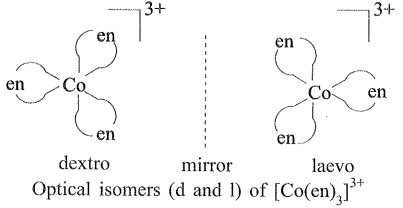
→ Optical isomerism is common in octahedral complexes involving didentate ligands
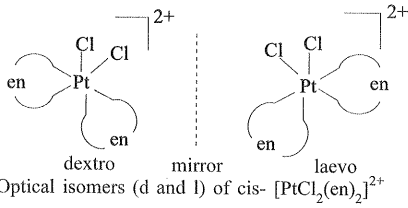
→ In a coordination entity of the type [PtCl2(en)2]2+, only the cis isomer shows optical activity.
→ These are called as enantiomers.
→ The molecules or ions that cannot be superimposed are called chiral.
→ The two forms are called dextro (d) and laevo (1) depending upon the direction they rotate the plane of polarised light in a polarimeter
→ Dextro (d) rotates plane polarised light to the right, and leaevo (1) rotates plane polarised light to the left.
→ Optical isomerism is common in octahedral complexes involving didentate ligands
→ In a coordination entity of the type [PtCl2(en)2]2+, only the cis isomer shows optical activity.