Questions

3 Marks Question

🎯

Test yourself on this topic

8 questions · timed · auto-graded

Question 13 Marks
Zinc rod is dipped in 0.1 M solution of $ZnSO _4$
The salt is $95 \%$ dissociated at is dilution at 298 K . Calculate the electrode potential. Given
$E ^0\left( Zn ^{2+} / Zn \right)=-0.76$
Answer
$\begin{array}{l}{\left[Z n^{2+}\right]=0.1 \times \frac{95}{100}=0.095 M} \\ Z n^{2+}+2 e^{-} \rightarrow Z n \\ E_{\left(Z n^{+} / Z n\right)}=E_{\left(Z n^{+} / Z n\right)}^0-\frac{0.0591}{2} \log \frac{1}{\left[Z n^{2+}\right]} \\ =-0.76 V-\frac{0.0591}{2} \log \frac{1}{0.095} \\ =-0.76 V-\frac{0.0591}{2}[\log 1000-\log 95] \\ =-0.76-\frac{0.0591}{2}[3.000-1.9777] \\ =-0.76 V-\frac{0.0591}{2} \times 1.0223 \\ =-0.76 V-\frac{0.0604}{2}=0.76-0.0302 \\ =-0.7902 V\end{array}$
View full question & answer
Question 23 Marks
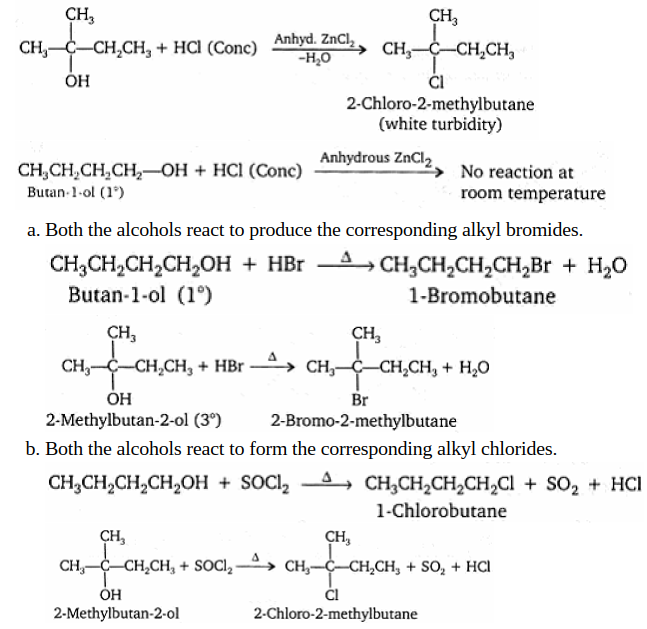
Give structures of the products you would except when each of the following alcohols
i. Butan-1-ol
ii. 2-Methylbutan-2-ol react with
a. HCI - ZnCl2
b. HBr and
c. SOCI2
Answer
i. a. With HCl - ZnCl2 (lucas reagent) 2-Methylbutane-2-ol
ii. Being a 3º alcohol, reacts with Lucas reagent to produce turbidity immediately due to the formation of insoluble tert-alkyl chloride while butane-l-ol (i) being a 1ºalcohol does not react with Lucas reagent at room temperature.
Image
View full question & answer
Question 33 Marks
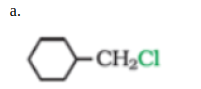
Image
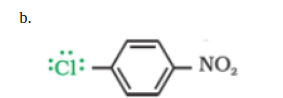
Image
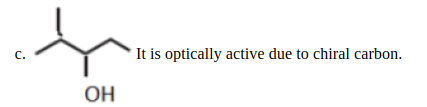
Image
Answer

Image
is more reactive towards SN2 because it is a primary halide.
Image
is more reactive towards nucleophilic substitution reaction because it is more reactive due to the presence of electron with drawing - NO2 group.
Image
View full question & answer
Question 43 Marks
The following results have been obtained during the kinetic studies of the reaction.
2A + BC → D
Experiment[A]/mol L-1[B]/mol L-1Initial rate of formation of D/mol L-1 min-1
I0.10.16.0 x 10-3
II0.30.27.2 x 10-2
III0.30.42.88 × 10-1
IV0.40.12.40 x 10-2

Determine the rate law and the rate constant for the reaction.
Answer
From experiments I and IV, it may be noted that $[B]$ is same but $[A]$ has been made four times, the rate of reaction has also becomes four times. This means w.r.t A
$
\text { Rate } \propto[A]
$
From experiments II and III it may be noted that [A] is kept same an [B] has been doubled, the rate of reaction has become four times. This means w.r.t B,
$
\text { Rate } \propto[B]^2
$
Combining (i) and (ii), we get the rate law for the given reaction as:
$
\text { Rate }=k[A][B]^2
$
Thus order w.r.t $A =1$
Order w.r.t B $=2$
The overall order of the reaction
$
=1+2=3
$
The rate constant and its units can be calculated from the data of each experiment using the expression. $
\begin{array}{l}
k=\frac{\text { rate }}{[A][B]^2} \\
=\frac{mol L^{-1} \min ^{-1}}{\left(mol L^{-1}\right)\left(mol L^{-1}\right)^2} \\
=mol^{-2} L^{-2} \min ^{-1}
\end{array}
$
Expt. $k=$ mol $^{-2} L^{-2} \min ^{-1}$
i. $\frac{6.0 \times 10^{-3}}{0.1 \times(0.1)^2}=6.0$
ii. $\frac{7.2 \times 10^{-2}}{0.3 \times(0.2)^2}=6.0$
iii. $\frac{2.88 \times 10^{-1}}{0.3 \times(0.4)^2}=6.0$
iv. $\frac{2.4 \times 10^{-2}}{0.4 \times(0.1)^2}=6.0$
Rate constant $k=6.0 mol^{-2} L^{-2} \min ^{-1}$
View full question & answer
Question 53 Marks
Calculate the emf of the following cell at 298 K .
$
2 Cr(s)+3 Fe^{2+}(0.1 M) \rightarrow 2 Cr^{3+}(0.01 M)+3 Fe(s)
$
Given, $E_{c r^{3+} / c r}^o=-0.74 V, E_{F e^{2+} / F e}^o=-0.44 V$
Answer
Since oxidation of Cr is taking place in the given reaction, the chromium electrode is anode and as Fe is reduced in the reaction, Fe electrode is the cathode. The half-cell reactions are as follows.
At anode $\left.Cr \rightarrow Cr ^{3+}+3 e ^{-}\right] \times 2$
At cathode $\left.Fe ^{2+}+2 e ^{-} \rightarrow Fe \right] \times 3$
Overall reaction
$
2 Cr+3 Fe^{2+} \rightarrow 2 Cr^{3+}+3 Fe
$  
$
\begin{array}{l}
\text { Eo }=E_{\text {cathode }}-E_{\text {anode }}=-0.44-(-0.74)=0.3 V \\
E=E^{o}-\frac{0.0591}{n} \log \frac{\left[Cr^{3+}\right]^2}{\left[Fe^{2+}\right]^3}
\end{array}
$
Here, $n =$ number of electrons transferred, i.e. equal to 6 .
$
\begin{array}{l}
=0.3-\frac{0.0591}{6} \log \frac{[0.01]^2}{[0.1]^3} \\
=0.309 \approx 0.31
\end{array}
$
View full question & answer
Question 63 Marks
Calculate the e.m.f at $25^{\circ} c$ for the following cell:
$
N i(s)\left|N i^{2+}(0.01 M) \| C u^{2+}(0.1 M)\right| C u(s)
$
Given: $E ^0 Ni ^{+2} / Ni =-0.25 V$
$
E_{C u^{2+} / C u}^0=+0.34 V
$
$\left[1 F=96,500 Cmol ^{-1}\right]$. Calculate the maximum work that can be accomplished by the operation of this cell
Answer
Cell reaction is
$
N i(s)\left|N i^{2+}(0.01 M)\right|\left|C u^{2+}(0.1 M)\right| C u(s)
$
At anode : $N i(s) \rightarrow N i^{2+}(a q)+2 e^{-}$
At cathode: $Cu ^{2+}(a q)+2 e \rightarrow Cu (s)$
Net cell reaction
$
\begin{array}{l}
Ni(s)+Cu^{2+}(a q) \rightarrow N i^{2+}(a q)+Cu(s) \\
E_{\text {cell }}=E_{\text {cell }}^0-\frac{0.0591}{2} \log \frac{\left[Ni^{2+}\right]}{\left[Cu^{2+}\right]} \\
=[+0.34 V-(-0.25 V)]-\frac{0.0591}{2} \log \frac{1}{10} \\
=0.59 V-\frac{0.0591}{2} \times-1 \\
=0.59+0.0295 \\
=0.6195 V
\end{array}
$
$
\begin{array}{l}
\Delta G=-n E F \\
=-2 \times 0.6195 V \times 96500 C / mol \\
=-119563.5 J / mol \\
\Delta G=-119.5635 KJ / mol \\
-\Delta G=W_{\max }=119.5635 KJ / mol
\end{array}
$
View full question & answer
Question 73 Marks
Draw structures of the following derivatives:
i. 2,4-Dinitrophenylhydrazone of benzaldehyde
ii. Cyclopropanone oxime
iii. Acetaldehydedimethylacetal
View full question & answer
Question 83 Marks
Explain how does the - OH group attached to a carbon of benzene ring activate it towards electrophilic substitution?
Answer
The -OH group is an electron-donating group. Thus, it increases the electron density in the benzene ring as shown in the given resonance structure of phenol.
Image
As a result, the benzene ring is activated towards electrophilic substitution.
View full question & answer
3 Marks Question - Chemistry STD 12 Science Questions - Vidyadip