Dependence of the rate of reaction on the concentration of reactants, temperature, and other factors is the most general method for weeding out unsuitable reaction mechanisms. The term mechanism means all the individual collisional or elementary processes involving molecules (atoms, radicals, and ions included) that take place simultaneously or consecutively to produce the observed overall reaction. For example, when hydrogen gas reacts with bromine, the rate of the reaction was found to be proportional to the concentration of H₂ and to the square root of the concentration of Br2. Furthermore, the rate was inhibited by increasing the concentration of HBr as the reaction proceeded. These observations are not consistent with a mechanism involving bimolecular collisions of a single molecule of each kind. The currently accepted mechanism is considerably more complicated, involving the dissociation of bromine molecules into atoms followed by reactions between atoms and molecules:
It is clear from this example that the mechanism cannot be predicted from the overall stoichiometry.
(source: Moore, J. W., & Pearson, R. G. (1981). Kinetics and mechanism. John Wiley & Sons.)
(a). Predict the expression for the rate of reaction and order for the following:
H2 + Br2 → 2 HBr
What are the units of rate constant for the above reaction?
(b). How will the rate of reaction be affected if the concentration of Br2 is tripled?
Answer$\begin{aligned} & \text { a. Rate }=\mathrm{k}\left[\mathrm{H}_2\right]\left[\mathrm{Br}_2\right]^{1 / 2} \\ & \text { order }=3 / 2 \\ & \text { units of } \mathrm{k}=\frac{\mathrm{molL}^{-1}}{\mathrm{~mol}^{3 / 2} \mathrm{~s}^{-1} \mathrm{~L}^{-3 / 2}}=\mathrm{mol}^{-1 / 2} \mathrm{~L}^{1 / 2} \mathrm{~s}^{-1} \\ & \text { b. Rate }=\mathrm{k}\left[\mathrm{H}_2\right]\left[\mathrm{Br}_2\right]^{1 / 2} \text { If conc of } \mathrm{Br}_2 \text { is tripled } \\ & \text { Rate' }=\mathrm{k}\left[\mathrm{H}_2\right]\left[3 \mathrm{Br}_2\right]^{1 / 2} \\ & \text { Rate }=\sqrt{3} \mathrm{k}\left[\mathrm{H}_2\right]\left[\mathrm{Br}_2\right]^{1 / 2} \\ & \text { Rate' }=\sqrt{ } 3 \text { Rate }\end{aligned}$
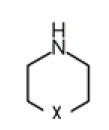 Compound 2: HXCH2CH2NH2