Questions

3 Marks Question

🎯

Test yourself on this topic

8 questions · timed · auto-graded

Question 13 Marks
How can diethyl ether be prepared from
i. ethyl iodide
ii. ethyl alcohol?
Why is the boiling point of an ether lower than that of the isomeric alcohols.
Answer
i. $\underset{\text { ethanol (excess) }}{2 CH _3 CH _2 OH } \xrightarrow{ Conc . H _2 SO _4}{ }_4 CH _3 CH _2-\underset{\text { ethoxyethane }}{ O - CH _2 CH _3}+ H _2 O$
ii. $2 R^{\prime}- OH +2 Na \rightarrow 2 R ^{\prime}- O - Na a^{+}+ H _2$ Alcohol
iii. $R^{\prime}-O^{-} N a^{+}+R-X \xrightarrow{S_{N^2}} R^{\prime}-\underset{\text { Ether }}{O}-R+N a^{+} X^{-}$
Boiling points: Ethers are isomeric with monohydric alcohols but their boiling points are much lower than those of the isomeric alcohols. This is due to the reason that unlike alcohols, ethers do not form hydrogen bonds. As a result ethers do not show molecular association and hence have lower boiling point than corresponding alcohols.
View full question & answer
Question 23 Marks
On the basis of the following data, explain why Co -(III) is not stable in aqueous solution? $
Co^{3+}+e^{-} \rightarrow Co^2+, E^0=+1.82 V
$
$
2 H_2 O \rightarrow O_2+4 H^{+}+4 e^{-}, E^0=1.23 V
$
Answer
Adding the two half reactions, e.m.f. comes out to positive.
$
\begin{array}{l}
emf=E_{\text {cathode }}-E_{\text {anode }} \\
emf=1.82-1.23=+0.59
\end{array}
$
This means that Co (III) in aqueous solution has the tendency to change to Co (II). Hence, Co (III) is not stable in aqueous solution.
View full question & answer
Question 33 Marks
a. Write the formulation for the galvanic cell in which the reaction $C u(s)+2 A g^{+}(a q) \rightarrow C u^{2+}(a q)+2 A g(s)$ takes place.
Identify the cathode and the anode reactions in it.
b. Write Nernst equation and calculate the emf of the following cell: $Sn ( s )\left| Sn ^{2+}(0.04 M ) \| H ^{+}(0.02 M )\right|$ $H _2(g) \mid \operatorname{Pt}( s )$
$\left(\right.$ Given $\left.E_{S n^{2+} / S n}=-0.14 V\right)$
Answer
a. We have
$
E_{\left(C u^{2+} / Cu\right)}^{\Theta}=0.34 V \text { and } E_{\left(Ag^{+} / Ag\right)}^{\Theta}=0.80 V
$
Standard emf of Cu is less than Ag , therefore it is strong reducing agent and is oxidised. Therefore Cu acts as Anode and Ag acts as Cathode.
Half cell reactions are:
At Cathode (Reduction):
$
2 Ag^{+}(a q)+2 e^{-} \rightarrow 2 Ag(s)
$
At Anode (Oxidation):
$
C u(s) \rightarrow C u^{2+}(a q)+2 e^{-}
$
b. The reactions are :
At Anode:
$
S n(s) \rightarrow S n^{2+}(a q)+2 e^{-}
$
At Cathode:
$
2 H^{+}(a q)+2 e^{-} \rightarrow H_2(g)
$
Full cell reaction:
$
Sn(s)+2 H^{+}(a q) \rightarrow Sn^{2+}(a q)+H_2(g)
$
Standard emf of the cell is:
$
\begin{array}{l}
E_{\text {cell }}^0=E_{H^{+} / H_2}^0-E_{S n^{2+} / S n}^0 \\
=0-(-0.14) V \\
=+0.14 V
\end{array}
$
For this reaction $n =2$ moles of electrons. Using Nernst equation,
$
\begin{array}{l}
E_{\text {cell }}=0.14-\frac{0.0591}{2} \log \frac{\left[Sn^2+\right]}{\left[H^{+}\right]^2} \\
=0.14-\frac{0.0591}{2} \log \frac{0.04}{(0.02)^2} \\
=0.14-\frac{0.0591}{2} \log \frac{4}{100} \times \frac{100}{2} \times \frac{100}{2} \\
=0.14 V-0.0591 V \\
=0.0809 V
\end{array}
$
View full question & answer
Question 43 Marks
The decomposition of $NH _3$ on platinum surface is zero order reaction. What are the rates of production of $N _2$ and $H_2$ if $k=2.5 \times 10^{-4} mol^{-1} Ls ^{-1}$ ?
Answer
The decomposition of on platinum surface is represented by the following equation.
$
2 NH_3(g) \rightarrow N_2(g)+3 H_2(g)
$
Therefore, Rate $=-\frac{1}{2} \frac{d\left[N H_3\right]}{d t}=\frac{d\left[N_2\right]}{d t}=\frac{1}{3} \frac{d\left[H_2\right]}{d t}$
However, it is given that the reaction is of zero order.
$
-\frac{1}{2} \frac{d\left[N H_3\right]}{d t}=\frac{d\left[N_2\right]}{d t}=\frac{1}{3} \frac{d\left[H_2\right]}{d t}=k
$
Therefore, $k=2.5 \times 10^{-4} mol L^{-1} s^{-1}$
Hence, the rate of production of $N_2$ is
$
\frac{d\left[N_2\right]}{d t}=2.5 \times 10^{-4} mol L^{-1} s^{-1}
$
And, the rate of production of $H _2$ is
$
\frac{d\left[H_2\right]}{d t}=3 \times 2.5 \times 10^{-4} mol L^{-1} s^{-1}=7.5 \times 10^{-4} mol L^{-1} s^{-1}
$
View full question & answer
Question 53 Marks
Name the reagents used in the following reactions:
i. Oxidation of a primary alcohol to carboxylic acid.
ii. Oxidation of a primary alcohol to aldehyde.
iii. Bromination of phenol to 2,4,6-tribromophenol.
iv. Benzyl alcohol to benzoic acid.
v. Dehydration of propan-2-ol to propene.
vi. Butan-2-one to butan-2-ol.
Answer
i. Acidified potassium permanganate
ii. Pyridinium chlorochromate (PCC)
iii. Bromine water
iv. Acidified potassium permanganate
v. 85% phosphoric acid
vi. NaBH4 or LiAlH4
View full question & answer
Question 63 Marks
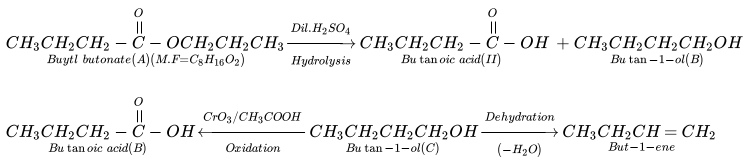
An organic compound (A) (molecular formula C8H1602) was hydrolysed with dilute sulphuric acid to give a carboxylic acid (B) and an alcohol (C). Oxidation of (C) with chromic acid produced (B). (C) on dehydration gives but-1-ene. Write equations for the reactions involved.
Answer
The relevant equations for all the reactions involved may be explained as follows:
Image
View full question & answer
Question 73 Marks
How long will it take an electric current of 0.15 A to deposit all the copper from 500 ml of 0.15 M copper sulphate solution?
Answer
You have mols in
500 ml of $0.15 M CuSO _4$ solution contains
$\frac{500 \times 0.15}{1000}=0.075 mole$ of Cu
Mass of $Cu =0.075 \times 63.5=4.7625 g$ Eq. Wt. of $C u=\frac{635}{2}=31.75$
$
\begin{array}{l}
m=Z \times I \times t \\
4.7625=\frac{31.75}{96500} \times 0.15 \times t \\
t=\frac{4.7625 \times 96500}{31.75 \times 0.15}=96500 sec \\
=\frac{96500}{60 \times 60}=26.80 \text { hours. }
\end{array}
$
View full question & answer
Question 83 Marks
How the following conversions can be carried out?
i. 2-Bromopropane to 1-bromopropane
ii. Chloroethane to butane
iii. Benzene to diphenyl
Answer
i. 2-Bromopropane to 1-bromopropane
a. alc KOH heat
b. HBr peroxide.
ii. Chloroethane to butane
Na wurtz reaction
iii. Benzene to diphenyl
a. Bromine, ferric bromide
b. Na Dry ether fitting reaction
View full question & answer
3 Marks Question - Chemistry STD 12 Science Questions - Vidyadip