Questions

4 Marks Questions

🎯

Test yourself on this topic

2 questions · timed · auto-graded

Question 14 Marks
Answer
i. KCl in a kg of water would be expected to increase the boiling point by $2 \times 0.52 K=1.04 K$. This could led us to conclude that mass of 2 moles of particles is 74.5 g hence mass of 1 mole of KCl would be 37.25 g . Hence, in case of KCl where dissociation occurs experimentally determined molar mass is always lower than true value.
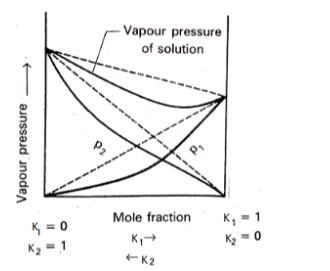
ii. Negative Deviation.
iii. A liquid mixture consisting of $20 \%$ acetone and $80 \%$. chloroform by mass.
View full question & answer
Question 24 Marks
The d-block of the periodic table contains the elements of the groups 3 to 12 and are known as transition elements. In general, the electronic configuration of these elements is $(n-1) d^{1-10} n s^{1-2}$. The d-orbitals of the penultimate energy level in their atoms receive electrons giving rise to the three rows of the transition metals i.e. 3d, 4d and 5d series. However, $Zn , Cd$ and Hg are not regarded as transition elements. Transition elements exhibit certain characteristic properties like variable oxidation stables, complex formation, formation of coloured ions, alloys, catalytic activity etc. Transition metals are hard (except $Zn , Cd$ and Hg ) and have a high melting point.
i. Why are $Zn , Cd$ and Hg non-transition elements?
ii. Which transition metal of 3d series does not show variable oxidation state?
iii. Why do transition metals and their compounds show catalytic activity?
OR
iii. Why are melting points of transition metals high?
Answer
i. It is because neither they nor their ions have incompletely filled d-orbitals.
ii. Scandium (Sc) and Zinc (Zn).
iii. It is because they show variable oxidation state, can form intermediate complexes and have large surface area for adsorption of gases.
View full question & answer
4 Marks Questions - Chemistry STD 12 Science Questions - Vidyadip