Questions · Page 1 of 4

M.C.Q [1M]

🎯

Test yourself on this topic

50 questions · timed · auto-graded

MCQ 11 Mark
The adsorption of hydrogen by platinum black is called:
  • A
    Hydrogenation
  • B
    Reduction
  • C
    Occlusion
  • D
    Hydration
Answer
  1. Occlusion

Explanation:

When adsorption happens on metals, it is called occlusion. Occlusion happens on a variety of metals, including iron, platinum and palladium, but hydrogen gas is the only adsorbate.
View full question & answer
MCQ 21 Mark
Gallium is in __________ state at room temperature.
  • A
    Plasma.
  • B
    Liquid.
  • C
    Solid.
  • D
    Gaseous.
Answer
  1. Liquid.

Explanation:

Gallium is in liquid state at room temperature. The melting point of gallium is 303K.

View full question & answer
MCQ 31 Mark
Which one of the following statements about lanthanides is false ?
  • A
    Lanthanides are seperated from one another by ion exchange method.
  • B
    The ionic radii of trivalent lanthanides steadily increases with increase in atomic number.
  • C
    All lanthanides are highly dense metals.
  • D
    Most typical oxidation state of lanthanides is +3
Answer
  1. The ionic radii of trivalent lanthanides steadily increases with increase in atomic number

Explanation:

The ionic radii of trivalent lanthanides steadily decreases with increase in atomic number due to lanhanide contraction.

View full question & answer
MCQ 61 Mark
What else are d-block elements called
  • Transition elements
  • B
    Representative elements
  • C
    Inner transition elements
  • D
    s-block elements
Answer
Correct option: A.
Transition elements
A
View full question & answer
MCQ 81 Mark
Which forms coloured salts?
  • A
    Metals
  • B
    Non-metals
  • C
    p-block elements
  • D
    Transitional elements
Answer
  1. Transitional elements

Explanation:

Transitional elements form coloured salts due to the presence of unpaired electrons of d-orbital.

View full question & answer
MCQ 91 Mark
There are 14 elements in actinoid series. Which of the following elements does not belong to this series?
  • A
    U
  • B
    Np
  • C
    Tm
  • D
    Fm
Answer
  1. Tm

Explanation:

Tm (thulium) atomic no. = 69 belongs to Lanthanoids (4f) series.

View full question & answer
MCQ 101 Mark
The transition metals are mostly:
  • A
    Diamagnetic.
  • B
    Paramagnetic.
  • C
    Neither diamagnetic nor paramagnetic.
  • D
    Both diamagnetic and paramagnetic.
Answer
  1. Paramagnetic.

Explanation:

Most of trasition metls have unpaired electron (d-configuration) in their electronic configuration so they are paramagnetic in nature.

View full question & answer
MCQ 111 Mark
Most of the radio active elements are present in:
  • A
    Lanthanoids
  • B
    Actinoids
  • C
    Representative elements
  • D
    Second transition series
Answer
  1. Actinoids

Explanation:

The actinoids are radioactive elements and the earlier members have relatively long half-lives.

The most common and known element is Uranium, which is used as nuclear fuel when its converted into plutonium, through a nuclear reaction.

View full question & answer
MCQ 121 Mark
Which of the following elements belongs to actinide series?
  • A
    Lu
  • B
    Gd
  • C
    Th
  • D
    La
Answer
  1. Th

Explanation:

Lu, Gd and La belongs to lanthanide series and Th belongs to actinide series.

View full question & answer
MCQ 131 Mark
Which of the following pairs of atom have the most similar radii ?
  • A
    Zr, Hf
  • B
    Cu, Ag
  • C
    Sc, Ti
  • D
    Pd, Pt
Answer
  1. Zr, Hf
View full question & answer
MCQ 141 Mark
The following belongs to d-block but it is not transition element:
  • A
    Mn
  • B
    Fe
  • C
    Zn
  • D
    Cr
Answer
  1. Zn

Explanation:

Zinc is not a transition element due to complete d-orbital.

View full question & answer
MCQ 151 Mark
The transition metal used in X-rays tube is:
  • A
    Mo
  • B
    Ta
  • C
    Tc
  • D
    Pm
Answer
  1. Mo

Explanation:

Among given metals, molybdenum is used in X-rays tube. In medical X-ray tubes the target is usually tungsten or a more crack-resistant alloy of rhenium (5%) and tungsten (95%), but sometimes molybdenum is used for more specialized applications, such as when softer X-rays are needed as in mammography.

View full question & answer
MCQ 161 Mark
Iron sheets are covered with a layer of zinc i.e., galvanized mainly to:
  • A
    Harden the surface.
  • B
    Increase the surface.
  • C
    Prevent action of water only.
  • D
    Prevent action of oxygen and water.
Answer
  1. Prevent action of oxygen and water.

Explanation:

Iron sheets are covered with a layer of Zinc i.e. galvanized mainly to prevent action of oxygen and water.

View full question & answer
MCQ 171 Mark
Atomic number of three elements A, B, and C are respectively,
Pm (Z = 61), Sm (Z = 62), Eu (Z = 63).
Which one has a maximum atomic radius?
  • A
    A
  • B
    B
  • C
    C
  • D
    All have the same radius.
Answer
  1. A
View full question & answer
MCQ 181 Mark
The electronic configuration of Cu(II) is 3d9 whereas that of Cu(I) is 3d10. Which of the following is correct?
  • A
    Cu(II) is more stable
  • B
    Cu(II) is less stable
  • C
    Cu(I) and Cu(II) are equally stable
  • D
    Stability of Cu(I) and Cu(II) depends on nature of copper salts
Answer
  1. Cu(II) is more stable

Explanation:

Cu (II) is more stable due to greater effective nuclear charge of Cu (II).

View full question & answer
MCQ 191 Mark
ll Cu(II) halides are known except the iodide. The reason for it is that:
  • A
    iodide is a bulky ion.
  • B
    Cu2+ oxidizes iodide to iodine.
  • C
    $\text{Cu}^{2+}_\text{(aq)}$ has much more negative hydration enthalpy.
  • D
    Cu2+ ion has smaller size.
Answer
  1. Cu2+ oxidizes iodide to iodine.

Explanation:

All Cu(II) halides are known except the iodine because Cu2+ oxidizes iodine to iodine.

2Cu2++ 4I−1 → 2CuI(S)​ + I2​.

View full question & answer
MCQ 201 Mark
Among the following metals, interatomic forces are probably the weakest in:
  • A
    Cu
  • B
    Ag
  • C
    Zn
  • D
    Hg
Answer
  1. Hg

Explanation:

Among the metals, interatomic forces are probably the weakest in Hg.

This can be understand from the fact that Hg is liquid whereas Cu, Ag and Zn are solids at room temperature.

View full question & answer
MCQ 211 Mark
What is the atomic number of the element with M2+ ion having electronic configuration [Ar]3d8?
  • A
    25
  • B
    28
  • C
    27
  • D
    26
Answer
  1. 28

Explanation:

E.C of M : [Ar]4s23d8

E.C of M2+ : [Ar]4s03d8

Total electrons = 28 = atomic number.

View full question & answer
MCQ 221 Mark
Colour of Fe2+ ions is:
  • A
    Blue.
  • B
    Light green.
  • C
    Very dark green.
  • D
    Yellow.
Answer
  1. Light green.

Explanation:

Colour of Fe2+ is light green.

Due to this many salts having Fe2+ ion are also green in colour.

For ex: FeSO4​

View full question & answer
MCQ 231 Mark
Metallic radii of some transition elements are given below. Which of these elements will have highest density?
Element
Fe
Co
Ni
Cu
Metallic radii/pm
126
125
125
128
  • A
    Fe
  • B
    Ni
  • C
    Co
  • D
    Cu
Answer
  1. Cu

Explanation:

On moving across the period in the periodic table the atomic radii of the element decreases towards right that is why density increases towards right in a period.

View full question & answer
MCQ 241 Mark
Transition metals show paramagnetism due to:
  • A
    Characteristic configuration.
  • B
    High lattice energy.
  • C
    Variable oxidation states.
  • D
    Unpaired electrons.
Answer
  1. Unpaired electrons.

Explanation:

Magnetic moment is $\sqrt{\text{n(n+2)}}$ where n is no of unpaired electron so transition metals show paramagnetism due to unpaired electron.

View full question & answer
MCQ 251 Mark
The following is not a noble metal:
  • A
    Au
  • B
    Cu
  • C
    Ag
  • D
    Pt
Answer
  1. Cu

Explanation:

The noble metals are those metals that are resistant to corrosion and oxidation in moist air, unlike most base metals. The noble metals are most commonly considered to be ruthenium, rhodium, palladium, silver, platinum and gold. Copper is not considered to be a noble metal.

View full question & answer
MCQ 261 Mark

Transition metals are good electrical conductor because ___________.

  • A
    They are metals.
  • B
    They are solids.
  • C
    They have free electrons in outer energy levels.
  • D
    They are hard.
Answer
  1. They have free electrons in outer energy levels.

Explanation:

Transition metals have free electrons in outer energy levels because d-orbitals shields poorly and due to this they acts as good conductor of electricity.

View full question & answer
MCQ 271 Mark
If each one of the above ionic species is in turn kept in a magnetic field, which  one will get attracted ?
  • A
    Co+2
  • B
    Mn+7
  • C
    Sc+3
  • D
    Ti+4
Answer
  1. Co+2

Explanation:

Co+2 = [Ar]3d7n = 3  attracted by a magnetic field due to presence of 3 unpaired electron.

View full question & answer
MCQ 281 Mark
The number of elements in the transition metal series Sc through Zn that have four unpaired electrons in their +2 state are:
  • A
    2
  • B
    4
  • C
    5
  • D
    6
Answer
  1. 2

Explanation:

Fe+ (z = 26) = [Ar] 3d6

Cr+ (z = 24) = [Ar] 3d4

View full question & answer
MCQ 291 Mark
Which sub shell is filled up progressively in actinoids?
  • A
    4f
  • B
    5f
  • C
    6d
  • D
    7s
Answer
  1. 5f

Explanation:

5f sub shell is filled up progressively in actinoids.

View full question & answer
MCQ 301 Mark
The magnetic nature of elements depends on the presence of unpaired electrons. Identify the configuration of transition element, which shows highest magnetic moment.
  • A
    3d7
  • B
    3d5
  • C
    3d8
  • D
    3d2
Answer
  1. 3d5

Explanation:

The greater the number of unpaired electron, the higher will be its value of magnetic moment. Since, 3d5 has 5 unpaired electrons hence highest magnetic moment.

$\mu=\sqrt{5(5+2)}$

$=\sqrt{35}$

$=5.95\text{BM}$

View full question & answer
MCQ 311 Mark
In which pair highest oxidation states of transition metals are found?
  • A
    Nitrides and Chlorides.
  • B
    Fluorides and Chlorides.
  • C
    Fluorides and Oxides.
  • D
    Nitrides and Oxides.
Answer
  1. Fluorides and Oxides.

Explanation:

The highest oxidation states of transition metals are found in fluorides and oxides since fluorine and oxygen are the most electronegative elements and small in size.

View full question & answer
MCQ 321 Mark
5f series elements are known as_______?
  • A
    Lanthanides.
  • B
    Representative elements.
  • C
    Transition elements.
  • D
    Actinides.
Answer
  1. Actinides.

Explanation:

Actinides are also called the 5f series.

Filling up of the 5f orbitals after actinium (Z = 89) gives the 5f-inner transition series known as the actinoid series.

View full question & answer
MCQ 331 Mark
KMnO4 acts as an oxidising agent in alkaline medium. When alkaline KMnO4 is treated with KI, iodide ion is oxidised to ____________.
  • A
    $\text{I}_2$
  • B
    $\text{IO}^-$
  • C
    $\text{IO}_3^-$
  • D
    $\text{IO}_4^-$
Answer
  1. $\text{IO}_3^-$

Explanation:

Iodide ion neutral of faintly alkaline solutions converts iodide to iodate:

$2\text{MnO}_4^-+\text{H}_2\text{O}+\text{I}^-\rightarrow2\text{MnO}_2+2\text{OH}^-+\text{IO}_3^-$

View full question & answer
MCQ 341 Mark
Chemically Zinc group elements closely resemble ______.
  • A
    I A group
  • B
    II A group
  • C
    III A group
  • D
    IV A group
Answer
  1. II A group

Explanation:

Zinc belongs to IIB and it closely resembles IIA because of the completely filled valence orbitals. The reason is in IIA group all the elements have completely filled s-orbital while in IIB group the elements have completely filled s orbital along with d-orbital.

View full question & answer
MCQ 351 Mark
Transition elements show positive oxidation state, generally, due to:
  • A
    Large atomic size.
  • B
    Low ionization energy.
  • C
    Low electronegativity.
  • D
    High electronegativity.
Answer
  1. Low ionization energy.
View full question & answer
MCQ 361 Mark
Transition metal compounds are usually colored. This is due to the electronic transition:
  • A
    From p-orbital to s-orbital.
  • B
    From d-orbital to s-orbital.
  • C
    From d-orbital to p-orbital.
  • D
    Within the d-orbitals.
Answer
  1. Within the d-orbitals.

Explanation:

Colour in transition series metal compounds arises due to two types of transitions. they are:

(a) Charge transfer transitions [Ligand-to-metal charge transfer (LMCT), Metal-to-ligand charge transfer]

(b) d−d transition

In transition metal complexes, all the d− orbitals do not possess same energy. So, electrons can jump from a lower energy d− orbital to a higher energy d− orbital, by absorbing energy. When it returns to the ground state, excess energy is released, and a corresponding wavelength is found in the visible region.

View full question & answer
MCQ 371 Mark
The property seen in f-block elements is:
  • A
    Lanthanoid contraction.
  • B
    Actinide contraction.
  • C
    Both (A) and (B).
  • D
    Lanthanoid expansion.
Answer
  1. Both (A) and (B).

Explanation:

The property seen in f-block elements are Lanthanoid contraction and Actinide contraction. Lanthanide contraction is a term used in chemistry to describe the greater than expected decrease in ionic radii of the elements in the lanthanide series.

View full question & answer
MCQ 381 Mark
How many electron present in penultimate shell of d-block element?
  • A
    9 - 18
  • B
    8 - 18
  • C
    1 - 10
  • D
    1 - 32
Answer
  1. 9 - 18
View full question & answer
MCQ 391 Mark
Gadolinium belongs to 4f series. It’s atomic number is 64. Which of the following is the correct electronic configuration of gadolinium?
  • A
    $[\text{Xe}]\ 4\text{f}^7\ 5\text{d}^1\ 6\text{s}^2$
  • B
    $[\text{Xe}]\ 4\text{f}^6\ 5\text{d}^2\ 6\text{s}^2$
  • C
    $[\text{Xe}]\ 4\text{f}^8\ 6\text{d}^2$
  • D
    $[\text{Xe}]\ 4\text{f}^9\ 5\text{s}^1$
Answer
  1. $[\text{Xe}]\ 4\text{f}^7\ 5\text{d}^1\ 6\text{s}^2$

Explanation:

Gadolinium belongs to 4f series it has atomic no. = 64. It has extra stability due to half-filled 4f sub shell.

View full question & answer
MCQ 401 Mark
Which of the following belongs to the actinide series of elements?
  • A
    Y
  • B
    Ta
  • C
    U
  • D
    Lu
Answer
  1. U

Explanation:

Uranium belongs to actinide series. Yttrium and tantalum belons to d-block. Lutetium belongs to lanthanide series.

View full question & answer
MCQ 411 Mark
Generally transition elements and their salts are coloured due to presence of ___________?
  • A
    Coloured compounds and ions.
  • B
    Coloured anions and cations.
  • C
    Coloured particles and ions.
  • D
    Unpaired electrons.
Answer
  1. Unpaired electrons.
View full question & answer
MCQ 421 Mark
Generally transition elements form coloured salts due to the presence of unpaired electrons. Which of the following compounds will be coloured in solid state?
  • A
    Ag2SO4
  • B
    CuF2
  • C
    ZnF2
  • D
    Cu2Cl
Answer
  1. CuF2

Explanation:

Cu2+ has 1 unpaired electron in CuF2, hence, it is coloured in solid state.

View full question & answer
MCQ 431 Mark
The only radioactive element among the lanthanoids is:
  • A
    Gadolinium.
  • B
    Holmium.
  • C
    Promethium.
  • D
    Neodynium.
Answer
  1. Promethium.

Explanation:

Promethium is a lanthanoid element with the symbol Pm and atomic number 61. All of its isotopes are radioactive. Gadolinium, holmium and neodynium are lanthanoids but are not radio active.

View full question & answer
MCQ 441 Mark
Monazite is an ore of:
  • A
    Titanium.
  • B
    Throium.
  • C
    Zirconium.
  • D
    Iron.
Answer
  1. Throium.

Explanation:

Monazite is a prosphate material containing rare earth metals. It is reddish in colour. It is an important ore  for throium, lanthanum, cerium.

View full question & answer
MCQ 451 Mark
Which of the following statements concerning lanthanide elements is false?
  • A
    All lanthanides are highly dense metals.
  • B
    The characteristic oxidation state of lanthanide elements is +3.
  • C
    Lanthanides are separated from one another by ion exchange method.
  • D
    Ionic radii of trivalent lanthanides steadily increase with an increase in the atomic number.
Answer
  1. Ionic radii of trivalent lanthanides steadily increase with an increase in the atomic number.

Explanation:

Ionic radii decreases with increasing atomic number in Lanthanide series. So, the ionic radii of trivalent Lanthanide will also follow the same property.

View full question & answer
MCQ 461 Mark
Lanthanides and actinides resemble in:
  • A
    Electronic configuration.
  • B
    Oxidation state.
  • C
    Ionization energy.
  • D
    Formation of complexes.
Answer
  1. Electronic configuration.

Explanation:

Lanthanides and actinides resemble in electronic configuration:

(n−2)f1−14(n−1)d1−10ns1−2

View full question & answer
MCQ 471 Mark
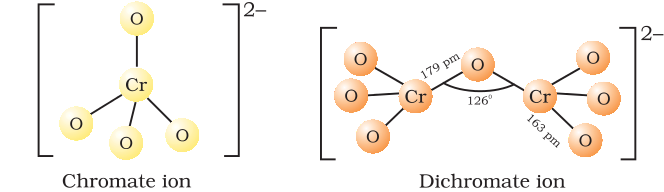
The ionic charges on chromate ion and dichromate ion respectively is:
  • A
    -2, -2
  • B
    -3, -2
  • C
    -2, -4
  • D
    -4, -2
Answer
  1. -2, -2

Explanation:

Chromate salts contain the chromate anion, $\text{CrO}^{2-}_4$​ with -2 ionic charge.

Dichromate salts contain the dichromate anion, $\text{CrO}^{2-}_7$ with -2 ionic charge.

They are oxoanions of chromium in the +6 oxidation state.

View full question & answer
MCQ 481 Mark
Which one of the following ion exhibits colour in aqueous solution ?
  • A
    Sc3+
  • B
    Ni2+
  • C
    Ti4+
  • D
    Zn+2
Answer
  1. Ni2+

Explanation:

Only Ni+2 has incomplete d-orbitals d8 so it is colourfull. Sc+3, Ti+4 ; d0 configuration and Zn+2, d10 configuration so they are colourless.

View full question & answer
MCQ 491 Mark
Transition metals make the most efficient catalysts because of their ability to:
  • A
    Adopt multiple oxidation states and to form complexes.
  • B
    Form coloured ions.
  • C
    Show paramagnetism due to unpaired electrons.
  • D
    Form a large number of oxides.
Answer
  1. Adopt multiple oxidation states and to form complexes.

Explanation:

Transition metals have partially filled d- orbitals so they can easily withdraw the electrons from the reagents or give electrons to them depending on the nature of the reaction. They also have a tendency to show large no. of oxidation states and the ability to form complexes which makes them a good catalyst.

View full question & answer
MCQ 501 Mark
The color of Cu+ compounds is?
  • A
    White
  • B
    Blue
  • C
    Orange
  • D
    Yellow
Answer
  1. White

Explanation:

Cu+ compounds are generally colourless (white). The electronic configuration is 3d104s0. So there is no unpaired electron present in the ion. So the electronic transition between two energy levels t2g​ and eg​ (responsible for the colour of transition metals) is not possible.

View full question & answer