Questions

4 Marks Questions

🎯

Test yourself on this topic

8 questions · timed · auto-graded

Question 14 Marks
What can be inferred from the magnetic moment values of the following complex species?
ExampleMagnetic Moment (BM)
$K _4\left[ Mn ( CN )_6\right]$2.2
$\left[ Fe \left( H _2 O \right)_6\right]^{2+}$5.3
$K _2\left[ MnCl _4\right]$5.9
Answer
(i) Magnetic moment of K4[Mn(CN)6] is μ = 2.2 B.M. has been given. Theoretically, according to the formula, $\mu=\sqrt{n(n+2)}$ BM, when $n=1$, the value of μ comes to 1.732 BM, which is almost equal to 2.2.
Therefore, in this complex there will be d2sp3 hybridization on Mn because $\overline{ C } N$ is a strong ligand due to which the electronic configuration of Mn2+ will be (t2g)5, which has one unpaired electron. Hence this complex is paramagnetic.
(ii) For $\left[ Fe \left( H _2 O \right)_6\right]^{2+}, \mu=5.3 BM$ is given.
Therefore, taking n = 4 according to the formula gives $\mu$ = 4.89BM which is almost equal to 5.3.
Therefore, in this complex there will be sp3d2 hybridization on Fe because H2O is a weak ligand due to which the electronic configuration of $Fe ^{2+}$ will be $\left( t _{2 g}\right)^4\left( e _{ g }\right)^2$, which has four unpaired electrons. Hence this complex is also paramagnetic.
(iii) For $K _2\left[ MnCl _4\right]$ it is given that $\mu=5.9 BM$.
Therefore, taking n = 5 according to the formula gives $\mu$= 5.91BM which is almost equal to 5.9. Therefore, in this complex there will be sp3 hybridization on Mn and Cl- is a weak ligand. In the presence of which the electronic configuration of Mn+2 will be $\left(e_g\right)^2\left(t_{2 g}\right)^3$, which has 5 unpaird electrons. Hence this complex paramagnetic.
View full question & answer
Question 24 Marks
Comment on the statement that elements of the first transition series possess many properties different from those of heavier transition elements.
Answer
There are the following differences in the properties of first transition series elements and heavy transition elements : 
(i) Elements of the first transition series generally show +2 and +3 oxidation states, whereas in heavier transition elements, higher oxidation states are more stable.
(ii) The elements of the first transition series do not have metal-metal (M-M) bond which is generally found in heavy transition elements. For this reason, the melting points of heavy transition elements are higher than the melting points of the elements of the first transition series.
(iii) Elements of the first transition series do not form complexes with high coordination numbers, like 7 to 8, whereas heavy transition elements also form complexes with coordination numbers 7 or 8.
(iv) Nature of the ligand in the elements of the first transition series, on the basis of strength, low spin complexes and high spin complexes are formed, whereas heavy transition elements always form low spin complexes.
View full question & answer
Question 34 Marks
Compare the general characteristics of the first series of the transition metals with those of the second and third series metals in the respective vertical coloumns. Give special emphasis on the following points :
(i) Electronic configurations
(ii) Oxidation states
(iii) Ionisation enthalpies and
(iv) Atomic sizes.
Answer
(i) Electronic configurations : In first transition series, electrons are filled in 3d orbitals, whereas in the second and third transition series, electrons are filled in 4d and 5d orbitals respectively and generally the configuration of all the elements of a group is the same, but there are exceptions, including transition elements.
(ii) Oxidation states : All elements generally show similar oxidation states. These are maximum in the middle of the range and minimum at the end.
(iii) Ionization enthalpy : In comparison of first transition series elements the value of ionization enthalpy of the elements of the second transition series is less but the value of ionization enthalpy of the elements of the third transition series is higher than the elements of the second transition series.
(iv) Atomic size : The atomic sizes of the elements of the second and third transition series are more than those of the elements of the first transition series. But due to lanthanoid contraction, the sizes of elements of second and third transition series are almost the same.
View full question & answer
Question 44 Marks
Indicate the steps in the preparation of :
(i) $K _2 Cr _2 O _7$ from chromite ore
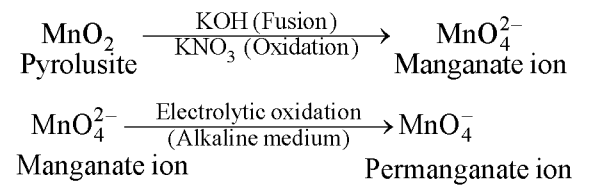
(ii) $KMnO _4$ from pyrolusite ore.
View full question & answer
Question 54 Marks
Give examples and suggest reasons for the following features of the transition metal chemistry :
(i) The lowest oxide of transition metal is basic, the highest is amphoteric/acidic.
(ii) A transition metal exhibits highest oxidation state in oxides and fluorides.
(iii) The highest oxidation state is exhibited in oxoanions of a metal.
Answer
(i) Oxides of transition metals are basic in the lowest oxidation state and amphoteric in the highest oxidation state. They are acidic because in low oxidation state, only a few electrons are used to form bonds, hence the effective nuclear charge is less, hence they can give electrons easily, hence they are basic, but in high oxidation state, due to more effective nuclear charge. Because they have more tendency to accept electrons, hence they are mainly acidic and sometimes amphoteric. Example :
$\begin{array}{ccc}\underset{+2}{ MnO } & \underset{+4}{ MnO _2} & \underset{+7}{ Mn _2 O _7} \\ \text { Alkaline oxide } & \text { Amphoteric oxide } & \text { Acidic oxide }\end{array}$
(ii) Due to the high electronegativity and small size of oxygen and fluorine, they oxidize metals to the highest oxidation state, hence the highest oxidation state of transition metals is displayed only in oxides and fluorides.
(iii) Oxoanions of transition metals are formed only when their oxides having higher oxidation states are reacted with acids and bases. Therefore, even in oxoanions, the oxidation state of the metal will be high and in these oxoanions, highly electronegativity oxygen is associated with the metal.
View full question & answer
Question 64 Marks
How would you account for the following :
(i) Of the d4 species Cr2+ is strongly reducing while manganese(III) is strongly oxidising.
(ii) Cobalt(III) is stable in aqueous but in the presence of complexing reagents it is easily oxidised.
(iii) The d1 configuration is very unstable in ions.
Answer
(i) Cr2+ is a strong reducing agent because when one electron is released from it, there is a change from d4 to d3 and d3 configuration $\left( t _{2 g}^3\right)$ is more stable because it is half filled. By Mn(III) when it is converted into Mn(II) by accepting electrons, it changes from 3d4 to 3d5 and 3d5 is a semi-complemented stable configuration. Hence manganese(III) is a strong oxidant.
(ii) In the presence of complexing reagent (ligand), Co(II) is easily oxidized to form Co(III) which has 3d6 configuration. The reason for this is that the crystal field splitting energy (CFSE) obtained on the formation of the complex fulfill the third ionization energy required for the formation of Co+3 and the stable octahedral complexes in the +3 state are diamagnetic.
(iii) Ions of d1 configuration are extremely unstable because the ionization energy requried to remove an electron from the d1 configuration is easily compensated by hydration energy or lattice energy and the configuration obtained after removing an electron from the d1 configuration (d0) is permanent. In some instances there is also disproportionation.
${3 MnO _4^{2-}}+4 \stackrel{+}{ H } \rightarrow {2 MnO _4^{-}}+{ MnO _2}+2 H _2 O$
$\quad$$+6$$\quad\quad\quad\quad\quad\quad$$+7$ $\quad\quad\quad$$+4$
View full question & answer
Question 74 Marks
Describe the preparation of potassium permanganate. How does the acidified permanganate solution react with (i) Iron (II) ions (ii) SO2 and (iii) oxalic acid? Write the ionic equations for the reactions.
Answer
To make potassium permanganate, MnO2 is fused with an oxidant like KOH or KNO3, this forms dark green coloured potassium manganese (K2MnO4) which disproportions in neutral or acidic medium to form potassium permanganate.
$2 MnO _2+4 KOH + O _2 \rightarrow 2 K_2 MnO _4+2 H _2 O$
or $MnO _2+2 KOH + KNO _3 \xrightarrow{\Delta} K_2 MnO _4+ KNO _2+ H _2 O$
$3 MnO _4^{2-}+4 H ^{+} \rightarrow 2 MnO _4^{-}+ MnO _2+2 H _2 O$
Permanganate is also formed when the salts of Mn (II) ion are oxidized by peroxodisulphate in the laboratory.
$2 Mn ^{2+}+5 S_2 O _8^{2-}+8 H _2 O \rightarrow 2 MnO _4^{-}+10 SO _4^{2-}+16 H ^{+}$
Reactions of KMnO4 in acidic medium :
(i) From iron (II) ion : It oxidizes iron (II) to iron (III).
$5 Fe ^{2+}+ MnO _4^{-}+8 \stackrel{+}{ H } \rightarrow Mn ^{2+}+4 H _2 O +5 Fe ^{3+}$
(ii) From SO2 : It oxidizes aqueous SO2 to H2SO4.
$2 MnO _4^{-}+5 SO _2+2 H _2 O \rightarrow 5 SO _4^{2-}+2 Mn ^{2+}+4 H ^{+}$
(iii) By Oxallic acid : It is oxidised to CO2 by reaction with KMnO4.
$5 C _2 O _4^{2-}+2 MnO _4^{-}+16 H ^{+} \longrightarrow 2 Mn ^{2+}+8 H _2 O +10 CO _2$
View full question & answer
Question 84 Marks
Write down the electronic configuration of :
(i) Cr3+ (ii) Pm3+ (iii) Cu+ (iv) Ce4+ (v) Co2+ (vi) Lu2+ (vii) Mn2+ (viii) Th4+
Answer
The electronic configuration of these elements are follows :
Atomic Number Cr = 24, pm = 61, Cu = 29, Ce = 58, Co = 27, Lu = 71, Mn = 25, Th = 90
$(i)$ $Cr ^{3+} : 1 s^2 2 s^2 2 p^6 3 s^2 3 p^6 3 d^3 \text { or }[ Ar ] 3 d^3 $
$(ii)$ $ Pm ^{3+} : 1 s^2 2 s^2 2 p^6 3 s^2 3 p^6 3 d^{10} 4 s^2 4 p^6 4 d^{10} 5 s^2 6 p^6 4 f^4 \text { or }[ Xe ] 4 f^4$
$(iii)$ $ Cu ^{+} : 1 s^2 2 s^2 2 p^6 3 s^2 3 p^6 3 d^{10}$ or $[ Ar ] 3 d^{10}$
$(iv)$ $ Ce ^{4+} : 1 s^2 2 s^2 2 p^6 3 s^2 3 p^6 3 d^{10} 4 s^2 4 p^6 4 d^{10} 5 s^2 5 p^6 \text { or }[ Xe ]$
$(v)$ $Co ^{2+} : 1 s^2 2 s^2 2 p^6 3 s^2 3 p^6 3 d^7$ or $[ Ar ] 3 d^7$
$(vi)$ $ Lu ^{2+} : 1 s^2 2 s^2 2 p^6 3 s^2 3 p^6 3 d^{10} 4 s^2 4 p^6 4 d^{10} 5 s^2 5 p^6 4 f^{14} 5 d^1 \text { or }[ Xe ] 4 f^{14} 5 d^1$
$(vii)$ $ Mn ^{2+}: 1 s^2 2 s^2 2 p^6 3 s^2 3 p^6 3 d^5$ or $[ Ar ] 3 d^5$
$(viii)$ $ Th ^{4+}: 1 s^2 2 s^2 2 p^6 3 s^2 3 p^6 3 d^{10} 4 s^2 4 p^6 4 d^{10} 4 f^{14}$$5 s^2 5 p^6 5 d^{10} 6 s^2 6 p^6$ or $[ Rn ]$
View full question & answer
4 Marks Questions - Chemistry STD 12 Science Questions - Vidyadip