- A potentiometer.
- A hot-wire voltmeter.
- A moving-coil galvanometer.
- A moving-magnet galvanometer.
- A hot-wire voltmeter.
Explanation:
The AC voltae across a resustance can be measured using a hot-wore volmeter.
16 questions · timed · auto-graded
Explanation:
The AC voltae across a resustance can be measured using a hot-wore volmeter.
May be zero.
Explanation:
$\omega=2\pi\text{f}=2\times3.14\times50$
$\omega=314$
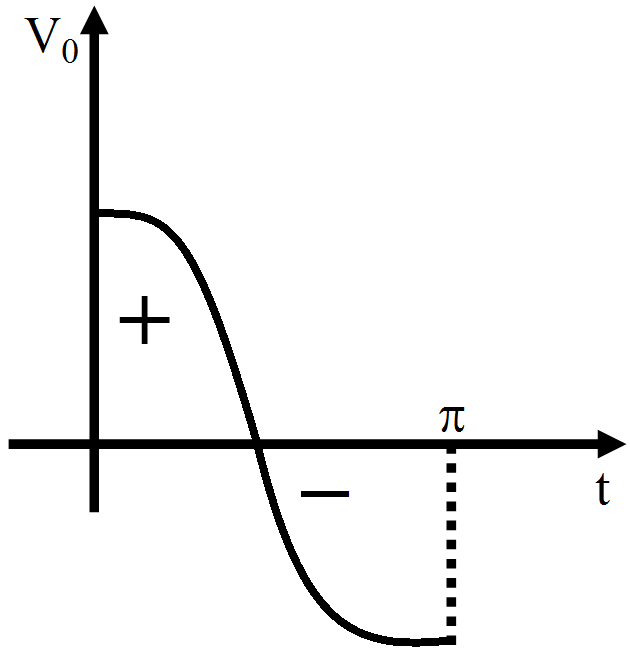
$\text{V}_\text{avg}=\frac{\int\limits_0^{0.01}\text{V}\text{dt}}{\int\limits_0^{0.01}\text{dt}}$
$=\text{V}_0\Big(\frac{1\cos\omega\text{t}}{\omega}\Big)_0^{0.01}$
$=\frac{\text{V}_0}{\omega\times0.01}\big(1-\cos\omega(0.1)\big)$
$=\frac{\text{V}_0}{314\times0.01}\big(1-\cos(314\times0.01)\big)$
$=\frac{\text{V}_0}{3.14}\big(1-\cos(314)\big)$
$=\frac{\text{V}_0}{3.14}\big(1-\cos\pi\big)$
$=\frac{2\text{V}_0}{\pi}=140.127\text{volt}$

if $\text{V}=\text{V}_0\cos\omega\text{t}$
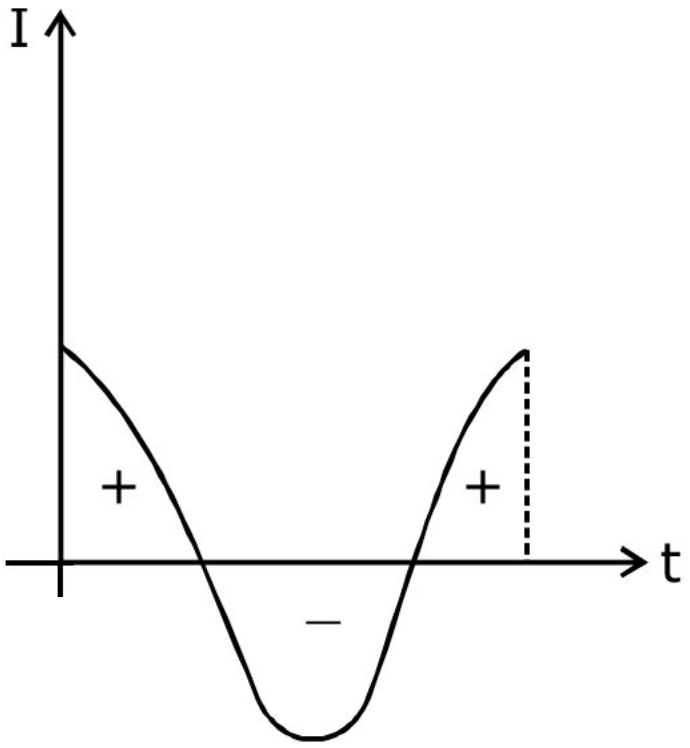
$\text{V}_\text{avg}=\frac{\int\text{V d}\rho}{\int\text{dt}}=0$
Explanation:
Average power $\text{P}_\text{av}=\text{V}_\text{rms}\text{I}_\text{rms}\cos\phi$
$=100\times10\cos\phi$
$\text{P}_\text{av}=1000\cos\phi$
$\therefore\ \cos\phi$ lies "0 to 1".
$\Rightarrow\ 0\leq\text{P}_\text{av}\leq1000.$
50Hz.
Explanation:
Frequency of the source is remain constant = 50Hz.
Explanation:
$\text{Q}=\text{C}\in=\in_{0}\text{C}\Big[\cos\big(100\pi\text{s}^{-1}\big)\text{t}+\cos\big(500\pi\text{s}^{-1}\big)\text{t}\Big]$
$\text{i}=\frac{\text{dQ}}{\text{dt}}$
$\text{Q}=\text{C}\in=\in_{0}\text{C}\Big[\cos\big(100\pi\text{s}^{-1}\big)\text{t}+\cos\big(500\pi\text{s}^{-1}\big)\text{t}\Big]$
$\in_0\text{C}\times100\pi\Big[\sin\big(100\pi\text{s}^{-1}\big)\text{t}\Big]\\+\in_0\text{C}\times500\pi\Big[\sin\big(500\pi\text{s}^{-1}\big)\text{t}\Big]$
$=100\text{C}\pi\in_0\cos\Big[\big(100\pi\text{s}^{-1}\big)\text{t}+\phi_1\Big]\\+500\text{C}\pi\in_0\cos\Big[\big(500\pi\text{s}^{-1}\big)\text{t}+\phi_2\Big]$
$\text{i}_1=100\pi\in_0\text{C}$ and $\text{i}_2=500\pi\in_0\text{C}$
$\text{i}_2>\text{i}_1$
Explanation:
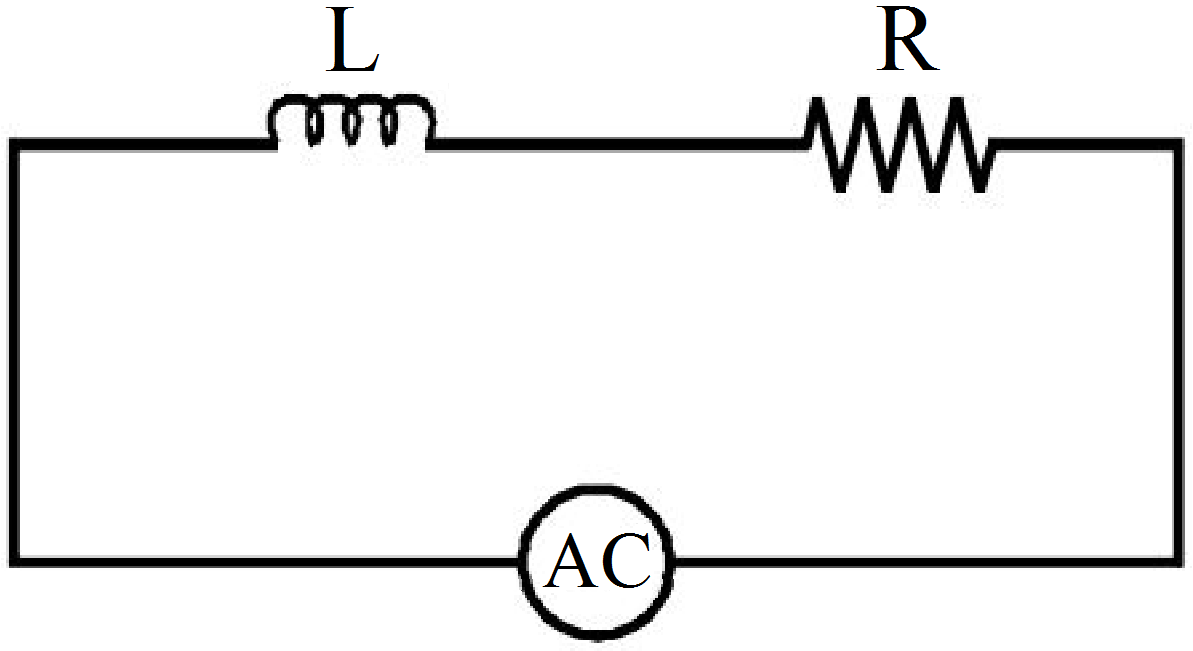
$\text{Z}=\sqrt{\text{R}^2+\text{X}^2}$
$\text{R}=4\Omega,\text{X}=3\Omega$
$=\text{Z}=\sqrt{4^2+3^2}=5\Omega$
Pure inductor.
Pure capacitor.
Explanation:
Instantaneous current is zero when the intantaneous voltage is maximum.
Mean resistance = 0.
Explanation:
$\text{V}_\text{rms}=220\text{V}$
$\text{V}_\text{p}=\sqrt{2}\times\text{V}_\text{rms}$
$=220\times1.414=311\text{volt}$
Explanation:
Transformers are used in AC circuits only.
Explanation:
$\text{X}=0$ (Given)
$\text{X}=\text{X}_\text{L}+\text{X}_\text{C}$
$=\omega\text{L}-\frac{1}{\omega\text{C}}=0$
It is possible that the circuit contains an inductor and a capacitor.
Explanation:
$\text{I}=\text{I}_0\sin\omega\text{t}$


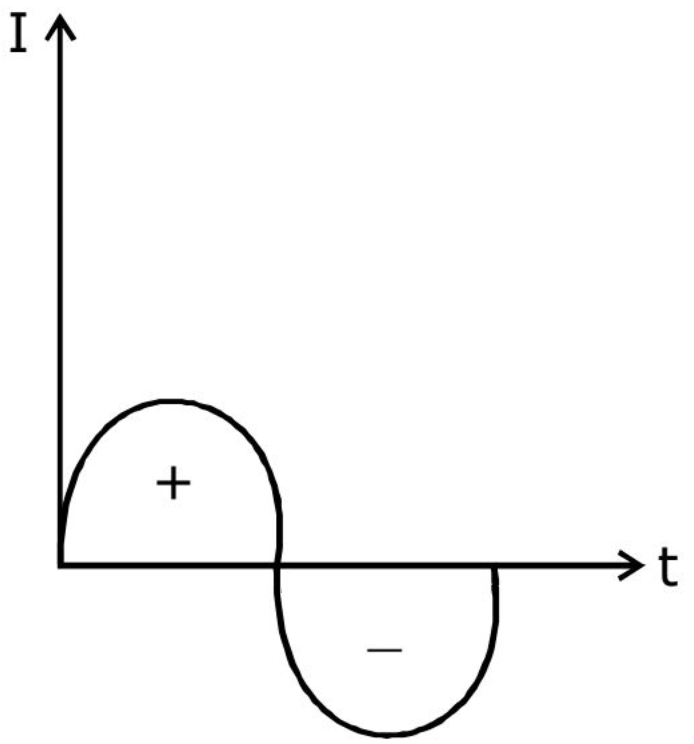
Average value of current over a cycle = 0
$\text{V}=\text{V}_0\cos\omega\text{t}$
$=\text{V}_0\sin\bigg(\omega\text{t}+{\frac{\pi}{2}}\bigg)$

Average value of induced emf in inductor over a cycle = 0.
Explanation:
$\text{X}_\text{L}=\omega\text{L}$
$\text{X}_\text{C}=\frac{1}{\omega\text{C}}$
If frequency increases that causes 'XL' raction of inductor increases and 'XC' reactance of capacitor decreses.
Explanation:
$\text{X}_\text{C}\frac{1}{\omega\text{C}}=\frac{1}{0\times\text{C}}$ $\bigg\{\text{in}\stackrel{{\text{DC}}}{{\omega = 0 }}\bigg\}$
$=\infty$
Explanation:
$\text{i}=\text{i}_1\cos\omega\text{t}+\text{i}_2\sin\omega\text{t}$
$\text{I}_\text{rms}=\frac{\int\limits_0^\text{T}\text{I}^2\text{dt}}{\int\limits_0^\text{T}\text{dt}}$
if $\text{I}=\cos\omega\text{t}$
$\text{I}_\text{rms}^2=\frac{\text{I}_0^2}{2}$
$\text{i}=\text{i}_1\cos\omega\text{t}+\text{i}_2\sin\omega\text{t}$
Than $\text{i}_\text{rms}^2=\frac{\text{i}_1^2}{2}+\frac{\text{i}_2^2}{2}$
$\text{i}_\text{rms}=\sqrt{\frac{\text{i}_1^2+\text{i}_2^2}{2}}$
Explanation:
DC dynamo or AC dynamo use to convert mechnical energy into electrial energy.
Explanation:
A constant current exists in a resistor is rms current it is equal to 2.8Amp.