A stone is fastened to one end of a string and is whirled in a vertical circle of radius R. Find the minimum speed the stone can have at the highest point of the circle.
Question types
Circular Motion question types
40 questions across 5 question groups — pick any mix to generate a Physics paper with step-by-step answer keys.
40
Questions
5
Question groups
5
Question types
01
1 Marks Question
3 Q→02Short Answer Type Questions [2M]
8 Q→033 Marks Question
14 Q→044 Marks Questions
5 Q→05Long Answer Type Questions [5M]
10 Q→Sample Questions
Circular Motion questions
One sample from each question group in this chapter. Select any group above to see the full set with answer keys.
View full solution →
Is it necessary to express all angles in radian while using the equation $\omega=\omega_0+\text{at}?$
View full solution →A scooter weighing 150kg together with its rider moving at 36km/ hr is to take a turn of radius 30m. What horizontal force on the scooter is needed to make the turn possible?
A heavy mass m is hanging from a string in equilibrium without breaking it. When this same mass is set into oscillation, the string breaks. Explain.
Suppose the amplitude of a simple pendulum having a bob of mass m is $\theta_0.$ Find the tension in the string when the bob is at its extreme position.
View full solution →You are driving a motorcycle on a horizontal road. It is moving with a uniform velocity. Is it possible to accelerate the motoreyle without putting higher petrol input rate into the engine?
A circular road of radius 50m has the angle of banking equal to 30°. At what speed should a vehicle go on this road so that the friction is not used?
The bob of a simple pendulum of length 1m has mass 100g and a speed of 1.4m/s at the lowest point in its path. Find the tension in the string at this instant.
Consider the circular motion of the earth around the sun. Which of the following statements is more appropriate?
- Gravitational attraction of the sun on the earth is equal to the centripetal force.
- Gravitational attraction of the sun on the earth is the centripetal force.
Find the acceleration of the moon with respect to the earth from the following data:
Distance between the earth and the moon = 3.85 × 10⁵km and the time taken by the moon to complete one revolution around the earth = 27.3 days.
Distance between the earth and the moon = 3.85 × 10⁵km and the time taken by the moon to complete one revolution around the earth = 27.3 days.
If the horizontal force needed for the turn in the previous problem is to be supplied by the normal force by the road, what should be the proper angle of banking?
A ceiling fan has a diameter (of the circle through the outer edges of the three blades) of 120cm and rpm 1500 at full speed. Consider a particle of mass 1g sticking at the outer end of a blade. How much force does it experience when the fan runs at full speed? Who exerts this force on the particle? How much force does the particle exert on the blade along its surface?
Find the acceleration of a particle placed on the surface of the earth at the equator due to earth's rotation. The diameter of earth = 12800km and it takes 24 hours for the earth to complete one revolution about its axis.
A bird while flying takes a left turn, where does it get the centripetal force from?
A small coin is placed on a record rotating at $33\frac{1}{3}$ rev/ minute. The coin does not slip on the record. Where does it get the required centripetal force from?
View full solution →Some washing machines have cloth driers. It contains a drum in which wet clothes are kept. As the drum rotates, the water particles get separated from the cloth. The general description of this action is that "the centrifugal force throws the water particles away from the drum". Comment on this statement from the viewpoint of an observer rotating with the drum and the observer who is washing the clothes.
A car driver going at some speed v suddenly finds a wide wall at a distance r. Should he apply brakes or turn the car in a circle of radius r to avoid hitting the wall?
After a good meal at a party you wash your hands and find that you have forgotten to bring your handkerchief. You shake your hands vigorously to remove the water as much as you can. Why is water removed in this process?
A car goes on a horizontal circular road of radius R, the speed increasing at a constant rate $\frac{\text{d}\nu}{\text{dt}}=\text{a}.$ The friction dt coefficient between the road and the tyre is $\mu.$ Find the speed at which the car will skid.
View full solution →A person stands on a spring balance at the equator.
- By what fraction is the balance reading less than his true weight?
- If the speed of earth's rotation is increased by such an amount that the balance reading is half the true weight, what will be the length of the day in this case?
A track consists of two circular parts ABC and CDE of equal radius 100m and joined smoothly as shown in figure. Each part subtends a right angle at its centre. A cycle weighing 100 kg together with the rider travels at a constant speed of 18km/h on the track.
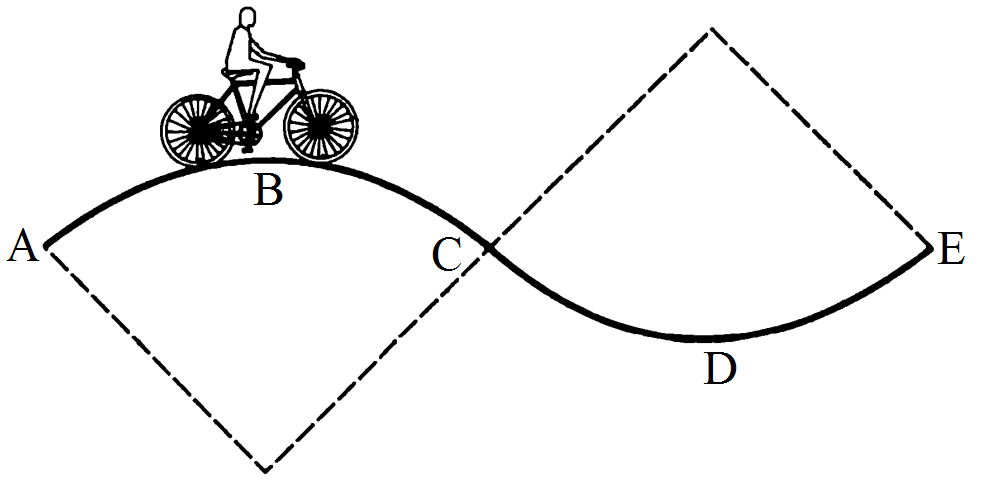
- Find the normal contact force by the road on the cycle when it is at B and at D.
- Find the force of friction exerted by the track on the tyres when the cycle is at B, C and D.
- Find the normal force between the road and the cycle just before and just after the cycle crosses C.
- What should be the minimum friction coefficient between the road and the tyre, which will ensure that the cyclist can move with constant speed? Take g= 10m/s2.
A table with smooth horizontal surface is fixed in a cabin that rotates with a uniform angular velocity $\omega$ in a circular path of radius R (In figure). A smooth groove AB of length L(<<R) is made on the surface of the table. The groove makes an angle $\theta$ with the radius OA of the circle in which the cabin rotates. A small particle is kept at the point A in the groove and is released to move along AB. Find the time taken by the particle to reach the point B.

View full solution →A block of mass m is kept on a horizontal ruler. The friction coefficient between the ruler and the block is g. The ruler is fixed at one end and the block is at a distance L from the fixed end. The ruler is rotated about the fixed end in the horizontal plane through the fixed end.
View full solution →- What can the maximum angular speed be for which the block does not slip?
- If the angular speed of the ruler is uniformly increased from zero at an angular acceleration $\alpha,$ at what angular speed will the block slip?
Generate a Circular Motion paper free
Pick question groups from the list above, set marks and difficulty, and export a branded PDF with step-by-step answer keys. First 3 chapters free — no signup.