Question 13 Marks
What do you mean by colour code of carbon resistance ?
Answer
View full question & answer→Carbon resistors are too small in size to mark the value of their resistances on them. Therefore a colour code is used to indicate the resistance value and its percentage accuracy i.e. tolerence. The resistor has a set of four co-axial coloured rings of different colours on it.
First three rings (I, II, III) are made near one end of the cylinder and are close to each other. Fourth ring (IV) is made near the other end of the cylinder and its colour is either silver or gold. In carbon resistors of very small size all the four rings are very close to each other.
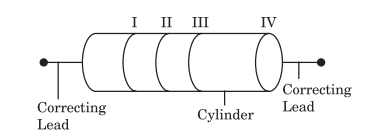
The colour of first two rings (bands) I, II, indicates the first two significant figures of the value of resistance of the resister in ohm. Third band (III) indicates the decimal multiplier i.e. the multiplier of power of 10. Fourth band (IV) indicates tolerance i.e. possible variation in percent about the indicated value of the resistance. Gold colour of IV band represents tolerance of ± 5% and silver colour of this band represents the tolerance of ± 10%, If fourth band is not made on the resister it means its tolerance will be $\pm 20$%.
$\therefore \quad$ Resistance $=\left[\right.$ I II × $1 0 ^{\text {III }} \pm$ IV $\left.\%\right]$
First three rings (I, II, III) are made near one end of the cylinder and are close to each other. Fourth ring (IV) is made near the other end of the cylinder and its colour is either silver or gold. In carbon resistors of very small size all the four rings are very close to each other.
The colour of first two rings (bands) I, II, indicates the first two significant figures of the value of resistance of the resister in ohm. Third band (III) indicates the decimal multiplier i.e. the multiplier of power of 10. Fourth band (IV) indicates tolerance i.e. possible variation in percent about the indicated value of the resistance. Gold colour of IV band represents tolerance of ± 5% and silver colour of this band represents the tolerance of ± 10%, If fourth band is not made on the resister it means its tolerance will be $\pm 20$%.
$\therefore \quad$ Resistance $=\left[\right.$ I II × $1 0 ^{\text {III }} \pm$ IV $\left.\%\right]$