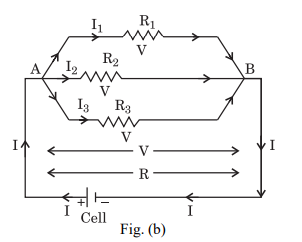
Question 14 MarksEstablish the expression for equivalent parallel combination of resistance separately.AnswerResistances in Parallel Combination : "A number of resistors are said to be connected in parallel combination when they are arranged in such a way that their first ends are joined at one point and the second ends at another point."In this combination when some potential difference is applied across the ends of the combination, by connecting a cell between these points, then the potential difference between the ends of all the resistors is the same as that of applied potential difference but electric current in different resistors is different according to their resistance. The sum of individual currents is equal to the main current in the circuit.In Fig. (b) three resistors of resistances $ R_1, R_2 $ and $ R_3 $ are connected in parallel combination between two pointsA and B. When a potential difference V is applied between these points by connecting a cell between the points, then let the current drawn from the cell in the circuit be I. The potential difference across the ends of individual resistors will also be V. At point A the current I is divided into three parts. Let $ I_1, I_2, $ and $ I_3 $ be the electric current in the resistors of the resistances $ R_1, R_2 $ and $ R_3 $, respectively. Let R be the equivalent resistance of this parallel combination.According to Ohm's law,$ V = IR \Rightarrow I = V/R $and $ I_1 = V/R_1, I_2 = V/R_2 $ and $ I_3 = V/R_3 $But in parallel combination:$ I = I_1 + I_2 + I_3 $$ \Rightarrow \frac{V}{R} = \frac{V}{R_1} + \frac{V}{R_2} + \frac{V}{R_3} $$ \Rightarrow \frac{1}{R} = \frac{1}{R_1} + \frac{1}{R_2} + \frac{1}{R_3} $"Thus the reciprocal of the equivalent resistance of the resistances of resistors connected in parallel is equal to the sum of the reciprocals of the individual resistances. The value of the equivalent resistance is always less than the value of the smallest resistance in the combination."View full question & answer→
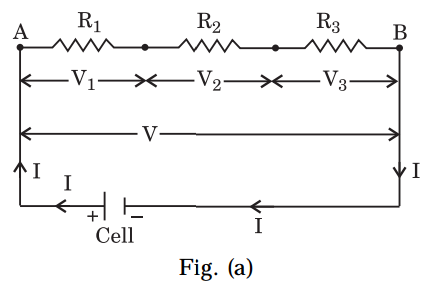
Question 24 MarksEstablish the expression for equivalent resistance of series combination and parallel combination of resistance separately.Answer(a) Resistances in series combination : "A number of resistors are said to be connected in series combination if they are connected end to end."In this combination when some potential difference is applied across the ends of the combination the same current flows through each of the resistors. But potential difference across each of the resistors is different and the sum of the potential difference across the individual resistors is equal to the potential difference applied across the combination.In fig. (a) the series combination of three resistors having resistances $R _1, \quad R _2$ and $R _3$ is shown, when a potential difference V is applied across the ends A and B of the combination by connecting a cell between these points, let the current flowing through all the resistors be I. Suppose that the potential difference across the individual resistors of resistance $R _1, \ R _2$ and $R _3$ are $V _1, \ V _2$ and $V _3$ respectively. Then, according to Ohm's law,$V _1= IR _1, V_2= IR _2$ and $V _3= IR _3$Let the equivalent resistance of the combination be R, then according to Ohm's law,V = IR.But for series combination :$V=V_1+V_2+V_3$$\Rightarrow \quad IR = IR _1+ IR _2+ IR _3$$\Rightarrow \quad R = R _1+ R _2+ R _3$The same argument may be applied to the series combination of any number of resistors. Hence$R = R _1+ R _2+ R _3+\ldots \ldots+ R _i \Rightarrow R =\sum_{i=1}^n R _i$"Thus, equivalent resistance of series combination of any number of resistors is equal to the sum of their individual resistances and is always greater than the value of resistance of individual resistors."View full question & answer→