Questions · Page 1 of 4

M.C.Q [1M]

🎯

Test yourself on this topic

50 questions · timed · auto-graded

MCQ 11 Mark
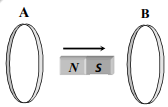
In the diagram shown if a bar magnet is moved along the common axis of two single turn coils A and B in the direction of arrow then-
Image
  • A
    Current is induced only in A.
  • B
    Current is induced only in B.
  • C
    Induced currents in A and B are in the same directions
  • Induced currents in A and B are in opposite directions
Answer
Correct option: D.
Induced currents in A and B are in opposite directions
D
View full question & answer
MCQ 21 Mark
The self-inductance of a solenoid is L. Keeping the length and area same, the number of turns in the coil is increased to two times. The self-inductance of the solenoid will now be-
  • A
    $\frac{ L }{4}$
  • 4 L
  • C
    16 L
  • D
    $\frac{ L }{16}$
Answer
Correct option: B.
4 L
B
View full question & answer
MCQ 31 Mark
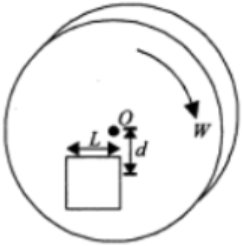
Find the approximate value of induced current assuming the resistance to the current is confined to the square.
Image
  • A
    $\frac{\text{BL}\omega\text{dt}}{\rho}$
  • B
    $\frac{\text{BL}^2\omega\text{dt}}{\rho}$
  • C
    $\frac{\text{BL}^2\omega\text{d}}{\rho}$
  • D
    $\frac{\text{BL}\omega\text{d}^2}{\rho}$
Answer
  1. $\frac{\text{BL}\omega\text{dt}}{\rho}$

Explanation:

$\text{emf},\in=\frac{\text{d}\phi}{\text{dt}}=\text{BL}^2\omega$

$\text{I}=\frac{\in}{\text{R}}=\frac{\text{BL}^2\omega}{\rho\frac{\text{L}}{\text{dt}}}=\frac{\text{BL}\omega\text{dt}}{\rho}$

View full question & answer
MCQ 41 Mark
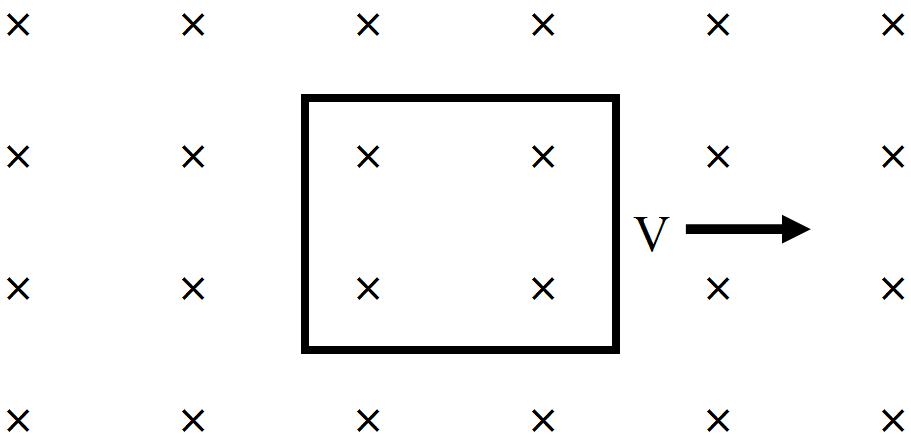
A conducting square loop of side l and resistance R moves in its plane with a uniform velocity u perpendicular to one of its sides. A uniform and constant magnetic field B exists along the perpendicular to the plane of the loop as shown in figure. The current induced in the loop is:

  • A
    $\frac{\text{Blv}}{\text{R}}$ clockwise.
  • B
    $\frac{\text{Blv}}{\text{R}}$ anticlockwise.
  • C
    $\frac{2\text{Blv}}{\text{R}}$ anticlockwise.
  • D
    $\text{Zero.}$
Answer
  1. $\text{Zero.}$

Explanation:

Induced emf is AB is Bvl and Induced emf is DC is also Bvl.

Net emf in the closed circuit (loop) is zero.

So induced current in the loop is zero.

View full question & answer
MCQ 51 Mark
A coil of area 80cm2 and number of turns 50 is rotating about an axis perpendicular to a magnetic field of 0.05 Tesla at 2000 rotations per minute. The maximum value of emf induced in it will be.
  • A
    $200\pi\text{ volt}$
  • B
    $\frac{10\pi}{3}\text{volt}$
  • C
    $\frac{4\pi}{3}\text{volt}$
  • D
    $\frac{2}{3}\text{volt}$
Answer
  1. $\frac{4\pi}{3}\text{volt}$

Explanation:

$\text{Max.emf = nAB}\omega$

$=50\times0.008\times0.05\times2000\frac{2\pi}{60}=\frac{4\pi}{3}\text{V}$

View full question & answer
MCQ 61 Mark
The self-inductance of a long solenoid carrying current is independent of:
  • A
    its length
  • B
    the current
  • C
    its cross-sectional area
  • D
    magnetic permeability of the core
Answer
  1. the current

Explanation:

Self-inductance of a solenoid is given by $\text{L}=\frac{\mu_0\text{N}^2\text{A}}{1}$

where, N = number of turns in solenoid

l = length of the solenoid

A = area of one turn of solenoid.

The self-inductance of solenoid does not depend on current passing through it.

View full question & answer
MCQ 71 Mark
The coefficient of mutual inductance of the two coils is 5H. The current through the primary coil is reduced to zero value from 3A in 1millisecond. The induced emf in the secondary coils is.
  • A
    zero
  • B
    1.67KV
  • C
    15KV
  • D
    600V
Answer
  1. 15KV

Explanation:

Flux linking the secondary coil due to current in primary = Mi1​ 

induced emf in the secondary coils = rate of change of flux

$=\text{M}\frac{\triangle\text{i}_1}{\triangle\text{t}}$

$=5\times\frac{3-0}{0.001}$

$=15\text{kv}$

View full question & answer
MCQ 81 Mark
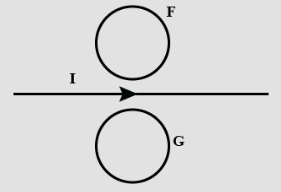
Two conducting circular loops F and G are kept in a plane on either side of a straight current-carrying wire as shown in the figure below. If the current in the wire decreases in magnitude, the induced current in the loops will be.

  • A
    clockwise in F and clockwise in G.
  • B
    anti-clockwise in F and clockwise in G.
  • C
    clockwise in F and anti-clockwise in G.
  • D
    anti-clockwise in F and anti-clockwise in G.
Answer
  1. anti-clockwise in F and clockwise in G.

Explanation:

The magnetic field above the wire is out of the plane. This flux is decreasing and should be compensated by the current in the loop F and so the current in loop F will be anti-clockwise. For loop G the situation is opposite

View full question & answer
MCQ 91 Mark
A conducting disc of radius r spins about its axis with an angular velocity ω. There is a uniform magnetic field of magnetude B perpendicular to the plane of the disc. C is the centre of the ring.
  • A
    No emf is induced in the disc.
  • B
    The potential difference between C and the rim is $\frac{1}{3}\text{Br}^2\omega$
  • C
    C is at a higher potential than the rim.
  • D
    Current flows between C and the rim.
Answer
  1. The potential difference between C and the rim is $\frac{1}{3}\text{Br}^2\omega$
  2. C is at a higher potential than the rim.
View full question & answer
MCQ 101 Mark
The two rails of a railways track, insulated from each other and the ground, are connected to a milli voltmeter. What is the reading of the milli voltmeter when a train travels at a speed of 20 ms-1 along the track, given that the vertical component of the earth's magnetic field is 0.2 × 10-4 Wbm-2 and the rails are separated by 1m?
  • A
    4mV
  • B
    0.4mV
  • C
    80mV
  • D
    10mV
Answer
  1. 0.4mV

Explanation:

emf = Blv

= 0.2 × 10-4 × 1 × 20

= 0.4mV

View full question & answer
MCQ 111 Mark
Comment on the statement given below:
In self-inductionWhen the current in a coil is increasing, induced emf opposes it
When the current in a coil is decreasing, induced emf supports it
  • A
    A is true, B is false
  • B
    A and B are false
  • C
    A and B are true
  • D
    A is false, B is true
Answer
  1.  A is true, B is false

Explanation:

In self-induction,induced emf always opposes when the current in a coil is changing either increasing or decreasing.

So, A is true, B is false because when the current in a coil is increasing or decreasing, induced emf opposes it.

View full question & answer
MCQ 121 Mark
A car moves up a plane road. The induced emf in the axle connecting the two wheels is maximum when it moves.
  • A
    At the poles
  • B
    At equator
  • C
    Remains stationary
  • D
    No emf is induced at all
Answer
  1. At the poles

Explantion:

Induced emf in the axle = Blv

v - velocity of car

l - length of car

B - component of magnetic field perpendicular to both l and v. 

That is B is the vertical component of magnetic field.

Vertical component of magnetic field is maximum at the poles.

Therefore emf induced in the axle will be maximum at the poles.

View full question & answer
MCQ 131 Mark
Unit of induced emf is:
  • A
    ampere
  • B
    volt
  • C
    joule
  • D
    electron volt
Answer
  1. volt

Explanation:

Induced emf is potential difference only, hence its unit is volt only.

View full question & answer
MCQ 141 Mark
Two circular coils can be arranged in any of the three situations shown in the figure. Their mutual inductance will be.
Image
  • A
    maximum in situation (A)
  • B
    maximum in situation (B)
  • C
    maximum in situation (C)
  • D
    the same in all situations
Answer
  1. maximum in situation (A)
View full question & answer
MCQ 151 Mark
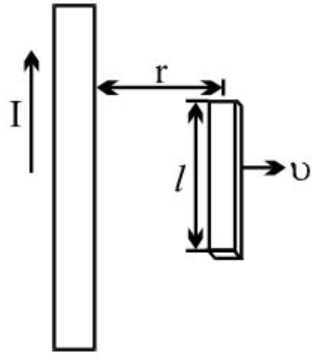
A long metal bar of 30cm length is aligned along a north south line and moves eastward at a speed of 10ms-1. A uniform magnetic field of 4.0T points vertically downwards. If the south end of the bar has a potential of 0V, the induced potential at the north end of the bar is:
Image
  • A
    +12V
  • B
    -12V
  • C
    0V
  • D
    cannot be determined since there is not closed circuit
Answer
  1. +12V

Explanation:

induced emf = Blv = 12V. It is induced in the northward direction by right hand rule $\big(\text{emf}=\overrightarrow{\text{V}}\times\overrightarrow{\text{B}}\big)$

therefore if south end of pole has potential of 0V, north end will have a potential of 12V

View full question & answer
MCQ 161 Mark
The self induction takes place when magnetic flux through a coil:
  • A
    Remains steady
  • B
    Decreases
  • C
    Increases
  • D
    Either (B) or (C)
Answer
  1. Either (B) or (C)

Explanation:

As per Faradays law, EMF is always directly proportional to the rate of change of magnetic flux. Therefore, electromagnetic induction takes place whenever the magnetic flux passing through the object changes.

View full question & answer
MCQ 171 Mark
What is the SI unit of self-inductance?
  • A
    Henry
  • B
    Tesla
  • C
    Weber
  • D
    Gauss
Answer
  1. Henry

Explanation:

Henry (symbol H) is the SI derived unit of self-inductance. 

View full question & answer
MCQ 181 Mark
The self inductance of a straight conductor is.
  • A
    Zero
  • B
    Infinity
  • C
    Very large
  • D
    Very small
Answer
  1. Zero

Explanation:

Since there are no enclosed loops in a straight inductor the inductance of straight inductor is zero. 

View full question & answer
MCQ 191 Mark
The magnetic flux in a coil of 100 turns increases by 12 × 103 Maxwell in 0.2 second due to the motion of a magnet. The emf induced in the coil will be.
  • A
    6 V
  • B
    0.6 V
  • C
    0.06 V
  • D
    60 V
Answer
  1. 0.06 V

Explanation:

emf = rate of change of flux × number of turns $=\frac{12\times10^3\times10^{-8}}{0.2}\times100=0.06\text{V}$

emf = rate of change of flux × number of turns.

View full question & answer
MCQ 201 Mark
Check the incorrect statement: When a magnet is moved into a coil the strength of the current depends on:
  • A
    The number of turns in the coil
  • B
    The speed with which the magnet moves
  • C
    The resistance of the coil
  • D
    None of the above
Answer
  1. None of the above

Explanation:

According to Faraday's Law when the magnetic flux linking a circuit changes, an electromotive force is induced in the circuit proportional to the rate of change of the flux linkage.

View full question & answer
MCQ 211 Mark
An average emf of 32V is induced in a coil in which the current drops from 10A to 2A in 0.1s. The inductance of the coil is:
  • A
    0.32H
  • B
    0.4H
  • C
    4H
  • D
    0.04H
Answer
  1. 0.4H

Explanation:

$\text{emf}=\text{L}\frac{\text{di}}{\text{dt}}$

$\text{emf}=\text{L}\frac{\triangle\text{i}}{\triangle\text{i}}$

So, $\text{L}=\text{emf}\times\frac{\triangle\text{t}}{\triangle\text{i}}$

$=32\times\frac{0.1}{8}$

$=0.4\text{H}$

View full question & answer
MCQ 221 Mark
In the field of electromagnetism, the term 'EMI' stands for:
  • A
    Electromotive Impact
  • B
    Electromagnetic Induction
  • C
    Electromotive inertia
  • D
    none of these
Answer
  1. Electromagnetic Induction

Explanation:

In the field of electromagnetism, the term EMI stands for Electro Magnetic Induction.

View full question & answer
MCQ 231 Mark
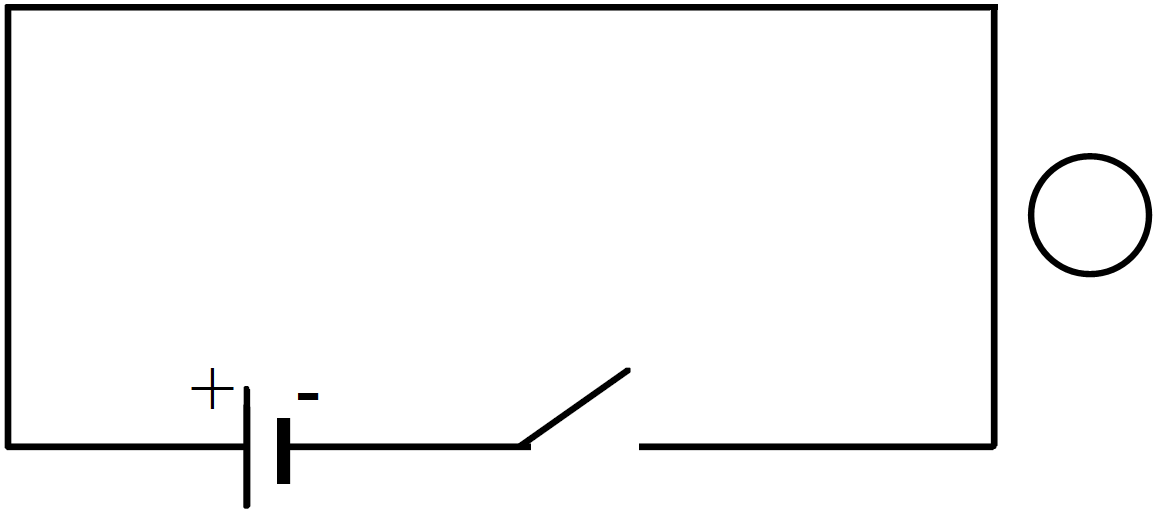
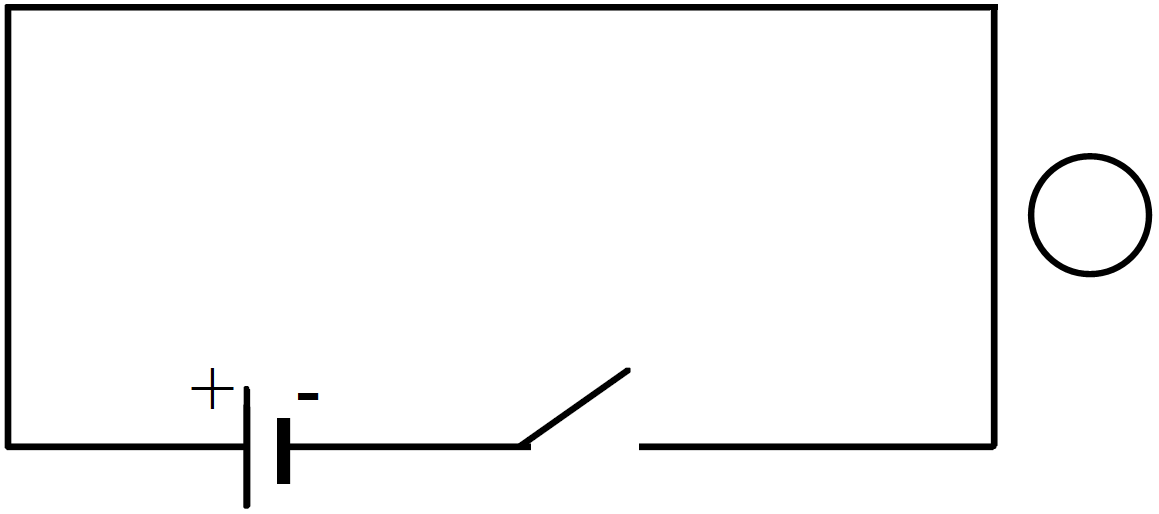
Consider the situation shown in figure. If the switch is closed and after some time it is opened again, the closed loop will show:
  • A
    An anticlockwise current-pulse.
  • B
    A clockwise current-pulse.
  • C
    An anticlockwise current-pulse and then a clockwise current-pulse.
  • D
    A clockwise current-pulse and then an anticlockwise current-pulse.
Answer
  1. A clockwise current-pulse and then an anticlockwise current-pulse.

Explanation:

When the switch is closed than a clock wise current pulse generated (Because initially current flow the terminal to negative terminal).

Due to Mutual Induction, current is generated in the loop. If circuit is open after some time. Dut to loop an anticlock wise current pulse generated in the circuit.

View full question & answer
MCQ 241 Mark
A conducting rod of length L is falling with velocity v perpendicular to a uniform horizontal magnetic field B. The potential difference between its two ends will be.
  • A
    2BLv
  • B
    BLv
  • C
    $\frac{1}{2}\text{BLv}$
  • D
    (BLv)2
Answer
  1. BLv

Explanation:

Force on a charge q in the rod = qvB

electric field inside the rod due to displacements of charges due to force by relative motion in magnetic field $=\frac{\text{emf}}{1}$

As the rod moves in constant velocity, net force of constituent charge q in the rod = 0 

Therefore,

$\text{q}\frac{\text{emf}}{1}=\text{qvB}$

$\Rightarrow\text{emf}=\text{BIv}$

View full question & answer
MCQ 251 Mark
The area of a coil is 500cmand the number of turns in it is 2000. It is kept perpendicular to a magnetic field of induction 4 × 10⁻⁵Wb/ m2. The coil is rotated through 180 in 0.1 second. If the resistance of the total circuit is 20Ω, then the value of the induced charge flowing in the circuit will be :
  • A
    1 × 10⁻⁴
  • B
    2 × 10⁻⁴
  • C
    3 × 10⁻⁴
  • D
    4 × 10⁻⁴
Answer
  1. 4 × 10⁻⁴

Explanation:

Initial flux through the coil, $=\text{BA}\cos\theta$

$=\text{BA}\cos0^\circ$ as the coil is perpendicular to magnetic field

= BA Wb

Final flux after the rotation,

$=\text{BA}\cos180^\circ$ the coil is rotated through 180°

=-BA Wb

Therefore, estimated value of the induced emf (E) as per Faraday's law is,

$\text{E}=\frac{\text{N}}{\text{t}}=\frac{\text{N}(\text{BA-(-BA}))}{\text{t}}=\frac{\text{2NBA}}{\text{t}}........(\text{i})$

Further, $\text{E}=\text{IR}=\frac{\text{QR}}{\text{t}}............(\text{ii})$

From (i) & (ii)

$\text{Q}=\frac{\text{2NBA}}{\text{R}}=\frac{2\times2000\times4\times10^{-5}\times500\times10^{-4}}{20}=4\times10^{-4}\text{C}$

View full question & answer
MCQ 261 Mark
When the current changes from +2A to -2A in 0.05 second, an e.m.f. of 8V is induced in a coil. The coefficient of self-induction of the coil is:
  • A
    0.2H
  • B
    0.4H
  • C
    0.8H
  • D
    0.1H
Answer
  1. 0.1H

Explanation:

lf e is the induced e.m.f. in the coil, then $\text{e}=\text{-L}\frac{\text{di}}{\text{dt}}$

$\therefore\text{L}=-\frac{\text{e}}{\frac{\text{di}}{\text{dt}}}$

Substituting values, we get $\text{L}=\frac{-8\times0.05}{-4}=0.1\text{H}$

View full question & answer
MCQ 271 Mark
The self inductance L of a solenoid of length l and area of crosssection A, with a fixed number of turns N increases as:
  • A
    l and A increase.
  • B
    l decreases and A increases.
  • C
    l increases and A decreases.
  • D
    Both l and A decrease.
Answer
  1. l decreases and A increases.

Solution:

Key concept: The self inductance L of a solenoid depends on various factor like geometry and magnetic permeability of the core material.

$\text{L}=\mu_\text{r}\mu_0\text{n}^2\text{Al}$

where, $\text{n}=\frac{\text{N}}{\text{l}}$ (no. of turns per unit length)

  1. No. of turns: Larger the number of turns in solenoid, larger is its self inductance.
  2. Area of cross section: Larger the area of cross section of the solenoid, larger is its self inductance.
  3. Permeability of the core material. The self inductance of a solenoid increases μr times if it is wound over an iron core of relative permeability μr.

The long solenoid of cross-sectional area A and length l, having A turns, filled inside of the solenoid with a material of relative permeability (e.g., soft iron, which has a high value of relative permeability) then its self inductance is $\text{L}=\mu_\text{r}\mu_0\text{n}^2\frac{\text{A}}{\text{l}}$.

So, the self inductance L of a solenoid increases as l decreases and A increases because L is directly proportional to area and inversely proportional to length.

Important point: The self and mutual inductance of capacitance and resistance depend on the geometry of the devices as well as permittivity/permeability of the medium.

View full question & answer
MCQ 281 Mark
The induction coil works on the principle of.
  • A
    Self-induction
  • B
    Mutual induction
  • C
    Ampere's rule
  • D
    Fleming's right hand rule
Answer
  1. Mutual induction

Explanation:

Induction coil works on the principle of mutual induction that an emf or current is induced in the second coil if the magnetic flux due to first coil linked with the second coil changes.

View full question & answer
MCQ 291 Mark
Two coils of self inductances 2 mH and 8 mH are placed so close together that the effective flux in one coil is completely linked with the other. The mutual inductance between these coils is:
  • A
    10 mH
  • B
    6 mH
  • C
    4 mH
  • D
    16 mH
Answer
  1. 4 mH

Explanation:

Given,

L1​ = 2mH

L2 ​= 8mH

The mutual inductance between coil is

$\text{M}=\sqrt{\text{L}_1\text{L}_2}$

$\text{M}=\sqrt{2\times8}=16\text{mH}$

$\text{M}=4\text{mH}$

View full question & answer
MCQ 301 Mark
The area of the coil must be._____
  • A
    1.8m2
  • B
    18m2
  • C
    8m2
  • D
    none of these
Answer
  1. 18m2

Explanation:

Flux through a circular coil $\phi=\text{NBA}\cos\omega\text{t}$

Voltage required $\in=\frac{-\text{d}\phi}{\text{dt}}$

$\Rightarrow9=\text{NBA}\omega\sin\omega\text{t}$

$9=\frac{8\times10^{-5}\times\text{A}\times30\times2\pi\times2000}{60}$

$\text{A}=\frac{9\times10^5}{50\times10^3}=18\text{m}^2$

View full question & answer
MCQ 311 Mark
Change in number of magnetic field lines induces.
  • A
    current in coil
  • B
    EMF in the coil
  • C
    frequency in coil
  • D
    both A and C
Answer
  1. EMF in the coil

Explanation:

As per Faraday's law, the change in magnetic flux associated with coil produces an EMF in the coil. Whenever there is a change in magnetic flux associated with a coil, an EMF is induced in the coil. Magnetic flux is defined as the number of field lines passing normally through a given area. When magnetic flux changes, obviously, it means that, the number of magnetic field lines change.

View full question & answer
MCQ 321 Mark
If a spark is produced on removing the load from an AC circuit then the element connected in the circuit is.
  • A
    high resistance
  • B
    high capacitance
  • C
    high inductance
  • D
    high impedance
Answer
  1. high inductance

Explanation:

On removal of load from the circuit, the circuit suddenly becomes an open circuit.

Thus $\frac{\text{di}}{\text{dt}}\rightarrow\infty$

For sparking, high voltage must appear across the open ends. This will happen only in case of an inductor as the voltage drop across the

inductor is $\text{L}\frac{\text{di}}{\text{dt}}$

Therefore, the circuit has high inductance.

View full question & answer
MCQ 331 Mark
A metal plate is getting heated. It can be because:
  • A
    A direct current is passing through the plate.
  • B
    It is placed in a time varying magnetic field.
  • C
    It is placed in a space varying magnetic field, but does not vary with time.
  • D
    A current (either direct or alternating) is passing through the plate.
Answer
  1. A direct current is passing through the plate.
  2. It is placed in a time varying magnetic field.
  1. a current (either direct or alternating) is passing through the plate.

Solution:

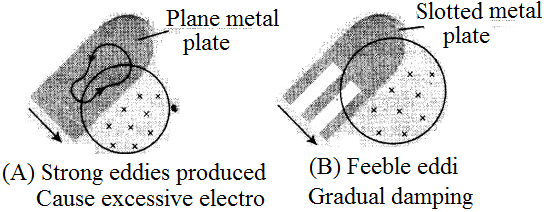
Key concept: Eddy Current: When a changing magnetic flux is applied to a bulk piece of conducting material, then circulating currents called eddy currents are induced in the material. Because the resistance of the bulk conductor is usually low, eddy currents often have large magnitudes and heat up the conductor.

  1. These are circulating currents like eddies in water.
  2. Experimental concept is given by Focault, hence also named as "Focault current".
  3. The production of eddy currents in a metallic block leads to the loss of electric energy in the form of heat.
  4. By lamination, slotting processes, the resistance path for circulation of eddy current increases, resulting into weakening them and also reducing losses causes by them.

​​​​​​​

A metal plate is getting heated when a DC or AC current is passed through the plate, known as heating effect of current. This current (called eddy current) is induced in the plate when a metal plate is subjected to a time varying magnetic field, i.e., the magnetic flux linked with the plate changes and eddy currents comes into existence which make the plate hot.

View full question & answer
MCQ 341 Mark
Complete the following statement. For electromagnetic induction to occur:
  • A
    a magnet must be at rest within a coil of wire
  • B
    a coil of wire must be at rest relative to the magnet.
  • C
    a magnet must move through a coil of wire.
  • D
    a magnet and a coil must have the same velocity.
Answer
  1. a coil of wire must be at rest relative to the magnet.

Explanation:

Current is induced in a coil when flux through the coil changes. The flux through the coil changes when a magnet moves relative to the coil and coil is at rest relative to the magnet.

View full question & answer
MCQ 351 Mark
A straight copper wire is moved in a uniform magnetic field such that it cuts the magnetic lines of force. Then
  • A
    emf will not be induced
  • B
    emf will be induced
  • C
    sometimes emf will be induced and sometimes not
  • D
    nothing can be predicted
Answer
  1. emf will be induced

Explanation:

As the copper wire cuts the magnetic lines of force, the free charges in the wire will experience a force and will get displaced. This displacement of charges in the wire creates a potential difference and hence emf is induced.

View full question & answer
MCQ 361 Mark
A conducting rod of length l and mass m is moving down a smooth inclined plane of inclination $\theta$ with constant velocity v. A current i is flowing in the conductor in a direction perpendicular to paper inward. A vertically upward magnetic field B exists in space. Then, magnitude of magnetic field B is:
  • A
    $\frac{\text{mg}}{\text{il}}\sin\theta$
  • B
    $\frac{\text{mg}}{\text{il}}\tan\theta$
  • C
    $\frac{\text{mg}\cos\theta}{\text{il}}\tan\theta$
  • D
    $\frac{\text{mg}}{\text{il}\sin\theta}$
Answer
  1. $\frac{\text{mg}}{\text{il}}\tan\theta$

Explanation:

The magnetic force due to the conducting rod of length l and mass m is,

Fm​ = i(l × B), the angle between l and B is 90°.

Fm ​= ilB

The horizontal component of Fm​ is

$\text{F}=\text{F}_\text{m}\cos\theta$

The force due to gravity is F = mg and its horizontal component is

$\text{F}''=\text{mg}\sin\theta$

From the above figure,

$\text{mg}\sin\theta=\text{ilB}\cos\theta$

$\text{B}=\frac{\text{mg}}{\text{il}}\tan\theta$

View full question & answer
MCQ 371 Mark
The rate of change of current needed to induce an emf of 8V in 0.1H coil is.
  • A
    $\frac{0.8\text{A}}{\text{s}}$
  • B
    $\frac{0.125\text{A}}{\text{s}}$
  • C
    $\frac{80\text{A}}{\text{s}}$
  • D
    $\frac{8\text{A}}{\text{s}}$
Answer
  1. $\frac{80\text{A}}{\text{s}}$

Explanation:

$\text{emf}=\text{L}\frac{\text{di}}{\text{dt}}$

$\frac{\text{di}}{\text{dt}}=\frac{\text{emf}}{\text{L}}$

$=\frac{8}{0.1}$

$=\frac{80\text{A}}{\text{s}}$

View full question & answer
MCQ 381 Mark
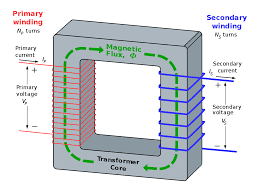
Which of the following statement regarding transformer is incorrect?
  • A
    A transformer makes use of Faradays Law.
  • B
    The ferromagnetic properties of an iron core is used by it to efficiently raise or lower AC voltage
  • C
    It cannot increase power so that if the voltage is raised, the current is proportionally lowered and vice versa.
  • D
    The current induced in primary circuit is of same nature as in secondary circuit with differences in amplitude only.
Answer
  1. The current induced in primary circuit is of same nature as in secondary circuit with differences in amplitude only.

Explanation:

The transformer does this by linking together two or more electrical circuits using .The two coil windings are not electrically connected but are only .The difference in voltage between the primary and the secondary windings is .Also this induced voltage has the same frequency as the primary winding voltage.The current induced in primary circuit is of same nature as in secondary circuit with differences in amplitude only.A transformer is a static electrical device that transfers electrical energy between two or more circuits through electromagnetic induction.

View full question & answer
MCQ 391 Mark
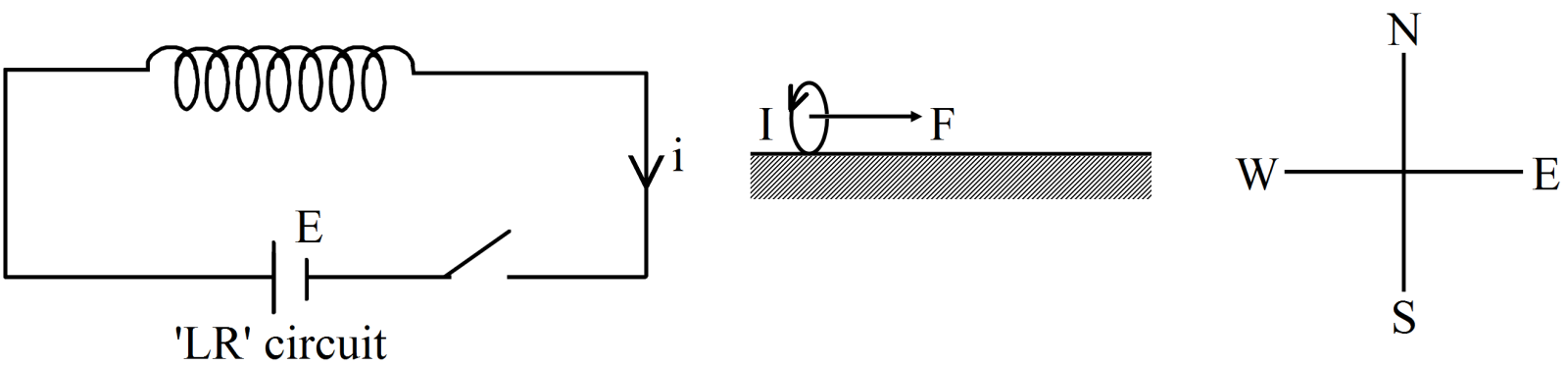
An LR circuit with a battery is connected at t = 0. Which of the following quantities is not zero just after the connection?
  • A
    Current in the circuit.
  • B
    Magnetic field energy in the inductor.
  • C
    Power delivered by the battery.
  • D
    Emf induced in the inductor.
Answer
  1. Emf induced in the inductor.

Explanation:

Current will be zero at t = 0+

if the current is zero magnetic field will be zero at t = 0+

power delivered will be zero at t = 0+

The EMF induced will be equal to the applied voltage in the inductor to oppose the current.

View full question & answer
MCQ 401 Mark
When a current of 5A flows in the primary coil then the flux linked with the secondary coil is 200 weber. The value of coefficient of mutual induction will be
  • A
    1000H
  • B
    40H
  • C
    195H
  • D
    205H
Answer
  1. 40H

Explanation:

Coefficient of mutual induction will be the ratio of the flux linked with the secondary coil and the current primary coil.

$\text{M}=\frac{200}{5}=40\text{H}$

View full question & answer
MCQ 411 Mark
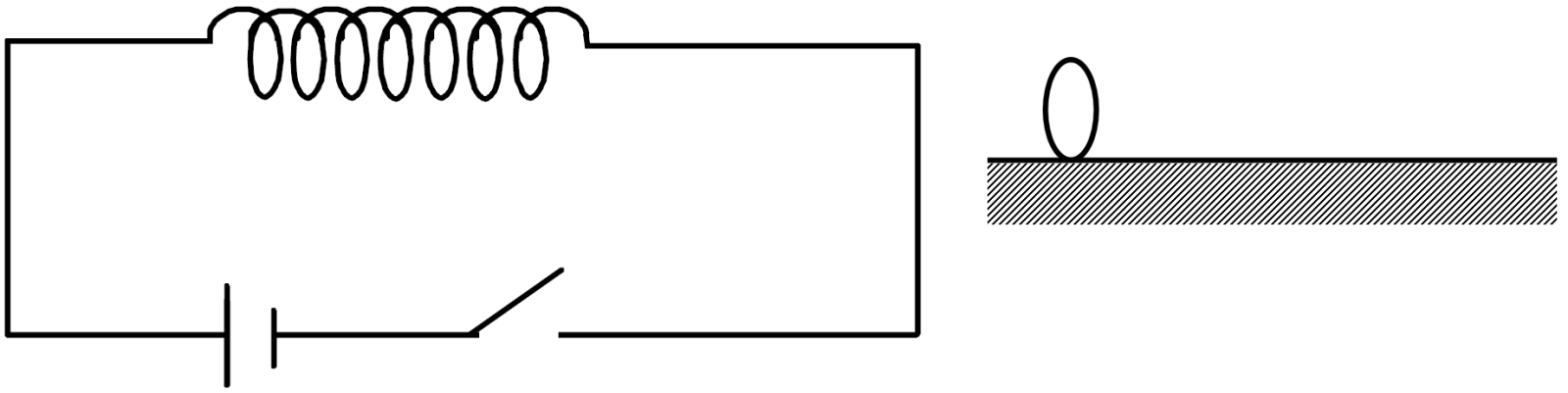
Figure shows a horizontal solenoid connected to a battery and a switch. A copper ring is placed on a frictionless track, the axis of the ring being along the axis of the solenoid. As the switch is closed, the ring will:
  • A
    Remain stationary.
  • B
    Move towards the solenoid.
  • C
    Move away from the solenoid.
  • D
    Move towards the solenoid or away from it depending on which terminal (positive or negative) of the battery is connected to the left end of the solenoid.
Answer
  1. Move away from the solenoid.

Explanation:

$\text{e}=-\text{L}\frac{\text{di}}{\text{dt}}$

Current flow in the CKt is clock wise direction, due to Mutual Induction current flow in the loop anti clockwise direction. The net force applied on the loop in east direction. So we can say that the ring will move away from the solenoid.

View full question & answer
MCQ 421 Mark
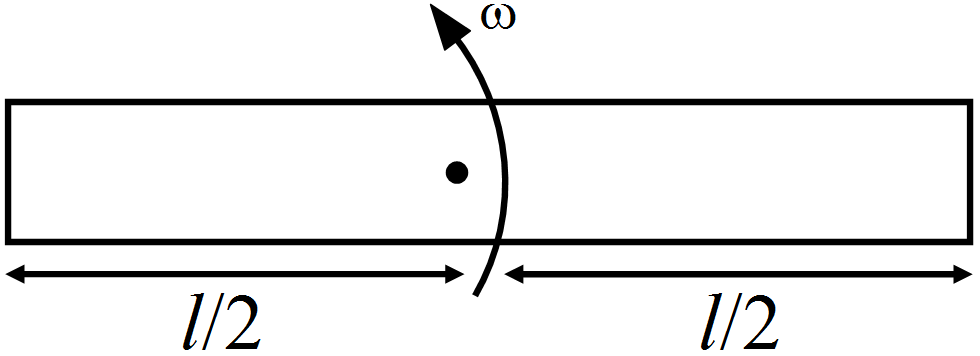
A rod of legth l rotates with a uniform angular velocity $\omega$ about its perpendicular bisector. A uniform magnetic field B exists parallel to the axis of rotation. The potential difference between the two ends of the rod is:
  • A
    $\text{zero}$
  • B
    $\frac{1}{2}\text{Bl}\omega^2$
  • C
    $\text{Bl}\omega ^2$
  • D
    $2\text{B}\text{l}\omega^2$ 
Answer
  1. $\text{zero}$

Explanation:

Emf at both end is same $=\frac{1}{8}\text{Bwl}^2$

So the potential difference between the two ends of therod is zero.

View full question & answer
MCQ 431 Mark
The coefficient of mutual inductance between two coils depends on.
  • A
    medium between the coils
  • B
    separation between the two coils
  • C
    orientation of the two coils
  • D
    all of the above
Answer
  1. all of the above

Explanation:

The flux linked with two coils will depend upon the angle between the two coils. If their planes are parallel, then magnetic flux from one would completely pass through the other. If the planes are perpendicular, no flux due to any of the coils would flow through the other.

The size of the two coils may be different which will affect the number of lines crossing the coil. The medium, if magnetic, will concentrate the field lines. Thus, all parameters would affect the inductance between them.


View full question & answer
MCQ 441 Mark
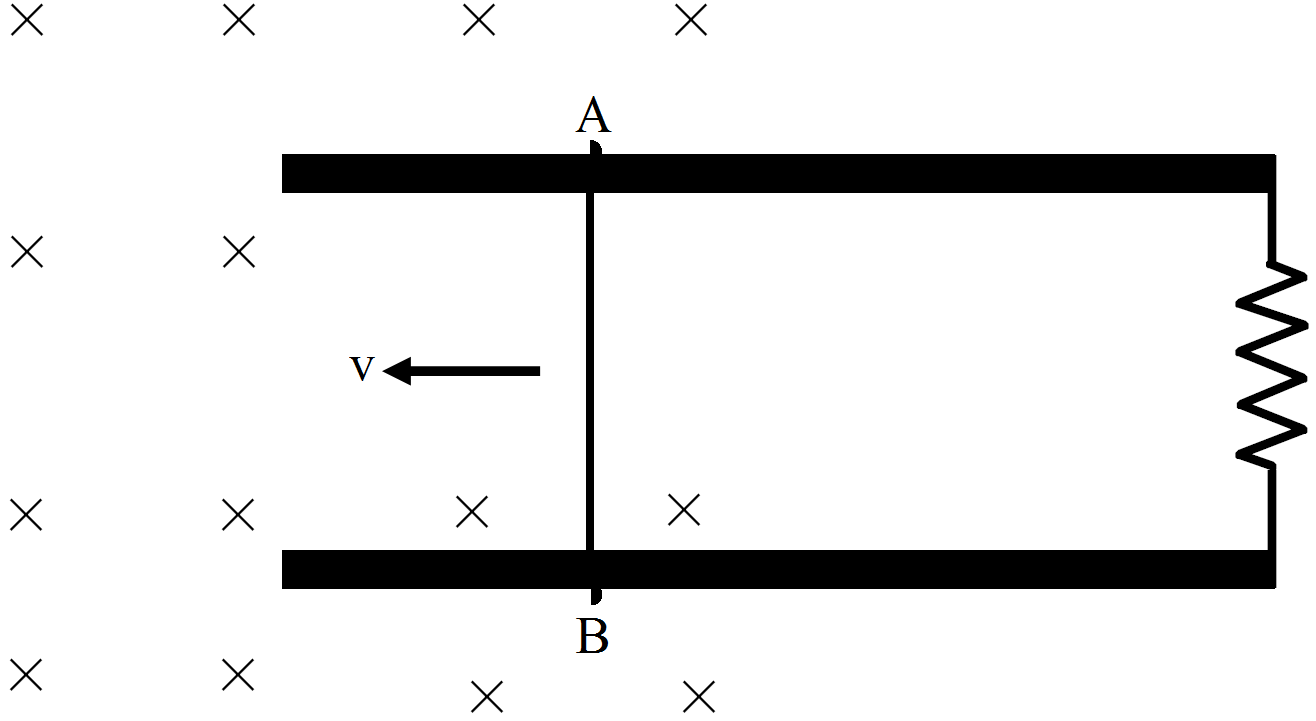
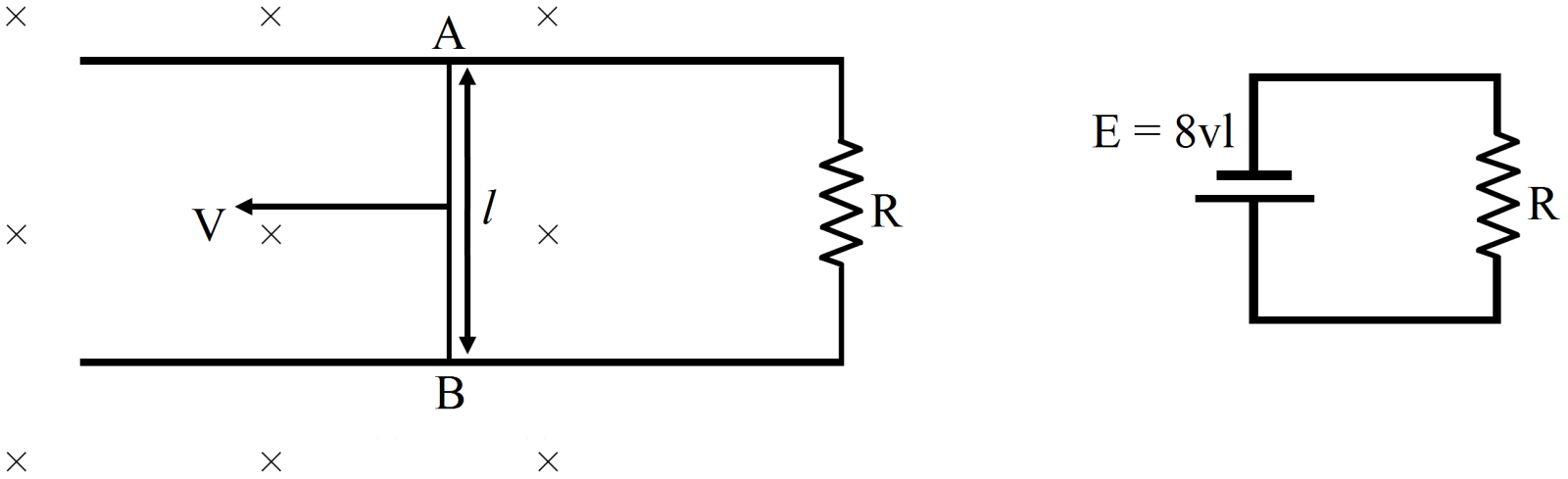
Consider the situation shown in figure. The wire AB is slid on the fixed rails with a constant velocity. If the wire AB is replaced by a semicircular wire, the magnitude of the induced current will: 
  • A
    Increase.
  • B
    Remain the same.
  • C
    Decrease.
  • D
    Increase or decrease depending on whether the semicircle bulges towards the resistance or away from it.
Answer
  1. Remain the same.

Explanation:

E = Bvl

If the wire AB is replaced by a semicircular wire, the magnitude of the induced current will be same. Because it is depend on the velcoty & lenght of the wire.

View full question & answer
MCQ 451 Mark
The coefficient of self induction of a coil is given by.
  • A
    $\text{L}=\Big(-\frac{\text{dI}}{\text{dt}}\Big)$
  • B
    $\text{L}=-\frac{\text{edI}}{\text{dt}}$
  • C
    $\text{L}=\frac{\text{dI}}{\text{edt}}$
  • D
    $\text{L}=\frac{\text{dI}}{\text{dt}}\text{e}^2$
Answer
  1. $\text{L}=\Big(-\frac{\text{dI}}{\text{dt}}\Big)$

Explanation:

Inductance is the property of a conductor by which a change in current flowing through it induces (creates) a voltage (electromotive force) in both the conductor itself (self-inductance) and in any nearby conductors (mutual inductance). By Lenz's law the induced voltage opposed the the change in current. Hence inductance is defined as.

$\text{L}=\Big(-\frac{\text{dI}}{\text{dt}}\Big)$

View full question & answer
MCQ 461 Mark
Two coils P and Q are lying parallels and very close to each other. Coil P is connected to an AC source whereas Q is connected to a sensitive galvanometer. On pressing key K.
  • A
    small variations are observed in the galvanometer for applied 50 Hz voltage
  • B
    deflections in the galvanometer can be observed for applied voltage of 1 Hz to 2 Hz.
  • C
    no deflection in the galvanometer will be observed
  • D
    constant deflection will be observed in the galvanometer for 50 Hz supply voltage
Answer
  1. deflections in the galvanometer can be observed for applied voltage of 1 Hz to 2 Hz.

Explanation:

Upon connecting to the AC source, a current starts to flow in the coil P. This current induces a current in the galvanometer coil Q due to mutual inductance because of the flux linkages. This induced current causes a deflection in the galvanometer.

View full question & answer
MCQ 471 Mark
A boat is moving due east in a region where the earth's magnetic field is 5.0 × 10⁻⁵NA-1m-1 due north and horizontal. The boat carries a vertical aerial 2m long. If the speed of the boat is 1.50 ms-1, the magnitude of the induced emf in the wire of aerial is:
  • A
    1 mV
  • B
    0.75 mV
  • C
    0.50 mV
  • D
    0.15 mV
Answer
  1. 0.15 mV

Explanation:

Induced emf is given by:

ε = Bvl

On putting the values we get

= 5 × 10-5 × 1.50 × 2

= 0.15 mV

View full question & answer
MCQ 481 Mark
Flux $\phi$ (in water) in a closed circuit of resistance $10\Omega$ varies with time t (in $\sec$) according to the equation $\phi=6\text{t}^2-5\text{t}+1.$ What is the magnitude of the induced current at t = 0.25s?
  • A
    1.2 A
  • B
    0.8 A
  • C
    0.6 A
  • D
    0.2 A
Answer
  1. 0.2 A

Explanation:

$\text{emf}=-\frac{\text{d}\phi}{\text{dt}}=-12\text{t}+5$

$\text{Current}=-\frac{\text{emf}}{10}=-1.2\text{t}+0.5$

$\text{Current at t}=0.25\text{s},$

$=1.2\times0.25+0.5=0.2\text{A}$

View full question & answer
MCQ 491 Mark
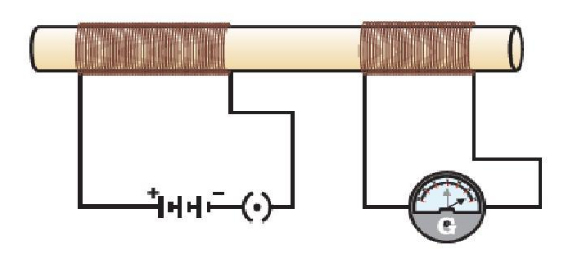
In the arrangement shown in given Figure, there are two coils wound on a non-conducting cylindrical rod. Initially the key is not inserted. Then the key is inserted and later removed. Then,

  • A
    the deflection in the galvanometer remains zero throughout
  • B
    there is a momentary deflection in the galvanometer but it dies out shortly and there is no effect when the key is removed
  • C
    there are momentary galvanometer deflections that die out shortly; the deflections are in the same direction
  • D
    there are momentary galvanometer deflections that die out shortly; the deflections are in opposite directions
Answer
  1. there are momentary galvanometer deflections that die out shortly; the deflections are in opposite directions
View full question & answer
MCQ 501 Mark
Electromagnetic induction is the:
  • A
    charging of a body with a positive charge
  • B
    production of current by relative motion between a magnet and a coil
  • C
    rotation of the coil of an electric motor
  • D
    generation of magnetic field due to a current carrying solenoid
Answer
  1. production of current by relative motion between a magnet and a coil

Explanation:

Electromagnetic induction is the production of current by relative motion between a magnet and a coil.The phenomenon of producing electric current in a conductor by moving it perpendicular to a magnetic field or vice -versa, is called electro magnetic induction.

View full question & answer
M.C.Q [1M] - Physics STD 12 Science Questions - Vidyadip