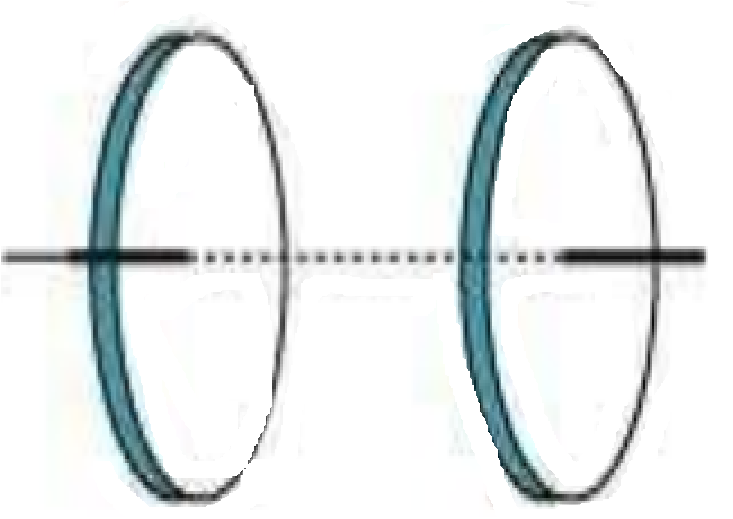
Radius of each circular plate, r = 12 cm = 0.12 m Distance between the plates, d = 5 cm = 0.05 m Charging current, I = 0.15 A Permittivity of free space, $\varepsilon_0=8.85\times10^{-12} \ \text{cm}=0.12 \ \text{m}$ - Capacitance between the two plates is given by the relation,
$\text{C}=\frac{\varepsilon_0\text{A}}{\text{d}}$
Where,
A = Area of each plate $=\pi\text{r}^2$
$\text{C}=\frac{\varepsilon_0\pi\text{r}^2}{\text{d}}$
$=\frac{8.85\times10^{-12}\times\pi\times12^2}{0.05}$
$=8.0032\times10^{-12}\text{F}=80.032\text{pF}$
Charge on each plate, q = CV
Where,
V = Potential difference across the plates
Differentiation on both sides with respect to time (t) gives:
$\frac{\text{dq}}{\text{dt}}=\text{C}\frac{\text{dV}}{\text{dt}}$
But, $\frac{\text{dq}}{\text{dt}}=\text{current }(I)$
$\therefore\frac{\text{dV}}{\text{dt}}=\frac{I}{\text{C}}$
$\Rightarrow\frac{0.15}{80.032\times10^{-12}}=1.87\times10^9\text{V}/\text{s}$
Therefore, the change in potential difference between the plates is $1.87\times10^9\text{V}/\text{s}$.
- The displacement current across the plates is the same as the conduction current. Hence, the displacement current, id is 0.15 A.
- Yes
Kirchhoff’s first rule is valid at each plate of the capacitor provided that we take the sum of conduction and displacement for current.