Question 13 Marks
On the basis of the charging of capacitor, clarify that there is something missing in the Ampere circuital law.
Answer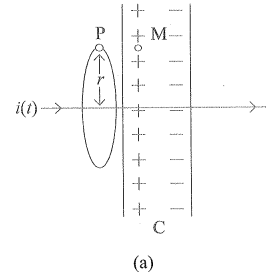
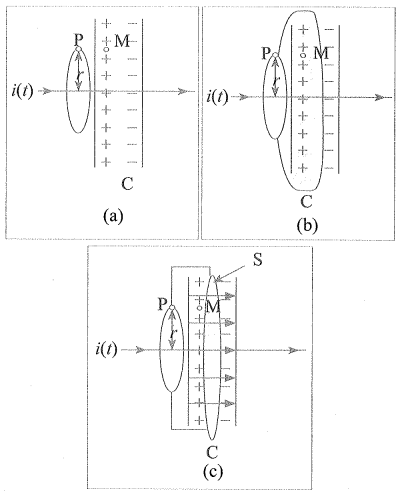
→As shown in fig. (a), a parallel plate capacitor is connected to a time-varying electric current. Magnetic field at a point P outside the parallel plates is to be found out.
→For this, consider a plane circular loop of radius r, whose plane is perpendicular to the direction of the current carrying wire, and which is centred symmetrically with respect to the wire.
→From symmetry, the magnetic field is directed along the circumference of the circular loop and its magnitude is same at all points on the loop.
→From Ampere's circuital law,
$\oint \overrightarrow{ B } \cdot \overrightarrow{d l}=\mu_0 i(t)$
$\begin{array}{l}\oint B d l \cos 0^{\circ}=\mu_0 i(t) \\ \therefore \quad B \oint d l=\mu_0 i(t) \\ \text { but } \oint d l=2 \pi r =\text { circumference of the closed loop } \\ \therefore B (2 \pi r )=\mu_0 i(t)......(1)\end{array}$
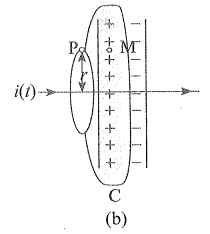
→As shown in fig. (b), now think of another surface. This is a pot like surface, which no where touches the current, but has its bottom between the capacitor plates, its mouth is the circular loop mentioned above.
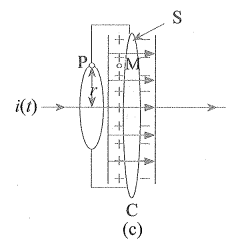
→As shown in fig. (c), think of a third surface which is shaped like a tiffin box without the lid.
→Electric current isn't passing through the surfaces shown in fig. (b) and (c). Hence Ampere's circuital law is applied to such surfaces having different shapes but same perimeter. It gives:
$B \oint \overrightarrow{d l}=\mu_0 i(t) \quad$ (Ampere is circuital law)
→In this equation LHS (left hand side) has not changed (and is not zero), but the RHS (right hand side) becomes zero, since the current enclosed by these loops is zero.
→This is a contradiction; because, calculated one way, there is a magnetic field at point P; calculated another way, the magnetic field at point P is zero.
→Due to this contradicton, we can say that there is something missing in the Ampere circuital law.
View full question & answer→→As shown in fig. (a), a parallel plate capacitor is connected to a time-varying electric current. Magnetic field at a point P outside the parallel plates is to be found out.
→For this, consider a plane circular loop of radius r, whose plane is perpendicular to the direction of the current carrying wire, and which is centred symmetrically with respect to the wire.
→From symmetry, the magnetic field is directed along the circumference of the circular loop and its magnitude is same at all points on the loop.
→From Ampere's circuital law,
$\oint \overrightarrow{ B } \cdot \overrightarrow{d l}=\mu_0 i(t)$
$\begin{array}{l}\oint B d l \cos 0^{\circ}=\mu_0 i(t) \\ \therefore \quad B \oint d l=\mu_0 i(t) \\ \text { but } \oint d l=2 \pi r =\text { circumference of the closed loop } \\ \therefore B (2 \pi r )=\mu_0 i(t)......(1)\end{array}$
→As shown in fig. (b), now think of another surface. This is a pot like surface, which no where touches the current, but has its bottom between the capacitor plates, its mouth is the circular loop mentioned above.
→As shown in fig. (c), think of a third surface which is shaped like a tiffin box without the lid.
→Electric current isn't passing through the surfaces shown in fig. (b) and (c). Hence Ampere's circuital law is applied to such surfaces having different shapes but same perimeter. It gives:
$B \oint \overrightarrow{d l}=\mu_0 i(t) \quad$ (Ampere is circuital law)
→In this equation LHS (left hand side) has not changed (and is not zero), but the RHS (right hand side) becomes zero, since the current enclosed by these loops is zero.
→This is a contradiction; because, calculated one way, there is a magnetic field at point P; calculated another way, the magnetic field at point P is zero.
→Due to this contradicton, we can say that there is something missing in the Ampere circuital law.