Question 14 Marks
Derive the formula of electric potential at a point due to electric dipole.
Answer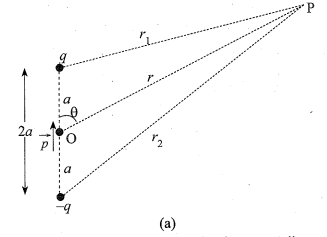
→As shown in fig. point P is given at a distance ' $r$ ' from the midpoint ' O ' of electric dipole and at an angle $\theta$ (with the electric dipole moment $\vec{p}$ ).
We want to find electric potential at this point $P$.
→ Electric potential at point P due to charge $+q$,
$V _1=\frac{1}{4 \pi \varepsilon_0} \cdot \frac{q}{r_1}$
→Electric potential at point P due to charge $-q$,
$\begin{aligned}
V _2 & =\frac{1}{4 \pi \varepsilon_0} \frac{(-q)}{r_2} \\
& =-\frac{1}{4 \pi \varepsilon_0} \cdot \frac{q}{r_2}
\end{aligned}$
→Total electric potential at point P as per super position principle,
$V = V _1+ V _2$
$\begin{array}{l}
\therefore V =\frac{1}{4 \pi \varepsilon_0} \cdot \frac{q}{r_1}-\frac{1}{4 \pi \varepsilon_0} \cdot \frac{q}{r_2} \\
\therefore V =\frac{q}{4 \pi \varepsilon_0}\left(\frac{1}{r_1}-\frac{1}{r_2}\right)
\end{array}$
→As shown in the figure (a), position vector of point P with respect to origin O is $\vec{r}$.
Position vector of point P with respect to $+q$ is $\vec{r}_1$.
Position vector of point P with respect to $-q$ is $\vec{r}_2$.
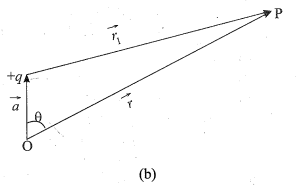
→From figure (b),
$\begin{aligned}
\vec{r} & =\vec{a}+\vec{r}_1 \\
\therefore \vec{r}_1 & =\vec{r}-\vec{a} \\
\therefore r_1^2 & =r^2+a^2-2 r a \cos \theta
\end{aligned}$
( $\theta$ is angle between $\vec{r}$ and $\vec{a}$ )
$\therefore r_1^2=r^2\left( i +\frac{a^2}{r^2}-\frac{2 a \cos \theta}{r}\right)$
→But value of $\frac{a^2}{r^2}$ is very less for $r \gg a$,
so it can be neglected from equation.
$\begin{array}{l}
\therefore r_1^2=r^2\left(1-\frac{2 a \cos \theta}{r}\right) \\
\therefore r_1=r\left(1-\frac{2 a \cos \theta}{r}\right)^{\frac{1}{2}} \\
\therefore \quad \frac{1}{r_1}=\frac{1}{r}\left(1-\frac{2 a \cos \theta}{r}\right)^{-\frac{1}{2}}
\end{array}$
View full question & answer→→As shown in fig. point P is given at a distance ' $r$ ' from the midpoint ' O ' of electric dipole and at an angle $\theta$ (with the electric dipole moment $\vec{p}$ ).
We want to find electric potential at this point $P$.
→ Electric potential at point P due to charge $+q$,
$V _1=\frac{1}{4 \pi \varepsilon_0} \cdot \frac{q}{r_1}$
→Electric potential at point P due to charge $-q$,
$\begin{aligned}
V _2 & =\frac{1}{4 \pi \varepsilon_0} \frac{(-q)}{r_2} \\
& =-\frac{1}{4 \pi \varepsilon_0} \cdot \frac{q}{r_2}
\end{aligned}$
→Total electric potential at point P as per super position principle,
$V = V _1+ V _2$
$\begin{array}{l}
\therefore V =\frac{1}{4 \pi \varepsilon_0} \cdot \frac{q}{r_1}-\frac{1}{4 \pi \varepsilon_0} \cdot \frac{q}{r_2} \\
\therefore V =\frac{q}{4 \pi \varepsilon_0}\left(\frac{1}{r_1}-\frac{1}{r_2}\right)
\end{array}$
→As shown in the figure (a), position vector of point P with respect to origin O is $\vec{r}$.
Position vector of point P with respect to $+q$ is $\vec{r}_1$.
Position vector of point P with respect to $-q$ is $\vec{r}_2$.
→From figure (b),
$\begin{aligned}
\vec{r} & =\vec{a}+\vec{r}_1 \\
\therefore \vec{r}_1 & =\vec{r}-\vec{a} \\
\therefore r_1^2 & =r^2+a^2-2 r a \cos \theta
\end{aligned}$
( $\theta$ is angle between $\vec{r}$ and $\vec{a}$ )
$\therefore r_1^2=r^2\left( i +\frac{a^2}{r^2}-\frac{2 a \cos \theta}{r}\right)$
→But value of $\frac{a^2}{r^2}$ is very less for $r \gg a$,
so it can be neglected from equation.
$\begin{array}{l}
\therefore r_1^2=r^2\left(1-\frac{2 a \cos \theta}{r}\right) \\
\therefore r_1=r\left(1-\frac{2 a \cos \theta}{r}\right)^{\frac{1}{2}} \\
\therefore \quad \frac{1}{r_1}=\frac{1}{r}\left(1-\frac{2 a \cos \theta}{r}\right)^{-\frac{1}{2}}
\end{array}$