Question types

Friction question types

57 questions across 6 question groups — pick any mix to generate a Physics paper with step-by-step answer keys.

57
Questions
6
Question groups
5
Question types
Sample Questions

Friction questions

One sample from each question group in this chapter. Select any group above to see the full set with answer keys.

Q 1M.C.Q [1M]1 Mark
A boy of mass M is applying a horizontal force to slide a box of mass M' on a rough horizontal surface. The coefficient of friction between the shoes of the box and the floor is $\mu.$ In which of the following cases it is certainly not possible to slide the box?

  1. $\mu<\mu',\text{M < M}'$

  2. $\mu>\mu',\text{M < M}'$

  3. $\mu<\mu',\text{M > M}'$

  4. $\mu>\mu',\text{M > M}'$

View full solution
Q 2M.C.Q [1M]1 Mark
Let F, FN and f denote the magnitudes of the contact force, normal force and the friction exerted by one surface on the other kept in contact. If none of these is zero:
  1. F > FN
  2. F > f
  3. F> f
  4. FN - f < F < F+ f
View full solution
Q 3M.C.Q [1M]1 Mark
While walking on ice, one should take small steps to avoid slipping. This is because smaller steps ensure:
  1. Larger friction.
  2. Smaller friction.
  3. Larger normal force.
  4. Smaller normal force.
View full solution
Q 4M.C.Q [1M]1 Mark
Two cars of unequal masses use similar tyres. If they are moving at the same initial speed, the minimum stopping distance:
  1. Is smaller for the heavier car.
  2. Is smaller for the lighter car.
  3. Is same for both cars.
  4. Depends on the volume of the car.
View full solution
Q 5M.C.Q [1M]1 Mark
In a situation the contact force by a rough horizontal surface on a body placed on it has constant magnitude. If the angle between this force and the vertical is decreased, the frictional force between the surface and the body will:
  1. Increase.
  2. Decrease.
  3. Remain the saint.
  4. May increase or decrease.
View full solution
For most of the surfaces used in daily life, the friction coefficient is less than 1. Is it always necessary that the friction coefficient is less than 1?
View full solution
Spring fitted doors close by themselves when released. You want to keep the door open for a long time, say for an hour. If you put a half kg stone in front of the open door, it does not help. The stone slides with the door and the door gets closed. However, if you sandwitch a 20g piece of wood in the small gap between the door and the floor, the door stays open. Explain why a much lighter piece of wood is able to keep the door open while the heavy stone fails.
View full solution
A block of mass 2kg is pushed against a rough vertical wall with a force of 40N, coefficient of static friction being 0.5. Another horizontal force of 15N, is applied on the block in a direction parallel to the wall. Will the block move? If yes, in which direction? If no, find the frictional force exerted by the wall on the block.
View full solution
Q 163 Marks Question3 Marks
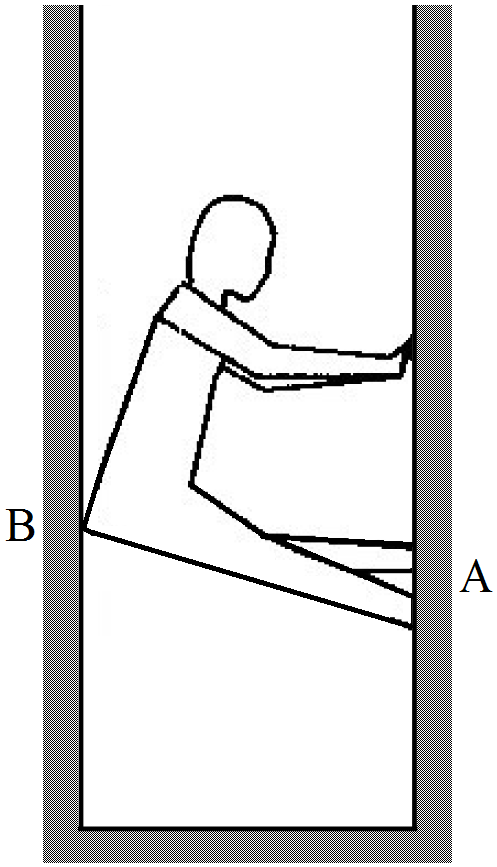
A person (40kg) is managing to be at rest between two vertical walls by pressing one wall A by his hands and feet and the other wall B by his back. Assume that the friction coefficient between his body and the walls is 0.8 and that limiting friction acts at all the contacts.
  1. Show that the person pushes the two walls with equal force.
  2. Find the normal force exerted by either wall on the person. Take g = 10m/s2.
​​​​​​​
View full solution
Q 173 Marks Question3 Marks
A block is projected along a rough horizontal road with a speed of 10m/s. If the coefficient of kinetic friction is 0.10, how far will it travel before coming to rest?
View full solution
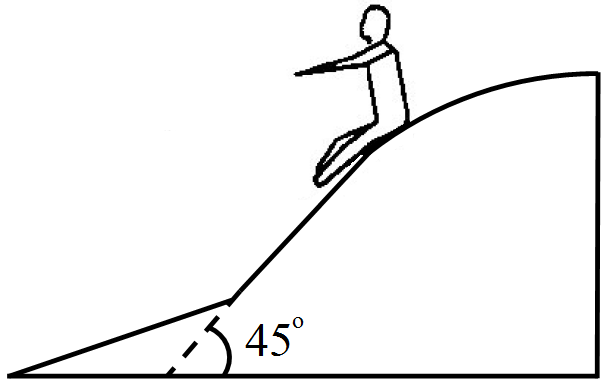
In a children-park an inclined plane is constructed with an angle of incline 45° in the middle part. Find the acceleration of a boy sliding on it if the friction coefficient between the cloth of the boy and the incline is 0.6 and g = 10m/s2.

View full solution
A car starts from rest on a half kilometer long bridge. The coefficient of friction between the tyre and the road is 1.0. Show that one cannot drive through the bridge in less than 10s.
View full solution
The friction coefficient between an athelete's shoes and the ground is 0.90. Suppose a superman wears these shoes and races for 50m. There is no upper limit on his capacity of running at high speeds.
  1. Find the minimum time that he will have to take in completing the 50m starting from rest.
  2. Suppose he takes exactly this minimum time to complete the 50m, what minimum time will he take to stop?
View full solution
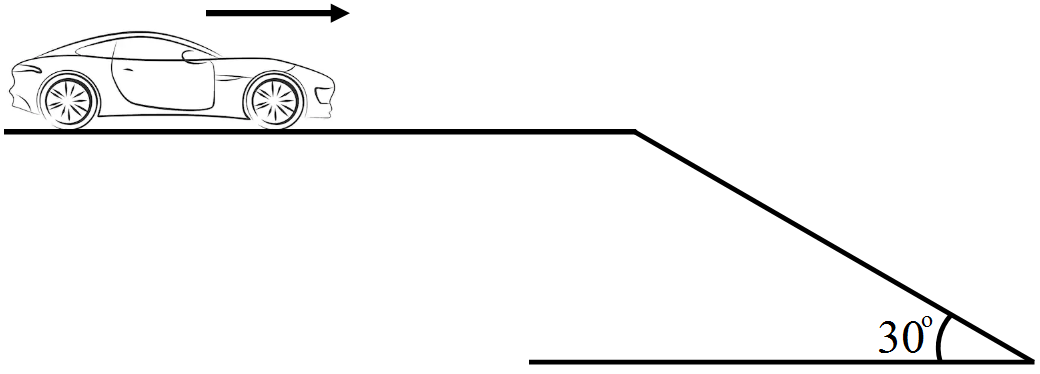
A car is going at a speed of 21.6km/hr when it encounters a 12.8m long slope of angle 30°. The friction coefficient between the road and the tyre is $\frac{1}{2\sqrt{3}}.$ Show that no matter how hard the driver applies the brakes, the car will reach the bottom with a speed greater than 36km/hr. Take g = 10m/s2.

View full solution
A block of mass M is kept on a rough horizontal surface. The coefficient of static friction between the block and the surface is $\mu.$ The block is to be pulled by applying a force to it. What minimum force is needed to slide the block? In which direction should this force act?
View full solution
A 2kg block is placed over a 4kg block and both are placed on a smooth horizontal surface. The coefficient of friction between the blocks is 0.20. Find the acceleration of the two blocks if a horizontal force of 12N is applied to:
  1. The upper block.
  2. The lower block. Take g = 10m/s2.
View full solution
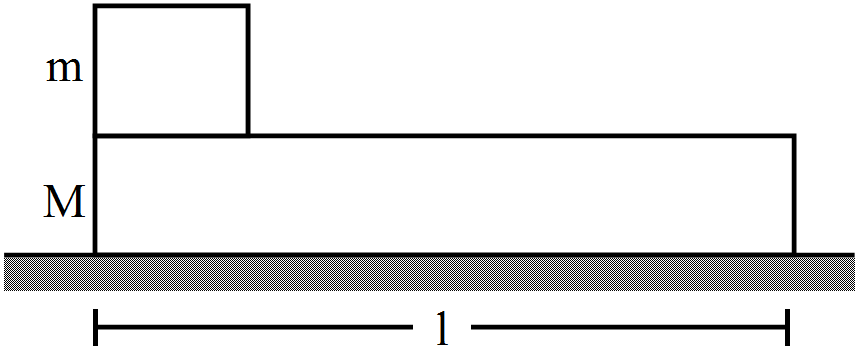
Figure shows a small block of mass m kept at the left end of a larger block of mass M and length l. The system can slide on a horizontal road. The system is started towards right with an initial velocity v. The friction coefficient between the road and the bigger block is g and that between the block is $\frac{\mu}{2}.$ Find the time elapsed before the smaller blocks separates from the bigger block.

View full solution

Generate a Friction paper free

Pick question groups from the list above, set marks and difficulty, and export a branded PDF with step-by-step answer keys. First 3 chapters free — no signup.

Download App