Question types

Magnetic Field due to a Current question types

92 questions across 5 question groups — pick any mix to generate a Physics paper with step-by-step answer keys.

92
Questions
5
Question groups
5
Question types
Sample Questions

Magnetic Field due to a Current questions

One sample from each question group in this chapter. Select any group above to see the full set with answer keys.

Q 1M.C.Q [1M]1 Mark
Two parallel, long wires carry currents i1 and i2 with i1 > i2. When the currents are in the same direction, the magnetic field at a point midway between the wires is $10 \mu\text{T}.$ If the direction of i2 is reversed, the field becomes $30 \mu\text{T}.$ The ratio $\frac{\text{i}_1}{\text{i}_2}$ is:
  1. 4
  2. 3
  3. 2
  4. 1
View full solution
Q 2M.C.Q [1M]1 Mark
A long, straight wire of radius R carries a current distributed uniformly over its cross section. T he magnitude of the magnetic field is:
  1. Maximum at the axis of the wire.
  2. Minimum at the axis of the wire.
  3. Maximum at the surface of the wire.
  4. Minimum at the surface of the wire.
View full solution
Q 3M.C.Q [1M]1 Mark
Consider three quantities $\text{x}=\frac{\text{E}}{\text{B}},\ \text{y}=\sqrt{\frac{1}{\mu_0\in_0}}$ and $\text{z}=\frac{1}{\text{CR}}.$ Here, l is the length of a wire, C is a capacitance and R is a resistance. All other symbols have standard meanings.
  1. x, y have the same dimensions.
  2. y, z have the same dimensions.
  3. z, x have the same dimensions.
  4. None of the three pairs have the same dimensions.
View full solution
Q 4M.C.Q [1M]1 Mark
In a coaxial, straight cable, the central conductor and the outer conductor carry equal currents in opposite directions. The magnetic field is zero:
  1. Outside the cable.
  2. Inside the inner conductor.
  3. Inside the outer conductor.
  4. In between the tow conductors.
View full solution
Q 5M.C.Q [1M]1 Mark
Two particles X and Y having equal charge, after being accelerated through the same potential difference enter a region of uniform magnetic field and describe circular paths of radii R1 and R2 respectively. The ratio of the mass of X to that of Y is:
  1. $\Big(\frac{\text{R}_1}{\text{R}_2}\Big)^{\frac{1}{2}}$
  2. $\frac{\text{R}_1}{\text{R}_2}$
  3. $\Big(\frac{\text{R}_1}{\text{R}_2}\Big)^2$
  4. $\text{R}_1\text{R}_2.$
View full solution
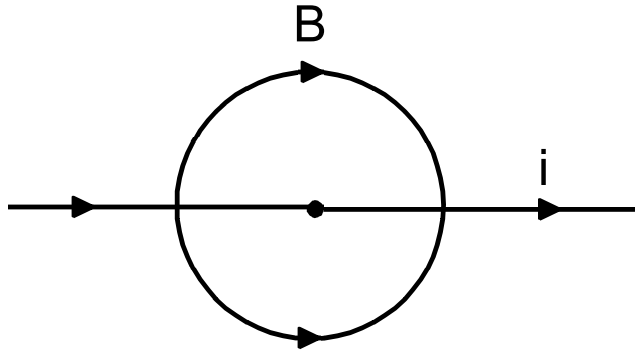
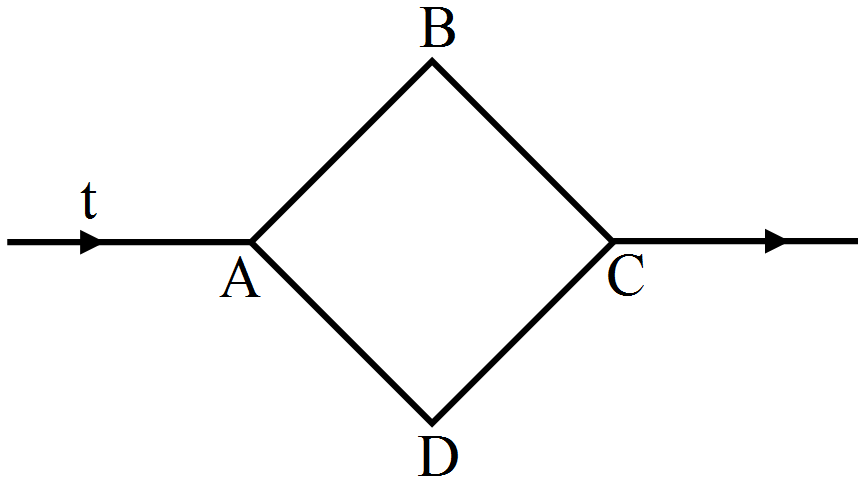
Consider the situation described in the previous problem. Suppose the current i enters the loop at the point A and leaves it at the point B. Find the magnetic field at the centre of the loop.
View full solution
Two proton beams going in the same direction repel each other whereas two wires carrying currents in the same direction attract each other. Explain.
View full solution
A long solenoid is fabricated by closely winding a wire of radius 0.5mm over a cylindrical nonmagnetic frame so that the successive turns nearly touch each other. What would be the magnetic field B at the centre of the solenoid if it carries a current of 5A?
View full solution
A circular loop of radius 4.0cm is placed in a horizontal plane and carries an electric current of 5.0A in the clockwise direction as seen from above. Find the magnetic field:
  1. At a point 3.0cm above the centre of the loop.
  2. At a point 3.0cm below the centre of the loop.
View full solution
A tightly-wound, long solenoid has n turns per unit length, a radius r and carries a current i. A particle having charge q and mass m is projected from a point on the axis in a direction perpendicular to the axis. What can be the maximum speed for which the particle does not strike the solenoid ?
View full solution
In Ampere's $\oint\overrightarrow{\text{B}}.\text{d}\overrightarrow{\text{l}}=\mu_0\text{i},$ the current outside the curve is not included on the right hand side. Does it mean that the magnetic field B calculated by using Ampere's law, gives the contribution of only the currents crossing the area bounded by the curve?
View full solution
Q 153 Marks Question3 Marks
A straight, long wire carries a current of 20A. Another wire carrying equal current is placed parallel to it. If the. force acting on a length of 10cm of the second wire is 2 ×10⁻⁵N, what is the separation between them?
View full solution
Q 163 Marks Question3 Marks
A charge of 3.14 × 10⁻⁶C is distributed uniformly over a circular ring of radius 20.0cm. The ring rotates about its axis with an angular velocity of 60.0 rad/s. Find the ratio of the electric field to the magnetic field at a point on the axis at a distance of 5.00cm from the centre.
View full solution
Q 173 Marks Question3 Marks
A circular loop of radius r carrying a current i is held at the centre of another circular loop of radius R(>> r) carrying a current I. The plane of the smaller loop makes an angle of 30° with that of the larger loop. If the smaller loop is held fixed in this position by applying a single force at a point on its periphery, what would be the minimum magnitude of this force?
View full solution
Q 183 Marks Question3 Marks
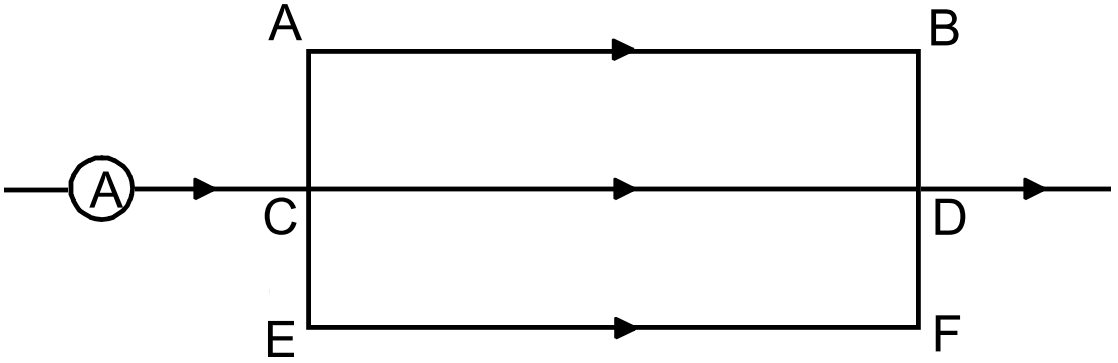
Figure shows a part of an electric circuit. The wires AB, CD and EF are long and have identical resistances. The separation between the neighbouring wires is 1.0cm. The wires AE and BF have negligible resistance and the ammeter reads 30A. Calculate the magnetic force per unit length of AB and CD.

View full solution
Q 193 Marks Question3 Marks
A long, straight wire of radius r carries a current i and is placed horizontally in a uniform magnetic field B pointing vertically upward. The current is uniformly distributed over its cross-section.
  1. At what points will the resultant magnetic field have maximum magnitude? What will be the maximum magnitude?
  2. What will be the minimum magnitude of the resultant magnetic field?
View full solution
Three coplanar parallel wires, each carrying a current of 10A along the same direction, are placed with a separation 5.0cm between the consecutive ones. Find the matnitude ol the magnetic force per unit lenght acting on the wires.
View full solution
A copper wire having resistance 0.01 ohm in each metre is used to wind a 400-turn solenoid of radius 1.0cm and length 20cm. Find the emf of a battery which when connected the solenoid will eauee a magnetic field of 1.0 × 10⁻²T near the centre of the solenoid.
View full solution
A tightly-wound solenoid of radius a and length l has n turns per unit length. It carries an electric current i. Consider a length dx of the solenoid at a distance x from one end. This contains n(dx) turns and may be approximated as a circular current in (dx).
  1. Write the magnetic field at the centre of the solenoid due to this circular current. Integrate this expression under proper limits to find the magnetic field at the centre of the solenoid.
  2. Verify that if a >> l, the field tends to $\text{B}=\frac{\mu_0\text{nil}}{2\text{a}}.$ Interpret these results.
View full solution

Generate a Magnetic Field due to a Current paper free

Pick question groups from the list above, set marks and difficulty, and export a branded PDF with step-by-step answer keys. First 3 chapters free — no signup.

Download App