Questions

3 Marks Question

🎯

Test yourself on this topic

8 questions · timed · auto-graded

Question 13 Marks
Show that the radius of the orbit in hydrogen atom varies as n2, where n is the principal quantum number of the atom.
View full question & answer
Question 23 Marks
i. Differentiate between three segments of a transistor on the basis of their size and level of doping.
ii. When is a transistor said to be in active state?
iii. Draw a plot of transfer characteristic ($V _0$ vs. $V _{ i }$ ) and show which portion of the characteristic is used in amplification and why?
iv. Draw the circuit diagram of the base bias transistor amplifier in CE configuration and briefly explain its working.
View full question & answer
Question 33 Marks
Two cells of EMFs $1 V, 2 V$ and internal resistance $2 \Omega$ and $1 \Omega$ respectively are connected in
i. series,
ii. parallel. What should be the external resistance in the circuit so that the current through the resistance be the same in the two cases? In which case, more heat is generated in the cells?
View full question & answer
Question 43 Marks
Define mutual inductance between a pair of coils. Derive an expression for the mutual inductance of two long  coaxial solenoids of the same length wound one over the other.
View full question & answer
Question 53 Marks
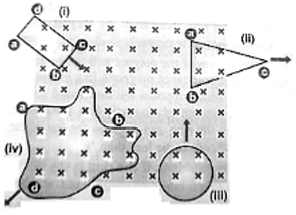
The figure below shows planer loops of different shapes moving out of or into a region of the magnetic field which is directed normal to the plane of the loops away from the reader. Determine the direction of induced current in each loop using Lenz's law. Check if you would obtain the same answers by considering the magnetic force on the charge inside the moving loops.

Image
View full question & answer
Question 63 Marks
A beam of light consisting of two wavelengths, 650 nm and 520 nm, are used to obtain interference fringes in a Young's double slit experiment.
a. Find the distance of the third bright fringe on the screen from the central maximum for wavelength 650 nm.
b. What is the least distance from the central maximum where the bright fringes due to both the wavelengths coincide?
Answer

Here, $\lambda_1=650 nm=650 \times 10^{-9} m$
$\lambda_2=520 nm=520 \times 10^{-9} m$
Suppose, d = distance between two slits
D = Distance of screen from the slits
a. For third bright fringe, n = 3
$\begin{array}{l}x=n \lambda_1 \cdot \frac{D}{d} \\ =3 \times 650 \times \frac{D}{d}=1950 \frac{D}{d}\end{array}$
b. Let nth bright fringe due to wavelength 650 nm coincide with (n -1)th due to wavelength 520 nm.
Therefore, $n \lambda_2=(n-1) \lambda_1$ or, $n \times 520=(n-1) \times 650 \Rightarrow n=5$
Hence, the least distance from the central maximum can be obtained by the relation:
$
x=n \lambda_2 \frac{D}{d}=5 \times 520 \frac{D}{d}=2600 \frac{D}{d} n m
$
Note: The value of d and D are not given in the question.


View full question & answer
Question 73 Marks
a. Differentiate between nuclear fission and nuclear fusion.
b. Deuterium undergoes fusion as per the reaction:
${ }_1^2 H +{ }_1^2 H \longrightarrow{ }_2^3 He +{ }_0^1 n +3.27 MeV$
Find the duration for which an electric bulb of 500 W can be kept glowing by the fusion of 100 g of deuterium.
Answer
a.
Nuclear fission Nuclear fusion
It is the process of disintegration of a heavy nuclei into smaller daughter nuclei of comparable masses with a release of huge amount of energy. It is the process of combining two lighter nuclei to form a heavy nuclei with the release of huge energy.
It can be possible in nuclear reactors. It can be possible on the surface of sun.
Example ${ }_{92}^{235} U \rightarrow{ }_{56}^{142} Ba +{ }_{36}^{91} kr +3{ }_0^1 n+$ heat Example ${ }_1^2 H+{ }_1^2 H \rightarrow{ }_2^3 H e+{ }_0^1 n+$ heat
It is a controllable process. It is uncontrollable process.
b. ${ }_1^2 H+{ }_1^2 H \rightarrow{ }_2^3 He +{ }_0^1 n+3.27 M ev$
when 2 atoms of deuterium $\left({ }_1^2 H \right)$ combine energy released $=3.27 M ev$
$\begin{array}{l}=3.27 \times 10^6 \times 1.6 \times 10^{-19} J \\ =5.232 \times 10^{-15} J\end{array}$
So, No. of atoms in 2 g of deuterium $=6.022 \times 10^{23}$ atoms
No. of atoms in 100 g of deuterium $=\frac{6.022 \times 10^{23} \times 100}{2}$
$=3.011 \times 10^{25}$ atoms
So total energy released by fusion of 100g of deuterium
$\begin{array}{l}=3.011 \times 10^{25} \times 5.232 \times 10^{-15} J \\ =15.75 \times 10^{10} J\end{array}$
Power of bulb = 500 W
Energy consumed by bulb in 1 second $=500 \times 1$
500J
So, time required to consume released energy $=\frac{15.75 \times 10^{10}}{500}$
$\begin{array}{l}=0.0315 \times 10^{10} sec \\ =9.989 \text { years }\end{array}$

View full question & answer
Question 83 Marks
Photoelectrons are emitted from a metal surface when illuminated with UV light of wavelength 330 nm . The minimum amount of energy required to emit the electrons from the surface is $3.5 \times 10^{-19} J$. Calculate :
a. the energy of the incident radiation, and
b. the kinetic energy of the photoelectron.
Answer
i. Energy of incident radiation
$\begin{array}{l} E = hv = h \frac{c}{\lambda} \\ =\frac{6.63 \times 10^{-34} \times 3 \times 10^8}{330 \times 10^{-9}} \\ =6.027 \times 10^{-19} J\end{array}$
ii. Kinetic energy of photoelectron
$\begin{array}{l}\text { K.E. }=E-\phi_0 \\ =\left(6.027 \times 10^{-19}-3.5 \times 10^{-19}\right) J \\ =2.527 \times 10^{-19} J\end{array}$

View full question & answer
3 Marks Question - Physics STD 12 Science Questions - Vidyadip