Question types

MODEL PAPER 5 question types

38 questions across 6 question groups — pick any mix to generate a Physics paper with step-by-step answer keys.

38
Questions
6
Question groups
5
Question types
Sample Questions

MODEL PAPER 5 questions

One sample from each question group in this chapter. Select any group above to see the full set with answer keys.

Q 1M.C.Q [1M]1 Mark
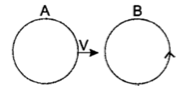
There are two coils A and B as shown in the figure. A current starts flowing in B as shown, when A is moved towards B and stops when A stops moving. The current in A is counter clockwise. B is kept stationary when A moves. We can infer that
Image
  • A
    there is a constant current in the counterclockwise direction in A.
  • B
    there is a constant current in the clockwise direction in A.
  • C
    there is a varying current in A.
  • D
    there is no current in A.
View full solution
Q 3M.C.Q [1M]1 Mark
When $10^{19}$ electrons are removed from a neutral metal plate, the electric charge on it is
  • A
    -1.6 C
  • B
    $10^{+19} C$
  • C
    +1.6 C
  • D
    $10^{-19} C$
View full solution
Q 4M.C.Q [1M]1 Mark
A bar magnet having a magnetic moment of $2 \times 10^4 JT ^{-1}$ is free to rotate in a horizontal plane. A horizontal magnetic field $B =6 \times 10^{-4} T$ exists in the space. The work done in taking the magnet slowly from a direction
  • A
    0.6 J
  • B
    12 J
  • C
    2 J
  • D
    6 J
View full solution
Q 5M.C.Q [1M]1 Mark
For a glass prism, the angle of minimum deviation will be smallest for the light of
  • A
    blue colour
  • B
    yellow colour
  • C
    green colour
  • D
    red colour.
View full solution
Assertion (A): When ultraviolet light is incident on a photocell, its stopping potential is $V _0$ and the maximum kinetic energy of the photoelectrons is $K _{\max }$. When the ultraviolet light is replaced by X-rays, both $V _0$ and $K _{\max }$. increase.
Reason (R): Photoelectrons are emitted with speeds ranging from zero to a maximum value because of the range of frequencies present in the incident light.
  • A
    Both A and R are true and R is the correct explanation of A.
  • B
    Both A and R are true but R is not the correct explanation of A.
  • C
    A is true but R is false.
  • D
    A is false but R is true.
View full solution
Assertion : When a capacitor is filled completely with a metallic slab its capacity becomes very large.
Reason : Dielectric constant for metal is zero.
  • A
    Both A and R are true and R is the correct explanation of A
  • B
    Both A and R are true but R is NOT the correct explanation of A
  • C
    A is true but R is false
  • D
    A is false and R is also false
View full solution
Assertion (A): Faraday’s laws are consequences of the conservation of energy.
Reason (R): In a purely resistive AC circuit, the current lags behind the emf in phase.
  • A
    Both A and R are true and R is the correct explanation of A.
  • B
    Both A and R are true but R is not the correct explanation of A.
  • C
    A is true but R is false.
  • D
    A is false but R is true.
View full solution
Assertion (A): According to Huygen’s principle, no backward wave-front is possible.
Reason (R): Amplitude of secondary wavelet is proportional to $(1+\cos \theta)$ where $\theta$ is the angle between the ray at the point of consideration and the direction of secondary wavelet.
  • A
    Both A and R are true and R is the correct explanation of A.
  • B
    Both A and R are true but R is not the correct explanation of A.
  • C
    A is true but R is false.
  • D
    A is false but R is true.
View full solution
Compare the following:
i. Wavelengths of the incident solar radiation absorbed by the earth's surface and the radiation re-radiated by the earth.
ii. Tanning effect produced on the skin by UV incident directly on the skin and that coming through glass window.
View full solution
A sample of paramagnetic salt contains $2.0 \times 10^{24}$ atomic dipoles each of dipole moment $1.5 \times 10^{-23} JT ^{-1}$. The sample is placed under homogeneous magnetic field of 0.84 T and cooled to the temperature of 4.2 K . The degree of magnetic saturation achieved is equal to $15 \%$. What is the total dipole moment of the sample for a magnetic field of 0.98 T and a temperature of 2.8 K (assume Curie's law)?
View full solution
a. It is not advisable to use a galvanometer as such to measure current directly. Why?
b. Why should the value of resistance connected in parallel to a galvanometer be low?
c. Is the reading shown by an ammeter in a circuit less than or more than the actual value of current flowing in the circuit? Why?
View full solution
Answer the following:
a. Magnetic field lines can be entirely confined within the core of a toroid, but not within a straight solenoid. Why?
b. Does a bar magnet exert a torque on itself due to its own field? Justify your answer.
c. When an electron revolves around a nucleus, obtain the expression for the magnetic moment associated with it.
View full solution
Q 163 Marks Question3 Marks
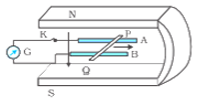
Figure shows a metallic rod PQ of length l, resting on the smooth horizontal rails AB positioned between the poles of a permanent magnet. The rails, the rod, and the magnetic field are in three mutually perpendicular directions. A galvanometer G connects the rails through a switch K. Assume the magnetic field to be uniform. Given the resistance of the closed-loop containing the rod is R.
Image

i. Suppose K is open and the rod is moved with a speed v in the direction shown. Find the polarity and magnitude of induced emf.
ii. With K open and the rod moving uniformly, there is no net force on the electrons in the rod PQ even though they do experience a magnetic force due to the motion of the rod. Explain.
iii. What is the induced emf in the moving rod if the magnetic field is parallel to the rails instead of being perpendicular?
View full solution
Q 173 Marks Question3 Marks
A coil of cross-sectional area A lies in a uniform magnetic field B with its plane perpendicular to the field. In this position the normal to the coil makes an angle of 0° with the field. The coil rotates at a uniform rate to complete one rotation in time T. Find the average induced emf in the coil during the interval when the coil rotates:
i. from $0^{\circ}$ to $90^{\circ}$ position
ii. from $90^{\circ}$ to $180^{\circ}$ position
iii. from $180^{\circ}$ to $270^{\circ}$ and
iv. from $270^{\circ}$ to $360^{\circ}$
View full solution
Q 183 Marks Question3 Marks
An electron in a hydrogen atom makes transitions from orbits of higher energies to orbits of lower energies.
a. When will such transitions result in (a) Lyman (b) Balmer series?
b. Find the ratio of the longest wavelength in Lyman series to the shortest wavelength in Balmer series.
View full solution
Q 193 Marks Question3 Marks
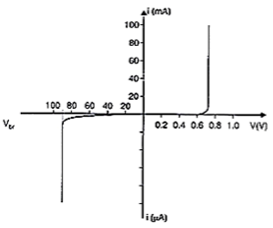
The following figure shows the V-I characteristics of a semiconductor diode.
i. Identify the semiconductor diode used.
ii. Draw the circuit diagram to obtain the given characteristics of this device.
iii. Briefly explain how this diode can be used as a voltage regulator.
Image
View full solution
An electromagnetic wave transports linear momentum as it travels through space. If an electromagnetic wave transfers a total energy U to a surface in time t , then total linear momentum delivered to the surface is $p =\frac{U}{c}$. When an electromagnetic wave falls on a surface, it exerts pressure on the surface. In 1903, the American scientists Nichols and Hull succeeded in measuring radiation pressures of visible light where other had failed, by making a detailed empirical analysis of the ubiquitous gas heating and ballistic effects.

(i) The pressure exerted by an electromagnetic wave of intensity $I \left( W m ^{-2}\right)$ on a non-reflecting surface is ( c is the velocity of light)
(a) $\frac{I}{c}$ (b) $\frac{I}{c^2}$ (c) $Ic ^2$ (d) IC

(ii) Light with an energy flux of $18 W / cm ^2$ falls on a non-reflecting surface at normal incidence. The pressure exerted on the surface is:
(a) $2 N / m ^2$
(b) $6 \times 10^{-4} N / m ^2$
(c) $2 \times 10^{-4} N / m ^2$
(d) $6 N / m ^2$

(iii) Radiation of intensity $0.5 W m ^{-2}$ are striking a metal plate. The pressure on the plate is
(a) $0.212 \times 10^{-8} N m ^{-2}$
(b) $0.132 \times 10^{-8} N m ^{-2}$
(c) $0.166 \times 10^{-8} N m ^{-2}$
(d) $0.083 \times 10^{-8} N m ^{-2}$
OR
The radiation pressure of the visible light is of the order of
(a) $10^{-4} N / m$
(b) $10^{-6} N / m ^2$
(c) $10^{-8} N$
(d) $10^{-2} N m ^2$

(iv) A point source of electromagnetic radiation has an average power output of 1500 W . The maximum value of electric field at a distance of 3 m from this source (in $V m ^{-1}$ ) is
(a) 500 (b) $\frac{500}{3}$ (c) $\frac{250}{3}$ (d) 100
View full solution
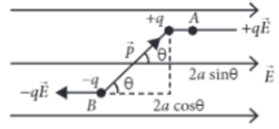
When electric dipole is placed in uniform electric field, its two charges experience equal and opposite forces, which cancel each other and hence net force on electric dipole in uniform electric field is zero. However these forces are not collinear, so they give rise to some torque on the dipole. Since net force on electric dipole in uniform electric field is zero. so no work is done in moving the electric dipole in uniform electric field. However some work is done in rotating the dipole against the torque acting on it.
Image
(i) The dipole moment of a dipole in a uniform external field $\vec{E}$ is $\vec{P}$. Then the torque $\vec{\tau}$ acting on the dipole is
(a) $\vec{\tau}=2(\vec{P}+\vec{E})$
(b) $\vec{\tau}=\vec{P} \cdot \vec{E}$
(c) $\vec{\tau}=(\vec{P}+\vec{E})$
(d) $\vec{\tau}=\vec{P} \times \vec{E}$

(ii) An electric dipole consists of two opposite charges, each of magnitude $1.0 \mu C$ separated by a distance of 2.0 cm . The dipole is placed in an external field of $10^5 NC ^{-1}$. The maximum torque on the dipole is
(a) $4 \times 10^{-3} Nm$
(b) $2 \times 10^{-3} Nm$
(c) $1 \times 10^{-3} Nm$
(d) $0.2 \times 10^{-3} Nm$

(iii) Torque on a dipole in uniform electric field is minimum when $\theta$ is equal to
(a) $0^{\circ}$ (b) $90^{\circ}$ (c) $180^{\circ}$ (d) Both $0^{\circ}$ and $180^{\circ}$

(iv) When an electric dipole is held at an angle in a uniform electric field, the net force F and torque on the dipole are
(a) $F =0, \tau=0$
(b) $F \neq 0, \tau \neq 0$
(c) $F \neq 0, \tau=0$
(d) $F =0, \tau \neq 0$
OR
An electric dipole of moment $p$ is placed in an electric field of intensity E. The dipole acquires a position such that the axis of the dipole makes an angle $\theta$ with the direction of the field. Assuming that the potential energy of the dipole to be zero when $\theta=90^{\circ}$, the torque and the potential energy of the dipole will respectively be
(a) $pE \sin \theta,- pE \cos \theta$
(b) $pE \cos \theta,- pE \sin \theta$
(c) $pE \sin \theta, 2 pE \cos \theta$
(d) $pE \sin \theta,-2 pE \cos \theta$
View full solution
a. Draw graphs showing the variations of inductive reactance and capacitive reactance with the frequency of the applied ac source.
b. Draw the phasor diagram for a series RC circuit connected to an ac source.
c. An alternating voltage of 220 V is applied across a device X, a current of 0.25 A flows, which lag behind the applied voltage in phase by $\frac{\pi}{2}$ radian. If the same voltage is applied across another device Y, the same current flows but now it is in phase with the applied voltage.
i. Name the devices X and Y.
ii. Calculate the current flowing in the circuit when the same voltage is applied across the series combination of X and Y.
View full solution
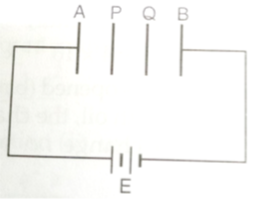
Two parallel metal plates P and Q are inserted at equal distances into a plane capacitor as shown in fig. Plates A and B of the capacitor are connected to a battery of e.m.f. V.
a. What are the potentials of the four plates?
Image
a. What are the potentials of the four plates?
b. How will the potentials of plates P and Q and the intensities of the fields in each of the three spaces change after plates P and Q have been connected by a wire?
c..What will happen to the charges on plates A and B, when plates P and Q are connected with a wire?
d. Will there be charges on the plates P and Q after connecting them with a wire?
View full solution
Two charged conducting spheres of radii a and b are connected to each other by a wire. What is the ratio of electric fields at the surfaces of the two spheres? Use the result obtained to explain why charge density on the sharp and pointed ends of a conductor is higher than on its flatter portions.
View full solution
i. An alternating voltage $V = V _{ m } \sin \omega t$ applied to a series $L - C - R$ circuit derives a current given by $I = I _{ m } \sin (\omega t+\phi)$. Deduce an expression for the average power dissipated over a cycle.
ii. For circuit used for transporting electric power, a low power factor implies large power loss in transmission. Explain.
View full solution
i. Using Huygens's construction of secondary wavelets explains how a diffraction pattern is obtained on a screen due to a narrow slit on which a monochromatic beam of light is incident normally.
ii. Show that the angular width of first diffraction fringe is half that of the central fringe.
iii. Explain why the maxima at $\theta=\left(n+\frac{1}{2}\right) \frac{\lambda}{a}$ a become weaker and weaker with increasing n.
View full solution

Generate a MODEL PAPER 5 paper free

Pick question groups from the list above, set marks and difficulty, and export a branded PDF with step-by-step answer keys. First 3 chapters free — no signup.

Download App