Question types

MODEL PAPER 7 question types

38 questions across 6 question groups — pick any mix to generate a Physics paper with step-by-step answer keys.

38
Questions
6
Question groups
5
Question types
Sample Questions

MODEL PAPER 7 questions

One sample from each question group in this chapter. Select any group above to see the full set with answer keys.

Q 1M.C.Q [1M]1 Mark
A microscope is focused on a mark. Then a glass slab of refractive index 1.5 and thickness 6 cm is placed on the mark. To get the mark again in focus the microscope should be moved
  • A
    9 cm upward c) 4 cm upward
  • B
    2 cm downward
  • C
    4 cm upward
  • D
    2 cm upward
View full solution
Q 2M.C.Q [1M]1 Mark
Consider the two idealised systems: (i) a parallel plate capacitor with large plates and small separation and (ii) a long solenoid of length L > > R, radius of cross-section. In (i), E is ideally treated as a constant between plates and zero outside. In (ii), magnetic field is constant inside the solenoid and zero outside. These idealised assumptions, however, contradict fundamental laws as below:
  • A
    case (ii) contradicts Gauss's law for magnetic fields.
  • B
    case (i) contradicts Gauss's law for electrostatic fields.
  • C
    case (ii) contradicts en $\oint H \cdot d 1=I_{e n}$
  • D
    case (i) agrees with $\oint E . d 1=0$
View full solution
Q 3M.C.Q [1M]1 Mark
In a compound microscope, maximum magnification is obtained when the final image
  • A
    coincides with the objective
  • B
    is formed at the least distance of distinct vision
  • C
    coincides with the object
  • D
    is formed at infinity
View full solution
Q 4M.C.Q [1M]1 Mark
The magnetic moment $(\mu)$ of a revolving electron around the nucleus varies with principal quantum number n as
  • A
    $\mu \propto n$
  • B
    $\mu \propto \frac{1}{n}$
  • C
    $\mu \propto \frac{1}{n^2}$
  • D
    $\mu \propto n^2$
View full solution
Q 5M.C.Q [1M]1 Mark
Two bulbs each marked 100 W, 220 V are connected in series across 220 V supply. The power consumed by them, when lit, is
  • A
    220W
  • B
    zero
  • C
    100W
  • D
    50W
View full solution
Assertion (A): In the process of photoelectric emission, all emitted electrons have the same kinetic energy.
Reason (R): According to Einstein's equation $E_k=h v-\phi_0$.
  • A
    Both A and R are true and R is the correct explanation of A.
  • B
    Both A and R are true but R is not the correct explanation of A.
  • C
    A is true but R is false.
  • D
    A is false but R is true.
View full solution
Assertion (A): If the frequency of the applied AC is doubled, then the power factor of a series R-L circuit decreases.
Reason (R): Power factor of series R-L circuit is given by \$\cos \phi=\frac{2 R}{R^2+\omega^2 L^2}$
  • A
    Both A and R are true and R is the correct explanation of A.
  • B
    Both A and R are true but R is not the correct explanation of A.
  • C
    A is true but R is false.
  • D
    A is false but R is true.
View full solution
Assertion (A): Two adjacent conductors of unequal dimensions, carrying the same positive charge have a potential difference between them.
Reason (R): The potential of a conductor depends upon the charge given to it.
  • A
    Both A and R are true and R is the correct explanation of A.
  • B
    Both A and R are true but R is not the correct explanation of A.
  • C
    A is true but R is false.
  • D
    A is false but R is true.
View full solution
Assertion (A): To observe diffraction of light, the size of the obstacle/aperture should be of the order of $10^{-7} m$.
Reason (R): $10^{-7}$ is the order of the wavelength of visible light.
  • A
    Both A and R are true and R is the correct explanation of A.
  • B
    Both A and R are true but R is not the correct explanation of A.
  • C
    A is true but R is false.
  • D
    A is false but R is true.
View full solution
Poynting vectors $\vec{S}$ is defined as a vector whose magnitude is equal to the wave intensity and whose direction is along the direction of wave propogation. Mathematically, it is given by $\vec{S}=\frac{1}{\mu_0} \vec{E} \times \vec{B}$. Show the nature of S vs t graph.
View full solution
A proton and an alpha particle having the same kinetic energy are, in turn, passed through a region of the uniform magnetic field, acting normal to the plane of the paper and travel in circular paths. Deduce the ratio of the radii of the circular paths described by them.
View full solution
An $\alpha$-particle moving with initial kinetic energy $K$ towards a nucleus of atomic number $Z$ approaches a distance $d$ at which it reverses its direction. Obtain the expression for the distance of closest approach $d$ in terms of the kinetic energy of $\alpha$-particle $K$.
View full solution
Q 153 Marks Question3 Marks
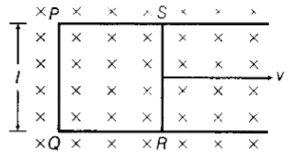
Figure shows a rectangular conducting loop PQRS in which arm RS of length I is movable. The loop is kept in a uniform magnetic field B directed downward perpendicular to the plane of the loop. The arm RS is moved with a uniform speed v.
Image

Deduce an expression for
i. the emf induced across the arm RS
ii. the external force required to move the arm and
iii. the power dissipated as heat.
View full solution
Q 163 Marks Question3 Marks
We are given the following atomic masses:
$\begin{array}{l}{ }_{92}^{238} U=238.05079 u \\
{ }_2^4 H e=4.00260 u \\
{ }_{90}^{234} Th =234.04363 u \\
{ }_1^1 H=1.00783 u \\
{ }_{91}^{237} Pa=237.05121 u \end{array}$
Here the symbol Pa is for the element protactinium (Z = 91).
i. Calculate the energy released during the alpha decay of ${ }_{92}^{238} U$.
ii. Calculate the kinetic energy of the emitted $\alpha$-particles.
iii. Show that ${ }_{92}^{238} U$ can not spontaneously emit a proton.
View full solution
Q 173 Marks Question3 Marks
A homogeneous poorly conducting medium of resistivity fills up the space between two thin coaxial ideally conducting cylinders. The radii of the cylinders are equal to a and b with a < b, the length of each cylinder is l. Neglecting the edge effects, find the resistance of the medium between the cylinders.
View full solution
Q 183 Marks Question3 Marks
Define the term self-inductance of a solenoid. Obtain the expression for the magnetic energy stored in an inductor of self-inductance L to build up a current I through it.
View full solution
Q 193 Marks Question3 Marks
Define the term wavefront. State Huygen's principle. Consider a plane wavefront incident on a thin convex lens. Draw a proper diagram to show how the incident wavefront traverses through the lens and after refraction focusses on the focal point of the lens, giving the shape of the emergent wavefront.
View full solution
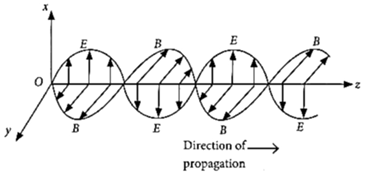
A stationary charge produces only an electrostatic field while a charge in uniform motion produces a magnetic field, that does not change with time. An oscillating charge is an example of accelerating charge. It produces an oscillating magnetic field, which in turn produces an oscillating electric fields and so on. The oscillating electric and magnetic fields regenerate each other as a wave which propagates through space.
Image
(i). Magnetic field in a plane electromagnetic wave is given by $\vec{B}= B _0 \sin ( kx +\omega t ) \hat{j} T$Expression for corresponding electric field will be (Where c is speed of light.)
(a) $\vec{E}= B _0 c \sin ( kx +\omega t ) \hat{k} V / m$
(b) $\vec{E}=- B _0 c \sin ( kx -\omega t ) \hat{k} V / m$
(c) $\vec{E}=- B _0 c \sin ( kx +\omega t ) \hat{k} V / m$
(d) $\vec{E}=\frac{B_0}{c} \sin ( kx +\omega t ) \hat{k} V / m$

(ii) The electric field component of a monochromatic radiation is given by $\vec{E}=2 E _0 \hat{i} \cos kz \cos \omega t$. Its magnetic field $\vec{B}$ is then given by
(a) $-\frac{2 E_0}{c} \hat{j} \sin kz \sin \omega t$
(b) $\frac{2 E_0}{c} \hat{j} \sin kz \sin \omega t$
(c) $\frac{2 E_0}{c} \hat{j} \sin kz \cos \omega t$
(d) $\frac{2 E_0}{c} \hat{j} \cos kz \cos \omega t$

(iii) A plane em wave of frequency 25 MHz travels in a free space along x -direction. At a particular point in space and time, $E =(6.3 \hat{j}) V / m$. What is magnetic field at that time?
(a) $0.089 \mu T$
(b) $0.124 \mu T$
(c) $0.021 \mu T$
(d) $0.095 \mu T$

OR

A plane electromagnetic wave travels in free space along $x$-axis. At a particular point in space, the electric field along $y$-axis is $9.3 V m ^{-1}$. The magnetic induction (B) along z -axis is
(a) $3.1 \times 10^{-8} T$
(b) $3 \times 10^{-5} T$
(c) $3 \times 10^{-6} T$
(d) $9.3 \times 10^{-6} T$

(iv) A plane electromagnetic wave travelling along the $x$-direction has a wavelength of 3 mm . The variation in the electric field occurs in the $y$-direction with an amptitude $66 V m ^{-1}$. The equations for the electric and magnetic fields as a function of $x$ and $t$ are respectively
$\begin{aligned} \text { a) } E_y & =11 \cos 2 \pi \times 10^{11}\left(t-\frac{x}{c}\right), & \text { b) } E_y & =66 \cos 2 \pi \times 10^{11}\left(t-\frac{x}{c}\right), \\ B_y & =11 \times 10^{-7} \cos 2 \pi \times 10^{11}\left(t-\frac{x}{c}\right) & B_z & =2.2 \times 10^{-7} \cos 2 \pi \times 10^{11}\left(t-\frac{x}{c}\right) \\ \text { c) } E_x & =33 \cos \pi \times 10^{11}\left(t-\frac{x}{c}\right), & \text { d) } E_y & =33 \cos \pi \times 10^{11}\left(t-\frac{x}{c}\right), \\ B_x & =11 \times 10^{-7} \cos \pi \times 10^{11}\left(t-\frac{x}{c}\right) & B_z & =1.1 \times 10^{-7} \cos \pi \times 10^{11}\left(t-\frac{x}{c}\right)\end{aligned}$
View full solution
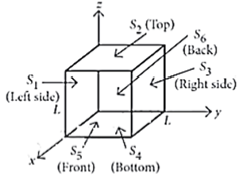
Net electric flux through a cube is the sum of fluxes through its six faces. Consider a cube as shown in figure, having sides of length $L =10.0 cm$. The electric field is uniform, has a magnitude $E =4.00 \times 10^3 NC ^{-1}$ and is parallel to the xy plane at an angle of $37^{\circ}$ measured from the + x -axis towards the + y -axis.
Image
(i) Electric flux passing through surface $S_6$ is
(a) $-24 Nm ^2 C ^{-1}$
(b) $32 Nm ^2 C ^{-1}$
(c) $-32 Nm ^2 C ^{-1}$
(d) $24 Nm ^2 C ^{-1}$

(ii) Electric flux passing through surface $S_1$ is
(a) $-32 Nm ^2 C ^{-1}$
(b) $-24 Nm ^2 C ^{-1}$
(c) $32 Nm ^2 C ^{-1}$
(d) $24 Nm ^2 C ^{-1}$

(iii) The surfaces that have zero flux are
 (a) $S _2$ and $S _4$ (b) $S_3$ and $S_6$ (c) $S _1$ and $S _2$ (d) $S _1$ and $S _3$

(iv) he total net electric flux through all faces of the cube is a) 24 Nm2 C-1 c)-8 Nm2 C-1 b
(a) $24 Nm ^2 C ^{-1}$ (b) $8 Nm ^2 C ^{-1}$ (c) $-8 Nm ^2 C ^{-1}$ (d) zero

OR

The dimensional formula of surface integral $\oint \vec{E} \cdot d \vec{S}$ of an electric field is
(a) $\left[ M ^{-1} L^3 T^{-3} A\right]$
(b) $\left[ M L ^2 T^{-2} A^{-1}\right]$
(c) $\left[ ML ^3 T^{-3} A^{-1}\right]$
(d) $\left[ M L ^{-3} T^{-3} A^{-1}\right]$
View full solution
i. With the help of a diagram, explain the principle and working of a device which produces current that reverses its direction after regular intervals of time.
ii. If a charged capacitor C is short-circuited through an inductor L, the charge and current in the circuit oscillate simple harmonically. a. In what form the capacitor and the inductor store energy? b. Write two reasons due to which the oscillations become damped.
View full solution
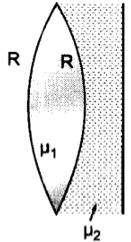
A biconvex lens with its two faces of equal radius of curvature R is made of a transparent medium of refractive index $\mu_1$. It is kept in contact with a medium of refractive index $\mu_2$ as shown in the figure.
Image

a. Find the equivalent focal length of the combination.
b. Obtain the condition when this combination acts as a diverging lens.
c. Draw the ray diagram for the case $\mu_1>\frac{\left(\mu_2+1\right)}{2}$, when the object is kept far away from the lens. Point out the nature of the image formed by the system.
View full solution
a. Draw the diagram of a device which is used to decrease high ac voltage into a low ac voltage and state its working principle. Write four sources of energy loss in this device.
b. A small town with a demand of 1200 kW of electric power at 220 V is situated 20 km away from an electric plant generating power at 440 V . The resistance of the two wire line carrying power is $0.5 \Omega per km$. The town gets the power from the line through a $4000-220 V$ step-down transformer at a sub-station in the town. Estimate the line power loss in the form of heat
View full solution
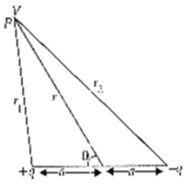
Two point charges $q$ and $-q$ are located at points $(0,0,-a)$ and $(0,0, a)$ respectively.
i. Find the electrostatic potential at $(0,0, z)$ and $(x, y, 0)$.
ii. How much work is done in moving a small test charge from the point $(5,0,0)$ to $(-7,0,0)$ along the $X$-axis?
iii. How would your answer change if the path of the test charge between the same points is not along the $x$-axis but along any other random path?
iv. If the above point charges are now placed in the same positions in a uniform external electric field $\vec{E}$, what would be the potential energy of the charge system in its orientation of unstable equilibrium? Justify your answer in each case.
View full solution

Generate a MODEL PAPER 7 paper free

Pick question groups from the list above, set marks and difficulty, and export a branded PDF with step-by-step answer keys. First 3 chapters free — no signup.

Download App