Question 14 Marks
Derive the formula for the magnetic field produced at a point on the axis of a current carrying circular loop.
Answer
View full question & answer→→As shown in the figure, a steady current I is flowing through a conducting loop of radius $R$.
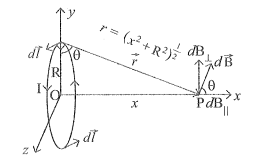
→The loop is placed in such a way that it lies in the $y-z$ plane and the X -axis passing through its axis.
→A point P lies at a distance $x$ on the X -axis from its origin. We want to calculate the magnetic field at the point P .
→Consider a current element $I d \vec{l}$ from the loop shown in figure. The magnitude of the magnetic field due to this element is,
$d B=\frac{\mu_0}{4 \pi} \cdot \frac{| I d \vec{l} \times \vec{r}|}{r^3}$
→But $I d \vec{l} \perp \vec{r}$ because $I d \vec{l}$ is in the $y z$ plane and the position vector $(\vec{r})$ is in $x y$ plane.
$\begin{array}{l}
\therefore d B=\frac{\mu_0}{4 \pi} \cdot \frac{ I d l r \sin 90}{r^3} \\
\therefore d B=\frac{\mu_0}{4 \pi} \cdot \frac{ I d l}{r^2}
\end{array}$
→From the figure, $r^2= R ^2+x^2$. Hence,
$d B=\frac{\mu_0}{4 \pi} \cdot \frac{ I d l}{\left( R ^2+x^2\right)}$
→The magnetic field has two components at point $P$
(i) Perpendicular component $\left(d B_{\perp}=d B \sin \theta\right)$
→When the perpendicular components are summed to get the net magnetic field, they cancel each other and the result is zero
(ii) Parallel component $\left(d B_{\|}=d B \cos \theta\right)$
→The parallel components are summed up to get the net magnetic field, so it can be obtained by integrating $d B_x=d B \cos \theta$ over the loop.
$\begin{array}{l}
→\Rightarrow \quad d B(x)=d B \cos \theta \\
\therefore \quad d B(x)=\frac{\mu_0}{4 \pi} \cdot \frac{ I d l}{ R ^2+x^2} \cdot \cos \theta
\end{array}$
$(\because$ from equation $(3))$
→From the figure,
$\begin{aligned}
\cos \theta & =\frac{ R }{\left(x^2+ R ^2\right)^{\frac{1}{2}}} \\
\therefore d B(x) & =\frac{\mu_0}{4 \pi} \cdot \frac{ I d l}{ R ^2+x^2} \cdot \frac{ R }{\left( R ^2+x^2\right)^{\frac{1}{2}}} \\
\therefore d B(x) & =\frac{\mu_0}{4 \pi} \cdot \frac{ I d l \cdot R }{\left(R^2+x^2\right)^{\frac{3}{2}}}
\end{aligned}$
→The resultant magnetic field.
$\begin{aligned}
B & =\oint d B(x)=\frac{\mu_0 IR }{4 \pi\left( R ^2+x^2\right)^{\frac{3}{2}}} \oint d l \\
\therefore \quad B & =\frac{\mu_0 IR }{4 \pi\left( R ^2+x^2\right)^{\frac{3}{2}}}(2 \pi R )(\because \oint d l=2 \pi R ) \\
\therefore \quad B & =\frac{\mu_0 IR ^2}{2\left( R ^2+x^2\right)^{\frac{3}{2}}}
\end{aligned}$
→In vector form,
$\overrightarrow{ B }=\frac{\mu_0 IR ^2}{2\left( R ^2+x^2\right)^{\frac{3}{2}}} \cdot \hat{i}$
→To obtain the magnetic field at the centre of the loop $x=0$
$\therefore B=\frac{\mu_0 IR ^2}{2 R ^3}=\frac{\mu_0 I }{2 R }$
→If there are N turns, then
$\overrightarrow{ B }=\frac{\mu_0 NIR ^2}{2\left( R ^2+x^2\right)^{\frac{3}{2}}} \cdot \hat{i}$
→The loop is placed in such a way that it lies in the $y-z$ plane and the X -axis passing through its axis.
→A point P lies at a distance $x$ on the X -axis from its origin. We want to calculate the magnetic field at the point P .
→Consider a current element $I d \vec{l}$ from the loop shown in figure. The magnitude of the magnetic field due to this element is,
$d B=\frac{\mu_0}{4 \pi} \cdot \frac{| I d \vec{l} \times \vec{r}|}{r^3}$
→But $I d \vec{l} \perp \vec{r}$ because $I d \vec{l}$ is in the $y z$ plane and the position vector $(\vec{r})$ is in $x y$ plane.
$\begin{array}{l}
\therefore d B=\frac{\mu_0}{4 \pi} \cdot \frac{ I d l r \sin 90}{r^3} \\
\therefore d B=\frac{\mu_0}{4 \pi} \cdot \frac{ I d l}{r^2}
\end{array}$
→From the figure, $r^2= R ^2+x^2$. Hence,
$d B=\frac{\mu_0}{4 \pi} \cdot \frac{ I d l}{\left( R ^2+x^2\right)}$
→The magnetic field has two components at point $P$
(i) Perpendicular component $\left(d B_{\perp}=d B \sin \theta\right)$
→When the perpendicular components are summed to get the net magnetic field, they cancel each other and the result is zero
(ii) Parallel component $\left(d B_{\|}=d B \cos \theta\right)$
→The parallel components are summed up to get the net magnetic field, so it can be obtained by integrating $d B_x=d B \cos \theta$ over the loop.
$\begin{array}{l}
→\Rightarrow \quad d B(x)=d B \cos \theta \\
\therefore \quad d B(x)=\frac{\mu_0}{4 \pi} \cdot \frac{ I d l}{ R ^2+x^2} \cdot \cos \theta
\end{array}$
$(\because$ from equation $(3))$
→From the figure,
$\begin{aligned}
\cos \theta & =\frac{ R }{\left(x^2+ R ^2\right)^{\frac{1}{2}}} \\
\therefore d B(x) & =\frac{\mu_0}{4 \pi} \cdot \frac{ I d l}{ R ^2+x^2} \cdot \frac{ R }{\left( R ^2+x^2\right)^{\frac{1}{2}}} \\
\therefore d B(x) & =\frac{\mu_0}{4 \pi} \cdot \frac{ I d l \cdot R }{\left(R^2+x^2\right)^{\frac{3}{2}}}
\end{aligned}$
→The resultant magnetic field.
$\begin{aligned}
B & =\oint d B(x)=\frac{\mu_0 IR }{4 \pi\left( R ^2+x^2\right)^{\frac{3}{2}}} \oint d l \\
\therefore \quad B & =\frac{\mu_0 IR }{4 \pi\left( R ^2+x^2\right)^{\frac{3}{2}}}(2 \pi R )(\because \oint d l=2 \pi R ) \\
\therefore \quad B & =\frac{\mu_0 IR ^2}{2\left( R ^2+x^2\right)^{\frac{3}{2}}}
\end{aligned}$
→In vector form,
$\overrightarrow{ B }=\frac{\mu_0 IR ^2}{2\left( R ^2+x^2\right)^{\frac{3}{2}}} \cdot \hat{i}$
→To obtain the magnetic field at the centre of the loop $x=0$
$\therefore B=\frac{\mu_0 IR ^2}{2 R ^3}=\frac{\mu_0 I }{2 R }$
→If there are N turns, then
$\overrightarrow{ B }=\frac{\mu_0 NIR ^2}{2\left( R ^2+x^2\right)^{\frac{3}{2}}} \cdot \hat{i}$