Question 13 Marks
Explain the process of thermonuclear fusion with example.
Answer
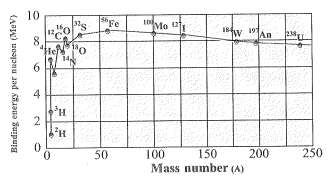
View full question & answer→→When two light nuclei fuse to form a larger nucleus, energy is released, because binding energy increases during the process.
→Some examples of such energy liberating nuclear fusion reactions are :
$\begin{array}{l}
{ }_1 H ^1+{ }_1 H ^1 \rightarrow{ }_1 H ^2+e^{+}+v+0.42 MeV \\
{ }_1 H ^2+{ }_1 H ^2 \rightarrow{ }_2 He ^3+n+3.27 MeV \\
{ }_1 H ^2+{ }_1 H ^2 \rightarrow{ }_1 H ^3+{ }_1 H ^1+4.03 MeV
\end{array}$
→In the first reaction, two protons combine to form a deuteron and a positron with a release of 0.42 MeV energy.
→In the second reaction, two deuterons combine to form the isotope of helium ${ }_2 He ^3$.
→In third reaction two deuterons combine to form a tritium and a proton. 4.03 MeV energy is released during this process.
→For a fusion to take place, the two nuclei must come close enough so that nuclear force is able to affect them.
→This force must be strong enough to overcome the repulsive barrier between two positively charged nuclei.
→The height of the barrier depends on the charges and radii of the two interacting nuclei.
→For example :
The barrier height for two protons is $\sim 400 keV$. The temperature required for a proton to overcome this barrier is T .
$\begin{aligned}
\therefore \quad \frac{3}{2} k T & =400 keV \\
T & =\frac{2 \times 400 \times 10^3 \times 1.6 \times 10^{-19}}{3 \times 1.38 \times 10^{-23}} \\
T & =3 \times 10^9 K
\end{aligned}$
→When fusion is achieved by raising the temperature of the system so that particles have enough kinetic energy to overcome the Coulomb repulsive barrier, it is called thermo - nuclear fusion.
→Some examples of such energy liberating nuclear fusion reactions are :
$\begin{array}{l}
{ }_1 H ^1+{ }_1 H ^1 \rightarrow{ }_1 H ^2+e^{+}+v+0.42 MeV \\
{ }_1 H ^2+{ }_1 H ^2 \rightarrow{ }_2 He ^3+n+3.27 MeV \\
{ }_1 H ^2+{ }_1 H ^2 \rightarrow{ }_1 H ^3+{ }_1 H ^1+4.03 MeV
\end{array}$
→In the first reaction, two protons combine to form a deuteron and a positron with a release of 0.42 MeV energy.
→In the second reaction, two deuterons combine to form the isotope of helium ${ }_2 He ^3$.
→In third reaction two deuterons combine to form a tritium and a proton. 4.03 MeV energy is released during this process.
→For a fusion to take place, the two nuclei must come close enough so that nuclear force is able to affect them.
→This force must be strong enough to overcome the repulsive barrier between two positively charged nuclei.
→The height of the barrier depends on the charges and radii of the two interacting nuclei.
→For example :
The barrier height for two protons is $\sim 400 keV$. The temperature required for a proton to overcome this barrier is T .
$\begin{aligned}
\therefore \quad \frac{3}{2} k T & =400 keV \\
T & =\frac{2 \times 400 \times 10^3 \times 1.6 \times 10^{-19}}{3 \times 1.38 \times 10^{-23}} \\
T & =3 \times 10^9 K
\end{aligned}$
→When fusion is achieved by raising the temperature of the system so that particles have enough kinetic energy to overcome the Coulomb repulsive barrier, it is called thermo - nuclear fusion.