Magnetic meridian is:
- A point.
- A line along north-south.
- A horizontal plane.
- A vertical plane.
54 questions across 4 question groups — pick any mix to generate a Physics paper with step-by-step answer keys.
M.C.Q [1M]
17 Q→021 Marks Question
6 Q→03Short Answer Type Questions [2M]
5 Q→044 Marks Questions
26 Q→One sample from each question group in this chapter. Select any group above to see the full set with answer keys.
$\frac{1}{\text{r}}$
$\frac{1}{\text{r}^2}$
$\frac{1}{\text{r}^3}$
None of these.
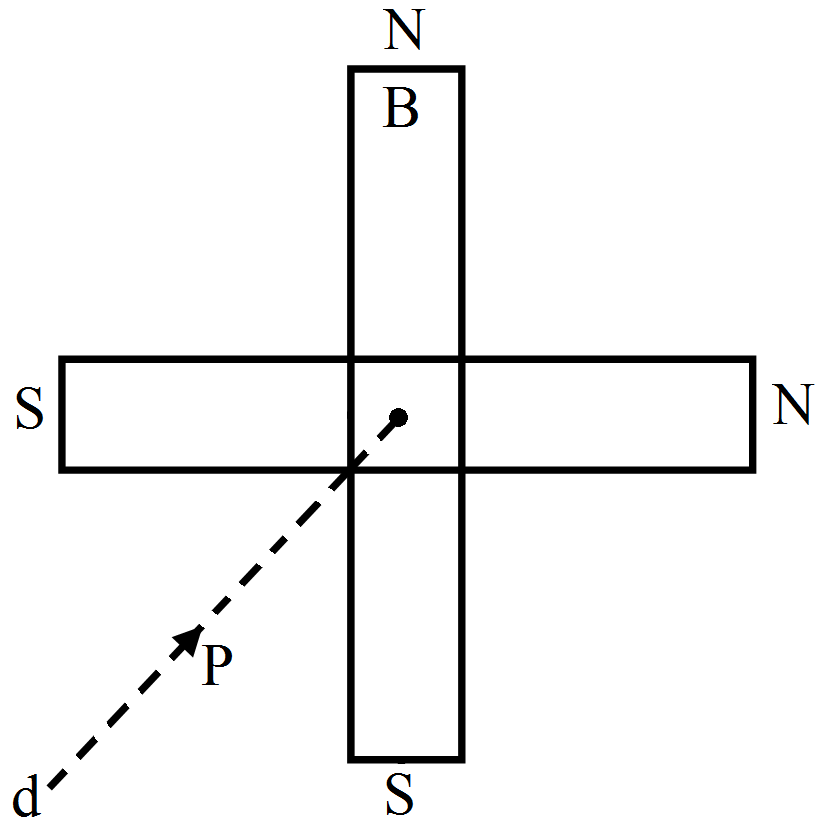
$\frac{\mu_0}{4\pi}\frac{2\text{M}}{\text{d}^3}$
$\text{U}(\overrightarrow{\text{r}_2})-\text{U}(\overrightarrow{\text{r}_1})=-\int\limits^{\vec{\text{r}}_2}_{\vec{\text{r}_1}} \vec{\text{B}}.\text{d}\vec{\text{l}}.$
Apply this equation to a closed curve enclosing a long atraicht wire. The RHS of the above equation is then
$-{\mu}_\text{o} \text{ i}$ by Ampere's law. We see that $\text{U}(\vec{\text{r}_2})\neq\text{U}(\vec{\text{r}_1})$ even when $\vec{\text{r}_2}=\vec{\text{r}_1}.$Can we have a magnetic acalar potential in this case?Pick question groups from the list above, set marks and difficulty, and export a branded PDF with step-by-step answer keys. First 3 chapters free — no signup.