Question types

Photoelectric Effect and WaveParticle Duality question types

68 questions across 6 question groups — pick any mix to generate a Physics paper with step-by-step answer keys.

68
Questions
6
Question groups
5
Question types
Sample Questions

Photoelectric Effect and WaveParticle Duality questions

One sample from each question group in this chapter. Select any group above to see the full set with answer keys.

Q 1M.C.Q [1M]1 Mark
A point source of light is used in a photoelectric effect. If the source is removed farther from the emitting metal, the stopping potential:
  1. Will increase.
  2. Will decrease.
  3. Will remain constant.
  4. Will either increase or decrease.
View full solution
Q 2M.C.Q [1M]1 Mark
The equation E = pc is valid:
  1. For an electron as well as for a photon.
  2. For an electron but not for a photon.
  3. For a photon but not for an electron.
  4. Neither for an electron nor for a photon.
View full solution
Q 3M.C.Q [1M]1 Mark
A photon of energy hv is absorbed by o free electron of a metal having work function $\varphi<\text{hv}.$
  1. The electron is sure to come out.
  2. The electron is sure to come out with a kinetic energy $\text{hv}-\varphi.$
  3. Either the electron does not come out or it comes out with a kinetic energy $\text{hv}-\varphi$ .
  4. It may come out with a kinetic energy less than $\text{hv}-\varphi.$
View full solution
Q 4M.C.Q [1M]1 Mark
Photoelectric effect supports quantum nature of light because:
  1. There is a minimum frequency below which no photoelectrons are emitted.
  2. The maximum kinetic energy of photoelectrons depends only on the frequency of light and not on its intensity.
  3. Even when the metal surface is faintly illuminated the photoelectrons leave the surface immediately.
  4. Electric charge of the photoelectrons is quantized.
View full solution
Q 5M.C.Q [1M]1 Mark
Light of wavelength $\lambda$ falls on a metal having work function $\frac{\text{h}_\text{c}}{\lambda_0}.$ Photoelectric effect will take place only if:

  1. $\lambda\geq\lambda_0$

  2. $\lambda\geq2\lambda_0$

  3. $\lambda\leq\lambda_0$

  4. $\lambda<\frac{\lambda_ 0}{2}.$

View full solution
In an experiment on photoelectric effect, a photon is incident on an electron from one direction and the photoelectron is emitted almost in the opposite direction. Does this violate conservation of momentu?
View full solution
The threshold wavelength of a metal is $\lambda_0.$ Light of wavelength slightly less $\tan \lambda_0.$ is incident on an insulated plate made of this metal. It is found that photoelectrons are emitted for some time and after that the emission stops. Explain.
View full solution
Consider the situation described in the previous problem. Show that the force on the sphere due to the light falling on it is the same even if the sphere is not perfectly absorbing.
View full solution
A sphere of radius 1.00cm is placed in the path of a parallel beam of light of large aperture. The intensity of the light is 0.5W/cm-2. If the sphere completely absorbs the radiation falling on it, find the force exerted by the light beam on the sphere.
View full solution
A parallel beam of monochromatic light of wavelength 663nm is incident on a totally reflecting plane mirror. The angle of incidence is 60° and the number of photons striking the mirror per second is 1.0 × 10¹⁹. Calculate the force exerted by the light beam on the mirror.
View full solution
A photographic film is coated with a silver bromide layer. When light fells on this film, silver bromide molecules dissociate end the film records the light there. A minimum of 0.6eV is needed to dissociate a silver bromide molecule. Find the maximum wavelength of light that can be recorded by the film.
View full solution
Q 173 Marks Question3 Marks
In a photoelectric experiment, the collector plate is at 2.0V with respect to the emitter plate made of copper ($\phi$ - 4.5eV). The emitter is illuminated by a source of monochromatic light of wavelength 200 run. Find the minimum and maximum kinetic energy of the photoelectrons reaching the collector.
View full solution
Q 193 Marks Question3 Marks
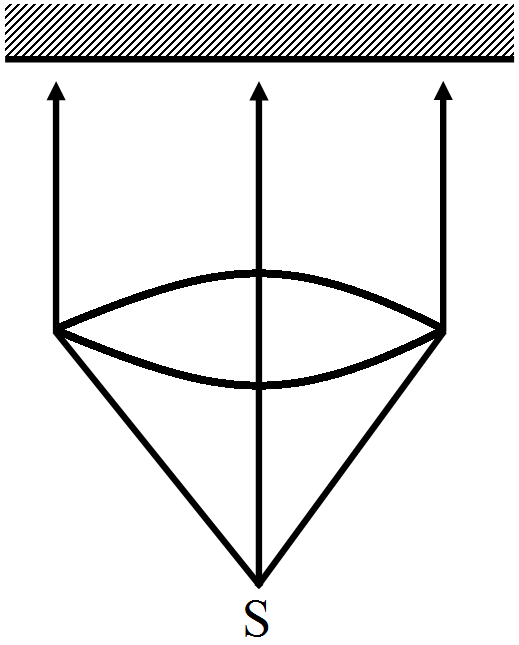
A totally reflecting, small plane mirror placed horizontally faces a parallel beam of light, as shown in the figure. The mass of the mirror is 20g. Assume that there is no absorption in the lens and that 30% of the light emitted by the source goes through the lens. Find the power of the source needed to support the weight of the mirror. Take g = 10m/s2.

View full solution
A silver ball of radius 4.8cm is suspended by a thread in a vacuum chamber. Ultraviolet light of wavelength 200 run is incident on the ball for some time during which a total light energy of 1.0 × 10⁻⁷J falls on the surface. Assuming that on the average one photon out of every ten thousand is able to eject a photoelectron, find the electric potential et the surface of the bell assuming zero potential at infinity. What is the potential at the centre of the bell?
View full solution
A beam of white light is incident normally on a plane surface absorbing 70% of the light and reflecting the rest. If the incident beam carries 10W of power, find the force exerted by it on the surface.
View full solution
A horizontal cesium plate ($\phi$ = l.9 eV) is moved vertically downward at a constant speed u in a room full of radiation of wavelength 250 run and above. What should be the minimum value of u so that the vertically upward component of velocity is nonpositive for each photoelectron?
View full solution
A horizontal cesium plate ($\phi$ = 1.9eV) is moved vertically downward at a constant speed u in a room full of radiation of wavelength 250 run and above. What should be the minimum value of u so that the vertically upward component of velocity is nonpositive for each photoelectron?
View full solution

Generate a Photoelectric Effect and WaveParticle Duality paper free

Pick question groups from the list above, set marks and difficulty, and export a branded PDF with step-by-step answer keys. First 3 chapters free — no signup.

Download App