Question types

Ray Optics and Optical Instruments question types

160 questions across 7 question groups — pick any mix to generate a Physics paper with step-by-step answer keys.

160
Questions
7
Question groups
5
Question types
Sample Questions

Ray Optics and Optical Instruments questions

One sample from each question group in this chapter. Select any group above to see the full set with answer keys.

Q 1M.C.Q [1M]1 Mark
If the magnification of optical instrument is negative, then the image will always be formed :
  • Real and inverted
  • B
    Virtual and erect
  • C
    Real and erect
  • D
    Virtual and inverted

Answer: A.

View full solution
Q 2M.C.Q [1M]1 Mark
If the magnification of objective and eyepiece in a compound microscope is ' $m_o$ ' and ' $m_e$ ' respectively, then the total magnifying power $( m )$ of the microscope will be :
  • A
    $m_o+m_e$
  • B
    $m_e-m_o$
  • $m_o \cdot m_e$
  • D
    $\frac{m_o}{m_e}$

Answer: C.

View full solution
Q 4M.C.Q [1M]1 Mark
If the refractive index of denser medium 1 relative to rare medium 2 is $n_{12}$ and the critical angle for the pair of these mediums is $i_{ c }$, then the relationship between $n _{12}$ and $i_c$ is :
  • A
    $n_{12}=\sin i_c$
  • B
    $n_{12}=\tan i_c$
  • C
    $n_{12}=\frac{1}{\tan i_c}$
  • $n_{12}=\frac{1}{\sin i_c}$

Answer: D.

View full solution
"A microscope and a telescope should have high magnification power as well as adequate resolution power." Explain the meaning of the statement.
View full solution
Double-convex lenses are to be manufactured from a glass of refractive index 1.55, with both faces of the same radius of curvature. What is the radius of curvature required if the focal length to be 20 cm?
View full solution
Answer the following questions: Magnifying power of a simple microscope is inversely proportional to the focal length of the lens. What then stops us from using a convex lens of smaller and smaller focal length and achieving greater and greater magnifying power?
View full solution
Q 163 Marks Question3 Marks
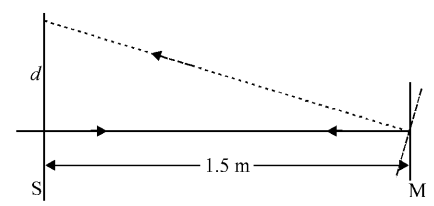
Light incident normally on a plane mirror attached to a galvanometer coil retrace backwards (as shown in Fig.). A current in the coil produces a deflection of 3.5° of the mirror. What is the displacement of the reflected spot of light on a screen placed 1.5 m away? Image
View full solution
Q 173 Marks Question3 Marks
A tank is filled with water to a height of 12.5 cm. The apparent depth of a needle lying at the bottom of the tank is measured by a microscope to be 9.4 cm. What is the refractive index of water? If water is replaced by a liquid of refractive index 1.63 up to the same height, by what distance would be the microscope have to be moved to focus on the needle again?
View full solution
Q 183 Marks Question3 Marks
A small telescope has an objective lens of focal length 140 cm and an eyepiece of focal length 5.0 cm. What is the magnifying power of the telescope for viewing distant objects when
(a) the telescope is in normal adjustment (i.e., when the final image is at infinity)?
(b) the final image is formed at the least distance of distinct vision (25 cm)?
View full solution
Q 193 Marks Question3 Marks
Answer the following questions: When viewing through a compound microscope, our eyes should be positioned not on the eyepiece but a short distance away from it for best viewing. Why? How much should be that short distance between the eye and eyepiece?
View full solution
Q 203 Marks Question3 Marks
A small pin fixed on a table top is viewed from above a distance of 50 cm. By what distance would the pin appear to be raised if it is viewed from the same point through a 15 cm thick glass slab held parallel to the table? Refractive index of glass = 1.5. Does the answer depend on the location of the slab?
View full solution
An object of size 3.0 cm is placed 14 cm in front of a concave lens of focal length 21 cm. Describe the image produced by the lens. What happens if the object is moved further away from the lens?
View full solution
A prism is made of glass of unknown refractive index. A parallel beam of light is incident on a face of the prism. The angle of minimum deviation is measured to be 40″ deg What is the refractive index of the material of the prism? The refracting angle of the prism is 60 deg If the prism is placed in water (refractive index 1.33), predict the new angle of minimum deviation of a parallel beam of light.
View full solution
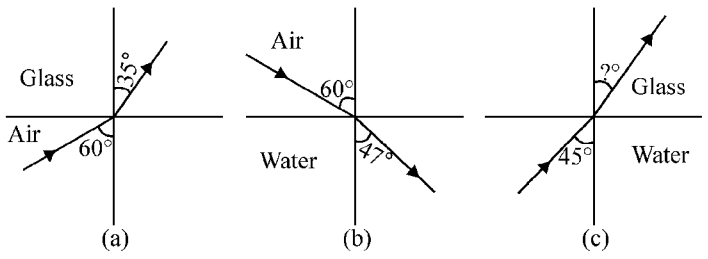
Figure (a) and (b) show refraction of a ray in air incident at 60 deg with the normal to a glass-air and water-air interface, respectively. Predict the angle of refraction in glass when the angle of incidence in water is 45 deg with the normal to a water-glass interface [Fig. (c)].
Image
View full solution
At what angle should a ray of light be incident on the face of a prism of refracting angle 60° so that it just suffers total internal reflection at the other face? The refractive index of the material of the prism is 1.524.
View full solution
A 4.5 cm needle is placed 12 cm away from a convex mirror of focal length 15 cm. Give the location of the image and the magnification. Describe what happens as the needle is moved farther from the mirror.
View full solution
Define total internal reflection. Establish the relation between $u, v$ and $f$ for a spherical mirror. Draw the necessary ray diagram. ### Define lateral displacement. Derive the lens maker formula.
$
\frac{1}{f}=\left(n_{21}-1\right)\left(\frac{1}{R_1}-\frac{1}{R_2}\right)
$
Draw the necessary ray diagram. (Where the signs have their usual meanings.)
View full solution
(a) What is meant by compound microscope? Draw a ray diagram of image formation by a compound microscope. Briefly describe its working and derive the formula for its total magnification.
(b) How does the resolving power of a microscope change when :
(i) The diameter of the objective lens decreases,
(ii) The wavelength of incident light increases?Justify your answer in each case.
View full solution
Draw a labelled diagram of a refracting telescope. Obtain an expression for its magnifying power. Write two main disadvantages of refracting telescope as compared to reflecting telescope. ### What is meant by telescope? Draw the ray diagram of image formation by a refracting telescope. Briefly describe its working and derive the formula for its magnifying power.
View full solution
A beam of light converges at a point P. Now a lens is placed in the path of the convergent beam 12 cm from P. At what point does the beam converge if the lens is (a) a convex lens of focal length 20 cm, and (b) a concave lens of focal length 16 cm?
View full solution
A small bulb is placed at the bottom of a tank containing water to a depth of 80 cm. What is the area of the surface of water through which light from the bulb can emerge out? Refractive index of water is 1.33. (Consider the bulb to be a point source.)
View full solution

Generate a Ray Optics and Optical Instruments paper free

Pick question groups from the list above, set marks and difficulty, and export a branded PDF with step-by-step answer keys. First 3 chapters free — no signup.

Download App