Question 14 Marks
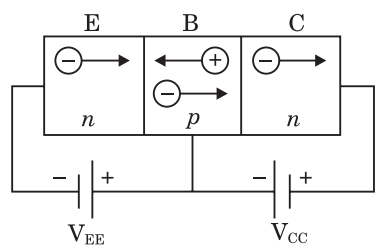
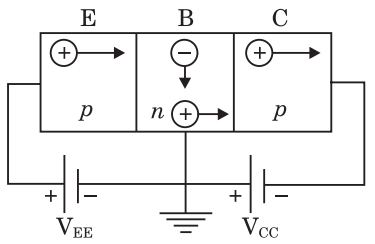
Describe with diagram the working method of $p-n-p$ and $n-p-n$ transistors.
View full question & answer→4 questions · timed · auto-graded
| $n$-type Semiconductor | $p$-type Semiconductor |
| 1. It is an extrinsic semicon-ductor obtained by adding a pentavalent impurity to a pure intrinsic semi-conductor. | It is also an extrinsic semi-conductor obtained by adding a trivalent impurity to a pure intrinsic semiconductor. |
| 2. The impurity atoms added provide extra free electrons to the crystal lattice and are called donor atoms. | The impurity atoms added create holes in the crystal lattice and are called acceptor atoms because the created holes accept electrons. |
| 3. The electrons are majority carriers and the holes are minority carriers. | The holes are majority carriers and the electrons are mino-rity carriers. |
| 4. The electron concentration is much more than the hole concentration $\left(n_e \gg n_h\right)$. | The hole concentration is much more than the electron concentration $\left(n_h \gg n_e\right)$. |
Logic Gate : "A logic gate is defined as a digital circuit which follows some logical relationship between the input and output voltages."
The digital circuit of a gate either allows a signal to pass through it or stop it, so it is called a gate.
The logic gates are building blocks of digital electronics. They are used in digital electronics to change one voltage level i.e., input voltage into another level i.e., output voltage following some logical conditions relating them. Logic gates can be made by using simple switches, semiconductor diodes and transistors.
A logic gate may have one or more inputs but it has only one output. There are three basic logic gates as given below:
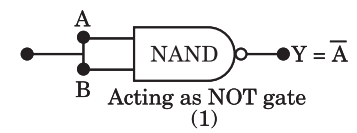
(i) OR gate, (ii) AND gate and (iii) NOT gate.
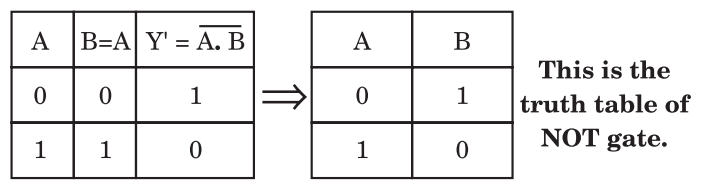
Each basic gate is represented by a symbol and its function is described by a Boolean expression or by a table known as truth table, which represents the relation between the possible values of input and output voltage in tabular form.
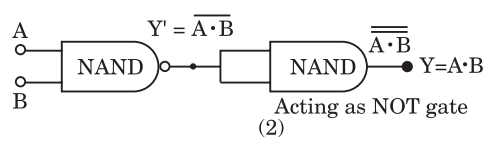
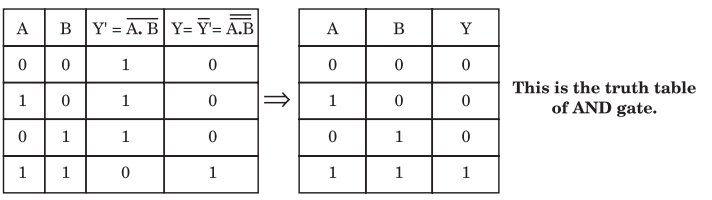
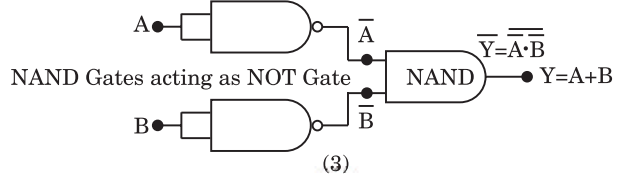
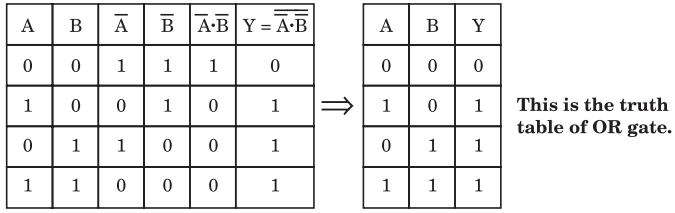
Difference between AND Gate and OR Gate
| AND Gate | OR Gate |
| In this gate when both the inputs are 1 then output is also 'equal to 1'. Otherwise output is always zero. | In this gate when both the inputs are zero, then output is also zero otherwise output is always 1. |