Questions

3 Marks Question

🎯

Test yourself on this topic

7 questions · timed · auto-graded

Question 13 Marks
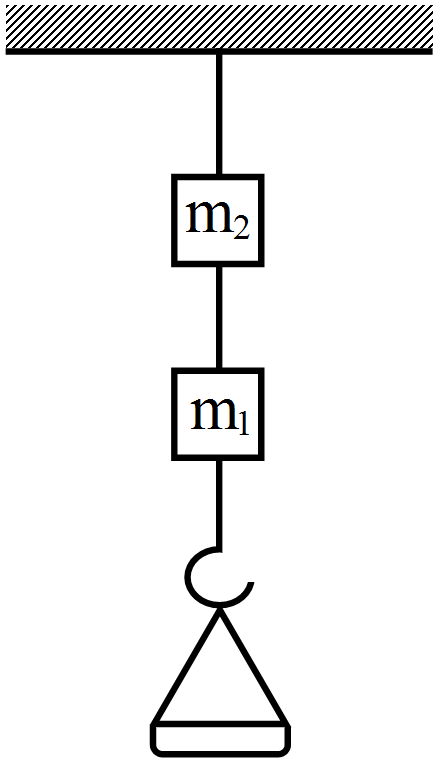
The two wires shown in are made of the,

same material which has a breaking stress of 8 × 10⁸N/m2. The area of cross-section of the upper wire is 0.006cm2 and that of the lower wire is 0.003cm2. The mass m1 = 10kg, m2 = 20kg and the hanger is light:
  1. Find the maximum load that can be put on the hanger without breaking a wire. Which wire will break first if the load is increased?
  2. Repeat the above part if m1 = 10kg and m2 = 36kg.
Answer

Breaking stress = 8 x 10⁸N/m2

$\frac{\text{C}}{\text{S}}$ Area of the upper wire A $=0.006\text{cm}^2=\frac{0.003}{10000}\text{m}^2$

$\frac{\text{C}}{\text{S}}$  area of the lower wire A' $=0.003\text{cm}^2=\frac{0.003}{10000}\text{m}^2$

  1. Let the length of each wire = L and the maximum load on the hanger W

Total load on the lower wire = W + m1

The stress on the lower wire (W + m1)g/A'

$=(\text{W}+10)\frac{\text{g}}{\Big(\frac{0.003}{10000}\big)}\text{N}/\text{m}^2$

$=(\text{W}+10)\text{g}\times\frac{10^7}{3}\text{N}{\text{m}}^2$

$=\frac{(\text{W}+30)\text{g}}{\frac{(0.0060)}{10000}}\text{N}/\text{m}^2$

$=\frac{(\text{W}+30)\text{g}^*10^7}{6}\text{N}/\text{m}^2$

Equationg it to breaking stress,$\frac{(\text{W}+30)\text{g}^*10^7}{6} = 8\times10^8$

$\Rightarrow \text{W}=\frac{6^*80}{10-30}$

$\Rightarrow \text{W}=48-30=18\text{kg}$

Since the lower wire reaches the breaking stress with a lower weight, the maximum weight W = 14kg. The lower wire will break first.

  1. If m2 = 36kg

The stress on upper wire $=\frac{(\text{W}+10+36)\text{g}}{\text{A}}$

$=\frac{(\text{W}+46)\text{g}}{\frac{0.006}{10000}}$

$=\frac{(\text{W}+46)\text{g}^*10^7}{6}$

Equating with breaking stress, $\frac{(\text{W}+46)\text{g}^*10^7}{6}=8\times 10^8$

$\Rightarrow \text{W}=\frac{6^*80}{10-46}$

$=48-46=2\text{kg}$
View full question & answer
Question 23 Marks
Estimate the change in the density of water in ocean at a depth of 400m below the surface. The density of water at the surface = 1030kg/m3 and the bulk modulus of water = 2 × 10⁹N/m2.
Answer

Given:

Bulk modulus of water B = 2 × 10⁹Nm2

Depth d = 400m

Density of water at the surface $\rho_0=1030\text{Kg}/\text{m}^3$

We know that:

Density at surface $=\frac{\text{m}}{\text{V}_0}$

Density at depth $\rho_\text{d}=\frac{\text{m}}{\text{V}_\text{d}}$

$\Rightarrow\frac{\rho_\text{d}}{\rho_\text{0}}=\frac{\text{V}_0}{\text{V}_\text{d}}\ \cdots(1)$

Here:

$\rho_\text{d}$ = density of water at a depth

m = mass

V0 = volume at the surface

Vd = volume at a depth

Pressure at a depth d $=\rho_0\text{gd}$

Acceleration due to gravity g = 10ms2

Volume strain $=\frac{\text{V}_0-\text{V}_\text{d}}{\text{V}_0}$

$\text{B}=\frac{\text{pressure}}{\text{volume}\ \text{strain}}$

$\Rightarrow\text{B}=\frac{\rho_0\text{gd}}{\Big(\frac{\text{V}_0-\text{V}_\text{d}}{\text{V}_0}\Big)}$

$\Rightarrow1-\frac{\text{V}_\text{d}}{\text{V}_0}=\frac{\rho_0\text{gd}}{\text{B}}$

$\Rightarrow\frac{\text{V}_\text{d}}{\text{V}_0}=\Big(1-\frac{\rho_0\text{gd}}{\text{B}}\Big)\ \cdots(2)$

Using equations (1), and (2), we get:

$\Rightarrow\frac{\rho_\text{d}}{\rho_0}=\frac{1}{\Big(1-\frac{\rho_0\text{gd}}{\text{B}}\Big)}$

$\Rightarrow\rho_\text{d}=\frac{1}{\Big(1-\frac{\rho_0\text{gd}}{\text{B}}\Big)}\rho_0$

$\Rightarrow\rho_\text{d}=\frac{1030}{\Big(1-\frac{1030\times10\times400}{2\times10^9}\Big)}\approx1032\text{Kg}/\text{m}^3$

Change in density $=\rho_\text{d}-\rho_0$

= 1032 - 1030 = 2Kg/m3

Hence, the required density at a depth of 400m below the surface is 2Kg/m3.

View full question & answer
Question 33 Marks
A steel wire of original length 1m and cross-sectional area 4.00mm2 is clamped at the two ends so that it lies horizontally and without tension. If a load of 2.16kg is suspended from the middle point of the wire, what would be its vertical depression? Y of the steel = 2.0 × 10¹¹N/m2 Take g = 10m/s2.
Answer

Given:

Original length of steel wire L = 1m

Area of cross-section A = 4.00mm2 = 4 ×10⁻²cm2

Load = 2.16kg

Young's modulus of steel Y = 2 × 1011N/m2

Acceleration due to gravity g = 10ms-2

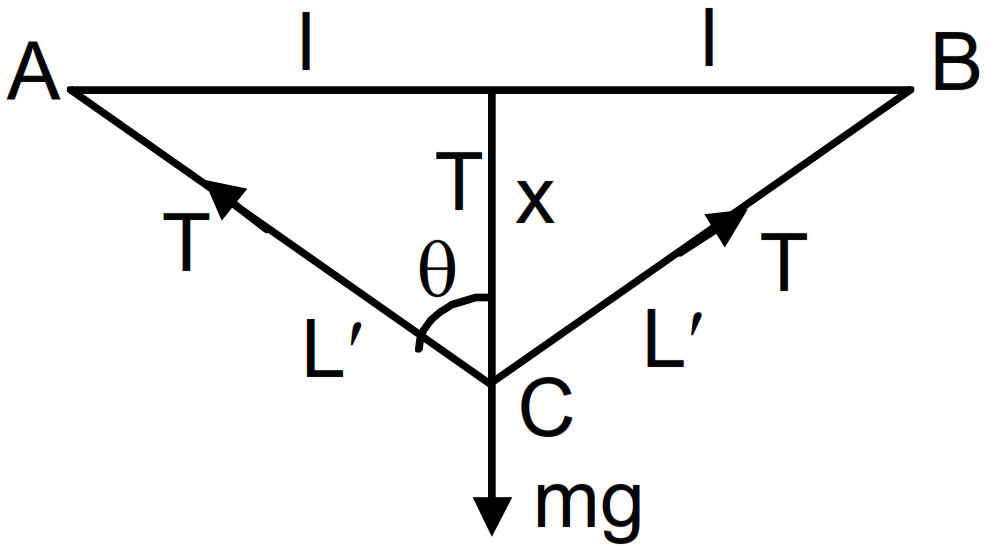
Let T be the tension in the string after the load is suspended and $\theta$ be the angle made by the string with the vertical, as shown in the figure:

$\cos\theta=\frac{\text{x}}{\sqrt{\text{x}^2+\text{l}^2}}=\frac{\text{x}}{\text{l}}\Big\{1+\frac{\text{x}^2}{\text{l}^2}\Big\}^{\frac{-1}{2}}$

Expanding the above equation using the binominal theorem:

$\cos\theta=\frac{\text{x}}{\text{l}}\Big\{1-\frac{1}{2}\frac{\text{x}^2}{\text{l}^2}\Big\}$ (neglecting the higher order terms)

Since x << l, $\frac{\text{x}^2}{\text{l}^2}$ can be neglected.

$\Rightarrow\cos\theta=\frac{\text{x}}{\text{l}}$

increase in length:

$\triangle\text{l}=(\text{AC}+\text{CB})-\text{AB}$

$\text{AC}=\big(\text{l}^2+\text{x}^2\big)^{\frac{1}{2}}$

$\triangle\text{l}=2\big(\text{l}^2+\text{x}^2\big)^{\frac{1}{2}}-2\text{l}$

We know that:

$\text{Y}=\frac{\text{F}}{\text{A}}\frac{\text{L}}{\triangle\text{L}}$

$\Rightarrow2\times10^{12}=\frac{\text{T}\times100}{\big(4\times10^{-2}\big)\times\big[2\big (50^2+\text{x}^2\big)^{\frac{1}{2}}-100\Big]}$

From the free body diagram:

$2\text{T}\cos\theta=\text{mg}$

$2\text{T}\Big(\frac{\text{x}}{50}\Big)=2.16\times10^{3}\times980$

$\Rightarrow\frac{2\times\big(2\times10^{12}\big)\times\big(4\times10^{-2}\big)\times\Big[2\Big(50^2+\text{x}^2\frac{1}{2}\Big)-100\Big]\text{x}}{100\times50}=(2.16)\times10^3\times980$

On solving the above equation, we get x = 1.5cm

Hence, the required vertical depression is 1.5cm.

View full question & answer
Question 43 Marks
The force of surface tension acts tangentially to the surface whereas the force due to air pressure acts perpendicularly on the surface. How is then the force due to excess pressure inside a bubble balanced by the force due to the surface tension?
Answer
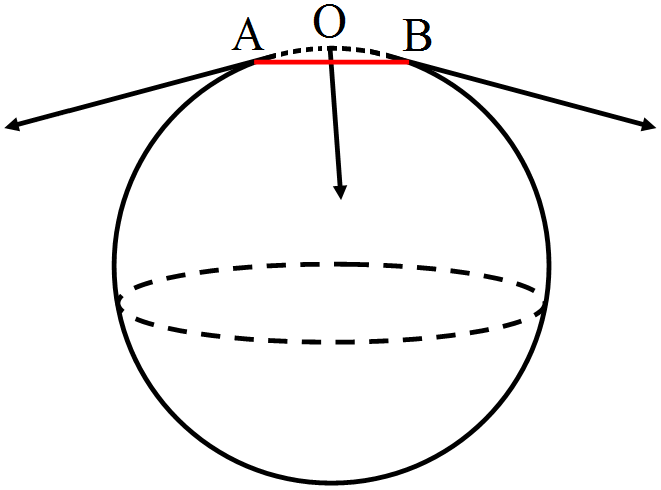
The forces act tangentially to the bubble surface on both sides of a given line but they have one component normal to the bubble surface. This component balances the force due to excess pressure inside the bubble.
In the figure, let us consider a small length AB on the surface of the spherical bubble. Let the surface forces act tangentially along A and B. On producing the forces backwards, they meet at a point O. By the parallelogram law of forces, we see that the resultant force acts opposite to the normal. This balances the internal forces due to excess pressure.

View full question & answer
Question 53 Marks
A sphere of mass 20kg is suspended by a metal wire of unstretched length 4m and diameter 1mm. When in equilibrium, there is a clear gap of 2mm between the sphere and the floor. The sphere is gently pushed aside so that the wire makes an angle $\theta$ with the vertical and is released. Find the maximum value of $\theta$ so that the sphere does not rub the floor. Young's modulus of the metal of the wire is 2.0 × 10¹¹N/m2. Make appropriate approximations.
Answer
m = 20Kg

L = 4m

2r = 1mm, r = 5 × 10⁻⁴m

At equilibrium T = mg

When it moves at an angle $\theta$ and released the tension T at lowest point is

$=\text{mg}+\frac{\text{mv}^2}{\text{r}}$

The change in tension is due to centrifugal force

$\triangle\text{T}=\frac{\text{m}\text{v}^2}{\text{r}}\ \cdots(1)$

Again by work energy principle

$\frac{1}{2}\text{mv}^2-0=\text{mgr}(1-\cos\theta)$

$\text{v}^2=2\text{gr}(1-\cos\theta)\cdots(2)$

So, $\triangle\text{T}=\frac{\text{m}[2\text{gr}(1-\cos\theta)]}{\text{r}}$

$=2\text{mg}(1-\cos\theta)$

$\Rightarrow\text{F}=\triangle\text{T}$

$\Rightarrow\text{F}=\frac{\text{Y}\ \text{A}\triangle\text{L}}{\text{L}}$

 $=2\text{mg}\cos\theta=2\text{mg}-\frac{\text{Y}\ \text{A}\triangle\text{L}}{\text{L}}$

$\Rightarrow\cot\text{h}\ \eta=1-\frac{\text{Y}\text{A}\triangle\text{L}}{\text{L}(2\text{mg})}$

$\Rightarrow\cos\theta=1-\Big[\frac{2\times10^{11}\times4\times3.14\times(5)^2\times10^{-8}\times2\times10^{-3}}{4\text{x}2\times20\times10}\Big]$

$\Rightarrow\cos\theta=0.80$

$\theta=36.4^\circ$

View full question & answer
Question 63 Marks
Water near the bed of a deep river is quiet while that near the surface flows. Give reasons.
Answer
The motion of any liquid is dependent upon the amount of stress acting on it. The motion of one layer of liquid is resisted by the other due to the property of viscosity. A river bed remains in a static state. Therefore, any immediate layer of liquid in contact with the river bed will also remain static due to the frictional force. However, the next layer of liquid above this static layer will have a greater velocity due to lesser resistance offered by the static layer. Moving upwards, subsequent layers provide lesser and lesser resistance to the movement of the layers above it. Finally, the topmost layer acquires the maximum velocity. Therefore, for a river, the surface waters flow the fastest.
View full question & answer
Question 73 Marks
When a block of mass M is suspended by a long wire of length L, the elastic potential energy stored in the wire is $\frac{1}{2}\times$ stress × strain × volume. Show that it is equal to $\frac{1}{2}\text{Mgl}$ where l is the extension. The loss in gravitational potential energy of the Mass-earth sustem is Mgl. does the remaining $\frac{1}{2}\text{Mgl}$ energy go?
Answer
Let the CSA of the wire be A.

Strees $=\frac{\text{Force}}{\text{Area}}=\frac{\text{Mg}}{\text{A}}$

Strain $=\frac{\text{l}}{\text{L}}$

Volume $=\text{AL}$

We need to calculate the elastic potential energy stored in the wire which is given to be equal to $\frac{1}{2}\times\text{strees}\times\text{strain}\times\text{volume}$

Elastic potential energy $=\frac{1}{2}\times\text{strees}\times\text{strain}\times\text{volume}$

$\frac{1}{2}\times\frac{\text{Mg}}{\text{A}}\times\frac{\text{l}}{\text{L}}\times\text{AL}$

$=\frac{1}{2}\text{Mgl}$

The other $=\frac{1}{2}\text{Mgl}$ is converted into kinetic energy of the mass.

When the mass leaves its initial point on the spring, it acquires a velocity as it moves down. The velocity reaches its maximum at the end point. The spring oscillates. Finally, when the kinetic energy is dissipated into heat, the spring comes to rest.

View full question & answer
3 Marks Question - Physics STD 12 Science Questions - Vidyadip