Question types

Sound Waves question types

118 questions across 6 question groups — pick any mix to generate a Physics paper with step-by-step answer keys.

118
Questions
6
Question groups
5
Question types
Sample Questions

Sound Waves questions

One sample from each question group in this chapter. Select any group above to see the full set with answer keys.

Q 1M.C.Q [1M]1 Mark
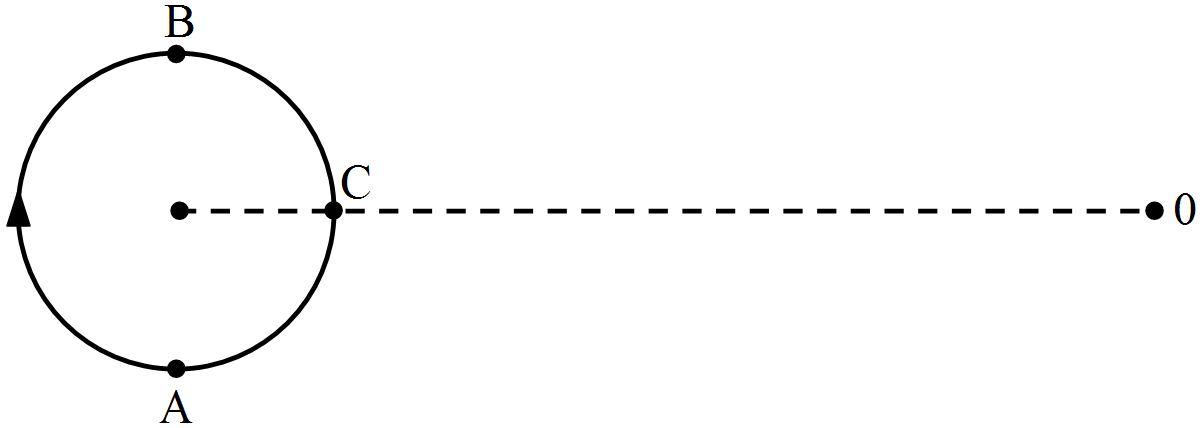
A small source of sound moves on a circle as shown-in figure and an observer is sitting at 0. Let v1, v2, v3 be the frequencies heard when the source is at A, B and C respectively.

  1. v1 > v2 > v3

  2. v1 = v2 > v3

  3. v2 > v3 > v1

  4. v1 > v2 > v2.

View full solution
Q 2M.C.Q [1M]1 Mark
A listener is at rest with respect to the source of sound. A wind starts blowing along the line joining the source and the observer. Which of the following quantities do not change?
  1. Frequency.
  2. Velocity of sound.
  3. Wavelength.
  4. Time period.
View full solution
Q 3M.C.Q [1M]1 Mark
When sound wave is refracted from air to water, which of the following will remain unchanged?
  1. Wave number.
  2. Wavelength.
  3. Wave velocity.
  4. Frequency.
View full solution
Q 4M.C.Q [1M]1 Mark
An organ pipe, open at both ends, contains
  1. Longitudinal stationary waves.
  2. Longitudinal travelling waves.
  3. Transverse stationary waves.
  4. Transverse travelling waves.
View full solution
Q 5M.C.Q [1M]1 Mark
The fundamental frequency of a vibrating organ pipe is 200Hz.
  1. The first overtone is 400Hz.
  2. The first overtone may be 400Hz.
  3. The first overtone may be 600Hz.
  4. 600Hz is an overtone.
View full solution
A Kundt's tube apparatus has a copper rod of length 1.0m clamped at 25cm from one of the ends. The tube contains air in which the speed of sound is 340m/s. The powder collects in heaps separated by a distance of 5.0cm. Find the speed of sound waves in copper.
View full solution
An electronically driven loudspeaker is placed near the open end of a resonance column apparatus. The length of air column in the tube is 80cm. The frequency of the loudspeaker can be varied between 20Hz-2kHz. Find the frequencies at which the column will resonate. Speed of sound in air = 320m/s.
View full solution
Two loudspeakers are arranged facing each other at some distance. Will a person standing behind one of the loudspeakers clearly hear the sound of the other loudspeaker or the clarity will be seriously damaged because of the 'collision' of the two sounds in between?
View full solution
Q 133 Marks Question3 Marks
Calculate the speed of sound in oxygen from the following data. The mass of 22.4 litre of oxygen at STP (T = 273K and p = 1.0 x 10⁵N/m2) is 32g, the molar heat capacity of oxygen at constant volume is Cv = 2.5R and that at constant pressure is Cp = 3.5R.
View full solution
Q 143 Marks Question3 Marks
Two sources of sound, S1 and S2, emitting waves of equal wavelength 20.0cm, are placed with a separation of 20.0cm between them. A detector can be moved on a line parallel to S1S2, and at a distance of 20.0cm from it. Initially, the detector is equidistant from the two sources. Assuming that the waves emitted by the sources are in phase, find the minimum distance through which the detector should be shifted to detect a minimum of sound.
View full solution
Q 153 Marks Question3 Marks
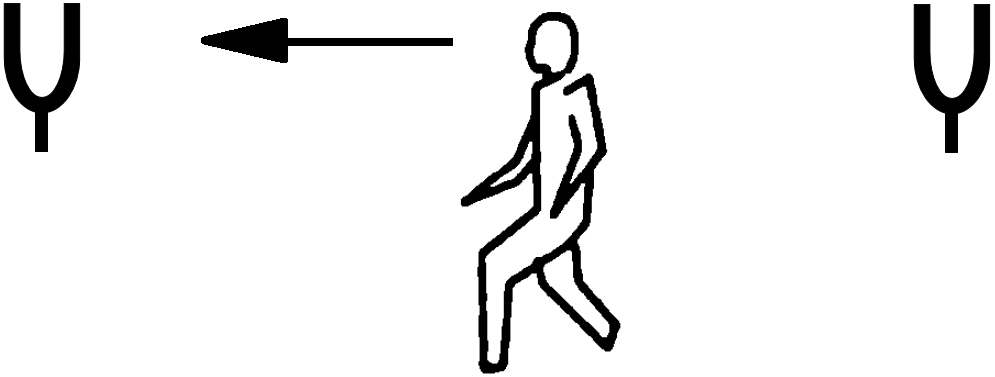
Two identical tuning forks vibrating at the same frequency 256Hz are kept fixed at some distance apart. A listener runs between the forks at a speed of 3.0m/s so that he approaches one tuning fork and recedes from the other figure. Find the beat frequency observed by the listener. Speed of sound in air = 332ms/s.

View full solution
Q 163 Marks Question3 Marks
A person riding a car moving at 72km/h sounds a whistle emitting a wave of frequency 1250Hz. What frequency will be heard by another person standing on the road.
  1. In front of the car.
  2. Behind the car? Speed of sound in air = 340m/s.
View full solution
Q 173 Marks Question3 Marks
A person standing on a road sends a sound signal to the driver of a car going away from him at a speed of 72km/h. The signal travelling at 330m/s in air and having a frequencyof 1600Hz gets reflected d from the body of the car and returns. Find the frequency of the reflected signal as heard by the person.
View full solution
At a prayer meeting, the disciples sing JAI-RAM JAI-RAM. The sound amplified by a loudspeaker comes back after reflection from a building at a distance of 80m from the meeting. What maximum time interval can be kept between one JAI-RAM and the next JAI-RAM so that the echo does not disturb a listener sitting in the meeting. Speed of sound in air is 320m/s.
View full solution
Find the change in the volume of 1.0 litre kerosene when it is subjected to an extra pressure of 2.0 x 10⁵N/m2 from the following data. Density of kerosene = 800kg/m3 and speed of sound in kerosene = 1330m/s.
View full solution
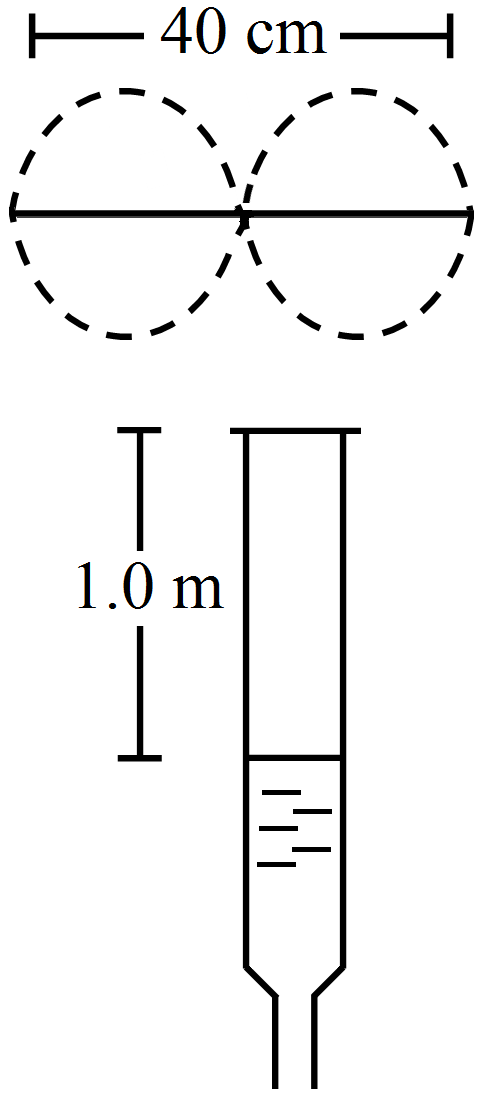
Consider the situation shown in figure. The wire which has a mass of 4.00g oscillates in its second harmonic and sets the air column in the tube into vibrations in its fundamental mode. Assuming that the speed of sound in air is 340m/s, find the tension in the wire.

View full solution
Two submarines are approaching each other in a calm sea. The first submarine travels at a speed of 36km/h and the other at 54km/h relative to the water. The first submarine sends a sound signal (sound waves in water are also called sonar) at a frequency of 2000Hz.
  1. At what frequency is this signal received by the second submarine?
  2. The signal is reflected from the second submarine. At what frequency is this signal received by the first submarine. Take the speed of the sound wave in water to be 1500m/s.
View full solution
An operator sitting in his base camp sends a sound signal of frequency 400Hz. The signal is reflected back from a car moving towards him. The frequency of the reflected sound is found to be 410Hz. Find the speed of the car. Speed of sound in air = 324m/s.
View full solution
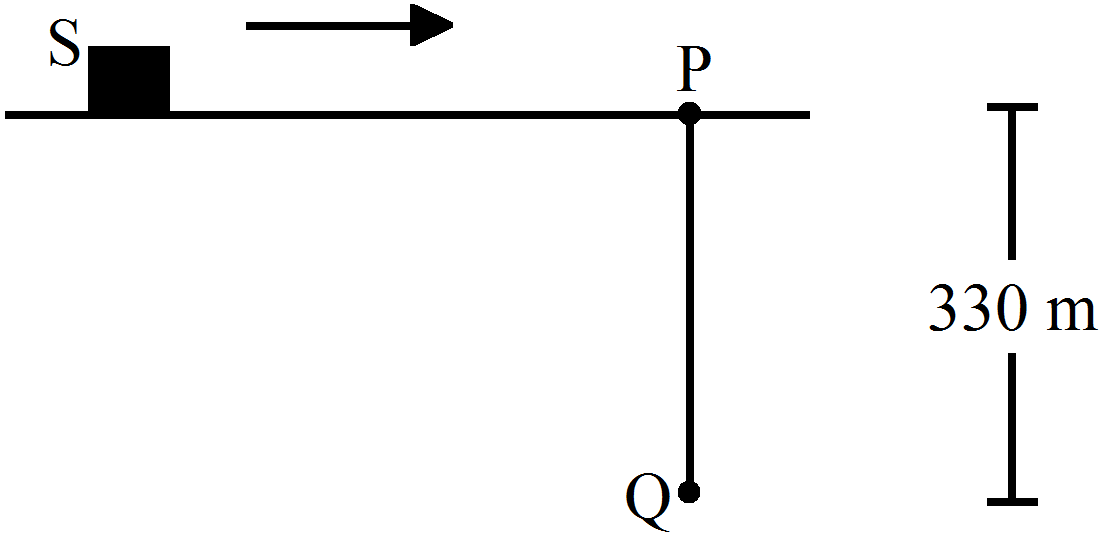
Figure, shows a source of sound moving along the X-axis at a speed of 22m/s continuously emitting a sound of frequency 2.0kHz which travels s in air at a speed of 330m/s. A listener Q stands on the Y-axis at a distance of 330 m from the origin. At t = 0, the source crosses the origin P.

  1. When does the sound emitted from the source at P reach the listener Q?
  2. What will be the frequency heard by the listener at this instant?
  3. Where will the source be at this instant?


View full solution
A piston is fitted in a cylindrical tube of small cross-section with the other end of the tube open. The tube resonates with a tuning fork of frequency 512Hz. The piston is gradually pulled out of the tube and it is found that a second resonance occurs when the piston is pulled out through a distance of 32.0cm. Calculate the speed of sound in the air of the tube.
View full solution
A U-tube having unequal arm-lengths has water in it. A tuning fork of frequency 440Hz can set up the air in the shorter arm in its fundamental mode of vibration and the same tuning fork can set up the air in the longer arm in its first overtone vibration. Find the length of the air columns. Neglect any end effect and assume that the speed of sound in air = 330m/s.
View full solution
A source of sound operates at 2.0kHz, 20W emitting sound uniformly in all directions. The speed of sound in air is 340m/s and the density of air is 1.2kg/m3.
  1. What is the intensity at a distance of 6.0m from the source?
  2. What will be the pressure amplitude at this point?
  3. What will be the displacement amplitude at this point ?
View full solution

Generate a Sound Waves paper free

Pick question groups from the list above, set marks and difficulty, and export a branded PDF with step-by-step answer keys. First 3 chapters free — no signup.

Download App