Questions · Page 2 of 5

[1 Marks Each] M.C.Q.

MCQ 511 Mark
The magnetic properties of iron disappear when it is heated strongly. Which of these changes does this illustrate?
  • A
    A chemical change.
  • B
    An irreversible change.
  • A physical change.
  • D
    A periodic change.
Answer
Correct option: C.
A physical change.
The losing of magnetic property is only a physical change as there is no change in the chemical composition of the substance.
View full question & answer
MCQ 521 Mark
A physical change is a:
  • A
    Is a temporary change.
  • B
    Change in which no new substance is formed.
  • C
    Reversible change.
  • All the above are correct.
Answer
Correct option: D.
All the above are correct.
View full question & answer
MCQ 531 Mark
Which of the following changes can be reversed?
  • A
    Raw egg to boiled egg.
  • Wet clothes to dry clothes.
  • C
    Bud to flower.
  • D
    Cow dung to biogas.
Answer
Correct option: B.
Wet clothes to dry clothes.
All other changes are irreversible.
View full question & answer
MCQ 541 Mark
Identify the chemical change from the following:
  • A
    The melting of ice.
  • The heating of sugar crystals.
  • C
    The freezing of water.
  • D
    The dissolution of salt in water.
Answer
Correct option: B.
The heating of sugar crystals.
Sugar crystals on heating form new substance caramel and water vapour. Hence, it is a chemical change.
View full question & answer
MCQ 551 Mark
Which of the following is an example of periodic change?
  • A
    Occurrence of earthquake.
  • Heartbeat.
  • C
    A car accident.
  • D
    Landslide.
Answer
Correct option: B.
Heartbeat.
Heartbeat.
View full question & answer
MCQ 561 Mark
Which pair among the following are the reversible change?
  • A
    Melting of wax and burning of wax.
  • Melting of ice and freezing of ice.
  • C
    Rolling a roti and baking a roti.
  • D
    Folding of paper and burning of paper.
Answer
Correct option: B.
Melting of ice and freezing of ice.
View full question & answer
MCQ 571 Mark
Which of the following is a chemical change?
  • A
    Evaporation of water.
  • Burning of fuels.
  • C
    Moving of a wheel.
  • D
    Breaking of a brick.
Answer
Correct option: B.
Burning of fuels.

Burning of fuels is an example of chemical change.

View full question & answer
MCQ 581 Mark
The burning of coal in air is a:
  • A
    Physical change.
  • Chemical change.
  • C
    Reversible change.
  • D
    Periodic change.
Answer
Correct option: B.
Chemical change.
A change in composition occurs when coal is burnt in air. So, it is a chemical change.
View full question & answer
MCQ 591 Mark
When water freezes to ice:
  • A
    Heat energy is absorbed.
  • Heat energy is given out.
  • C
    Both $(a)$ and $(b).$
  • D
    Either $(a)$ or $(b).$
Answer
Correct option: B.
Heat energy is given out.
View full question & answer
MCQ 601 Mark
Which among the following is a characteristic of physical change?
  • A
    Involvement of great amount of heat energy.
  • Change in states.
  • C
    Change in chemical composition.
  • D
    Formation of a new substance.
Answer
Correct option: B.
Change in states.
Change in states.
View full question & answer
MCQ 611 Mark
What is common among the following phenomena?
  1. Blinking of traffic lights.
  2. Rotation of blades of a fan.
  3. Swinging of pendulum of a clock.
  • A
    All are chemical changes.
  • All are periodic changes.
  • C
    All are undesirable changes.
  • D
    All are irreversible changes.
Answer
Correct option: B.
All are periodic changes.
View full question & answer
MCQ 621 Mark
Directions: Read the following two statements carefully and choose the correct option.
  1. Rusting of iron is a chemical change.
  2. The change of liquid water to ice on cooling is a reversible change.
  • A
    Statement $(i)$ is correct while statement $(ii)$ is in correct.
  • B
    Statement $(ii)$ is correct while statement $(i)$ is incorrect.
  • Both statements are correct.
  • D
    Both statements are incorrect.
Answer
Correct option: C.
Both statements are correct.
View full question & answer
MCQ 631 Mark
Read the given statements and mark the correct option.
Statement 1: While fixing a metal rim on a wooden wheel of a cart, the size of the metal rim is kept slightly smaller than that of the wooden wheel.
Statement 2: Metals expand on heating and contract on cooling.
  • Both statements $1$ and $2$ are true and statement $2$ is the correct explanation of statement $1.$
  • B
    Both statements $1$ and $2$ are true but statement $2$ is not the correct explanation of statement $1.$
  • C
    Statement $1$ is true and statement $2$ is false.
  • D
    Both statements $1$ and $2$ are false.
Answer
Correct option: A.
Both statements $1$ and $2$ are true and statement $2$ is the correct explanation of statement $1.$
While fixing the metal rim, it is heated. It becomes slightly larger in size and can be fixed into the wooden wheel. On cooling, it contracts and fits tightly on to the wheel.
View full question & answer
MCQ 641 Mark
If you pour a few drops of petrol on your palm, you will feel cool as it evaporates. What type of reaction is this?
  • Endothermic reaction.
  • B
    Exothermic reaction.
  • C
    Chemical reaction.
  • D
    Slow reaction.
Answer
Correct option: A.
Endothermic reaction.
When petrol it comes into contact with our skin, it absorbs our body heat and evaporates. It is an endothermic reaction.
View full question & answer
MCQ 651 Mark
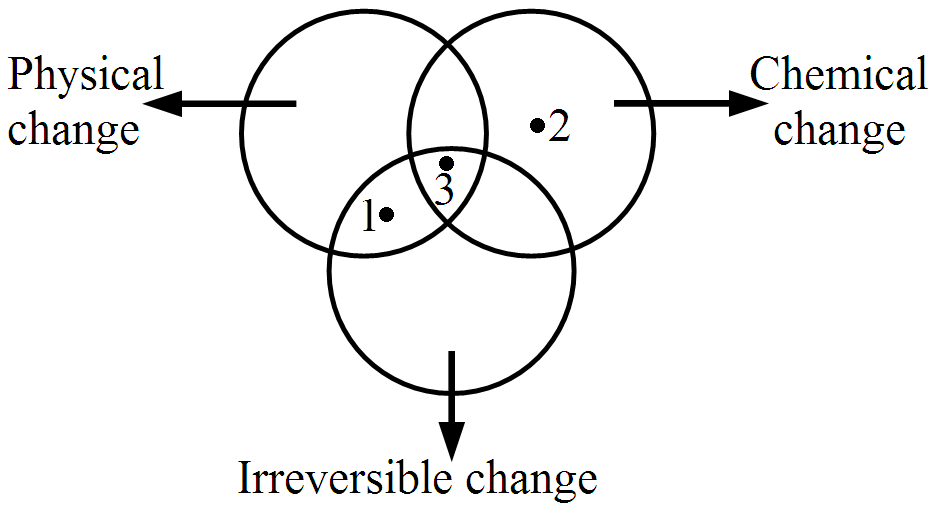
Study the given Venn diagram.

Identify points $1, 2$ and $3.$
  • A
    $1$
    $2$
    $3$
    Melting of ice
    Boiling of rice
    Burning of a candle
  • B
    $1$
    $2$
    $3$
    Burning of paper
    Rusting of iron
    Culting of fruits
  • $1$
    $2$
    $3$
    Breaking of a glass
    Banking a cake
    Burning of LPG in kitchen
  • D
    $1$
    $2$
    $3$
    Tearing of paper
    Evaporation of water
    Making lemonade
Answer
Correct option: C.
$1$
$2$
$3$
Breaking of a glass
Banking a cake
Burning of LPG in kitchen
 
$1$
$2$
$3$
Breaking of a glass
Banking a cake
Burning of $LPG$ in kitchen
View full question & answer
MCQ 661 Mark
Charcoal burning on the grill is an example of:
  • A
    Physical change.
  • Chemical change.
  • C
    Periodic change.
  • D
    Reversible change.
Answer
Correct option: B.
Chemical change.
Charcoal burning is a chemical change.
View full question & answer
MCQ 671 Mark
Which of the following is a reversible change?
  • A
    Ripening of the fruit.
  • Melting of ice.
  • C
    Burning of paper.
  • D
    Converting wood into saw dust.
Answer
Correct option: B.
Melting of ice.
Melting of ice.
View full question & answer
MCQ 681 Mark
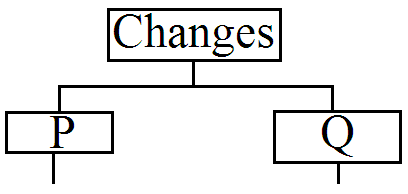
Study the flowchart carefully.
$(i)$
Melting of ice
$(i)$
Cutting of paper
$(ii)$
Blowing of balloon
$(ii)$
Flowering of bud
Which of the following is correct$?$
  • A
    $P$
    $Q$
    Reversible change
    Reversible change
  • B
    $P$
    $Q$
    Irreversible change
    Reversible change
  • C
    $P$
    $Q$
    Irreversible change
    Irreversible change
  • $P$
    $Q$
    Reversible change
    Irreversible change
Answer
Correct option: D.
$P$
$Q$
Reversible change
Irreversible change
 
$P$
$Q$
Reversible change
Irreversible change
The water formed after melting of ice can be frozen again to form ice. If the air inside the blown balloon is allowed to escape, then the balloon regains its original shape. So, both these changes are reversible changes. While changes like cutting of paper and flowering of bud cannot be reversed and hence, are irreversible.
View full question & answer
MCQ 691 Mark
Why do we keep food in a refrigerator?
  • A
    To save money.
  • B
    To make food tastier.
  • To prevent food from getting spoiled.
  • D
    It is fashionable to keep food in the refrigerator.
Answer
Correct option: C.
To prevent food from getting spoiled.
The low temperature in a refrigerator prevents food from getting spoiled.
View full question & answer
MCQ 701 Mark
Nitrogen reacts with hydrogen under high temperature and pressure and forms ammonia. Which type of change is undergone in the given example?
  • A chemical change.
  • B
    A physical change.
  • C
    An exothermic reaction.
  • D
    A natural change.
Answer
Correct option: A.
A chemical change.
It has undergone a chemical change. A new substance (ammonia gas) having different properties is formed. It is an endothermic change requiring high temperature and pressure.
View full question & answer
MCQ 711 Mark
If the chemical properties of a substance remain unchanged and the appearance or shape of a substance changes it is called a:
  • A
    Chemical change.
  • Physical change.
  • C
    Slow change.
  • D
    Periodic change.
Answer
Correct option: B.
Physical change.
Physical change.
View full question & answer
MCQ 721 Mark
During which of the following changes a new substance is formed?
  • Cooking.
  • B
    Melting.
  • C
    Freezing.
  • D
    Crushing.
Answer
Correct option: A.
Cooking.
Cooking, as cooked food is different in composition than uncooked food.
View full question & answer
MCQ 731 Mark
Which among the following is an irreversible change?
  • A
    Melting of ice.
  • Formation of flower from bud.
  • C
    Heating of milk.
  • D
    Kicking a football.
Answer
Correct option: B.
Formation of flower from bud.
View full question & answer
MCQ 741 Mark
Which of the following is incorrect about physical changes?
  • A
    No new substance is formed.
  • B
    Are reversible changes.
  • C
    Change in size is a physical change.
  • Are irreversible changes.
Answer
Correct option: D.
Are irreversible changes.
View full question & answer
MCQ 751 Mark
Which of the following are endothermic change?
  • A
    Condensation and melting.
  • B
    Condensation and freezing.
  • Evaporation and melting.
  • D
    Evaporation and freezing.
Answer
Correct option: C.
Evaporation and melting.
In both evaporation and melting heat is absorbed so both of them are endothermic changes.
View full question & answer
MCQ 761 Mark
Identify the fast reaction from the following:
  • The burning of a match stick.
  • B
    The seed changing into a big tree.
  • C
    The biodegradation of paper.
  • D
    The change of milk into curd.
Answer
Correct option: A.
The burning of a match stick.
The burning of a match stick is a fast reaction.
View full question & answer
MCQ 771 Mark
Direction: Read the following three statements carefully and choose the correct option.
  1. A physical change is one in which the substance undergoing change is not destroyed and no new substance is formed.
  2. Glowing of an electric bulb is a physical change.
  3. When antacid tablet is dropped in water, it fizzes. This is a chemical change.
  • A
    Statements $(i)$ and $(iii)$ are in correct but $(ii)$ is correct.
  • B
    Statements $(i)$ and $(ii)$ are in correct but $(iii)$ is correct.
  • All three statements are correct.
  • D
    All three statements are in correct.
Answer
Correct option: C.
All three statements are correct.

When antacid tablet is dropped in water, it fizzes and form carbon dioxide gas which is a chemical change.

View full question & answer
MCQ 781 Mark
Mark the incorrect statement.
  • A
    Melting of wax is a physical change while burning of wax in a candle is a chemical change.
  • B
    Metals expand on heating while contract on cooling. Both are physical changes.
  • C
    Composition of matter changes during a chemical change while it remains same during a physical change.
  • High and low tides in sea are the examples of non-periodic changes while growth of a tree is a periodic change.
Answer
Correct option: D.
High and low tides in sea are the examples of non-periodic changes while growth of a tree is a periodic change.
Changes which occur again and again after fixed intervals of time are known as periodic changes. For example, change of day and night, occurrence of full moon, beating of heart, oscillation of pendulum of clock, high and low tides in sea, etc. Changes which do not repeat themselves at regular intervals are called non-periodic changes. You cannot predict when will they reoccur. For example, occurrence of earthquake, accidents, sneezing, rusting of iron, growing of a tree, etc.
View full question & answer
MCQ 791 Mark
If few drops of petroleum are poured on your palm, you feel cool as the petrol evaporates. This change is:
  • A
    Slow change.
  • B
    Chemical reaction.
  • Endothermic change.
  • D
    Periodic change.
Answer
Correct option: C.
Endothermic change.
Endothermic change.
View full question & answer
MCQ 801 Mark
On heating metal rim:
  • Expands.
  • B
    Contracts.
  • C
    Depends how much it is heated.
  • D
    Depends as the type of meted.
Answer
Correct option: A.
Expands.
All the metals expand on heating.
View full question & answer
MCQ 811 Mark
Select the one that represents a periodic change.
  • A
    Occurrence of tides.
  • B
    Opening of a morning glory flower.
  • Both the above.
  • D
    None of these.
Answer
Correct option: C.
Both the above.

Both occurrence of tides and opening of a morning glory flower are periodic changes.

View full question & answer
MCQ 821 Mark
Any change in which the original substance can be obtained by reversing conditions is known as a:
  • A
    Reversible change.
  • B
    Periodic change.
  • C
    Physical change.
  • Both $(a)$ and $(c).$
Answer
Correct option: D.
Both $(a)$ and $(c).$

In both types of changes (i.e. reversible change and physical change) we can get back the original substance by reversing the conditions.

View full question & answer
MCQ 831 Mark
Read the given passage and fill in the blanks by choosing an appropriate option. Iron nails when new are grey and bright. When exposed to ___________ $(i)$ ___________, they get covered with a ___________ $(ii)$ ___________ coating. This process is called ___________ $(iii)$ ___________ and it is a ___________ $(iv)$ ___________ change.
  • A
    $(i)$
    $(ii)$
    $(iii)$
    $(iv)$
    Moist air
    Grey
    Corrosion
    Chemical, reversible
  • $(i)$
    $(ii)$
    $(iii)$
    $(iv)$
    Air and water
    Reddish brown
    Rusting
    Chemical, irreversible
  • C
    $(i)$
    $(ii)$
    $(iii)$
    $(iv)$
    Oxygen in air
    Green
    Rancidity
    Physical, irreversible
  • D
    $(i)$
    $(ii)$
    $(iii)$
    $(iv)$
    Nitrogen in air
    Reddish brown
    Galvanisation
    Chemical, irreversible
Answer
Correct option: B.
$(i)$
$(ii)$
$(iii)$
$(iv)$
Air and water
Reddish brown
Rusting
Chemical, irreversible
 
$(i)$
$(ii)$
$(iii)$
$(iv)$
Air and water
Reddish brown
Rusting
Chemical, irreversible
View full question & answer
MCQ 841 Mark
Making biogas from cow-dung is which kind of change?
  • Irreversible change.
  • B
    Reversible change.
  • C
    Both $(a)$ and $(b)$.
  • D
    Either $(a)$ or $(b).$
Answer
Correct option: A.
Irreversible change.
View full question & answer
MCQ 851 Mark
The change which can be reversed.
  • A
    Chemical change.
  • Physical change.
  • C
    Both $(a)$ and $(b).$
  • D
    Either $(a)$ or $(b).$
Answer
Correct option: B.
Physical change.
Physical change.
View full question & answer
MCQ 861 Mark
What is the process of heating a liquid to a high temperature and rapidly cooling it so that the bacteria is killed called?
  • Pasteurization.
  • B
    Chlorination.
  • C
    Bacterial disinfection.
  • D
    Sublimation.
Answer
Correct option: A.
Pasteurization.
The process of heating a liquid to high temperature and rapidly cooling it in order to kill bacteria is called pasteurization.
View full question & answer
MCQ 871 Mark
What type of change is used for fixing a metal rim on a wooden wheel of a cart?
  • Physical change.
  • B
    Chemical change.
  • C
    Both the above.
  • D
    None of these.
Answer
Correct option: A.
Physical change.

Iron expands on heating and contracts on cooling. This is a physical change.

View full question & answer
MCQ 881 Mark
When you burn petrol, flames appear. What type of a reaction is this?
  • A
    An endothermic reaction.
  • An exothermic reaction.
  • C
    A physical change.
  • D
    A reversible reaction.
Answer
Correct option: B.
An exothermic reaction.
Heat is released when you burn petrol. So, it is an exothermic reaction.
View full question & answer
MCQ 891 Mark
Which is an example of chemical change?
  • A
    Water freezes.
  • B
    Wood is cut.
  • Bread is baked.
  • D
    Wire is bent.
Answer
Correct option: C.
Bread is baked.
Bread is baked.
View full question & answer
MCQ 901 Mark
On heating, the colour of zinc oxide changes from white to yellow. What type of change is this?
  • Physical change.
  • B
    A chemical change.
  • C
    A photochemical change.
  • D
    An irreversible change.
Answer
Correct option: A.
Physical change.
Change of colour is a physical change.
View full question & answer
MCQ 911 Mark
In a physical change, which of the following takes place?
  1. No new substance is formed.
  2. The change is reversible.
  3. The change is temporary.
  • A
    Only $(i)$ and $(ii)$
  • B
    Only $(ii)$ and $(iii)$
  • C
    Only $(i)$ and $(iii)$
  • $(i), (ii)$ and $(iii)$
Answer
Correct option: D.
$(i), (ii)$ and $(iii)$

 All the given changes occur in a physical change.

View full question & answer
MCQ 921 Mark
What is a chemical reaction in which heat energy is liberated called?
  • An exothermic reaction.
  • B
    A physical change.
  • C
    An endothermic reaction.
  • D
    A photochemical reaction.
Answer
Correct option: A.
An exothermic reaction.
A chemical reaction in which heat energy is liberated is called an exothermic reaction.
View full question & answer
MCQ 931 Mark
Select a reversible change.
  • A
    Milk to paneer.
  • B
    Growth of a tree.
  • C
    Cow-dung to biogas.
  • Ice-cream to molten ice cream.
Answer
Correct option: D.
Ice-cream to molten ice cream.
Molten ice cream when cooled gives ice-cream again.
View full question & answer
MCQ 941 Mark
Iron rim is made slightly smaller than the wooden wheel. The rim is usually heated before fixing into the wooden wheel, because on heating the iron rim
  • A
    Expands and fits onto the wooden wheel.
  • B
    Contracts and fits onto the wooden wheel.
  • C
    No change in the size takes place.
  • Expands first, then on cooling contracts and fits onto the wooden wheel.
Answer
Correct option: D.
Expands first, then on cooling contracts and fits onto the wooden wheel.
On heating the iron rim, it expands first, then on cooling it contracts and fits onto the wooden wheel.
Note: Expansion occurs on heating whereas contraction occurs on cooling.
View full question & answer
MCQ 951 Mark
Which of the following is a natural, periodic change?
  • The occurrence of days and nights.
  • B
    The explosion of a bomb.
  • C
    The occurrence of an earthquake.
  • D
    Formation of snow.
Answer
Correct option: A.
The occurrence of days and nights.
The occurrence of days and nights is a natural, periodic change.
View full question & answer
MCQ 961 Mark
Direction: Read the passage (s) given below and answer the questions that follow Passage Sheetal once preparing evening tea. In the mean while telephone bell rangs and she rushed upto attend telephone call. She got busy on phone and sudden heard a sound from kitchen. When she enter back in kitchen. She saw that tea water was boiling with steal over it and cover of tea container is flew a side with water droplets over it. Why cover of tea kettle flew away?
  • A
    Not properly tight.
  • B
    Tea is explosive in nature.
  • Pressure of steam.
  • D
    None of these.
Answer
Correct option: C.
Pressure of steam.

On boiling tea, steam is formed. So, due to pressure of steam the cover of tea kettle flew away.

View full question & answer
MCQ 971 Mark
The energy required to start a chemical reaction is known as:
  • A
    Kinetic energy.
  • Activation energy.
  • C
    Potential energy.
  • D
    Magnetic energy.
Answer
Correct option: B.
Activation energy.
Activation energy.
View full question & answer
MCQ 981 Mark
Raghu in his craft class is making beads by using $POP$ (plaster of paris). The setting of beads by using water is a/ an:
  • A
    Physical change.
  • B
    Reversible change.
  • Irreversible change.
  • D
    No change.
Answer
Correct option: C.
Irreversible change.
View full question & answer
MCQ 991 Mark
Which of the following is an example of physical change?
  • A
    Mixing baking soda and vinegar together, and this causes bubbles and foam.
  • A glass cup falls from the counter and shatters on the ground.
  • C
    Lighting a piece of paper on fire and the paper bums up and leaves ashes.
  • D
    Baking a birthday cake for your mother.
Answer
Correct option: B.
A glass cup falls from the counter and shatters on the ground.
View full question & answer
MCQ 1001 Mark
Why is spoiling of food considered a chemical change?
  • A
    In it the food changes from one chemical substance to another.
  • B
    It is not possible to get original food from spoiled food.
  • C
    It is a permanent change.
  • All the above.
Answer
Correct option: D.
All the above.
All the above.
View full question & answer