MCQ 11 Mark
A chord of a circle of radius $10\ cm$ subtends a right angle at its centre. The length of the chord $($in $\ cm)$ is :
- A
$5\sqrt{2}$
- ✓
$10\sqrt{2}$
- C
$\frac{5}{\sqrt{2}}$
- D
$10\sqrt{3}$
AnswerCorrect option: B. $10\sqrt{2}$
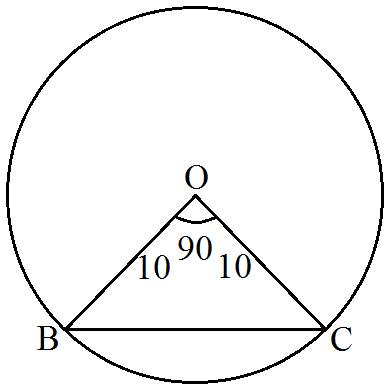
From right angle triangle $\text{BOC},$
$\Rightarrow\text{BC}^2=\text{OB}^2+\text{OC}^2$
$\Rightarrow\text{BC}^2=(10)^2+(10)^2$
$\Rightarrow\text{BC}^2=100+100$
$\Rightarrow\text{BC}^2=200$
$\Rightarrow\text{BC}=\sqrt{200}$
$\Rightarrow\text{BC}=\sqrt{(100\times2)}$
$\Rightarrow\text{BC}=10\sqrt2$
So, the length of the chord is $10\sqrt2\text{ cm}$ View full question & answer→MCQ 21 Mark
The circumference of a circle is $22\ cm$. The area of its quadrant $($in $cm^2)$ is :
- A
$\frac{77}{2}$
- B
$\frac{77}{4}$
- ✓
$\frac{77}{8}$
- D
$\frac{77}{16}$
AnswerCorrect option: C. $\frac{77}{8}$
Circumference of the circle $=2\pi\text{r}$
$\Rightarrow\text{R}=\frac{22\times7}{44}$
$\Rightarrow\text{R}=\frac{7}{2}$
Area of quadrant $=\frac{1}{4}\pi\text{r}^2$
$\Rightarrow\frac{1}{4}\times\frac{22}{7}\times\frac{7}{2}\times\frac{7}{2}=\frac{77}{8}$
View full question & answer→MCQ 31 Mark
If the difference between the circumference and the radius of a circle is $37 \ cm,$ then using $\pi = \frac{22}{7},$ the circumference $($in $\ cm)$ of the circle is :
AnswerCircumference of the circle $2\times\text{pi}\times\text{r}$
$=\frac{2\times22}{7\times\text{r}}=\frac{44\times\text{r}}{7}$
Where $r =$ radius
Now,
Given difference $= 37$
$\frac{44\times\text{r}}{7-\text{r}}=37$
$\text{f}\Big\{\big(\frac{44}{7}\big)\Big\}=37$
$\text{r}\big(\frac{37}{7}\big)=37\text{ cm}$
$\text{r}=7$
Circumference of the circle $= 2 \times pi \times r$
$=2\times\big(\frac{22}{7}\big)\times7$
$=44\text{ cm}$
View full question & answer→MCQ 41 Mark
If the area of a circle is equal to sum of the areas of two circles of diameters $10\ cm$ and $24\ cm,$ then the diameter of the larger circle $($in $\ cm)$ is :
AnswerArea of two circles $=$ Area of first circle $+$ Area of second circle
$=\frac{22}{7}\times5\times5+\frac{22}{7}\times12\times12$
$=78.5+452.5$
$=531\text{ cm}^2$
$\therefore$ Area of bigger circle $=$
$531=\frac{22}{7}\times\text{r}^2$
$\text{r}^2=169$
$\text{r}=13$
$\text{d}=2\text{r} \ ($Because $r = 13)$
$\text{d}=2\times13$
$\text{d}=26\text{ cm}$
View full question & answer→MCQ 51 Mark
The radii of two circles are $4\ cm$ and $3\ cm$ respectively. The diameter of the circle having area equal to the sum of the areas of the two circles $($in $\ cm)$ is :
AnswerSum of areas of two circles $=\pi\text{r}^2+\pi\text{r}^2.$
Sum of big circle $=\pi\big(4^2+3^2\big)$
Area of big circle $=25\pi$
Now,
$\pi(\text{r}..)^2=25\pi$
$\text{r}...\ =5$
$\text{d}=2(5)$
$\text{d}=10$
View full question & answer→MCQ 61 Mark
The circumferences of two circles are in the ratio $3 : 4$. The ratio of their areas is :
- A
$3 : 4$
- B
$4 : 3$
- ✓
$9 : 16$
- D
$16 : 9$
AnswerCorrect option: C. $9 : 16$
Let the the radii of the two circles be $r$ and $R,$ the circumferences of the circles be $c$ and $C$ and the areas of the two circles be $a$ and $A$.
Now,
$\frac{\text{c}}{\text{C}}=\frac{3}{4}$
$\Rightarrow\frac{2\pi\text{r}}{2\pi\text{R}}=\frac{3}{4}$
$\Rightarrow\frac{\text{r}}{\text{R}}=\frac{3}{4}$
Now, the ratio between their areas is given by
$\frac{\text{a}}{\text{A}}=\frac{\pi\text{r}^2}{\pi\text{R}^2}$
$=\Big(\frac{\text{r}}{\text{R}}\Big)^2$
$=\Big(\frac{3}{4}\Big)^2$
$=\frac{9}{16}$
Hence, the correct answer is option $(c).$
View full question & answer→MCQ 71 Mark
The area of a square inscribed in a circle of diameter $'d\ ’$ is :
- A
$\frac{\text{d}^2}{4}$
- B
$\frac{\text{d}}{4}$
- ✓
$\frac{\text{d}^2}{2}$
- D
AnswerCorrect option: C. $\frac{\text{d}^2}{2}$
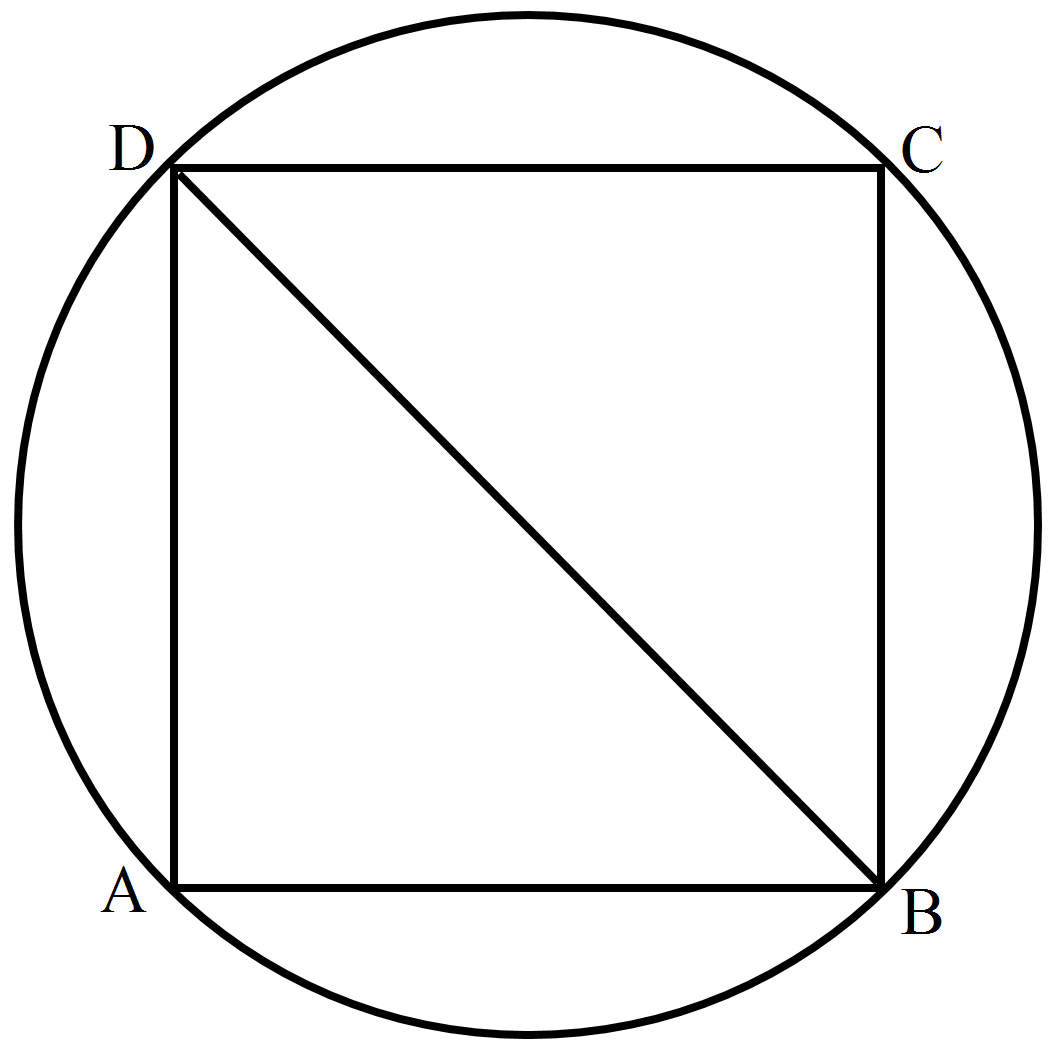
Area of square $=\frac{1}{2}\times(\text{Diagonal)}^2$
$\Rightarrow$ Area of square$=\frac{1}{2}\times(\text{BD)}^2=\frac{\text{d}^2}{2}$ View full question & answer→MCQ 81 Mark
The hour hand of a clock is $6\ cm$ long. The area swept by it between $11.20 \text{am}$ and $11.55 \text{am}$ is :
- A
$2.75\ cm^2$
- ✓
$5.5\ cm^2$
- C
$11\ cm^2$
- D
$10\ cm^2$
AnswerCorrect option: B. $5.5\ cm^2$
Hour hand moves $\Big(\frac{1^\circ}{2}\Big)$ in one minute.
So, area,
$=\frac{1}{2}(\text{r}^2)\Big(\frac{\theta}{180}\pi\Big)$
$=\frac{1}{2}(36)\Big(\frac{35}{2(180)}\pi\Big)$
$=5.5\text{ cm}^2$
So the answer is $(b)$
View full question & answer→MCQ 91 Mark
If the area of a square is same as the area of a circle, then the ratio of their perimeters, in terms of $\pi,$ is :
- A
$\pi:\sqrt{3}$
- ✓
$2:\sqrt{\pi}$
- C
$3:\pi$
- D
$\pi:\sqrt{2}$
AnswerCorrect option: B. $2:\sqrt{\pi}$
We have given that area of a circle of radius $r$ is equal to the area of a square of side a.
$\therefore\pi\text{r}^2=\text{a}^2$
$\therefore\text{a}=\sqrt{\pi\text{r}}$
We have to find the ratio of the perimeters of circle and square.
$\therefore\frac{\text{Perimeter of circle}}{\text{Perimeter of square}}=\frac{2\pi\text{r}}{4\text{a}}\ \dots(1)$
Now we will substitute $\text{a}=\sqrt{\pi\text{r}}$ in equation $(1).$
$\frac{\text{Perimeter of circle}}{\text{Perimeter of square}}=\frac{2\pi\text{r}}{4\sqrt{\pi\text{r}}}$
$\therefore\frac{\text{Perimeter of circle}}{\text{Perimeter of square}}=\frac{\pi}{2\sqrt{\pi}}$
$\therefore\frac{\text{Perimeter of circle}}{\text{Perimeter of square}}=\frac{\sqrt{\pi}}{2}$
Therefore, ratio of their perimeters is $\sqrt{\pi}:2.$
Hence, the correct answer is $(b).$
View full question & answer→MCQ 101 Mark
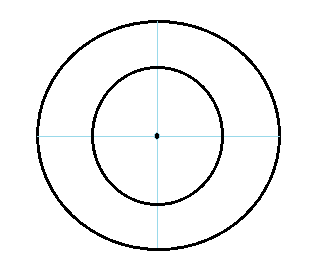
Two concentric circles intersect at $..........$ number of points :
AnswerTwo concentric circles do not intersect.
They only share a common centre as shown in the figure.
View full question & answer→MCQ 111 Mark
Choose the correct answer from the given four options : The diameter of a circle whose area is equal to the sum of the areas of the two circles of radii $24\ cm$ and $7\ cm$ is :
- A
$31\ cm$
- B
$25\ cm$
- C
$62\ cm$
- ✓
$50\ cm$
AnswerCorrect option: D. $50\ cm$
Let $r_1= 24\ cm$ and $r_2= 7\ cm$
$\therefore$ Area of first circle $=\pi\text{r}^2_1=\pi(24)^2=576\pi\text{ cm}^2$
and area of second circle $=\pi\text{r}^2_1=\pi(7)^2=79\pi\text{ cm}^2$
According to the given condition,
Area of circle $=$ Area of first circle $+$ Area of second circle
$\therefore\ \ \pi\text{R}^2=576\pi+49\pi \ [$where, $R$ be radius of circle$]$
$\Rightarrow\ \ \text{R}^2=625$
$\Rightarrow\ \text{R}=25\text{ cm}$
$\therefore$ Diameter of a circle $= 2R = 2 \times 25 = 50\ cm$
View full question & answer→MCQ 121 Mark
If the sum of the circumferences of two circles with radii $r_1$ and $r_2$ is equal to the circumference of a circle of radius $r,$ then :
- A
$r_1-r_2=r $
- B
$ r_1+r_2 > r $
- ✓
$ r_1+r_2=r $
- D
$ r_1+r_2 < r $
AnswerCorrect option: C. $ r_1+r_2=r $
Let required radius be $R$.
Then according to the question,
$2\pi\text{r}_1+2\pi\text{r}_2=2\pi\text{r}$
$\Rightarrow2\pi(\text{r}_1+\text{r}_2)=2\pi\text{r}$
$\Rightarrow\text{r}_1+\text{r}_2=\text{r}$
View full question & answer→MCQ 131 Mark
The length of an arc of the sector of angle $\theta^\circ$ of a circle with radius $R$ is :
- A
$\frac{2\pi\text{R}\theta}{180}$
- ✓
$\frac{2\pi\text{R}\theta}{360}$
- C
$\frac{\pi\text{R}^2\theta}{180}$
- D
$\frac{\pi\text{R}^2\theta}{360}$
AnswerCorrect option: B. $\frac{2\pi\text{R}\theta}{360}$
$\frac{2\pi\text{R}\theta}{360}$
View full question & answer→MCQ 141 Mark
A lighthouse throws light forming sector of radius $21m$ with central angle $120^\circ $. The area covered by it is :
- A
$456 \text{ sq.cm}$
- ✓
$462 \text{ sq.cm}$
- C
$428 \text{ sq.cm}$
- D
$441 \text{ sq.cm}$
AnswerCorrect option: B. $462 \text{ sq.cm}$
Area of the sector $=\frac{\theta}{360^\circ}\times\pi\text{r}^2$
$\Rightarrow $ Area of the sector $=\frac{120^\circ}{360^\circ}\times\frac{22}{7}\times21\times21$
$=\frac{1}{3}\times22\times3\times21$
$=22\times21$
$\Rightarrow $ Area of the shaded region $=462 \text{ sq.cm}$
View full question & answer→MCQ 151 Mark
The length of the minute hand of a clock is $21\ cm$. The area swept by the mmute hand in $10$ minutes is :
- ✓
$231\ cm^2$
- B
$210\ cm^2$
- C
$126\ cm^2$
- D
$252\ cm^2$
AnswerCorrect option: A. $231\ cm^2$
Angle subtends by the minute hand in $1$ minute $= 6^\circ$
$\therefore$ Angle subtends by the minute hand in $10$ minutes $= 60^\circ$
Now,
Area of the sector $=\frac{\theta}{360}\pi\text{r}^2$
$=\frac{60^\circ}{360^\circ}\times\frac{22}{7}(21)^2=231\text{ cm}^2$
Hence, the correct answer is option $(a).$
View full question & answer→MCQ 161 Mark
If the sum of the areas of two circles with radii $R_1$ and $R_2$ is equal to the area of a circle of radius $R,$ then :
- A
$\text{R}_1+\text{R}_2=\text{R}$
- B
$\text{R}_1+\text{R}_2<\text{R}$
- C
$\text{R}_1^2+\text{R}_2^2<\text{R}^2$
- ✓
$\text{R}_1^2+\text{R}_2^2=\text{R}^2$
AnswerCorrect option: D. $\text{R}_1^2+\text{R}_2^2=\text{R}^2$
Because the sum of the areas of two circles with radii $R_1$ and $R_2$ is equal to the area of a circle with
Radius $R,$ we have :
$\pi\text{R}_1^2+\pi\text{R}_2^2=\pi\text{R}^2$
$\Rightarrow\pi\big(\text{R}_1^2+\text{R}_2^2\big)=\pi\text{R}^2$
$\Rightarrow\text{R}_1^2+\text{R}_2^2=\text{R}^2$
View full question & answer→MCQ 171 Mark
If $O$ is a fixed point and $Q$ is a point which moves in such a way that the distance $OQ$ remains constant, then the locus of $Q$ is called :
AnswerIf $O$ is a fixed point and $Q$ is a point which moves in such a way that the distance $OQ$ remains constant, then the locus of $Q$ is called a circle.
because according to the definition of a circle, a circle is the collection of points at a fixed distance from a fixed point.
In this question, $O$ is the fixed point and $OQ$ is fixed distance.
$O$ is a centre of a circle and $OQ$ is the radius of the circle.
View full question & answer→MCQ 181 Mark
The radius of a circle is $20\ cm$. It is divided into four parts of equal area by drawing three concentric circles inside it. Then, the radius of the largest of three concentric circles drawn is :
- A
$10\sqrt{5}\text{ cm}$
- ✓
$10\sqrt{3}\text{ cm}$
- C
$10\sqrt{5}\text{ cm}$
- D
$10\sqrt{2}\text{ cm}$
AnswerCorrect option: B. $10\sqrt{3}\text{ cm}$
The circle can be divided into four parts of equal area by drawing three concentric circles inside it as,
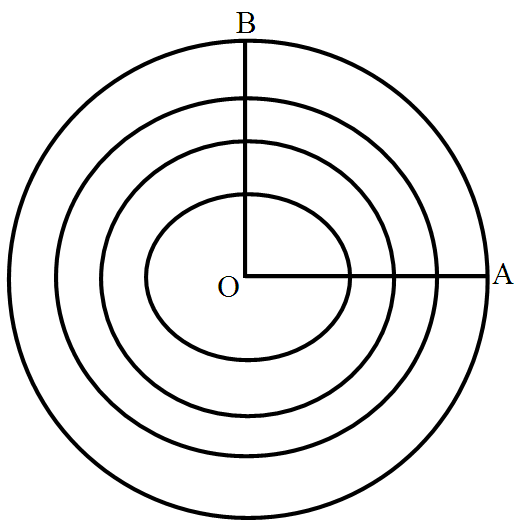
It is given that $OB = 20\ cm$.
Let $OA = x.$
Since the circle is divided into four parts of equal area by the three concentric circles, we have,
Area of the fourth region $=\frac{1}{4}\times$ Area of the given circle
$\pi\times(20^2-\text{x}^2)=\frac{1}{4}\times\pi\times20^2$
$400-\text{x}^2=100$
$\text{x}=300$
$\text{x}=10\sqrt{3}\text{ cm}$
Therefore, the correct answer is $(b)$. View full question & answer→MCQ 191 Mark
The diameter of a wheel is $84\ cm.$ How many revolutions Will it make to cover $792m?$
Answerlet $d \ cm$ be the diameter of the wheel.
We know :
Circumference of the wheel $=\pi\times\text{d}$
$=\Big(\frac{22}{7}\times84\Big)\text{ cm}$
$=264\text{ cm}$
Now,
Number of revolutions to cover $792m =\Big(\frac{792\times1000}{264}\Big)$
$=300$
View full question & answer→MCQ 201 Mark
A buffalo is tied to a peg at one corner of an equilateral triangle shaped the gross field of side $35m$ by means of a $21m$ long rope. The area of that part of the field in which the buffalo can graze is :
- A
$142 \text{ sq.cm}$
- B
$156 \text{ sq.cm}$
- C
$128 \text{ sq.cm}$
- ✓
$231 \text{ sq.cm}$
AnswerCorrect option: D. $231 \text{ sq.cm}$
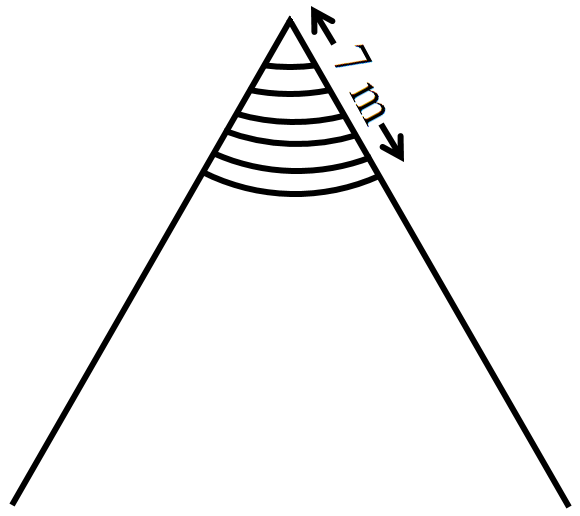
Area of the shaded region $=\frac{\theta}{360^\circ}\times\pi\text{r}^2$
$\Rightarrow$ Area of the shaded region $=\frac{60^\circ}{360^\circ}\times\frac{22}{7}\times21\times21$
$\Rightarrow$ Area of the shaded region $=231\text{ sq.cm}$ View full question & answer→MCQ 211 Mark
The area of circle is equal to the sum of the areas of two circles of radii $24\ cm$ and $7\ cm$. The diameter of the new circle is :
- A
$25\ cm$
- B
$31\ cm$
- ✓
$50\ cm$
- D
$62\ cm$
AnswerCorrect option: C. $50\ cm$
Let rem be the radius of the new circle.
Now,
Area of the new circle $=$ Area of the circle with radius $24\ cm \ +$ Area of the circle with radius $7cm$
Thus. we have :
$\pi\text{r}\text{r}^2=\pi\text{r}_1^2+\pi\text{r}_2^2$
$\Rightarrow\pi\text{r}^2=\big[\pi\times(24)^2+\pi\times(7)^2\big]\text{ cm}^2$
$\Rightarrow\pi\text{r}^2=\big[\pi\times576+\pi\times49\big]\text{ cm}^2$
$\Rightarrow\pi\text{r}^2=\pi\times(576+49)\text{ cm}^2$
$\Rightarrow\text{r}^2=625\pi\text{ cm}^2$
$\Rightarrow\text{r}^2=625$
$\Rightarrow\text{r}=25$
$\therefore$ Diameter of the new circle $=(25\times2)\text{ cm}$
$=50\text{ cm}$
View full question & answer→MCQ 221 Mark
The area of a circle whose area and circumference are numerically equal, is :
- A
$2\pi\text{ sq. units}$
- ✓
$4\pi\text{ sq. units}$
- C
$6\pi\text{ sq. units}$
- D
$8\pi\text{ sq. units}$
AnswerCorrect option: B. $4\pi\text{ sq. units}$
We have given that circumference and area of a circle are numerically equal.
Let it be $x.$
Let $r$ be the radius of the circle,
therefore, circumference of the circle is $2\pi\text{r}$ and area of the circle will be $\pi\text{r}^2.$
Therefore, from the given condition we have,
$2\pi\text{ r}=\text{x}\ \dots(1)$
$\pi\text{ r}^2=\text{x}\ \dots(2)$
Therefore, from equation $(1)$ get $\text{r}=\frac{\text{x}}{2\pi}$
Now we will substitute this value in equation $(2)$
we get, $\pi\Big(\frac{\text{x}}{2\pi}\Big)^2=\text{x}$
Simplifying further we get,
$\pi\times\frac{\text{x}^2}{4\pi^2}=\text{x}$
Cancelling $x$ we get,
$\pi\times\frac{\text{x}}{4\pi^2}=1$
Now we will cancel $\pi$
$\frac{\text{x}}{4\pi}=1\ \dots(3)$
Now we will multiply both sides of the equation $(3)$ by $4\pi$ we get,
$\text{x}=4\pi$
Therefore, area of the circle is $4\pi\text{ sq. units}.$
Hence, option $(b)$ is correct.
View full question & answer→MCQ 231 Mark
If the radius of a circle is diminished by $10\%,$ then its area is diminished by :
- A
$10\%$
- ✓
$19\%$
- C
$20\%$
- D
$36\%$
AnswerCorrect option: B. $19\%$
Let in first case radius of a circle $= r$
Then area $=\pi\text{r}^2$
In second case, radius $=\frac{\text{r}\times(100-10)}{100}$
$=\frac{\text{r}\times90}{100}=\frac{9}{10}\text{r}$
Then area $=\pi\Big(\frac{9}{10\text{r}}\Big)^2=\frac{81}{100}\pi\text{r}^2$
Difference $=\pi\text{r}^2-\frac{81}{100}\pi\text{r}^2$
$=\frac{100-81}{100}\pi\text{r}^2$
$=\frac{19}{100}\pi\text{r}^2$
$\therefore$ It is diminished by $19\%\ (b)$
View full question & answer→MCQ 241 Mark
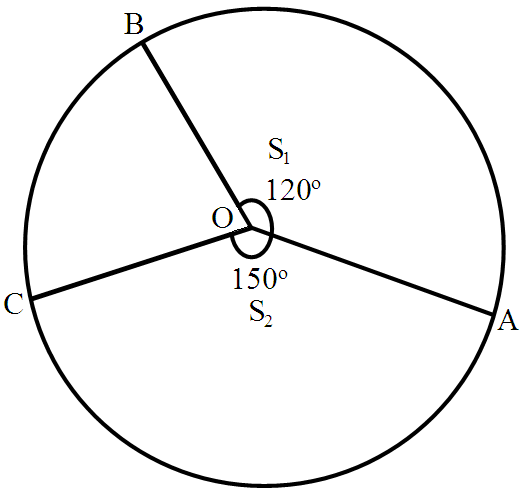
In the following figure, the ratio of the areas of two sectors $S_1$ and $S_2$ is :
- A
$5 : 2$
- B
$3 : 5$
- C
$5 : 3$
- ✓
$4 : 5 $
AnswerCorrect option: D. $4 : 5 $
Area of the sector $,\text{S}_1=\frac{\theta_1}{360}\times\pi\text{r}^2$
Area of the sector $,\text{S}_2=\frac{\theta_2}{360}\times\pi\text{r}^2$
Now we will take the ratio,
$\frac{\text{S}_1}{\text{S}_2}=\frac{\frac{\theta_1}{360}\times\pi\text{r}^2}{\frac{\theta_2}{360}\times\pi\text{r}^2}$
Now we will simplify the ratio as below,
$\frac{\text{S}_1}{\text{S}_2}=\frac{\theta_1}{\theta_2}$
Substituting the values we get,
$\frac{\text{S}_1}{\text{S}_2}=\frac{120}{150}$
$\therefore\frac{\text{S}_1}{\text{S}_2}=\frac{4}{5}$
Therefore, ratio of the areas of the two sectors is $4 : 5$
Hence, the correct answer is option $(d).$
View full question & answer→MCQ 251 Mark
Identify the center of the circle :
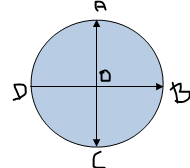
AnswerCenter of a circle is a point inside the circle and is at an equal distance from all of the points on its circumference.
In the given figure $, O$ is such point.
So $, O$ is the center of the given circle.
View full question & answer→MCQ 261 Mark
The radius of a wheel is $0.25m$. How many revolutions will it make in covering $11\ km?$
- A
$2800$
- B
$4000$
- C
$5500$
- ✓
$7000$
AnswerCorrect option: D. $7000$
Distance covered in $1$ revolulion $=2\pi\text{r}$
$=\Big(2\times\frac{22}{7}\times0.25\Big)\text{m}$
$=\Big(2\times\frac{22}{7}\times\frac{25}{100}\Big)\text{m}$
$=\frac{11}{7}\text{m}$
Number of revolutions taken to cover $11\ km =\Big(11\times1000\times\frac{7}{11}\Big)$
$=7000$
View full question & answer→MCQ 271 Mark
If an arc of a circle of radius $14 \ cm$ subtends an angle of $60^\circ$ at the centre, then the length of the arc is $\frac{44}{3}\text{ cm}.$
View full question & answer→MCQ 281 Mark
Choose the correct answer from the given four options : If the perimeter of a circle is equal to that of a square, then the ratio of their areas is :
- A
$22 : 7$
- ✓
$14 : 11$
- C
$7 : 22$
- D
$11 : 14$
AnswerCorrect option: B. $14 : 11$
Let radius of circle be $r$ and side of a square be a.
According to the given condition,
perimeter of a circle $=$ Perimeter of a square
$\therefore\ \ 2\pi\text{r}=4\text{a}$
$\Rightarrow\ \text{a}=\frac{\pi\text{r}}{2}\ \dots(\text{i})$
Now, $\frac{\text{Area of circle}}{\text{Area of square}} =\frac{\pi\text{r}^2}{(\text{a}^2)}$
$=\frac{\pi\text{r}^2}{\Big(\frac{\pi\text{r}}{2}\Big)^2}\ \ \ [$from Eq. $(i)]$
$=\frac{\pi\text{r}^2}{\frac{\pi^2\text{r}^2}{4}}=\frac{4}{\pi}$
$=\frac{4}{\frac{22}{7}}=\frac{28}{22}=\frac{14}{11}$
View full question & answer→MCQ 291 Mark
If the perimeter of a semi $-$ circular protractor is $36\ cm,$ then its diameter is :
- A
$10\ cm$
- B
$12\ cm$
- ✓
$14\ cm$
- D
$16\ cm$
AnswerCorrect option: C. $14\ cm$
We know that perimeter of a semi-circle of radius $\text{r}=\frac{1}{2}(2\pi\text{r})+2\text{r}\ \dots(1)$
We have given the perimeter of the semi $-$ circle and we are asked to find the diameter of the semi $-$ circle.
Therefore, substituting the perimeter of the semi $-$ circle in equation $(1)$ we get,
$36=\frac{1}{2}(2\pi\text{r})+2\text{r}$
Multiplying both sides of the equation by $2$ we get,
$72=2\pi\text{r}+4\text{r}$
Substituting $\pi=\frac{22}{7}$we get,
$\therefore72=\frac{44}{7}\text{r}+4\text{r}$
Now we will multiply both sides of the equation by $7$.
$504=44\text{r}+28\text{r}$
Adding like terms we get,
$\therefore 504=72\text{r}$
Dividing both sides of the equation $72$ we get $, r = 7$
Therefore, radius of the semi circle is $7cm.$
Now we will find the diameter.
$\text{Diameter}=2\times\text{r}$
$\therefore\text{Diameter}=2\times7$
$\therefore\text{Diameter}=14$
Hence, diameter of the semi $-$ circle is $14\ cm.$
Therefore, the correct answer is $(c).$
View full question & answer→MCQ 301 Mark
If the radius of the circle is $7\sqrt{\pi\text{ cm}} ,$ then its area is :
- A
$98 \text{ sq. cm}$
- ✓
$49 \text{ sq. cm}$
- C
$45 \text{ sq. cm}$
- D
$22 \text{ sq. cm}$
AnswerCorrect option: B. $49 \text{ sq. cm}$
Area of the circle $=\pi\text{r}^2$
$\Rightarrow $ Area of the circle $=\pi\Big(\frac{7}{\sqrt{\pi}}\Big)^2$
$=\pi\times\frac{49}{\pi}=49\text{ sq. cm}$
View full question & answer→MCQ 311 Mark
The circumference of a sector of angle $60^\circ$ of a circle with radius $10\ cm$ is :
- A
$\frac{200}{21}\text{ cm}$
- B
$\frac{20}{21}\text{ cm}$
- ✓
$\frac{220}{21}\text{ cm}$
- D
AnswerCorrect option: C. $\frac{220}{21}\text{ cm}$
Circumference of sector $ = \text{l}=\frac{\theta}{360^\circ}\times2\pi\text{r}$
$\Rightarrow\text{l}=\frac{60^\circ}{360^\circ}\times2\times\frac{22}{7}\times10$
$=\frac{220}{21}\text{ cm}$
View full question & answer→MCQ 321 Mark
If diameter of a circle is increased by $40\%,$ then its area increase by :
- ✓
$96\%$
- B
$40\%$
- C
$80\%$
- D
$48\%$
AnswerCorrect option: A. $96\%$
Let the diameter of a circle in first case $= 2r$
Then radius $= r$
Area $=\pi\text{r}^2$
By increasing $40\% $ of diameter or radius,
New radius $=\frac{\text{r}\times140}{100}=\frac{7\text{r}}{5}$
$\therefore$ New area $=\pi\Big(\frac{7\text{r}}{5}\Big)^2=\frac{49}{25}\pi\text{r}^2$
$\therefore$ Difference of areas $=\frac{49}{25}\pi\text{r}^2-\pi\text{r}^2$
$=\frac{24}{25}\pi\text{r}^2$
Percentage increase $=\frac{24\pi\text{r}^2}{25\pi\text{r}^2}\times100$
$= 96\%\ (a)$
View full question & answer→MCQ 331 Mark
What is name of following shape?

MCQ 341 Mark
The angle described by the minute hand between $4.00 \text{ pm}$ and $4.25 \text{ pm}$ is :
- A
$125^\circ$
- ✓
$150^\circ$
- C
$100^\circ$
- D
$90^\circ$
AnswerCorrect option: B. $150^\circ$
The time duration between $4.00 \text{ pm}$ and $4.25 \text{ pm} = 25$ minutes
$\because$ Angle described by minute hand in $60$ minutes $= 360^\circ$
$\therefore$ Angle described by minute hand in $25$ minutes $=\frac{360^\circ}{60^\circ}\times25=150^\circ$
View full question & answer→MCQ 351 Mark
If area of a circle inscribed in an equilateral triangle is $48\pi$ square units, then perimeter of the triangle is :
AnswerCorrect option: C. $72\text{ units}$
Area of a circle inscribed in an equilateral triangle $48\pi\text{ sq. units}$
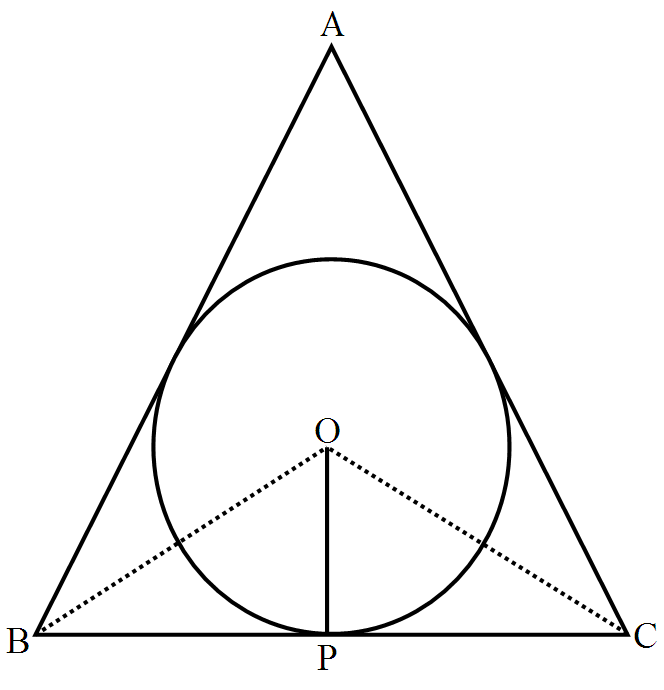
$\therefore$ Radius of the circle $=\sqrt{\frac{\text{Area}}{\pi}}=\sqrt{\frac{48\pi}{\pi}}$
$=\sqrt{48}\text{ units}=4\sqrt{3}\text{ units}$
$\therefore\text{OP}\perp\text{BC}$ and $\angle\text{B}=60^\circ$
$\therefore\angle\text{OAP}=30^\circ$
Now $\tan\theta=\frac{\text{OP}}{\text{BP}}$
$\Rightarrow\tan30^\circ=\frac{4\sqrt{3}}{\text{BP}}$
$\Rightarrow\frac{1}{\sqrt{3}}=\frac{4\sqrt{3}}{\text{BP}}$
$\Rightarrow\text{BP }4\sqrt{3}\times\sqrt{3}=12\text{ units}$
$\therefore BC = 2 \times BP = 2 \times 12 = 24$ units.
$\therefore$ Perimeter of $\triangle\text{ABC} = 3 \ \times$ side
$= 3 \times 24 =72$ units $(c)$ View full question & answer→MCQ 361 Mark
The area of a circle is $38.5 \mathrm{~cm}^2$. The circumference of the circle is :
- A
$6.2\ cm$
- B
$12.1\ cm$
- C
$11\ cm$
- ✓
$22\ cm$
AnswerCorrect option: D. $22\ cm$
Let the radius be $r \ cm.$
We know,
Area of a circle
$=\pi\text{r}^2\text{ cm}^2$
Thus, we have :
$\pi\text{r}^2=38.5$
$\Rightarrow\frac{22}{7}\times\text{r}^2=38.5$
$\Rightarrow\text{r}^2=\Big(38.5\times\frac{7}{22}\Big)$
$\Rightarrow\text{r}^2=\Big(\frac{385}{10}\times\frac{7}{22}\Big)$
$\Rightarrow\text{r}^2=\frac{49}{4}$
$\Rightarrow\text{r}=\frac{7}{2}$
Now,
Circumference of the circle $=2\pi\text{r}$
$=2\times\frac{22}{7}\times\text{r}$
$=\Big(2\times\frac{22}{7}\times\frac{7}{2}\Big)$
$=22\text{ cm}$
View full question & answer→MCQ 371 Mark
The ratio of the areas of a circle and an equilateral triangle whose diameter and a side are respectively equal, is :
- A
$\pi:\sqrt{2}$
- ✓
$\pi:\sqrt{3}$
- C
$\sqrt{3}:\pi$
- D
$\sqrt{2}:\pi$
AnswerCorrect option: B. $\pi:\sqrt{3}$
We are given that diameter and side of an equilateral triangle are equal.
Let $d$ and $a$ are the diameter and side of circle and equilateral triangle respectively.
$\therefore d = a$
We know that area of the circle $=\pi\text{r}^2$
Now we will find the ratio of the areas of circle and equilateral triangle.
$\therefore\frac{\text{Area of circle}}{\text{Area of equilateral triangle}}=\frac{\pi\text{r}^2}{\frac{\sqrt{3}}{4}\text{a}^2}$
We know that radius is half of the diameter of the circle.
$\therefore\frac{\text{Area of circle}}{\text{Area of equilateral triangle}}=\frac{\pi\Big(\frac{\text{d}}{2}\Big)^2}{\frac{\sqrt{3}}{4}\text{a}^2}$
$\therefore\frac{\text{Area of circle}}{\text{Area of equilateral triangle}}=\frac{\pi\times\frac{\text{d}^2}{4}}{\frac{\sqrt{3}}{4}\text{a}^2}$
Now we will substitute $d = a$ in the above equation,
$\frac{\text{Area of circle}}{\text{Area of equilateral triangle}}=\frac{\pi\times\frac{\text{a}^2}{4}}{\frac{\sqrt{3}}{4}\text{a}^2}$
$\frac{\text{Area of circle}}{\text{Area of equilateral triangle}}=\frac{\pi}{\sqrt{3}}$
Therefore, ratio of the areas of circle and equilateral triangle is $\pi:\sqrt{3}.$
Hence, the correct answer is option $(b).$
View full question & answer→MCQ 381 Mark
If the sum of the areas of two circles with radii $r_1$ and $r_2 $ is equal to the area of a circle of radius $r,$ then :
- A
$\text{r}=\text{r}_1+\text{r}_2$
- ✓
$\text{r}^2_1+\text{r}^2_2=\text{r}^2$
- C
$\text{r}_1=\text{r}_2<\text{r}$
- D
$\text{r}^2_1+\text{r}^2_2<\text{r}^2$
AnswerCorrect option: B. $\text{r}^2_1+\text{r}^2_2=\text{r}^2$
According to the given condition,
Area of circle $=$ Area of first circle $+$ Area of second circle.
$\therefore\pi\text{r}^2=\pi\text{r}^2_1+\pi\text{r}^2_2$
$\Rightarrow\text{r}^2=\text{r}^2_1+\text{r}^2_2\text{(b)}$
View full question & answer→MCQ 391 Mark
The radii of two concentric circles are $19 \ cm$ and $16 \ cm$ respectively. The area of the ring enclosed by these circles is :
- A
$320 \mathrm{~cm}^2$
- ✓
$330 \mathrm{~cm}^2$
- C
$332 \mathrm{~cm}^2$
- D
$340 \mathrm{~cm}^2$
AnswerCorrect option: B. $330 \mathrm{~cm}^2$
$R = 19\ cm$ and $r = 16\ cm$
Thus. we have :
Area of the ring $=\pi\big(\text{R}^2-\text{r}^2\big)$
$=\pi(\text{R}+\text{r})(\text{R}-\text{r})$
$=\big|\frac{22}{7}\times(19+16)\times(19-16)\big|\text{ cm}^2$
$=\Big(\frac{22}{7}\times35\times3\Big)\text{ cm}^2$
$=330\text{ cm}^2$
View full question & answer→MCQ 401 Mark
In the following figure, the area of the shaded region is :
- ✓
$3\pi\text{ cm}^2$
- B
$6\pi\text{ cm}^2$
- C
$9\pi\text{ cm}^2$
- D
$7\pi\text{ cm}^2$
AnswerCorrect option: A. $3\pi\text{ cm}^2$
In the figure,
$\angle\text{C}=\angle\text{B}=90^\circ$ and $\angle\text{D}=60^\circ,$
$\therefore\angle\text{A}+\angle\text{B}+\angle\text{C}+\angle\text{D}+=360^\circ$
$\angle\text{A}+90^\circ+90^\circ+60^\circ=360^\circ$
$\therefore\angle\text{A}=120^\circ$
Area of shaded region $=\frac{\theta}{360}\times\pi\text{r}^2$
$\therefore$ Area of shaded region $=\frac{120}{360}\times\pi\times3^2$
$\therefore$ Area of shaded region $=\frac{1}{3}\times\pi\times9$
$\therefore$ Area of shaded region $=3\pi$
Therefore, area of the shaded region is $3\pi\text{ cm}^2.$
Hence, the correct answer is option $(a).$
View full question & answer→MCQ 411 Mark
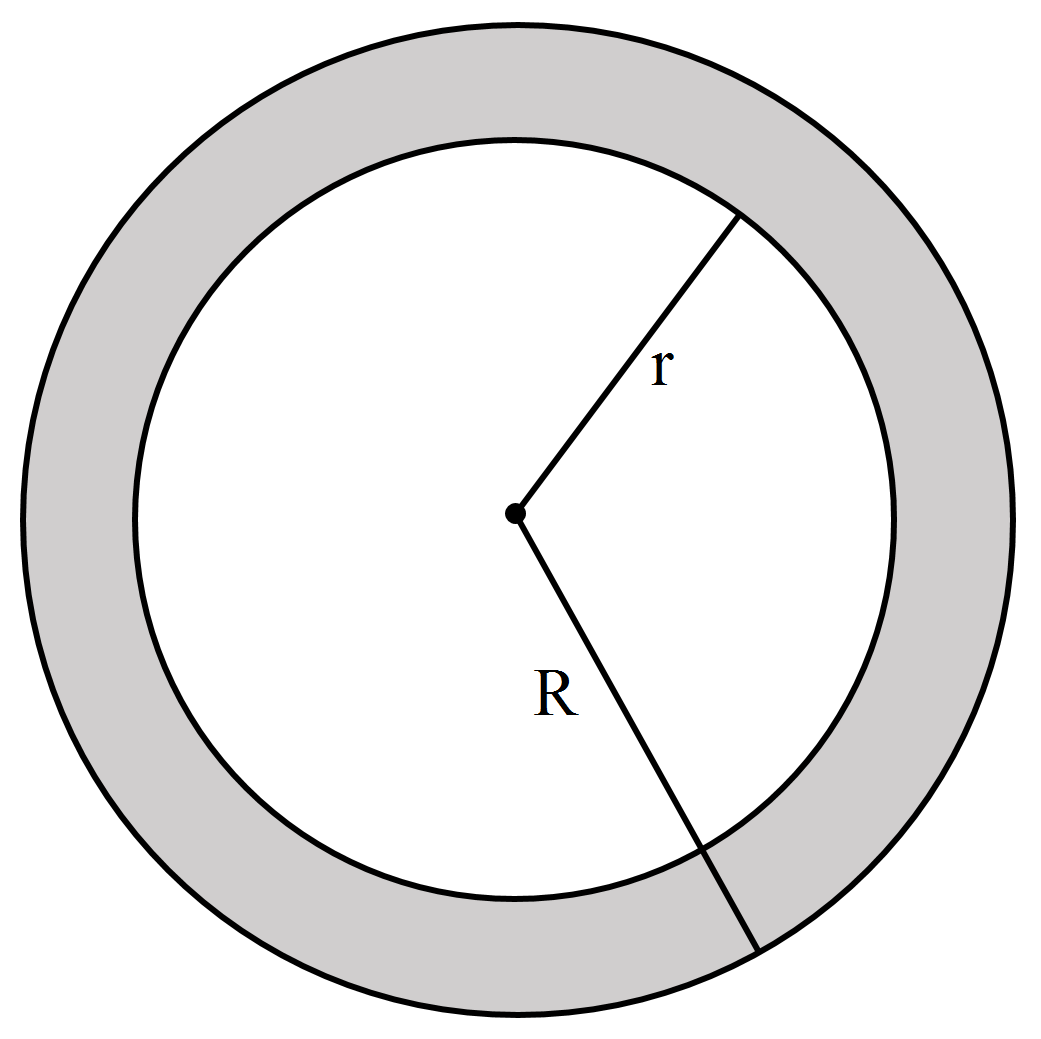
The area of a ring having $'R\ ’$ as outer radius and $'r\ '$ as inner radius is :
AnswerCorrect option: C. $\pi(\text{R}^2-\text{r}^2)$
The area of a ring having $'R\ ’$ as outer radius and $'r\ ’$ as inner radius is $\pi\text{R}^2 − \pi\text{r}^2 = \pi(\text{R}^2−\text{r}^2).$
View full question & answer→MCQ 421 Mark
In the figure, if $\text{ABC}$ is an equilateral triangle, then shaded area is equal to?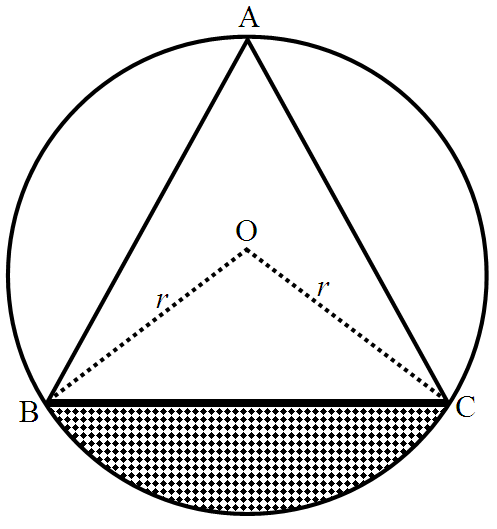
- ✓
$\Big(\frac{\pi}{3}-\frac{\sqrt{3}}{4}\Big)\text{r}^2$
- B
$\Big(\frac{\pi}{3}-\frac{\sqrt{3}}{2}\Big)\text{r}^2$
- C
$\Big(\frac{\pi}{3}+\frac{\sqrt{3}}{4}\Big)\text{r}^2$
- D
$\Big(\frac{\pi}{3}+\sqrt{3}\Big)\text{r}^2$
AnswerCorrect option: A. $\Big(\frac{\pi}{3}-\frac{\sqrt{3}}{4}\Big)\text{r}^2$
$\triangle\text{ABC}$ is an equilateral triangle inscribed in a circle with centre $O$ and radius $r$
$BO$ and $CO$ are joined.
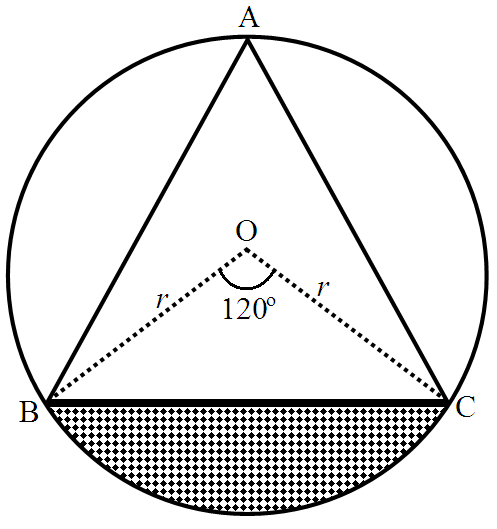
$\therefore\angle\text{BOC}=2\angle\text{BAC}=2\times60^\circ=120^\circ$
Area of shaded portion
$=\Big[\pi\frac{\theta}{360^\circ}-\sin\frac{\theta}{2}\cos\frac{\theta}{2}\Big]\text{r}^2$
$=\Big[\frac{\pi\times120^\circ}{360^\circ}-\sin60^\circ\cos60^\circ\Big]\text{r}^2$
$=\Big[\frac{\pi}{3}-\frac{\sqrt{3}}{2}\times\frac{1}{2}\Big]\text{r}^2=\Big[\frac{\pi}{3}-\frac{\sqrt{3}}{4}\Big]\text{r}^2$
Hence, the correct answer is $(a)$. View full question & answer→MCQ 431 Mark
Four circles each of radius a touch each other. The area between them is :
- A
$\frac{7}{6}\text{a}^2$
- B
$\frac{6}{7}\text{a}$
- ✓
$\frac{6}{7}\text{a}^2$
- D
AnswerCorrect option: C. $\frac{6}{7}\text{a}^2$
Area of required region $=$ Area of square $- $ Area of $4$ quadrant
$\Rightarrow $ Area of required region $=2\text{(a)}^2-4\times\frac{1}{4}\times\frac{22}{7}\times\text{a}^2$
$=4\text{a}^2-\frac{22}{7}\text{a}^2$
$=\frac{6}{7}\text{a}^2\text{ sq.cm}$
View full question & answer→MCQ 441 Mark
Fixed point in the circle is called $..........$ of the circle :
AnswerA circle is the set of all those point in a plane whose distance from a fixed point remains constant.
Then, this fixed point is called the centre of the circle.
View full question & answer→MCQ 451 Mark
The area of the largest triangle that can be inscribed in a semi $-$ circle of radius $r$ is :
- A
$2r$
- ✓
$r^2$
- C
$r$
- D
$\sqrt{\text{r}}$
AnswerRadius of semicircule $= r$
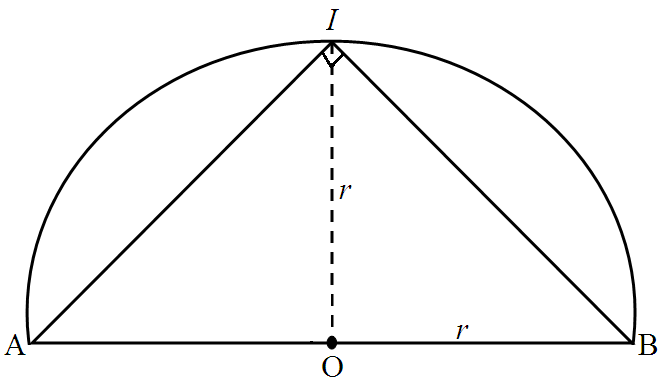
The base of the largest triangle.
$(b) = 2r$
and height $(h) = r$
$\therefore$ Area $=\frac{1}{2}\text{base}\times\text{height}$
$=\frac{1}{2}\times2\text{r}\times\text{r}=\text{r}^2\text{(b)}$ View full question & answer→MCQ 461 Mark
If a chord subtends a right angle at the centre, then the area of the corresponding segment is :
- ✓
$\Big(\frac{\text{x}}{4}-\frac{1}{2}\Big)\text{r}^2\text{ sq.units}$
- B
$\Big(\frac{\text{x}}{4}+\frac{1}{2}\Big)\text{r}^2\text{ sq.units}$
- C
$\Big(\frac{\text{x}}{2}+\frac{1}{2}\Big)\text{r}^2\text{ sq.units}$
- D
$\Big(\frac{\text{x}}{2}-\frac{1}{2}\Big)\text{r}^2\text{ sq.units}$
AnswerCorrect option: A. $\Big(\frac{\text{x}}{4}-\frac{1}{2}\Big)\text{r}^2\text{ sq.units}$
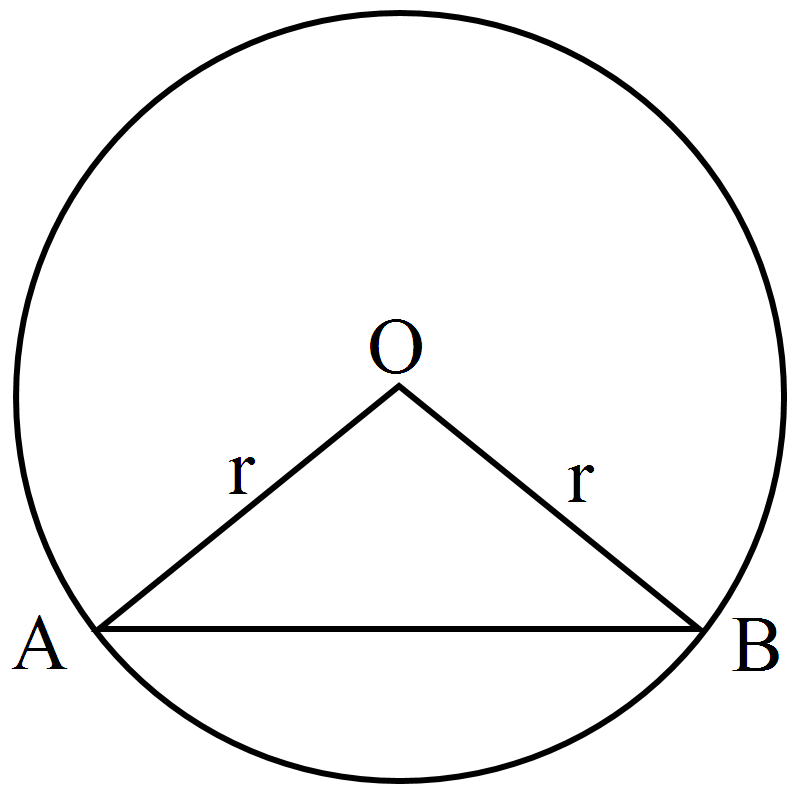
Area of segment $=\frac{\theta}{360^\circ}\times\pi\text{r}^2-\frac{1}{2}\times\text{(r)}^2$
$\Rightarrow $ Area of segment $=\frac{90^\circ}{360^\circ}\times\pi\text{r}^2-\frac{1}{2}\times\text{r}^2$
$\Rightarrow $ Area of segment $=\frac{1}{4}\times\pi\text{r}^2-\frac{1}{2}\times\text{r}^2=\Big(\frac{\text{x}}{4}-\frac{1}{2}\Big)\text{r}^2$
$\Rightarrow $ Area of segment $=\Big(\frac{\pi}{4}-\frac{1}{2}\Big)\text{r}^2\text{ sq.units}$ View full question & answer→MCQ 471 Mark
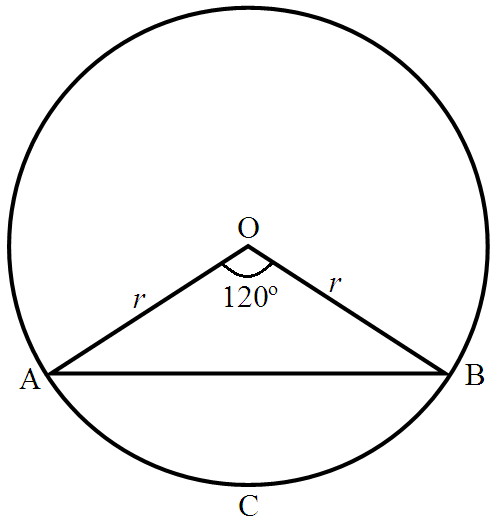
In the following figure, the area of segment $\text{ACB}$ is :
- A
$\Big(\frac{\pi}{3}-\frac{\sqrt{3}}{2}\Big)\text{r}^2$
- B
$\Big(\frac{\pi}{3}+\frac{\sqrt{3}}{2}\Big)\text{r}^2$
- C
$\Big(\frac{\pi}{3}-\frac{\sqrt{2}}{3}\Big)\text{r}^2$
- ✓
$\text{None of these}$
AnswerCorrect option: D. $\text{None of these}$
We have to find area of segment $\text{ACB}.$
Area of the $\text{ACB}$ segment $=\Big(\frac{\pi\theta}{360}-\sin\frac{\theta}{2}\cos\frac{\theta}{2}\Big)\text{r}^2$
We know that $\theta=120^\circ.$
Substituting the values we get,
Area of the $\text{ACB}$ segment $=\Big(\frac{\pi\times120}{360}-\sin60\cos60\Big)\text{r}^2$
$\therefore$ Area of the $\text{PAQ}$ segment $=\Big(\frac{\pi}{3}-\sin60\cos60\Big)\text{r}^2$
Substituting $\sin60=\frac{\sqrt{3}}{2}$ and $\cos60=\frac{1}{2}$ we get,
Area of the $\text{ACB}$ segment $=\Big(\frac{\pi}{3}-\frac{\sqrt{3}}{2}\times\frac{1}{2}\Big)\text{r}^2$
$\therefore$ Area of the $\text{ACB}$ segment $=\Big(\frac{\pi}{3}-\frac{\sqrt{3}}{4}\Big)\text{r}^2$
Therefore, area of the segment $\text{ACB}$ is $\Big(\frac{\pi}{3}-\frac{\sqrt{3}}{4}\Big)\text{r}^2$
Hence, the correct answer is option $(d).$
View full question & answer→MCQ 481 Mark
If $r$ is the radius of a circle, then it's circumference is given by :
- ✓
$2\pi\text{r}$
- B
$\pi\text{r}$
- C
$2\pi\text{d}$
- D
AnswerCorrect option: A. $2\pi\text{r}$
If the radius of a circle is given, the circumference or perimeter can be calculated using the formula below :
Circumference $= 2\pi\text{r}$
View full question & answer→MCQ 491 Mark
The part of the circular region enclosed by a chord and the corresponding arc of a circle is called :
Answer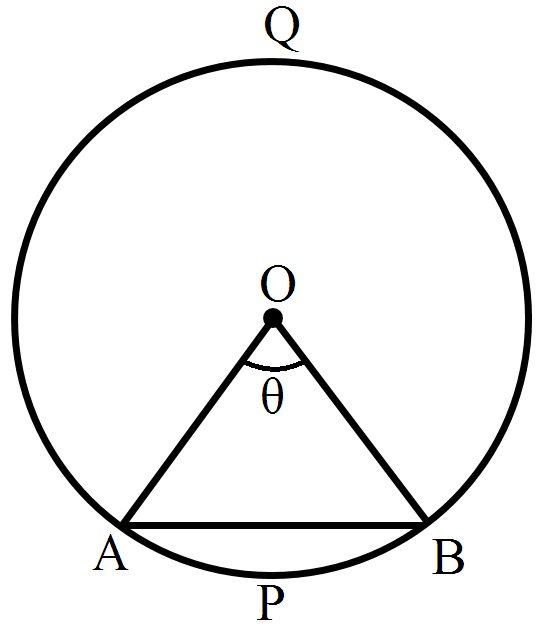
The part of the circular region enclosed by a chord and the corresponding arc of a circle is called a segment.
View full question & answer→MCQ 501 Mark
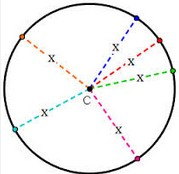
A set of points equidistant from a fixed point in a plane figure is called :
AnswerA set of points equidistant from a fixed point in a plane figure is called a circle where the distance between each of the set of the points and the fixed point forms the radius of the circle.
View full question & answer→