Questions

Assertion (A) & Reason (B) MCQ

🎯

Test yourself on this topic

5 questions · timed · auto-graded

MCQ 11 Mark
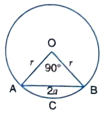
Statement-1 (A): The area of a segment of a circle formed by a chord of length 4 cm subtending an angle of $90^{\circ}$ at the centre is $(2 \pi+4) cm ^2$.
Statement-2 (R): The area of a segment of a circle formed by a chord of length 2 a subtending an angle of $90^{\circ}$ at the centre is $(\pi-2) \frac{a^2}{2}$ sq. units.
Image
  • A
    Statement-1 and Statement-2 are True; Statement-2 is a correct explanation for Statement-1.
  • B
    Statement-1 and Statement-2 are True; Statement-2 is not a correct explanation for Statement-1.
  • C
    Statement-1 is True, Statement-2 is False.
  • Statement-1 is False, Statement- 2 is True.
Answer
Correct option: D.
Statement-1 is False, Statement- 2 is True.
(D)
$\triangle O A B$ is a right triangle right angled at $O$.
$
O A^2+O B^2=A B^2 \Rightarrow 2 r^2=A B^2 \Rightarrow r=\frac{A B}{\sqrt{2}}=\sqrt{2} a
$
Area of segment $A C B=\frac{90}{360} \times \pi r^2-\frac{1}{2} r^2=\frac{\pi}{4} r^2-\frac{1}{2} r^2=\left(\frac{\pi-2}{4}\right) r^2=(\pi-2) \frac{a^2}{2}$
So, statement-2 is true.
Replacing $2 a$ by 4 i.e. $a$ by 2 , we obtain
Area of the segment $A C B=(\pi-2) \times \frac{2^2}{2} cm^2=(2 \pi-4) cm ^2$
So, statement-1 is not true. Hence, option (d) is correct.
View full question & answer
MCQ 21 Mark
Statement-1 (A): If a race track is in the form of a ring whose outer and inner radii differ by 10 m then the absolute ratio of the area of the track and the sum of the two boundries is $10: 3$.
Statement-2 (R): If a race track is in the form of a ring whose outer and inner radii are $R$ and $r$, then the area of the track and the sum of its two boundries are in the absolute ratio $(R-r): 2$.
  • A
    Statement-1 and Statement-2 are True; Statement-2 is a correct explanation for Statement-1.
  • B
    Statement-1 and Statement-2 are True; Statement-2 is not a correct explanation for Statement-1.
  • C
    Statement-1 is True, Statement-2 is False.
  • Statement-1 is False, Statement- 2 is True.
Answer
Correct option: D.
Statement-1 is False, Statement- 2 is True.
(D)
Let $A$ denote the area of the track and $C$ be the sum of lengths of two boundries. Then,
$
A=\pi R^2-\pi r^2=\pi\left(R^2+r^2\right)=\pi(R+r)(R-r) \text { and, } C=2 \pi R+2 \pi r=2 \pi(R+r)
$
Then, $ \qquad A: C=\pi(R+r)(R-r): 2 \pi(R+r)=(R-r): 2 \qquad\ldots (i) $
So, statement- 2 is true. Replacing $R-r$ by 10 in (i), we obtain: $A: C=10: 2=5: 1$ So, statement-1 is not true. Hence, option (d) is correct.
View full question & answer
MCQ 31 Mark
Statement-1 (A): The radius of the circle whose area is equal to the sum of the areas of two circles of radii 10 cm and 24 cm is 26 cm .
Statement-2 (R): The radius rof the circle whose area is equal to the sum of the areas of two circles of radii $r_1$ and $r_2$ is given by $r=r_1{ }^2+r_2{ }^2$.
  • A
    Statement-1 and Statement-2 are True; Statement-2 is a correct explanation for Statement-1.
  • B
    Statement-1 and Statement-2 are True; Statement-2 is not a correct explanation for Statement-1.
  • Statement-1 is True, Statement-2 is False.
  • D
    Statement-1 is False, Statement- 2 is True.
Answer
Correct option: C.
Statement-1 is True, Statement-2 is False.
(C)
Let $A_1, A_2$ denote the areas of two circles of radii $r_1$ and $r_2$ respectively and let $A=A_1+A_2$. Then,
$
\pi r^2=\pi r_1^2+\pi r_2^2 \Rightarrow r^2=r_1^2+r_2^2 \Rightarrow r=\sqrt{r_1^2+r_2^2}
$
So, statement-2 is not true.
Putting $r_1=10$ and $r_2=24$ in (i), we obtain
$
r=\sqrt{10^2+24^2}=\sqrt{100+576}=\sqrt{676}=26
$
So, statement-1 is true. Hence, option (c) is correct.
View full question & answer
MCQ 41 Mark
Statement-1 (A): The sum of the circumference and ara of a circle of radius 3 cm is in the absolute ratio $5: 8$ to the sum of the circumference and area of a circle of radius 4 cm .
Statement-2 (R): The sums of the circumferences and areas of a two circles of radii $r_1$ and $r_2$ are in the absolute ratio $r_1\left(2+r_1\right): r_2\left(2+r_2\right)$.
  • Statement-1 and Statement-2 are True; Statement-2 is a correct explanation for Statement-1.
  • B
    Statement-1 and Statement-2 are True; Statement-2 is not a correct explanation for Statement-1.
  • C
    Statement-1 is True, Statement-2 is False.
  • D
    Statement-1 is False, Statement- 2 is True.
Answer
Correct option: A.
Statement-1 and Statement-2 are True; Statement-2 is a correct explanation for Statement-1.
(A)
Let $C_1, C_2$ be the circumferences and $A_1$ and $A_2$ be the areas of two circles of radii $r_1$ and $r_2$ respectively. Then,
$
\begin{array}{l}
C_1+A_1=2 \pi r_1+\pi r_1^2=\pi r_1\left(2+r_1\right) \text { and, } C_2+A_2=2 \pi r_2+\pi r_2^2=\pi r_2\left(2+r_2\right) \\
\frac{C_1+A_1}{C_2+A_2}=\frac{\pi r_1\left(2+r_1\right)}{\pi r_2\left(2+r_2\right)}=\frac{r_1\left(2+r_1\right)}{r_2\left(2+r_2\right)} \qquad \ldots(i)
\end{array}
$
So, statement-2 is true.
Replacing $r_1$ by 3 and $r_2$ by 4 in (i), we obtain
$\frac{C_1+A_1}{C_2+A_2}=\frac{3 \times 5}{4 \times 6}=\frac{5}{8} \Rightarrow C_1+A_1: C_2+A_2=5: 8$
So, statement-1 is also true and statement-2 is a correct explanation for statement-1.
Hence, option (a) is correct.
View full question & answer
MCQ 51 Mark
Statement-1 (A): If the circumferences of two circles are in the raio $4: 5$, then their areas are in the ratio $16: 25$.
Statement-2 (R) : If the circumferences of two circles are in the ratio $C_1: C_2$, then their areas are in the ratio $C_1{ }^2: C_2{ }^2$.
  • Statement-1 and Statement-2 are True; Statement-2 is a correct explanation for Statement-1.
  • B
    Statement-1 and Statement-2 are True; Statement-2 is not a correct explanation for Statement-1.
  • C
    Statement-1 is True, Statement-2 is False.
  • D
    Statement-1 is False, Statement- 2 is True.
Answer
Correct option: A.
Statement-1 and Statement-2 are True; Statement-2 is a correct explanation for Statement-1.
(A)
Let $C_1, C_2$ be the circumferences and $A_1, A_2$ be the areas of two circles of radii $r_1$ and $r_2$ respectively. Then,
$
\begin{array}{ll}
& C_1=2 \pi r_1, C_2=2 \pi r_2, A_1=\pi r_1^2, A_2=\pi r_2^2 \\
\therefore & \frac{C_1}{C_2}=\frac{2 \pi r_1}{2 \pi r_2} \text { and } \frac{A_1}{A_2}=\frac{\pi r_1^2}{\pi r_2^2} \Rightarrow \frac{C_1}{C_2}=\frac{r_1}{r_2} \text { and } \frac{A_1}{A_2}=\frac{r_1^2}{r_2^2} \Rightarrow\left(\frac{C_1}{C_2}\right)^2=\frac{r_1^2}{r_2^2} \text { and } \frac{A_1}{A_2}=\frac{r_1^2}{r_2^2} \\
\Rightarrow & \left(\frac{C_1}{C_2}\right)^2=\frac{A_1}{A_2} \Rightarrow A_1: A_2=C_1^2: C_2^2
\end{array}
$
Thus, statement- 2 is true. It is given that $\frac{C_1}{C_2}=\frac{4}{5}$. Therefore,
$
\frac{A_1}{A_2}=\left(\frac{4}{5}\right)^2=\frac{16}{25} \Rightarrow A_1: A_2=16: 25
$
So, statement-1 is also true and statement- 2 is a correct explanation for statement-1.
Hence, option (a) is correct.
View full question & answer
Assertion (A) & Reason (B) MCQ - Maths STD 10 Questions - Vidyadip