Questions

3 Marks Question

🎯

Test yourself on this topic

7 questions · timed · auto-graded

Question 13 Marks
Two tangents $T P$ and $T Q$ are drawn to a circle with centre $O$ from an external point $T$. Prove that $\angle P T Q=2 \angle O P Q$.
Answer
Given: Two tangents $T P$ and $T Q$ are drawn to a circle with centre $O$ from an external point $T$.
To prove: $\angle P T Q=2 \angle O P Q$
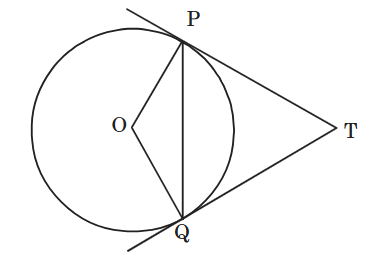
Image
Proof: $T P=T Q ($Tangents drawn from an external point to a circle are equal in length$)$
$\therefore \operatorname{In} \triangle T P Q$
$\angle T P Q=\angle T Q P ($Angles opposite to equal sides of a triangle$)$
$\angle P T Q+\angle T P Q+\angle T Q P=180^{\circ}$
$\angle P T Q+\angle T P Q+\angle T P Q=180^{\circ}$
$\angle P T Q+2 \angle T P Q=180^{\circ}$
$\angle T P Q=\frac{180^{\circ}-\angle P T Q}{2} \ldots \ldots(i)$
Also, $\angle T P O=90^{\circ} ($Tangent at any point of a circle is perpendicular to the radius$)$
$\angle O P Q+\angle T P Q=90^{\circ}$
$\angle O P Q+\frac{180^{\circ}-\angle P T Q}{2}=90^{\circ}$
$2 \angle O P Q+180^{\circ}-\angle P T Q=180^{\circ}$
$2 \angle O P Q=\angle P T Q$
Hence proved.
View full question & answer
Question 23 Marks
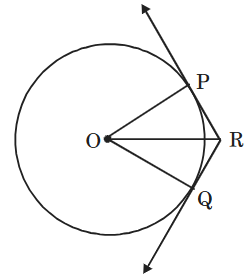
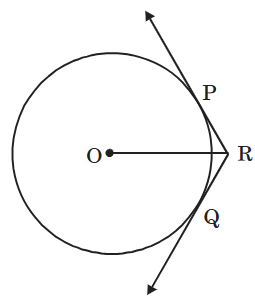
In figure, two tangents $R Q$ and $R P$ are drawn from an external point $R$ to the circle with centre $O$. If $\angle P R Q=120^{\circ}$, then prove that $O R=P R+R Q$.
Image
Answer
On joining $O P$ and $O Q$, we get $\triangle O P R$ and $\triangle O Q R$
Image
In $\triangle O P R$ and $\triangle O Q R$
$\angle O P R=\angle O Q R=90^{\circ}$ (Tangent is perpendicular to circle at point of contact)
$O P=O Q$ (Radii of same circle)
$O R$ is the common side.
By right hand side congruency
$\triangle O P R \cong \triangle O Q R$
$PR = RQ\quad \quad \ldots \ldots(i)$
Also, $\angle O R Q+\angle O R P=\angle P R Q$
$\angle P R Q=120^{\circ}$(Given)
$\angle O R P+\angle O R Q=120^{\circ}$
$\angle O R P+\angle O R P=120^{\circ}$
$\angle O R P=60^{\circ}$
Also, $\cos \theta=\frac{\text { Base }}{\text { Hypotenuse }}$
In $\triangle O P R$
$\cos 60^{\circ}=\frac{P R}{O R}, \frac{1}{2}=\frac{P R}{O R}$
$O R=2 P R$
$O R=P R+P R$
$O R=P R+R Q$
(From (i) $P R=R Q$ )
Hence proved.
View full question & answer
Question 33 Marks
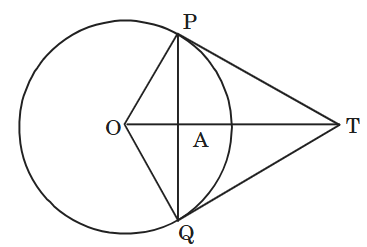
From a point $T$ outside a circle of centre $O$, tangents $T P$ and TQ are drawn to the circle. Prove that $O T$ is the right bisector of line segment $P Q$.
Answer

Image
Given: $T P$ and $T Q$ are the tangents drawn to the circle from the point $T$ outside the circle of centre $O$.
To Prove: $O T$ is the right bisector of line segment $P Q$.
Proof: In $\triangle P O T$ and $\triangle Q O T$
$P T=Q T$ (Lengths of the tangents drawn from an external point to a circle)
$O P=O Q$ (Radii of the circle)
$O T=O T$ (Common side)
$\Rightarrow \triangle P O T \cong \triangle Q O T$ (By SSS Rule)............(i)
$\Rightarrow \angle P T O=\angle Q T O$ (By CPCT Rule)
Suppose $O T$ intersect $P Q$ at $A$.
Now in $\triangle P T A$ and $\triangle Q T A$
$P T=Q T$ (Lengths of the tangents drawn from an external point to a circle)
$\angle P T O=\angle Q T O$ (Using (i))
$T A=T A($ Common Side $)$
$\Rightarrow \triangle P T A \cong \triangle Q T A$ (By SAS Rule)
$\Rightarrow \angle P A T=\angle Q A T$ (By CPCT Rule)
And $P A=Q A$ (By CPCT Rule)..............(ii)
Now $\angle P A T+\angle Q A T=180^{\circ}$ (Linear pair)
$\Rightarrow 2 \angle P A T=180^{\circ}\quad \quad \ldots \ldots(ii)$
$\Rightarrow \angle P A T=90^{\circ}$
From (ii) and (iii) it is proved that $O T$ is the right bisector of line segment $P Q$.
Hence proved.
View full question & answer
Question 43 Marks
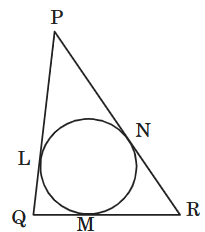
In Figure, a circle is inscribed in a triangle $P Q R$ with $PQ =10 \ cm, Q R=8 \ cm$ and $P R=12 \ cm$. Find the lengths $Q M, R N$ and $P L$.
Image
Answer
We know that, tangents drawn to a circle from an external point are equal in length.
$\therefore P L=P N, Q L=Q M $ and $ R M=R N$
Now, let us suppose $P L=x=P N$
$\Rightarrow Q L=10-x=Q M$
Now, since $P N=x$
$\Rightarrow R N=12-x=R M$
Now, $Q R=8 \ cm$
$\Rightarrow Q M+M R=8$
$\Rightarrow 10-x+12-x=8$
$\Rightarrow 22-2 x=8$
$\Rightarrow 2 x=14$
$\Rightarrow x=7$
Therefore, $P L=x=7 \ cm$
$Q M=10-x=10-7=3 \ cm, $ and 
$R N=12-x=12-7=5 \ cm$
The length of $Q M, P L$ and $R N$ are $3 \ cm, 7 \ cm$ and $5 \ cm$
View full question & answer
Question 53 Marks
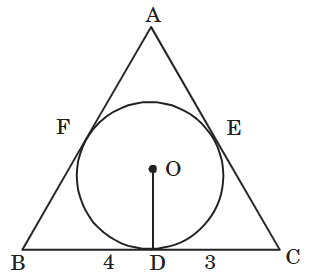
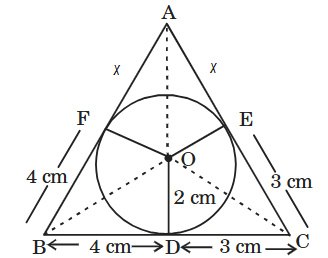
In the given figure, a triangle $\text{ABC}$ is drawn to circumscribe a circle of radius $2 \ cm$ such that the segments $B D$ and $D C$ into which $B C$ is divided by the point of contact $D$ are of lengths $4 \ cm$ and $3 \ cm$ respectively. If area of $\triangle A B C=21 \ cm^2,$ then find the lengths of sides $A B$ and $A C$.
Image
Answer
It is given that radius of the circle is $2 \ cm ,$ area of $\triangle A B C=21 \ cm^2$
Where $B D=4 \ cm$ and $C D=3 \ cm$.
Join $O A, O B$, and $O C$.
Image
Since length of the tangents drawn from an external points are equal,
$\therefore C D=C E=3 \ cm $ and  $B D=B F=4 \ cm$
And let $A F=A E=x \ cm$
Now the other two sides are,
$A B=(4+x) \ cm $ and $ AC=(3+x) \ cm$
Now since area of triangle $\text{ABC} =$ area of $(\triangle A O B +\triangle B O C+\triangle A O C)$
Area of $\triangle A O B$
$=\frac{1}{2} \times \text { base } \times \text { height }=\frac{1}{2} \times(4+x) \times 2=(4+x) \ cm^2$
Area of $\triangle A O C$
$=\frac{1}{2} \times \text { base } \times \text { height }=\frac{1}{2} \times(3+x) \times 2=(3+x) \ cm^2$
Area of $\triangle B O C$
$=\frac{1}{2} \times \text { base } \times \text { height }=\frac{1}{2} \times(4+3) \times 2=7 \ cm^2$
And as area of $\triangle B O C=21 \ cm^2$
Therefore
$\Rightarrow 21=(4+x)+(3+x)+7$
$\Rightarrow 21=14+2 x$
$\Rightarrow 2 x=7$
$\Rightarrow x=3.5$
Hence the side $A B=4+x=4+3.5=7.5 \ cm$
$A C=3+x=3+3.5=6.5 \ cm$
Hence the length of $A B$ is $7.5 \ cm$ and the length of $A C$ is $6.5 \ cm$ .
View full question & answer
Question 63 Marks
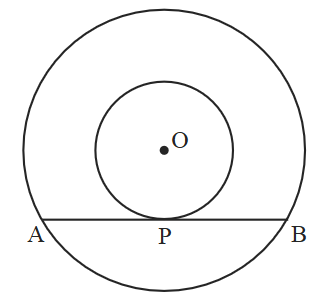
Two concentric circles with centre O are of radii 3 cm and 5 cm . Find the length of chord $A B$ of the larger circle which touches the smaller circle at $P$.
Image
Answer

Image
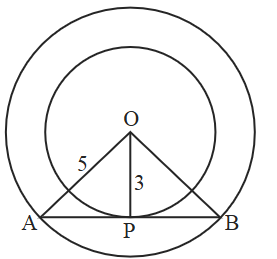
Let the two concentric circles with centre O . AB be the chord of the larger circle which touches the smaller circle at point $P$.
$\therefore AB$ is tangent to the smaller circle to the point P .
$
\Rightarrow \quad OP \perp AB
$
By Pythagoras theorem in $\triangle OPA$,
$
\begin{array}{rlrl}
OA^2 =AP^2+OP^2 \\
\Rightarrow 5^2 =AP^2+3^2 \\
\Rightarrow AP^2 =25-9 \\
\Rightarrow AP =4 cm
\end{array}
$
In $\triangle OPB$,
Since $OP \perp AB$,
$AP = PB$ (Perpendicular from the centre of the circle bisects the chord)
$
AB=2 AP=2 \times 4=8 cm
$ $\therefore$ The length of the chord of the larger circle is 8 cm .
View full question & answer
Question 73 Marks
Prove that the lengths of tangents down from an external point to a circle are equal.
Answer

Image
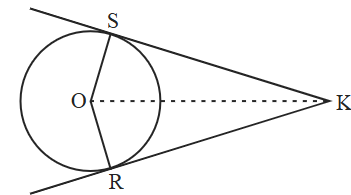
Two tangents $SK$ and $RK$ drawn to circle with centre $O$ from an external point $K$ .
To prove: $SK = RK$
Proof: Normal and tangent at a point on the circle are perpendicular to each other.
$\angle OSK=\angle ORK=90^{\circ}$
Using Pythagoras Theorem,
$OK^2=OS^2+SK^2 \ldots \ldots(i)$
$OK^2=OR^2+RK^2 \ldots \ldots(ii)$
Subtracting $(ii)$ from $(i),$
$OK^2-OK^2 =OS^2+SK^2-OR^2-RK^2$
$\Rightarrow SK^2 =RK^2 $
$\because OS=OR$
$SK =RK$
Hence, proved
View full question & answer
3 Marks Question - Maths STD 10 Questions - Vidyadip