MCQ 11 Mark
Statement-1 ( $\Lambda$ ): If the shadow of a verlical pole is $\frac{1}{\sqrt{3}}$ of its height, then the altitude of the sum is $60^{\circ}$
Slatement-2 (R): If the sun's altitude is $45^{\circ}$, then the shadow of a vertical pole is same as its
Slatement-2 (R): If the sun's altitude is $45^{\circ}$, then the shadow of a vertical pole is same as its
- AStatement-1 and Statement-2 are True; Statement-2 is a correct explanation for Statement-1.
- ✓Statement-1 and Statement-2 are True; Statement-2 is not a correct explanation for Statement-1.
- CStatement- 1 is True, Statement- 2 is False.
- DStatement-1 is False, Statement- 2 is True.
Answer
View full question & answer→Correct option: B.
Statement-1 and Statement-2 are True; Statement-2 is not a correct explanation for Statement-1.
(B)Statement-1 and Statement-2 are True; Statement-2 is not a correct explanation for Statement-1.
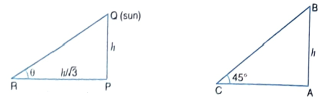
Let $P Q$ be a vertical pole of height $h$ such that its shadow is of length $\frac{h}{\sqrt{3}}$. Let the sun's altitude be 0 . Then,
$
\tan \theta=\frac{h}{h / \sqrt{3}}=\sqrt{3} \Rightarrow \tan \theta=\tan 60^{\circ} \Rightarrow \theta=60^{\circ}
$
Thus, statement-1 is true.
Let $A B$ be a vertical pole of height/ $/$ metre and $A C$ be the length of its shadow when sun's altitude is $45^{\circ}$ (see Fig.).
In $\triangle B A C$, we obtain
$
\tan 45^{\circ}=\frac{\Lambda B}{\Lambda C} \Rightarrow 1=\frac{h}{\Lambda C} \Rightarrow A C=h
$
Hence, the shadow $A C$ of pole $A B$ is of the same height as that of the pole. So, statement- 2 is true,
Let $P Q$ be a vertical pole of height $h$ such that its shadow is of length $\frac{h}{\sqrt{3}}$. Let the sun's altitude be 0 . Then,
$
\tan \theta=\frac{h}{h / \sqrt{3}}=\sqrt{3} \Rightarrow \tan \theta=\tan 60^{\circ} \Rightarrow \theta=60^{\circ}
$
Thus, statement-1 is true.
Let $A B$ be a vertical pole of height/ $/$ metre and $A C$ be the length of its shadow when sun's altitude is $45^{\circ}$ (see Fig.).
In $\triangle B A C$, we obtain
$
\tan 45^{\circ}=\frac{\Lambda B}{\Lambda C} \Rightarrow 1=\frac{h}{\Lambda C} \Rightarrow A C=h
$
Hence, the shadow $A C$ of pole $A B$ is of the same height as that of the pole. So, statement- 2 is true,