Questions

Case study (4 Marks)

🎯

Test yourself on this topic

9 questions · timed · auto-graded

Question 14 Marks
One evening, Kaushik was in a park: Children wre playing cricket Birds were singing on a neurby trec of height 80 m . He obseried a bird on the trec at an angle of clevaton of $45^{\circ}$. When a sixcer was hin, a ball flew through the three frightening the bird to fly away. In 2 seconds, he observed the bird flying at the same height at an angle of clevations of $30^{\circ}$ and the ball flying touards him at the same height at an angle of elevation of $60^{\circ}$.
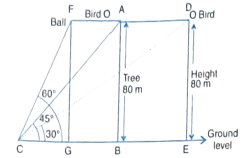
Image
(i) At what distance from the foot of the tree was he observing the bird sitting on the tree?
(ii) How far did the bird fly in the mentoned time?
(iii) After hitting the tree, how far did the ball travel in the sky when Kaushik saw the ball?
(iv) What is the specd of the bird in $m / min$ of it had flown $20(\sqrt{3}+1) m$ ?
Answer
(i) In right triangles CBA and CED, we obtain
$
\begin{array}{l}
\tan 45^{\circ}=\frac{A B}{B C} \text { and } \tan 30^{\circ}=\frac{D E}{C E} \Rightarrow 1=\frac{80}{B C} \text { and } \frac{1}{\sqrt{3}}=\frac{80}{C E} \Rightarrow B C=80 m \text { and } C E=80 \sqrt{3} m \\
\therefore B E=C E-C B=(80 \sqrt{3}-80) m=80(\sqrt{3}-1) m
\end{array}
$
Hence, Kaushik was observing the bird at a distance of $80(\sqrt{3}-1) m$ from the foot of the tree.
(ii) The bird flew distance $A D=B E=80(\sqrt{3}-1) m$.
(iii) In right triangle CGF, we obtain
$
\tan 60^{\circ}=\frac{G F}{C G} \Rightarrow \sqrt{3}=\frac{80}{C G} \Rightarrow C G=\frac{80}{\sqrt{3}}
$
Distance travelled by the ball after hitting the tree $=F A=G B=C B-C G$
$
=\left(80-\frac{80}{\sqrt{3}}\right) m=80\left(1-\frac{1}{\sqrt{3}}\right) m
$
(iv) Speed of the bird $=\frac{\text { Distance flown by it }}{\text { Time taken }}=\frac{20(\sqrt{3}+1)}{2} m / sec$
$
=\frac{20(\sqrt{3}+1)}{2} \times 60 m / min=600(\sqrt{3}+1) m / min
$
View full question & answer
Question 24 Marks
A short circuit can happen on electric poles duc to several reasons, like:
(a) If the insulation is damaged or old, it may allow the hot wires to touch with neutral. This will cause a short circuit.
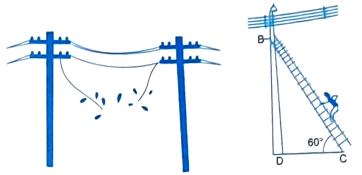
(b) If there are any loose wire connections or attachments, it will allow the live and neutral wires to touch. An electrician has to repair an clectric fault on a pole of height 5 m . He needs to reach a point 1 m below the top of the pole to undertake the repair work.
Based on the above information, answer the following questions:
Image
(i) What should be the length of the ladder that he should use which, when inclined at an angle of $60^{\circ}$ to the horizontal, cnables him to reach the required position?
(ii) How far from the foot of the pole should he place the foot of the ladder?
(iii) What is the length of the ladder if the foot is kept at a distance of 4 m from the foot of the pole?
Answer
(i) In $\triangle C D B$, we obtain
$
\sin 60^{\circ}=\frac{B D}{B C} \Rightarrow \frac{\sqrt{3}}{2}=\frac{4}{B C} \Rightarrow B C=\frac{8}{\sqrt{3}} m
$
Length of the ladder $=\frac{8}{\sqrt{3}} m$.
(ii) In $\triangle C D B$, we obtain
$
\tan 60^{\circ}=\frac{B D}{D C} \Rightarrow \sqrt{3}=\frac{4}{D C} \Rightarrow D C=\frac{4}{\sqrt{3}} m
$
The foot of the ladder is placed at a distance of $\frac{4}{\sqrt{3}} m$ from the foot of the pole.
(iii) If the foot of the ladder is kept at a distance of 4 m from the foot of the pole i.e. $C D=4 m$ and $B D=4 m$, then by using Pythagoras theorem in $\triangle C D B$, we obtain
$
B C^2=C D^2+B D^2=4^2+4^2=32 \Rightarrow B C=4 \sqrt{2}
$
$\therefore \quad$ Length of ladder $=4 \sqrt{2} m$.
View full question & answer
Question 34 Marks
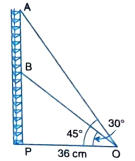
Radio towers are used for transmitting a range of communication services including radio and television. The tower will either act as an antenna itself or support one or more antennas on its structure. On a similar concept, a radio station tower was built in two Sections A and B. Tower is supported buy wires from a point $O$.
Distance between the base of the tower and point O is 36 cm . From point O, the angle of elevation of the top of the Section B is $30^{\circ}$ and the angle of elevation of the top of Section A is $45^{\circ}$.
(i) Find the length of the wire from the point $O$ to the top of Section B.
(ii) Find the distance $A B$.
(iii) Find the area of $\triangle O P B$.
(iv) Find the height of the Section A from the base of the tower.
Image
Answer
(i) In $\triangle O P B$, we obtain
$
\cos 30^{\circ}=\frac{O P}{O B} \Rightarrow \frac{\sqrt{3}}{2}=\frac{36}{O B} \Rightarrow O B=24 \sqrt{3} cm
$
(ii) In right triangles $O P B$ and $O P A$, we obtain
$\tan 30^{\circ}=\frac{P B}{O P}$ and $\tan 45^{\circ}=\frac{P A}{O P} \Rightarrow \frac{1}{\sqrt{3}}=\frac{P B}{36}$ and $1=\frac{P A}{36} \Rightarrow P B=12 \sqrt{3} cm$ and $P A=36 cm$
$
\therefore \quad A B=P A-P B=(36-12 \sqrt{3}) cm=12 \sqrt{3}(\sqrt{3}-1) cm
$
(iii) Area of $\triangle O P B=\frac{1}{2}(O P \times P B)=\frac{1}{2}(36 \times 12 \sqrt{3}) cm ^2=216 \sqrt{3} cm^2$
(iv) Height of section $A$ from the base of tower $=P A=36 cm$.
View full question & answer
Question 44 Marks
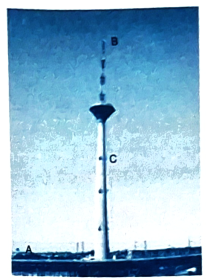
The following TV Tower was built in 1988 and is located in Pitampura, Delhi. It has an observation deck. Observe the picture given below:
Image
The TV Tower stands vertically on the ground. From a point ' $A$ ' on the ground, the angle of elevation of top of the tower (point ' $B$ ') is $60^{\circ}$. There is a point ' $C ^{\prime}$ ' on the tower which is 78 m (approx.) above the ground. The angle of elevation of the point $C$ from point $A$ is found to be $30^{\circ}$.
(i) Draw a well-labelled figure, based on the information given above.
(ii) Find the height of the tower and the distance of the tower from point $A$.
Answer
(ii) $234 m, 78 \sqrt{3} m$
View full question & answer
Question 54 Marks
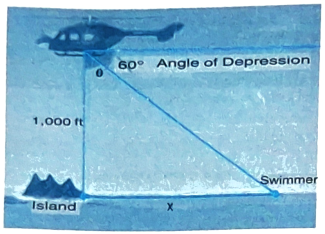
A helicopter lifts up 1000 feet over an island and spots a swimmer that need to be rescued. Using a distant land mark, the helicopter pilot determines the angle of depression.
Image
(i) As the angle of depression increases what will be the effect?
(a) The helicopter gets further from the island.
(b) The helicopter gets closer to the island.
(c) The swimmer gets closer to the island.
(d) The swimmer gets further from the island.
(ii) How does the swimmer's distance from island changes as the angle of depression is halved from $60^{\circ}$ to $30^{\circ}$ ?
(a) The swimmer's distance decreases to less than a quarter of his starting distance.
(b) The swimmer's distance from the island doubles
(c) The swimmer's distance from the island increases three times.
(d) The swimmer's distance from the island is halved.
(iii) For which angle of depression both the helicopter and swimmer's will be at same distance?
(a) $30^{\circ}$ $\qquad$ (b) $45^{\circ}$ $\qquad$ (c) $60^{\circ}$ $\qquad$ (d) $90^{\circ}$
(iv) Let the swimmer start out 1019 ft . from the island. If he swims half of the distance, what is angle of depression?)
(a) nearly $30^{\circ}$ $\qquad$ (b) nearly $45^{\circ}$ $\qquad$ (c) nearly $60^{\circ}$ $\qquad$ (d) nearly $90^{\circ}$
Answer
(i) (a) (ii) (c) (iii) (b) (iv) (a)
View full question & answer
Question 64 Marks
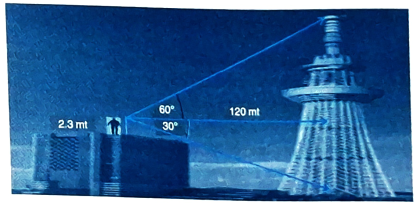
We know that during vacation period many people love to go out of the city and gain some experience about historical and scientific values. Keeping in views, Mr. Ramlal decided to go somewhere out of the country and chosen the country USA. In the series of sight seeing, he has first chosen the place sky tower of Mexico City. Then he decided to stand on a building and wanted to see the sky tower. Mr. Ramlal whose height is 2.3 m stood on the top of a building and started to look at the top of sky tower. The horizontal distance between sky tower and the building is 120 mt . as shown in Fig. 11.24. The angle of elevation of the top and angle of depression of the bottom of the sky tower are $60^{\circ}$ and $30^{\circ}$ respectively. Looking into the above circumstances to give the answer of the following questions:
Image
(i) What is the height of the building excluding the height of Mr. Ramlal standing on it?
(a) 65.98 m $\qquad$ (b) 66.98 m $\qquad$ (c) 67.98 m $\qquad$ (d) 68.98 m
(ii) Find the height of the building including height of Mr. Ramlal?
(a) $30 \sqrt{3} m$ $\qquad$ (b) $35 \sqrt{3} m$ $\qquad$ (c) $40 \sqrt{3} m$ $\qquad$ (d) $45 \sqrt{3} m$
(iii) What is the length of line of sight of Mr. Ramlal to the base of the Sky tower?
(a) $40 \sqrt{3} m$ $\qquad$ (b) $80 \sqrt{3} m$ $\qquad$ (c) $100 \sqrt{3} m$ $\qquad$ (d) $120 \sqrt{3} m$
(iv) Find the distance from the eye of Mr. Ramlal to top of the sky tower along the line of sight?
(a) 210 m $\qquad$ (b) 220 m $\qquad$ (c) 230 m $\qquad$ (d) 240 m
Answer
(i) (b) (ii) (c) (iii) (b) (iv) (d)
View full question & answer
Question 74 Marks
Answer
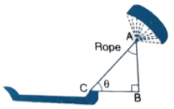
(i) (b): From Fig. we find that $A B=200 m$ and $\theta=30^{\circ}$. In right triangle $A B C$, we obtain
$
\sin \theta=\frac{A B}{A C} \Rightarrow \sin 30^{\circ}=\frac{200}{A C} \Rightarrow \frac{1}{2}=\frac{200}{A C} \Rightarrow A C=400 m
$
(ii) (c): We have, $A B=200 m$ and $\theta=30^{\circ}$. In right triangle $A B C$, we obtain
$
\tan 30^{\circ}=\frac{A B}{B C} \Rightarrow \frac{1}{\sqrt{3}}=\frac{200}{B C} \Rightarrow B C=200 \sqrt{3} m
$
(iii) (d): If $B C=15 m$ and $\theta=30^{\circ}$, then
$
\tan \theta=\frac{A B}{B C} \Rightarrow \tan 30^{\circ}=\frac{A B}{15} \Rightarrow \frac{1}{\sqrt{3}}=\frac{A B}{15} \Rightarrow A B=5 \sqrt{3} m
$
(iv) (c): In $\triangle A B C$, we obtain
$
\tan \theta=\frac{A B}{B C} \Rightarrow \tan \theta=1 \Rightarrow \tan \theta=\tan 45^{\circ} \Rightarrow \theta=45^{\circ}
$
View full question & answer
Question 84 Marks
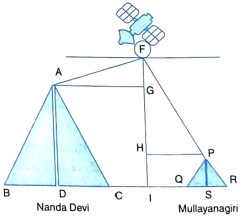
A satellite flying at a height $h$ is watching the top of the two tallest mountains in Uttarakhand and Karnataka, them being Nanda Devi (height 7,816 m) and Mullayanagri (height 1930 m ). The angle of depression from the satellite, to the top of Nanda Devi and Mullayanagiri are $30^{\circ}$ and $60^{\circ}$ respectively. If the distance between the peaks of two mountains is 1937 km , and the satellite is vertically above the mid-point of the distance between the two mountains. Based on the above information answer the following questions.
Image
(i) The distance of the satellite from the top of Nanda Devi is
(a) 1118.36 km $\qquad$ (b) $577 \sqrt{2} km$ $\qquad$ (c) 1937 km $\qquad$ (d) 1025.36 km
(ii) The distance of the satellite from the top of Mullayanagiri is
(a) 1139.4 km $\qquad$ (b) 577.52 km $\qquad$ (c) 1937 km $\qquad$ (d) 1025.36 km
(iii) The distance of the satellite from the ground is
(a) 1139.4 km $\qquad$ (b) 567 km $\qquad$ (c) 1937 km $\qquad$ (d) 1025.36 km
(iv) What is the angle of elevation if a man is standing at a distance of 7816 m from Nanda Devi?
(a) $30^{\circ}$ $\qquad$ (b) $45^{\circ}$ $\qquad$ (c) $60^{\circ}$ $\qquad$ (d) $0^{\circ}$
Answer
(i) (a): In $\triangle A G F$, we have: $A G=\frac{1}{2} \times 1937 km$ and $\angle G A F=30^{\circ}$
$
\therefore \quad \cos 30^{\circ}=\frac{A G}{A F} \Rightarrow \frac{\sqrt{3}}{2}=\frac{A G}{A F} \Rightarrow A F=\frac{2}{\sqrt{3}} A G=\frac{1937}{\sqrt{3}} km=1118.36 km
$
(ii) (c): In $\triangle P H F$, we have: $P H=\frac{1}{2} \times 1937 km$ and $\angle H P F=60^{\circ}$
$
\cos 60^{\circ}=\frac{P H}{P F} \Rightarrow \frac{1}{2}=\frac{P H}{P F} \Rightarrow P F=2 P H=1937 km
$
(iii) (b): In $\triangle A G F$, we have: $A G=\frac{1}{2} \times 1937 km$ and $\angle GAF =30^{\circ}$
$
\begin{array}{c}
\therefore \tan 30^{\circ}=\frac{G F}{A G} \Rightarrow \frac{1}{\sqrt{3}}=\frac{G F}{A G} \Rightarrow G F=\frac{1}{\sqrt{3}} A G=\frac{1}{\sqrt{3}} \times \frac{1}{2} \times 1937 km=559.18 km \\
I F=I G+G F=7.816+559.18=566.99 \cong 567 km
\end{array}
$
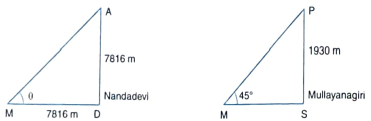
(iv) (b): In $\triangle A D M$, we have $A D=7816 m$ and $D M=7816 m$
$
\therefore \quad \tan \theta=\frac{A D}{D M}=1 \Rightarrow 0=45^{\circ}
$
Image
View full question & answer
Question 94 Marks
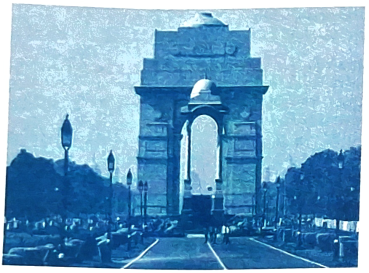
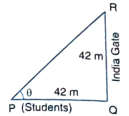
A group of sludents of class $X$ visited India Gate on an educatonal trip. The teacher as well as students had interest in history behind India Gate. The teacher narrated that India Gate's, official name is Delhn Memorial, Originally called All India War Memorial, a monumental sand stone arch in New Delhi, dedicated to the troops of British India who died in wars fought between 1914 and 1919. The teacher also said that Indw Gate, whels is located at the eastern end of the Kartanya Path (formerly called the Rajpath), is about 138 feet ( 42 metres) in height.
Image
(i) What is the angle of elevation if they are standing at a distance of 42 metres away from the monument?
(a) $30^{\circ}$ $\qquad$ (b) $45^{\circ}$ $\qquad$ (c) $60^{\circ}$ $\qquad$ (d) $0^{\circ}$
(ii) If they want to see the top at an angle of $60^{\circ}$, then the distance where they should stand is
(a) 24.24 m $\qquad$ (b) 20.12 m $\qquad$ (c) 24.64 m $\qquad$ (d) 25.24 m
(iii) If the altitude of the Sun is at $60^{\circ}$, then the height of the vertical tower that will cast a shadow of length 20 m , is
(a) $20 \sqrt{3} m$ $\qquad$ (b) $\frac{20}{\sqrt{3}} m$ $\qquad$ (c) $\frac{15}{\sqrt{3}} m$ $\qquad$ (d) $15 \sqrt{3} m$
(iv) If the ratio of the length of a rod and its shadow is $1: 1$, the angle of elevation of the Sun is
(a) $30^{\circ}$ $\qquad$ (b) $45^{\circ}$ $\qquad$ (c) $60^{\circ}$ $\qquad$ (d) $90^{\circ}$
Answer

Image
(i) (b): Let $\theta$ be the angle of elevation of the top of the India Gate. In $\triangle P Q R$, we have $P Q=42 m$ and $Q R=42 m$.
$
\tan \theta=\frac{Q R}{P Q}=\frac{42}{42}=1 \Rightarrow \theta=45^{\circ}
$
(ii) (a): In this case, $\theta=60^{\circ}, Q R=42 m$ and we
have to find $P Q$. In $\triangle P Q R$, we obtain
$
\tan \theta=\frac{Q R}{P Q} \Rightarrow \tan 60^{\circ}=\frac{42}{P Q} \Rightarrow P Q=\frac{42}{\sqrt{3}}=14 \sqrt{3}=14 \times 1.732=24.24 m
$
(iii) (a): Let $P Q$ be a tower that casts a shadow of length 20 m when altitude of sun is $60^{\circ}$. In $\triangle Q P R$, we obtain
$\tan 60=\frac{P Q}{20} \Rightarrow P Q=20 \sqrt{3} m$
(iv) (b): Let $P Q$ be a rod and $P R$ be the length of its shadow. It is given that $P Q: P R: 1: 1$.
In $\triangle Q P R$, we obtain
$
\tan \theta=\frac{P Q}{P R} \Rightarrow \tan \theta=1 \Rightarrow \theta=45^{\circ}
$
View full question & answer
Case study (4 Marks) - Maths STD 10 Questions - Vidyadip