MCQ 11 Mark
The value of $\cot 10^{\circ} \cot 15^{\circ} \cot 75^{\circ} \cot 80^{\circ}$ is equal to:
Answer$\cot 10^{\circ} \cot 15^{\circ} \cot 75^{\circ} \cot 80^{\circ}$
$=\cot (90-80)^{\circ} \cot 80^{\circ} \cot (90-75)^{\circ} \cot 75^{\circ}$
$=\tan 80^{\circ} \cdot \cot 80^{\circ} \cdot \tan 75^{\circ} \cdot \cot 75^{\circ}$
$=1 \times 1=1$
Hence the correct option is $(c).$
View full question & answer→MCQ 21 Mark
The value of $\sin ^2 30^{\circ}-\cos ^2 30^{\circ}+\tan ^2 45^{\circ}$ is:
- A
$\frac{-1}{2}$
- B
$\frac{\sqrt{3}}{2}$
- ✓
$\frac{1}{2}$
- D
$0$
AnswerCorrect option: C. $\frac{1}{2}$
$\sin ^2 30^{\circ}=\left(\frac{1}{2}\right)^2$
$\cos ^2 30^{\circ}=\left(\frac{\sqrt{3}}{2}\right)^2$
$\tan ^2 45^{\circ}=(1)^2$
Putting the values in the given question
$\Rightarrow \sin ^2 30^{\circ}-\cos ^2 30^{\circ}+\tan ^2 45^{\circ}$
$=\frac{1}{4}-\frac{3}{4}+1$
$=1-\frac{2}{4}$
$=\frac{4-2}{4}$
$=\frac{2}{4}$
$=\frac{1}{2}$
Hence the correct option is $(c).$
View full question & answer→MCQ 31 Mark
Given that $\sin \theta=\frac{a}{b}$, then $\tan \theta$ is equal to:
- A
$\frac{b}{\sqrt{a^2+b^2}}$
- B
$\frac{b}{\sqrt{b^2-a^2}}$
- C
$\frac{a}{\sqrt{a^2-b^2}}$
- ✓
$\frac{a}{\sqrt{b^2-a^2}}$
AnswerCorrect option: D. $\frac{a}{\sqrt{b^2-a^2}}$
We have,
$\sin \theta=\frac{a}{b}$
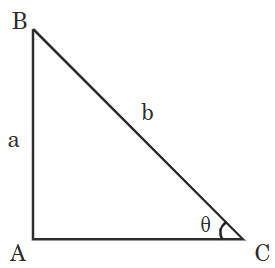
$\sin \theta=\frac{A B}{B C}=\frac{a}{b}($ Given $)$
By Pythagoras theorem, we know,
$B C^2=A B^2+A C^2$
$\Rightarrow b^2=a^2+A C^2$
$\Rightarrow A C^2=b^2-a^2$
$\Rightarrow A C=\sqrt{b^2-a^2}$
Using trigonometric ratios,
$\tan \theta=\frac{A B}{A C}$
$\tan \theta=\frac{a}{\sqrt{b^2-a^2}}$
Hence, the correct option is $(d).$ View full question & answer→MCQ 41 Mark
$3 \sin ^2 20^{\circ}-2 \tan ^2 45^{\circ}+3 \sin ^2 70^{\circ}$ is equal to:
Answer$3 \sin ^2 20^{\circ}-2 \tan ^2 45^{\circ}+3 \sin ^2 70^{\circ}($ Given $)$
$\Rightarrow 3\left(\sin ^2 20^{\circ}+\sin ^2 70^{\circ}\right)-2 \tan ^2 45^{\circ}$
We know that, $\sin 70^{\circ}=\sin (90-20)^{\circ}=\cos 20^{\circ}$ and $\tan 45^{\circ}=1$
Substituting these values in equation $(1),$
we get, $\Rightarrow 3\left(\sin ^2 20^{\circ}+\cos ^2 20^{\circ}\right)-2$
Also, by an identity $\sin ^2 20^{\circ}+\cos ^2 20^{\circ}=1$
$\Rightarrow 3-2=1$
Hence, the correct option is $(b).$
View full question & answer→MCQ 51 Mark
The maximum value of $\frac{1}{\operatorname{cosec} \theta}$ is
Answer(a)
We know
$
\frac{1}{\operatorname{cosec} \theta}=\sin \theta
$
The maximum value of $\sin \theta$ is 1 and the minimum value of $\sin \theta$ is -1 . Hence, the maximum value of $\frac{1}{\operatorname{cosec} \theta}$ is 1 .
The correct option is (a).
View full question & answer→MCQ 61 Mark
$[(\sec A+\tan A)(1-\sin A)]$ on simplification gives
- A
$\tan ^2 A$
- B
$\sec ^2 A$
- ✓
$\cos A$
- D
$\sin A$
AnswerCorrect option: C. $\cos A$
Using $\sec A=\frac{1}{\cos A}$ and $\tan A=\frac{\sin A}{\cos A}$ in given expression, we get
$[(\sec A+\tan A)(1-\sin A)]=\left[\begin{array}{l}
\left( \frac{1}{\cos A}+\frac{\sin A}{\cos A}\right) \\
(1-\sin A)
\end{array}\right].$
Apply $(a+b)(a-b)=a^2-b^2$ where $a=1$ and $b=\sin A$
$\Rightarrow[(\sec A+\tan A)(1-\sin A)]=\frac{1-\sin ^2 A}{\cos A}\quad \quad \ldots \ldots(i) .$
Also, $1-\sin ^2 A=\cos ^2 A\quad \quad \ldots \ldots(ii)$
Substitute equation $(ii)$ in equation $(i),$
$\Rightarrow[(\sec A+\tan A)(1-\sin A)]=\frac{\cos ^2 A}{\cos A}=\cos A$
Hence, the correct option is $(c).$
View full question & answer→MCQ 71 Mark
$4 \tan ^2 A-4 \sec ^2 A$ is equal to:
AnswerWe know that
$1+\tan ^2 A=\sec ^2 A$ or
$\tan ^2 A-\sec ^2 A=-1$
The given equation is $4 \tan ^2 A-4 \sec ^2 A$
By taking $4$ as a common $=4\left(\tan ^2 A-\sec ^2 A\right)$
Using equation $(i),$
$\Rightarrow 4 \tan ^2 A-4 \sec ^2 A=4(-1)=-4$
Hence, the correct option is $(b).$
View full question & answer→MCQ 81 Mark
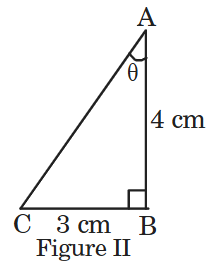
In figure, $AB =4 \ cm$ and $BC =3 \ cm$, then $\cot \theta$ equals:
- A
$\frac{3}{4}$
- B
$\frac{5}{4}$
- ✓
$\frac{4}{3}$
- D
$\frac{3}{5}$
AnswerCorrect option: C. $\frac{4}{3}$
It is given that $A B=4 \ cm$ and $B C=3 \ cm$
$\tan \theta=\frac{\text { Side opposite to } \angle \theta}{\text { Side adjacent to } \angle \theta}=\frac{B C}{A C}=\frac{3}{4}$
$\cot \theta=\frac{1}{\tan \theta}=\frac{4}{3}$
Hence, the correct option is $(c).$
View full question & answer→MCQ 91 Mark
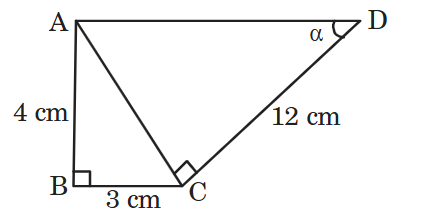
`In figure below, the value of $\sec x$ is
- ✓
$\frac{13}{12}$
- B
$\frac{5}{12}$
- C
$\frac{12}{5}$
- D
$\frac{12}{13}$
AnswerCorrect option: A. $\frac{13}{12}$
$\triangle \text{ABC}$ is a right angled triangle, therefore, using Pythagoras Theorem,
$A C=\sqrt{A B^2+B C^2}$
$\Rightarrow AC=\sqrt{4^2+3^2}$
$\Rightarrow AC=\sqrt{16+9}=5 \ cm \ldots \ldots\text{(i)}$
Similarly, $\triangle \text{ACD}$ is a right angled triangle, therefore, using Pythagoras Theorem,
$AD=\sqrt{AC^2+CD^2}$
$\Rightarrow AD=\sqrt{5^2+12^2} ($ Using value of from $(i))$
$\Rightarrow AD=\sqrt{25+144}=13 \ cm$
Using values of $AC$ and $AD$, we have
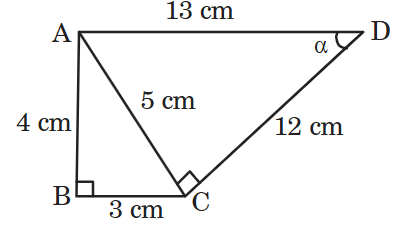
$\cos \alpha=\frac{\text { Base }}{\text { Hypotenuse }}=\frac{CD}{AD}=\frac{12}{13}$
Now, $\sec \alpha=\frac{1}{\cos \alpha}=\frac{13}{12}$ View full question & answer→MCQ 101 Mark
If $\sec \theta+\tan \theta=p$, then $\tan \theta$ is
- A
$\frac{p^2+1}{2 p}$
- ✓
$\frac{p^2-1}{2 p}$
- C
$\frac{p^2-1}{p^2+1}$
- D
$\frac{p^2+1}{p^2-1}$
AnswerCorrect option: B. $\frac{p^2-1}{2 p}$
(b)
$\operatorname{Sec} \theta+\tan \theta=p$
is the given equation.
Since, $1+\tan ^2 \theta=\operatorname{Sec}^2 \theta$
or $\sec \theta=\sqrt{1+\tan ^2 \theta}$
Put this value in (i), we get
$
\sqrt{1+\tan ^2 \theta}+\tan \theta=p
$
or $\sqrt{1+\tan ^2 \theta}=p-\tan \theta$
Squaring both sides, we get
$
1+\tan ^2 \theta=p 2+\tan ^2 \theta-2 p \tan \theta
$
or $1= p ^2-2 p (\tan \theta)$
or $1-p^2=2 p \tan \theta$
or $\tan \theta=\frac{ p ^2-1}{2 p }$
View full question & answer→MCQ 111 Mark
If $a \cot \theta+b \operatorname{cosec} \theta=p$ and $b \cot \theta+a \operatorname{cosec} \theta=q$, then $p^2-q^2=$
- A
$a^2-b^2$
- ✓
$b^2-a^2$
- C
$a ^2+ b ^2$
- D
AnswerCorrect option: B. $b^2-a^2$
(b)
$a \cot \theta+b \operatorname{cosec} \theta=p$ and $b \cot \theta+a \operatorname{cosec} \theta=q$ are the given equations.
Taking, $p ^2- q ^2$
$=(a \cot \theta+b \operatorname{cosec} \theta)^2-(b \cot \theta+a \operatorname{cosec} \theta)^2$
$=a^2 \cot ^2 \theta+b^2 \operatorname{cosec}^2 \theta+2 a b \cdot \cot \theta \cdot \operatorname{cosec} \theta$
$-b^2 \cot ^2 \theta-a^2 \operatorname{cosec}^2 \theta-2 a b \cdot \cot \theta \cdot \operatorname{cosec} \theta$
$=a^2\left(\cot ^2 \theta-\operatorname{cosec}^2 \theta\right)+ b ^2\left(\cot ^2 \theta-\operatorname{cosec}^2 \theta\right)$
$=a^2(-1)+b^2(-1)$
$=b^2-a^2$ [using, $\left.\operatorname{cosec}^2 \theta-\cot ^2 \theta=1\right]$
View full question & answer→MCQ 121 Mark
Given that $\sec \theta=\sqrt{2}$, the value of $\frac{1+\tan \theta}{\sin \theta}$ is
- ✓
$2 \sqrt{2}$
- B
$\sqrt{2}$
- C
$3 \sqrt{2}$
- D
$2$
AnswerCorrect option: A. $2 \sqrt{2}$
It is given that
$\sec \theta=\sqrt{2}$
Also, $\sec 45^{\circ}=\sqrt{2}$
From $(i)$ and $(ii),$ we get
$\theta=45^{\circ}$
$\text {Put value of } \theta \text { in } \frac{1+\tan \theta}{\sin \theta},$
$\Rightarrow \frac{1+\tan \theta}{\sin \theta}=\frac{1+\tan 45^{\circ}}{\sin 5^{\circ}}$
$\Rightarrow \frac{1+1}{\frac{1}{\sqrt{2}}}$
$\text { or } 2 \sqrt{2}$
View full question & answer→MCQ 131 Mark
In $\triangle ABC$ right angled at $B , \sin A =\frac{7}{25}$, then the value of $\cos C$ is
- ✓
$\frac{7}{25}$
- B
$\frac{24}{25}$
- C
$\frac{7}{24}$
- D
$\frac{24}{7}$
AnswerCorrect option: A. $\frac{7}{25}$
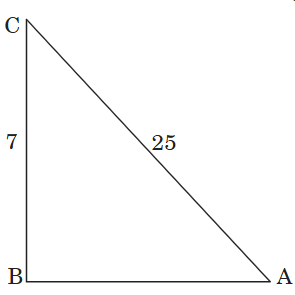
$\sin \theta=\frac{\text { Perpendicular }}{\text { Hypotenuse }}$
and $\cos \theta=\frac{\text { Base }}{\text { Hypotenuse }}$
$\sin A =\frac{ BC }{ AC }=\frac{7}{25}$
$\therefore \cos C =\frac{ BC }{ AC }=\frac{7}{25}$ View full question & answer→MCQ 141 Mark
If $\cot \theta=\frac{1}{\sqrt{3}}$, the value of $\sec ^2 \theta+\operatorname{cosec}^2 \theta$ is
- A
$1$
- B
$\frac{40}{9}$
- C
$\frac{38}{9}$
- ✓
$5 \frac{1}{3}$
AnswerCorrect option: D. $5 \frac{1}{3}$
It is given that
$\cot \theta=\frac{1}{\sqrt{3}}=\cot 60^{\circ}$
$\Rightarrow \theta=60^{\circ}$
Substituting the value of $\theta$
$\sec ^2 \theta+\operatorname{cosec}^2 \theta=\sec ^2 60^{\circ}+\operatorname{cosec}^2 60^{\circ}$
$=(2)^2+\left(\frac{2}{\sqrt{3}}\right)^2$
$=4+\frac{4}{3}$
$=\frac{16}{3}$
$=5 \frac{1}{3}$
View full question & answer→MCQ 151 Mark
Assertion - Reason Based Questions: A statement of Assertion (A) is followed by a
statement of Reason (R) Statement A (Assertion): For $0 \theta \leq 90^{\circ}, \operatorname{cosec} \theta$ $-\cot \theta$ and $\operatorname{cosec} \theta+\cot \theta$ are reciprocal of each other.
Statement R (Reason): $\operatorname{cosec}^2 \theta-\cot ^2 \theta=1$
Choose the correct option out of the following:
- A
Both Assertion (A) and Reason (R) are true; and Reason (R) is the correct explanation of Assertion (A).
- ✓
Both Assertion (A) and Reason (R) are true; but Reason (R) is not the correct explanation of Assertion (A).
- C
Assertion (A) is true but Reason (R) is false.
- D
Assertion (A) is false but Reason (R) is true.
AnswerCorrect option: B. Both Assertion (A) and Reason (R) are true; but Reason (R) is not the correct explanation of Assertion (A).
View full question & answer→MCQ 161 Mark
$\frac{\cos ^2 \theta}{\sin ^2 \theta}-\frac{1}{\sin ^2 \theta}$, in simplified form, is:
- A
$\tan ^2 \theta$
- B
$\sec ^2 \theta$
- C
- ✓
Answer(d)
$\begin{aligned} \tan ^2 \theta-\sec ^2 \theta & =1 \\ 1-(\sqrt{2})^2 & =1 \\ 1-2 & =1 \\ -1 & \neq 1\end{aligned}$
View full question & answer→MCQ 171 Mark
If $\theta$ is an acute angle of a right angled triangle, then which of the following equation is not true?
- A
$\sin \theta \cot \theta=\cos \theta$
- B
$\cos \theta \tan \theta=\sin \theta$
- C
$\operatorname{cosec}^2 \theta-\cot ^2 \theta=1$
- ✓
$\tan ^2 \theta-\sec ^2 \theta=1$
AnswerCorrect option: D. $\tan ^2 \theta-\sec ^2 \theta=1$
$\frac{\cos ^2 \theta}{\sin ^2 \theta}-\frac{1}{\sin ^2 \theta}$
$\Rightarrow \frac{\cos ^2 \theta-1}{\sin ^2 \theta}=\frac{\cos ^2 \theta-\left(\sin ^2 \theta+\cos ^2 \theta\right)}{\sin ^2 \theta} \left(\because \sin ^2 \theta+\cos ^2 \theta=1\right)$
$=\frac{\cos ^2 \theta-\sin ^2 \theta-\cos ^2 \theta}{\sin ^2 \theta}$
$=-\frac{\sin ^2 \theta}{\sin ^2 \theta}$
$=-1$
View full question & answer→MCQ 181 Mark
$\left(1+\tan ^2 A\right)(1+\sin A )(1-\sin A )$ is equal to
Answer$\text { (b) }\left(1+\tan ^2 A\right)(1+\sin A )(1-\sin A )$
$\quad=\left(1+\tan ^2 A\right)\left\{(1)^2-\sin ^2 A\right\}$
$\left\{\therefore( a + b )( a - b )=\left( a ^2- b ^2\right)\right\}$
View full question & answer→MCQ 191 Mark
$\frac{1}{1+\sin \theta}+\frac{1}{1-\sin \theta}$ can be simplified to get
AnswerCorrect option: D. $2 \sec ^2 \theta$
$\frac{1}{1+\sin \theta}+\frac{1}{1-\sin \theta}$
$=\frac{1-\sin \theta+1+\sin \theta}{(1+\sin \theta)(1-\sin \theta)}$ Taking $\text{L.C.M.})$
$=\frac{2}{(1)^2-\sin ^2 \theta}\left\{\text { Since, }( a - b )( a + b )= a ^2- b ^2\right\}$
$=\frac{2}{1^2-\sin ^2 \theta}=\frac{2}{\cos ^2 \theta}\left(\text { Since }, 1-\sin ^2 \theta=\cos ^2 \theta\right)$
$=2 \sec ^2 \theta \quad\left(\therefore \frac{1}{\cos ^2 \theta}=\sec 2 \theta\right)$
View full question & answer→MCQ 201 Mark
If $\tan \theta=\frac{2}{3}$, then the value of $\sec \theta$ is
- ✓
$\frac{\sqrt{13}}{3}$
- B
$\frac{\sqrt{5}}{3}$
- C
$\sqrt{\frac{13}{3}}$
- D
$\frac{3}{\sqrt{13}}$
AnswerCorrect option: A. $\frac{\sqrt{13}}{3}$
In $\triangle A B C$, right$-$angled at $B$,
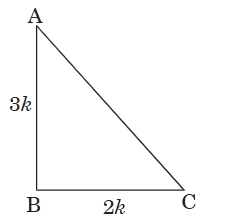
Let $ \angle A =\theta$
Given, $\tan \theta=\frac{2}{3}$
$\Rightarrow \tan \theta=\frac{BC}{AB}=\frac{2}{3}$
Let $BC =2 k$ and $AB =3 k$
By Pythagoras Theorem
$AC^2=AB^2+BC^2$
$\Rightarrow AC^2=(2 k)^2+(3 k)^2$
$\Rightarrow AC^2=4 k^2+9 k^2$
$\Rightarrow AC^2=(3 k)^2$
$\Rightarrow AC$
$=\sqrt{13 k}$
Now, $\sec \theta=\frac{ AC }{ AB }$
$=\frac{\sqrt{13 k }}{3 K}$
$=\frac{\sqrt{13}}{3}$ View full question & answer→MCQ 211 Mark
If $\sin \theta-\cos \theta=0$, then the value of $\theta$ is
- A
$30^{\circ}$
- ✓
$45^{\circ}$
- C
$90^{\circ}$
- D
$0^{\circ}$
AnswerCorrect option: B. $45^{\circ}$
$\text { (b) Since } \sin \theta-\cos \theta=0$
$\Rightarrow \sin \theta=\cos \theta$
$\Rightarrow \frac{\sin \theta}{\cos \theta}=1$
$\Rightarrow \tan \theta=1$
$\Rightarrow \tan \theta=\tan 45^{\circ}$
$\therefore \theta=45^{\circ}$
View full question & answer→MCQ 221 Mark
In a right-angled triangle $PQR , \angle Q =90^{\circ}$. If $\angle P =$ $45^{\circ}$, then value of $\tan P -\cos ^2 R$ is
- A
$0$
- B
- ✓
$\frac{1}{2}$
- D
$\frac{3}{2}$
AnswerCorrect option: C. $\frac{1}{2}$
(c)
$\angle P =45^{\circ}$
$\Rightarrow \angle R =45^{\circ}$
$\left(\angle P +\angle Q +\angle R =180^{\circ}\right)$
Now, $\tan P =\tan 45^{\circ}=1$
Also, $\cos R=\cos 45^{\circ}=\frac{1}{\sqrt{2}}$
Now, $\tan P-\cos ^2 R=1-\left(\frac{1}{\sqrt{2}}\right)^2=1-\frac{1}{2}=\frac{1}{2}$
View full question & answer→MCQ 231 Mark
Which of the following is not defined?
AnswerCorrect option: C. $\tan 90^{\circ}$
(c)
$\tan 90^{\circ}=\frac{\sin 90^{\circ}}{\cos 90^{\circ}}=\frac{1}{0}=$ not defined
View full question & answer→MCQ 241 Mark
The value of $\left(\tan ^2 45^{\circ}-\cos ^2 60^{\circ}\right)$ is
- A
$1 / 2$
- B
$1 / 4$
- C
$3 / 2$
- ✓
$3 / 4$
AnswerCorrect option: D. $3 / 4$
(d)
We know that,
$\operatorname{Tan} 45^{\circ}=1$ and $\cos 60^{\circ}=\frac{1}{2}$
So, $\left(\tan ^2 45^{\circ}-\cos ^2 60^{\circ}\right)=\left\{(1)^2-\left(\frac{1}{2}\right)^2\right\}$
$
=\left(1-\frac{1}{4}\right)=\frac{3}{4}
$
View full question & answer→MCQ 251 Mark
$\left(\frac{2}{3} \sin 0^{\circ}-\frac{4}{5} \cos 0^{\circ}\right)$ is equal to:
- A
$\frac{2}{3}$
- ✓
$\frac{-4}{5}$
- C
$0$
- D
$\frac{-2}{15}$
AnswerCorrect option: B. $\frac{-4}{5}$
(b)
$\sin 0^{\circ}=0$ and $\cos 0^{\circ}=1=-\frac{4}{5}$
View full question & answer→MCQ 261 Mark
$8 \cot ^2 A-8 \operatorname{cosec}^2 A$ is equal to
- A
$8$
- B
$\frac{1}{8}$
- ✓
$-8$
- D
$-\frac{1}{8}$
Answer$\text { (c) } 8 \cot ^2 A-8 \operatorname{cosec}^2 A$
$\Rightarrow-8\left(\operatorname{cosec}^2 A-\cot ^2 A\right)$
$\Rightarrow-8(1)$
$\Rightarrow-8$
View full question & answer→MCQ 271 Mark
$\sqrt{\frac{1-\sin \theta}{1+\sin \theta}}= ?$
- A
$\sec \theta+\tan \theta$
- ✓
$\sec \theta-\tan \theta$
- C
$\operatorname{cosec} \theta+\cot \theta$
- D
$\operatorname{cosec} \theta-\cot \theta$
AnswerCorrect option: B. $\sec \theta-\tan \theta$
$ \sqrt{\frac{1-\sin \theta}{1+\sin \theta}}$
$\sqrt{\frac{1-\sin \theta}{1+\sin \theta}} \times \sqrt{\frac{1-\sin \theta}{1-\sin \theta}}$
$= \frac{1-\sin \theta}{\sqrt{1-\sin ^2 \theta}}$
$= \frac{1-\sin \theta}{\cos \theta}=\frac{1}{\cos \theta}-\frac{\sin \theta}{\cos \theta}$
$= \sec \theta-\tan \theta$
View full question & answer→MCQ 281 Mark
$\sqrt{\sec ^2 \theta+\operatorname{cosec}^2 \theta}= ?$
- A
$\tan \theta+\cot \theta$
- ✓
$\tan \theta-\cot \theta$
- C
$\sec \theta+\operatorname{cosec} \theta$
- D
AnswerCorrect option: B. $\tan \theta-\cot \theta$
We have, $\sqrt{\sec ^2 \theta+\operatorname{cosec}^2 \theta}$
$=\sqrt{\left(1+\tan ^2 \theta\right)+\left(1+\cot ^2 \theta\right)}$
$=\sqrt{\tan ^2 \theta+\cot ^2 \theta+2}$
$=\sqrt{\tan ^2 \theta+\cot ^2 \theta+2 \tan \theta \cdot \cot \theta}\ [\because \tan \theta \cdot \cot \theta=1]$
$=\sqrt{(\tan \theta+\cot \theta)^2}$
$=(\tan \theta+\cot \theta)$
View full question & answer→MCQ 291 Mark
If $(\cos \theta+\sec \theta)=\frac{5}{2}$ then $\cos ^2 \theta+\sec ^2 \theta=$ ?
- A
$\frac{21}{4}$
- ✓
$\frac{17}{4}$
- C
$\frac{29}{4}$
- D
$\frac{33}{4}$
AnswerCorrect option: B. $\frac{17}{4}$
(b)
We have,
$
\begin{aligned}
& \sqrt{\sec ^2 \theta+\operatorname{cosec}^2 \theta} \\
= & \sqrt{\left(1+\tan ^2 \theta\right)+\left(1+\cot ^2 \theta\right)} \\
= & \sqrt{\tan ^2 \theta+\cot ^2 \theta+2} \\
= & \sqrt{\tan ^2 \theta+\cot ^2 \theta+2 \tan \theta \cdot \cot \theta} \\
& \quad \because \because \tan \theta \cdot \cot \theta=1] \\
= & \sqrt{(\tan \theta+\cot \theta)^2}=(\tan \theta+\cot \theta)
\end{aligned}
$
View full question & answer→MCQ 301 Mark
If $\tan \theta=\frac{ a }{ b }$ then $\frac{( a \sin \theta- b \cos \theta)}{( a \sin \theta+ b \cos \theta)}=$ ?
- A
$\frac{\left(a^2+b^2\right)}{\left(a^2-b^2\right)}$
- ✓
$\frac{\left(a^2-b^2\right)}{\left(a^2+b^2\right)}$
- C
$\frac{ a ^2}{\left( a ^2+ b ^2\right)}$
- D
$\frac{ b ^2}{\left( a ^2+ b ^2\right)}$
AnswerCorrect option: B. $\frac{\left(a^2-b^2\right)}{\left(a^2+b^2\right)}$
$\frac{ a \sin \theta- b \cos \theta}{ a \sin \theta+ b \cos \theta}$
$\cos \theta \text {. }$
$\Rightarrow \frac{ a \frac{\sin \theta}{\cos \theta}- b \cdot \frac{\cos \theta}{\cos \theta}}{ a \frac{\sin \theta}{\cos \theta}+ b \frac{\cos \theta}{\cos \theta}}$
$=\frac{ a \tan \theta- b }{ a \tan \theta+b}$
$= \frac{a \times \frac{a}{b}-b}{a \times \frac{a}{b}+b}$
$= \frac{\frac{a^2-b^2}{b}}{\frac{a^2+b^2}{b}}$
$=\frac{a^2-b^2}{a^2+b^2}$
View full question & answer→MCQ 311 Mark
If $\sin A +\sin ^2 A=1$, then $\cos ^2 A+\cos ^4 A= ?$
- A
$\frac{1}{2}$
- ✓
$1$
- C
$2$
- D
$3$
Answer$\sin A+\sin ^2 A=1$
$\Rightarrow \sin A=1-\sin ^2 A=\cos ^2 A$
$\therefore \cos ^2 A+\cos ^4 A$
$=\sin A+\sin ^2 A$
$=1$
View full question & answer→MCQ 321 Mark
If $\cos A+\cos ^2 A=1$ the $\sin ^2 A+\sin ^4 A= ?$
Answer$\cos A+\cos ^2 A=1$
$\Rightarrow \cos A=1-\cos ^2 A$
$\Rightarrow \cos A=\sin ^2 A$
$\therefore \sin ^2 A+\sin ^4 A$
$=\left(\cos A+\cos ^2 A\right)$
$=1$
View full question & answer→MCQ 331 Mark
$\sqrt{\frac{1+\cos A}{1-\cos A}}= ?$
- A
$\operatorname{cosec} A -\cot A$
- ✓
$\operatorname{cosec} A+\cot A$
- C
$\operatorname{cosec} A \cot A$
- D
AnswerCorrect option: B. $\operatorname{cosec} A+\cot A$
$\sqrt{\frac{1+\cos A }{1-\cos A }}$
$=\sqrt{\frac{(1+\cos A )}{(1-\cos A )} \times \frac{(1+\cos A )}{(1+\cos A )}}$
$=\frac{(1+\cos A )}{\sqrt{1-\cos ^2 A}}=\frac{1+\cos A }{\sqrt{\sin ^2 A}}$
$=\frac{1+\cos A }{\sin A }=\frac{1}{\sin A}+\frac{\cos A }{\sin A }$
$=\operatorname{cosec} A +\cot A $
View full question & answer→MCQ 341 Mark
If $\tan \theta=\frac{ a }{ b }$ then $\left(\frac{\cos \theta+\sin \theta}{\cos \theta-\sin \theta}\right)=$ ?
AnswerCorrect option: C. $\frac{ b + a }{ b - a }$
(c)
$
\left(\frac{\cos \theta+\sin \theta}{\cos \theta-\sin \theta}\right)
$
(dividing numerator and denominator by $\cos \theta$
$
\begin{aligned}
= & \frac{\frac{\cos \theta}{\cos \theta}+\frac{\sin \theta}{\cos \theta}}{\frac{\cos \theta}{\cos \theta}-\frac{\sin \theta}{\cos \theta}} \\
= & \frac{1+\tan \theta}{1-\tan \theta}=\frac{1+\frac{a}{b}}{1-\frac{a}{b}} \\
= & \frac{b+a}{\frac{b-a}{b}}=\frac{b+a}{b-a}
\end{aligned}
$
View full question & answer→MCQ 351 Mark
$(\operatorname{cosec}-\cot \theta)^2=?$
- A
$\frac{1+\cos \theta}{1-\cos \theta}$
- ✓
$\frac{1-\cos \theta}{1+\cos \theta}$
- C
$\frac{1+\sin \theta}{1-\sin \theta}$
- D
AnswerCorrect option: B. $\frac{1-\cos \theta}{1+\cos \theta}$
$(\operatorname{cosec} \theta-\cot \theta)^2$
$=\left(\frac{1}{\sin \theta}-\frac{\cos \theta}{\sin \theta}\right)^2$
$=\frac{(1-\cos \theta)^2}{\sin ^2 \theta}=\frac{(1-\cos \theta)^2}{1-\cos ^2 \theta}$
$=\frac{(1-\cos \theta)^2}{(1-\cos \theta)(1+\cos \theta)}$
$=\frac{1-\cos \theta}{1+\cos \theta}$
View full question & answer→MCQ 361 Mark
$(\sec A +\tan A )(1-\sin A )= ?$
- A
$\sin A$
- ✓
$\cos A$
- C
$\sec A$
- D
$cosec\ A$
AnswerCorrect option: B. $\cos A$
$(\sec A+\tan A)(1-\sin A)$
$=\left(\frac{1}{\cos A}+\frac{\sin A}{\cos A}\right)(1-\sin A)$
$=\left(\frac{1+\sin A}{\cos A}\right)(1-\sin A)$
$=\frac{1-\sin ^2 A}{\cos A}=\frac{\cos ^2 A}{\cos A} \quad\left(\because 1-\sin ^2 \theta=\cos ^2 \theta\right)$
$=\cos A$
View full question & answer→MCQ 371 Mark
$(\sec \theta-\tan \theta)^2=$ ?
- ✓
$\frac{1-\sin \theta}{1+\sin \theta}$
- B
$\frac{1+\sin \theta}{1-\sin \theta}$
- C
$\frac{1+\cos \theta}{1-\cos \theta}$
- D
$\frac{1-\cos \theta}{1+\cos \theta}$
AnswerCorrect option: A. $\frac{1-\sin \theta}{1+\sin \theta}$
$(\sec \theta-\tan \theta)^2$
$=\left(\frac{1}{\cos \theta}-\frac{\sin \theta}{\cos \theta}\right)^2$
$=\left(\frac{1-\sin \theta}{\cos \theta}\right)^2=\frac{(1-\sin \theta)^2}{\cos ^2 \theta}$
$=\frac{(1-\sin \theta)^2}{\left(1-\sin ^2 \theta\right)}$
$=\frac{(1-\sin \theta)^2}{(1-\sin \theta)(1+\sin \theta)}$
$=\frac{1-\sin \theta}{1+\sin \theta}$
View full question & answer→MCQ 381 Mark
$\sec ^4 \theta-\sec ^2 \theta=$ ?
AnswerCorrect option: C. $\tan ^2 \theta+\tan ^4 \theta$
$\sec ^4 \theta-\sec ^2 \theta .$
$=\sec ^2 \theta\left(\sec ^2 \theta-1\right)$
$=\quad\left(1+\tan ^2 \theta\right)\left(1+\tan ^2 \theta-1\right)$
$\quad\left[\because \sec ^2 \theta=1+\tan ^2 \theta\right]$
$=\left(1+\tan ^2 \theta\right) \tan ^2 \theta$
$=\tan ^2 \theta+\tan ^4 \theta .$
View full question & answer→MCQ 391 Mark
$\sec ^2 \theta+\operatorname{cosec}^2 \theta=$ ?
AnswerCorrect option: A. $\sec ^2 \theta \operatorname{cosec}^2 \theta$
$\sec ^2 \theta+\operatorname{cosec}^2 \theta$
$=\frac{1}{\cos ^2 \theta}+\frac{1}{\sin ^2 \theta}$
$=\frac{\sin ^2 \theta+\cos ^2 \theta}{\sin ^2 \theta \cdot \cos ^2 \theta}$
$=\frac{1}{\sin ^2 \theta \cdot \cos ^2 \theta}{\left[\because \sin ^2 \theta+\cos ^2 \theta=1\right]}$
$=\frac{1}{\cos ^2 \theta} \times \frac{1}{\sin ^2 \theta}$
$=\sec ^2 \theta \cdot \operatorname{cosec}^2 \theta .$
View full question & answer→MCQ 401 Mark
$\left(1+\tan ^2 \theta\right) \cos ^2 \theta=$ ?
Answer$\left(1+\tan ^2 \theta\right) \cos ^2 \theta$
$=\sec ^2 \theta \cdot \cos ^2 \theta\left[\because 1+\tan ^2 \theta=\sec ^2 \theta\right]$
$=\sec ^2 \theta \times \frac{1}{\sec ^2 \theta}=1 \left[\cos \theta=\frac{1}{\sec \theta}\right]$
View full question & answer→MCQ 411 Mark
$\left(1-\sin ^2 \theta\right) \sec ^2 \theta=$ ?
Answer(b)
$\begin{aligned} & \left(1-\sin ^2 \theta\right) \sec ^2 \theta \\ = & \cos ^2 \theta \cdot \sec ^2 \theta\left[\because 1-\sin ^2 \theta=\cos ^2 \theta\right] \\ = & \cos ^2 \theta \times \frac{1}{\cos ^2 \theta}\left[\because \sec \theta=\frac{1}{\cos \theta}\right] \\ = & 1\end{aligned}$
View full question & answer→MCQ 421 Mark
$\sec 70^{\circ} \sin 20^{\circ}-\cos 20^{\circ} \operatorname{cosec} 70^{\circ}=$ ?
Answer$\sec 70^{\circ} \sin 20^{\circ}-\cos 20^{\circ} \operatorname{cosec} 70^{\circ}$
$=\sec \left(90-20^{\circ}\right) \cdot \sin 20^{\circ}-\cos 20 \cdot \operatorname{cosec}\left(90^{\circ}-20^{\circ}\right)$
$=\operatorname{cosec} 20^{\circ} \cdot \sin 20^{\circ}-\cos 20^{\circ} \cdot \sec 20^{\circ}$
$=[\because \sec \left(90^{\circ}-\theta\right)=\operatorname{cosec} \theta$ and
$\operatorname{cosec}\left(90^{\circ}-\theta\right)=\sec \theta]$
$=\frac{\sin 20^{\circ}}{\sin 20^{\circ}}-\frac{\cos 20^{\circ}}{\cos 20^{\circ}}$
$=1-1$
$=0$
View full question & answer→MCQ 431 Mark
If $\theta=30^{\circ}$ then, $\tan 2 \theta=$ ?
- A
$\frac{1}{\sqrt{3}}$
- ✓
$\sqrt{3}$
- C
$1$
- D
$0$
AnswerCorrect option: B. $\sqrt{3}$
$\tan 2 \theta=\tan \left(2 \times 30^{\circ}\right)$
$=\tan 60^{\circ}=\sqrt{3}$
View full question & answer→MCQ 441 Mark
$\frac{\tan 60^{\circ}-\tan 30^{\circ}}{1+\tan 60^{\circ}-\tan 30^{\circ}}= ?$
- A
$\tan 60^{\circ}$
- B
$\tan 90^{\circ}$
- C
$\cot 30^{\circ}$
- ✓
$\tan 30^{\circ}$
AnswerCorrect option: D. $\tan 30^{\circ}$
$\frac{\tan 60^{\circ}-\tan 30^{\circ}}{1+\tan 60^{\circ} \tan 30^{\circ}}$
$=\frac{\left(\sqrt{3}-\frac{1}{\sqrt{3}}\right)}{\left(1+\sqrt{3} \times \frac{1}{\sqrt{3}}\right)}$
$=\frac{3-1}{\sqrt{3} \times 2}$
$=\frac{1}{\sqrt{3}}$
$=\tan 30^{\circ}$
View full question & answer→MCQ 451 Mark
$\tan 1^{\circ} \tan 2^{\circ} \tan 3^{\circ}........\tan 89^{\circ}=$ ?
AnswerWe have
$\tan 1^{\circ} \tan 2^{\circ} \tan 3^{\circ}......\tan 89^{\circ} \text {. }$
$=\left(\tan 1^{\circ} \tan 89^{\circ}\right)\left(\tan 2^{\circ} \tan 88^{\circ}\right)$
$........ \left.\tan 44^{\circ} \tan 46^{\circ}\right) \cdot \tan 45^{\circ} \text {. }$
$=\left\{\tan 1^{\circ} \tan \left(90^{\circ}-1^{\circ}\right)\right\}\left\{\tan 2^{\circ} \tan \left(90-2^{\circ}\right)\right\}$
$........\left\{\tan 44^{\circ} \tan \tan \left(90^{\circ}-44\right) . \tan 45^{\circ}\right\}$
$=\left(\tan 1^{\circ} \cot 1^{\circ}\right)\left(\tan 2^{\circ} \cot 2^{\circ}\right).....\left(\tan 44^{\circ} \cot 44^{\circ}\right)$
$1\left[\because \tan \left(90^{\circ}-\theta\right)=\cot \theta\right]$
$=1 \times 1 \times 1 \times .......... \times 1 \times 1=1$
View full question & answer→MCQ 461 Mark
$\sin ^2 65^{\circ}+\sin ^2 25^{\circ}=$ ?
Answer$\sin ^2 65^{\circ}+\sin ^2 25^{\circ} .$
$=\left[\sin \left(90^{\circ}-25^{\circ}\right)\right]^2+\sin ^2 25^{\circ} .$
$=\left(\cos 25^{\circ}\right)^2+\sin ^2 25^{\circ} .$
$=\cos ^2 25^{\circ}+\sin ^2 25^{\circ}$
$=1$
View full question & answer→MCQ 471 Mark
$\cot 34^{\circ}-\tan 56^{\circ}=$ ?
Answer$\cot 34^{\circ}-\tan 56^{\circ}$
$=\cot \left(90^{\circ}-56^{\circ}\right)-\tan 56^{\circ}$
$=\tan 56^{\circ}-\tan 56^{\circ}=0$
$\left[\because \cot \left(90^{\circ}-\theta\right)=\tan \theta\right]$
View full question & answer→MCQ 481 Mark
$\cos 48^{\circ}-\sin 42^{\circ}=$ ?
Answer$\cos 48^{\circ}-\sin 42^{\circ}$
$=\cos \left(90^{\circ}-42^{\circ}\right)-\sin 42^{\circ}$
$=\sin 42^{\circ}-\sin 42^{\circ}=0$
$\left[\because \cos \left(90^{\circ}-\theta\right)=\sin \theta\right]$
View full question & answer→MCQ 491 Mark
$\frac{\sec 49^{\circ}}{\operatorname{cosec} 41^{\circ}}=$ ?
Answer$\frac{\sec 49^{\circ}}{\operatorname{cosec} 41^{\circ}}=\frac{\sec \left(90^{\circ}-41^{\circ}\right)}{\operatorname{cosec} 41^{\circ}}$
$=\frac{\operatorname{cosec} 41^{\circ}}{\operatorname{cosec} 41^{\circ}} (\because \sec (90-\theta)=\operatorname{cosec} \theta)$
$=1$
View full question & answer→MCQ 501 Mark
$\frac{\cos 53^{\circ}}{\sin 37^{\circ}}=$ ?
Answer$\frac{\cos 53^{\circ}}{\sin 37^{\circ}}=\frac{\cos \left(90^{\circ}-37^{\circ}\right)}{\sin 37^{\circ}}$
$=\frac{\sin 37^{\circ}}{\sin 37^{\circ}}$
$=1 ([\because \cos (90-\theta)=\sin \theta])$
View full question & answer→